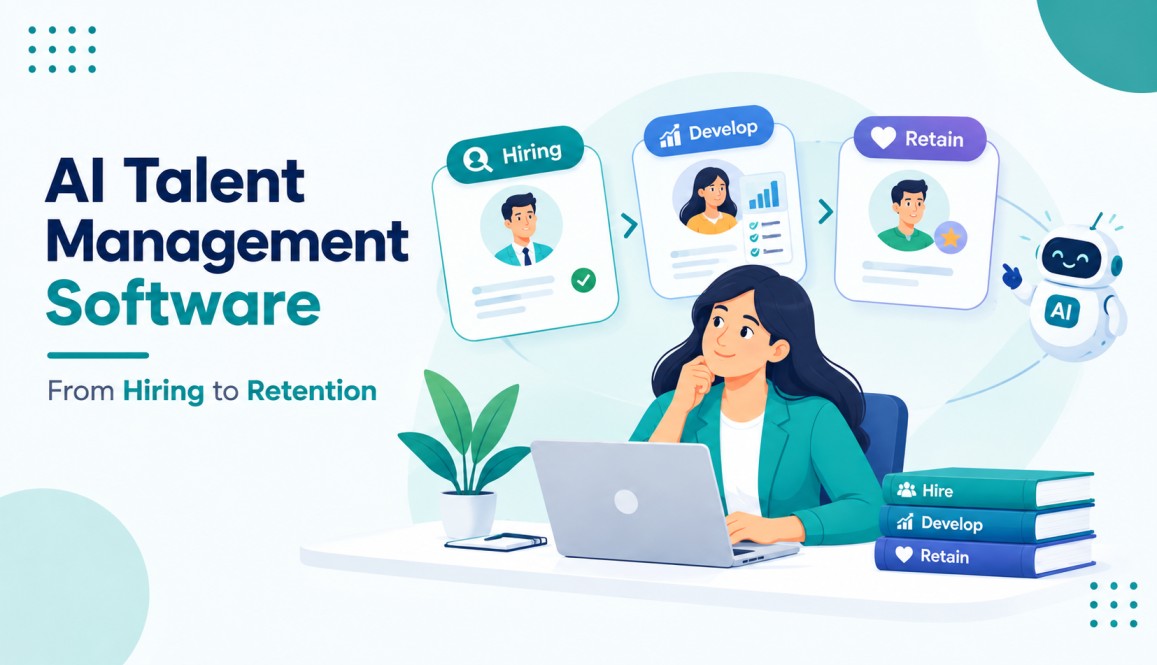
AI Talent Management Software: From Hiring to Retention
Most companies buy three or four different tools to manage people: one for sourcing, one for interviews, one for onboarding, and one for performance reviews. None of them talks to each other.
By the time a candidate becomes an employee, half their history is buried in an inbox nobody checks anymore. AI talent management software exists to fix exactly that gap, and the companies getting it right are shrinking their hiring timelines while cutting first-year attrition in ways spreadsheets never could.
This isn’t about adding a chatbot to your careers page. It’s about connecting the entire employee journey, from the first resume upload to the exit interview, under one intelligent system that learns from every interaction along the way.
SHRM’s State of AI in HR 2026 report, based on a survey of 1,722 HR professionals fielded in December 2025, found that 39% of organisations have adopted AI somewhere in HR, with recruiting accounting for the largest single share, 27%.
That’s a real shift from pilot projects to production workflows, and it puts pressure on HR leaders to move past single-purpose tools before their competitors do.
What AI Talent Management Software Actually Does
1. Beyond Applicant Tracking
An applicant tracking system stops caring about a person the day they accept an offer. That’s the core limitation HR leaders run into every quarter.
AI talent management software picks up where the ATS leaves off, carrying candidate data, skill assessments, and interview notes straight into onboarding, performance tracking, and succession planning.
The practical difference shows up fast. A hiring manager no longer has to re-explain a candidate’s background to the onboarding team, because the system already has it.
A performance review no longer starts from a blank template, because the platform already knows which skills the person was hired for and can measure growth against them.
2. The Core Modules
Most platforms in this category bundle five functions:
- Recruitment and sourcing, powered by resume parsing and candidate matching
- Interview coordination and structured evaluation
- Onboarding workflows tied to role and department
- Performance and goal tracking
- Retention analytics, including flight-risk scoring
Not every vendor builds all five well. Some started out building ATS platforms and bolted on retention features later; others began in performance management and added hiring modules to compete.
Worth checking which piece the vendor actually built first, since that’s usually the strongest part of the product.
Why HR Teams Are Replacing Point Solutions with AI Tools
1. The Cost of Disconnected Systems
A mid-sized company running separate tools for recruiting, HRIS, and performance management typically pays for three logins, three support contracts, and three data exports that never quite match.
HR teams spend hours each month reconciling headcount numbers between systems that should agree by default.
There’s a harder cost too. When candidate data doesn’t flow into the employee record, companies lose the context that predicts success. A candidate who scored high on collaboration during structured interviews but struggled in a solo-heavy first project is a pattern worth catching.
2. What Changes When HR AI Tools Talk to Each Other
Once recruiting and people-management data live in one system, patterns start showing up that were invisible before. Recruiters can see which sourcing channels produce employees who stay past two years, not just employees who accept offers.
Managers can see which onboarding steps correlate with faster ramp-up time. None of this requires a data science team; it requires the platform to hold the data in one place and run basic correlations on it.
This is the actual value of hr ai tools built for the full lifecycle: not smarter resume screening in isolation, but a feedback loop between hiring decisions and business outcomes.
AI Hiring Software: The Front End of Talent Management
1. Sourcing and Screening
AI hiring software earns its keep first near the top of the funnel.
Resume parsers extract structured data from unstructured documents, matching algorithms rank candidates against role requirements instead of keyword density alone, and skill-based filters cut down the noise from applicants who technically match a job title but not the actual work.
The mistake companies make here is treating this stage in isolation.
A screening tool that produces a great shortlist but doesn’t pass structured notes forward to the interview stage forces every interviewer to start from scratch, undoing half the time savings.
2. Interview Scheduling and Candidate Communication
Coordinating five interviewers across three time zones by email is still how a surprising number of companies operate in 2026.
AI scheduling tools that sync with calendars automatically, send reminders, and reschedule around conflicts remove a step that used to eat an entire recruiter’s afternoon per open role.
Candidate communication follows the same logic. Automated status updates, sent during the right stage rather than in a generic batch, cut down the volume of “any update?” emails recruiters answer every week.
Candidates notice the difference between a system that updates them proactively and one that goes silent for three weeks.
3. Reducing Time-to-Hire Without Cutting Corners
Speed matters, but speed built on skipped steps backfires.
The companies seeing real time-to-hire gains from AI hiring software aren’t skipping structured interviews; they’re automating the scheduling, note-taking, and follow-up around those interviews so recruiters spend their hours on judgment calls instead of logistics.
Candidate Relationship Management Systems: Keeping Talent Pools Warm
1. Why Candidates Disappear
A candidate who reaches the final round and doesn’t get the offer usually never hears from that company again, unless a manual reminder happens to land on someone’s calendar.
That’s a lost asset. This person already went through screening, interviews, and reference checks; the sunk cost alone makes re-engaging them cheaper than starting a fresh search.
2. Nurture Sequences That Don’t Feel Automated
Candidate relationship management systems solve this by tagging silver-medalist candidates and triggering re-engagement when a matching role opens, rather than requiring a recruiter to remember and manually search.
Done well, this doesn’t feel like a mass email blast. It reads like a recruiter genuinely tracking someone’s career, because in effect, the system is doing exactly that on the recruiter’s behalf.
3. Turning Rejected Candidates into Future Hires
Companies running mature candidate relationship management systems report shorter fill times on roles matching their talent acquisition pool, simply because half the search is already done.
The candidate is pre-vetted, previously interested, and often flattered to be remembered. That last part matters more than most hiring teams give it credit for.
From Hire to Onboard: Where Most Systems Break
-
The Handoff Gap
The moment a candidate signs an offer letter is where a lot of talent software quietly stops being useful.
Recruiting teams close the requisition and move to the next role; onboarding teams start a fresh checklist with no visibility into what happened during the hiring process.
Skills verified during interviews, salary negotiation notes, start-date flexibility discussed with the candidate: all of it can get lost in that handoff.
-
Data Continuity Across the Employee Lifecycle
Platforms built for the full lifecycle carry this context forward automatically. Onboarding checklists get built around the specific skills gaps identified during interviews rather than a generic new-hire template.
Managers walk into week one already knowing what training their new hire needs, instead of discovering it during the first project review.
Retention: The Part Most “Hiring Software” Ignores
-
Predictive Signals AI Can Actually Catch
Retention modules in AI talent management platforms track patterns that individual managers rarely notice on their own: declining meeting participation, delayed response times on internal tools, sudden drops in goal completion, or a stretch without a single 1:1 conversation logged.
None of these signals alone predicts someone quitting. Together, tracked over months, they build a flight-risk score worth acting on before an exit interview instead of during one.
-
Performance and Engagement Tracking Without Surveillance Creep
There’s a line between useful retention analytics and monitoring that makes employees uncomfortable.
The better platforms stick to work-output signals like goal completion, peer feedback frequency, and internal mobility interest, rather than keystroke tracking or activity monitoring that erodes trust the moment employees find out about it.
Worth confirming exactly what a vendor tracks before rolling this out company-wide.
Choosing AI Talent Management Software: What to Check Before You Buy
Integration Depth, Not Just Integration Count
Vendor pitch decks love listing fifty integrations. What matters is whether the three or four systems your team actually uses daily sync in real time, or once a night through a batch job that leaves data stale for hours.
Ask for a live demo of the specific integration your company needs, not a marketing slide.
Questions to Ask Vendors
- Does candidate data flow into the employee record automatically, or does someone re-enter it manually?
- Can recruiters see retention outcomes tied back to sourcing channels?
- What exactly does the retention model track, and can employees see their own data?
- How does the platform handle a rejected candidate’s data after twelve or eighteen months?
- What happens to historical hiring data during a platform migration?
These questions expose the difference between a vendor that built one strong module and bolted on the rest, versus one that designed the full lifecycle from the start.
The Real Payoff
Companies treating hiring, onboarding, and retention like one continuous system make better decisions throughout every stage, because every decision has more context behind it.
A recruiter sourcing for a hard-to-fill role can see which channels historically produced long-tenured hires. A manager onboarding a new employee already knows their strengths going in.
An HR leader spotting early flight-risk signals can act months before losing someone valuable.
That’s the actual promise of AI talent management software: not a single flashy feature, but a company that finally stops losing information every time an employee moves from one stage of their journey to the next.
This is exactly where Hirium fits into the picture for growing companies. Instead of forcing startups and SMBs to stitch together separate tools for sourcing, screening, interview scheduling, and candidate follow-up, Hirium keeps that data in one place from the first application onward.
Its AI resume parsing and candidate matching narrow down a shortlist without losing the context recruiters need later; its scheduling tools cut out the email back-and-forth, and its candidate database keeps silver-medalist applicants tagged and ready for re-engagement instead of forgotten in an inbox.
For a hiring team that wants the benefits described in this piece without building a custom tech stack from scratch, that’s the gap Hirium is built to close.
FAQs
1. What is AI talent management software?
AI talent management software connects hiring, onboarding, performance tracking, and retention under one system. It carries candidate data forward into the employee record, so recruiters, managers, and HR leaders work from the same history instead of separate tools.
2. How is AI hiring software different from a regular ATS?
A regular ATS stops tracking someone once they’re hired. AI hiring software adds resume parsing, candidate matching, and interview scheduling, then passes that data into onboarding and performance modules instead of letting it sit unused after an offer letter.
3. What do candidate relationship management systems actually do?
Candidate relationship management systems tag rejected or silver-medalist applicants and trigger re-engagement when a matching role opens. They keep talent pools warm automatically, so recruiters aren’t starting every search from zero.
4. Can AI talent management software predict employee retention?
It can flag risk patterns like declining goal completion, fewer peer interactions, or drops in engagement scores. These signals don’t guarantee an outcome, but they give managers months of lead time before someone decides to leave.
5. Is AI talent management software only for large companies?
No. Startups and SMBs benefit too, since fewer HR staff means more value from automating sourcing, scheduling, and candidate follow-up. Platforms like Hirium are built specifically for smaller hiring teams without enterprise-size budgets.