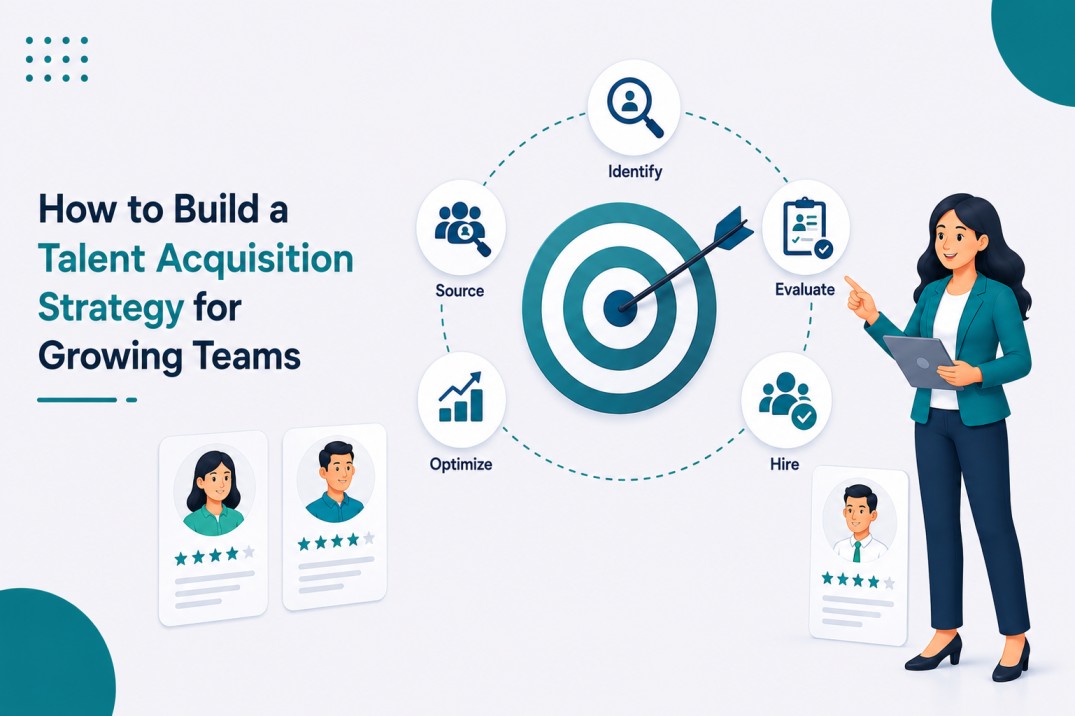
How to Build a Talent Acquisition Strategy for Growing Teams
More than half of fast-growing companies are hiring without a real plan.
For a startup or scaling business, that gap shows up quickly: open roles sit unfilled for weeks, new hires leave within months, and hiring managers end up firefighting instead of building teams that match where the company is headed.
According to SHRM’s 2026 Talent Trends report, 68% of HR professionals reported difficulty recruiting full-time employees, while 53% said recruiting has become more difficult compared with the previous year.
A talent acquisition strategy gives growing teams a repeatable way to source, evaluate, and hire people who fit both the role and the company culture, instead of scrambling every time a position opens.
It connects hiring decisions to business goals, so recruiting scales alongside headcount rather than falling behind it.
For founders and hiring managers building a team from the ground up, having this structure early makes every future hire faster, more consistent, and far less costly to get wrong
What Is a Talent Acquisition Strategy?
A talent acquisition strategy is a long-term plan for attracting, evaluating, and hiring people who can support a company’s current and future business goals.
Traditional recruitment often begins with an open position:
Role opens → Job posted → Applications received → Candidate hired
Talent acquisition takes a wider view:
Business goal → Workforce needs → Candidate profile → Talent pipeline → Hiring process → Measurement → Improvement
Signs Your Hiring Process Won’t Scale With Your Team
A hiring process that worked fine for the first five employees often starts breaking down around hire fifteen or twenty. The warning signs show up quietly at first, then all at once.
-
Common bottlenecks (ad hoc job posts, spreadsheet tracking, inconsistent interviews)
Job posts get written from scratch every time, with no template or consistent tone, so candidates get a different impression of the company depending on who wrote the listing.
Resumes pile up in a shared spreadsheet or an inbox folder, and nobody owns follow-up, so good candidates go quiet for weeks and assume they were rejected.
Interviews vary by whoever is running them that day: one manager asks about culture fit, another jumps straight into technical questions, and there’s no shared scorecard to compare notes afterward.
None of this is anyone’s fault. It’s just what happens when a process built for occasional hiring gets stretched to handle a growing team.
-
When to move from founder-led hiring to a structured process
Founder-led hiring works well early on, when every hire is high-stakes and the founder knows exactly who they need. But once a company is hiring for multiple roles at once, or handing interviews off to managers who aren’t used to running them, gaps start to show.
A good trigger point is the moment hiring managers start asking “what are we even looking for” in a role, or when two people get hired for similar positions with wildly different skill levels.
That’s usually the sign it’s time to document a process, set clear criteria for each role, and give the team a shared way to evaluate candidates instead of relying on one person’s gut feel.
Core Elements of a Talent Acquisition Strategy
A solid talent acquisition strategy rests on five connected pieces. Getting each one right gives growing teams a repeatable way to hire well, instead of starting from scratch every time.
1. Workforce planning tied to business goals
Before posting a single role, map out what the business needs over the next year or two: new markets, new products, or team gaps. This keeps hiring focused on roles that actually move the company forward, not just filling empty seats.
2. Employer brand and candidate positioning
Candidates research a company before they ever apply, checking reviews, social pages, and job descriptions to decide if it’s worth their time. A clear, honest picture of what it’s like to work there helps attract people who genuinely fit, not just anyone who applies.
3. Sourcing channels and talent pipelines
Relying on job boards alone leaves gaps when hiring picks up. Building relationships with passive candidates, past applicants, referrals, and niche communities creates a pipeline that’s ready to tap into, so open roles don’t start from zero every single time.
4. Structured selection and decision-making
Every role needs a defined process: who screens resumes, who interviews, what questions get asked, and who makes the final call. Using shared candidate scorecards keeps decisions consistent across hiring managers and cuts down on bias creeping into the process.
5. Metrics and continuous improvement
Tracking numbers like time to hire, offer acceptance rate, and quality of hire shows what’s actually working. Reviewing these regularly helps a growing team catch problems early and adjust the process before small issues turn into expensive ones.
How to Build a Talent Acquisition Strategy Step by Step
Turning a talent acquisition strategy into something usable takes a handful of concrete steps.
Here’s how growing teams can move from planning to execution without getting stuck in theory.
Step 1:Map hiring needs to growth plans
Sit down with leadership and map out where the business is headed over the next year, whether that means launching new products, entering new markets, or expanding existing teams.
This is where predictive hiring in talent acquisition can help teams plan ahead by using expected business growth, past hiring patterns, and workforce needs to identify which roles may be required and when.
Step 2 :Define your ideal candidate profiles
Go beyond a list of skills and think about who will genuinely succeed in the role and the company culture. Note the must-haves, the nice-to-haves, and where there’s room for flexibility, so job posts stay realistic instead of impossible to fill.
Step 3 :Build sourcing and pipeline channels
Identify where good candidates for each role actually spend their time, whether that’s niche job boards, industry communities, or employee networks. Start building relationships before roles open, so there’s already a pool of people to reach out to.
Step 4 :Standardize your interview and evaluation process
Create a consistent interview structure for each role, including who’s involved, what gets asked, and how answers get scored. A shared scorecard keeps evaluations fair across interviewers and makes it easier to compare candidates side by side.
Step 5 :Set up tracking with an ATS or hiring tool
Manually tracking candidates in spreadsheets falls apart fast once hiring picks up. An applicant tracking system keeps resumes, interview notes, and candidate status organized in one place, so nothing slips through the cracks as the team grows.
Step 6 :Review metrics and refine quarterly
Set a regular check-in, once a quarter works well, to look at time to hire, offer acceptance rate, and where candidates drop off. Use what’s found to adjust job posts, interview steps, or sourcing channels before small issues pile up.
Conclusion
Building a talent acquisition strategy isn’t a one-time project.
It’s a shift from reacting to every open role toward planning ahead, defining who you want to hire, and giving your team a repeatable process that holds up as headcount grows.
The companies that get this right early save time, avoid costly mismatches, and build teams that actually match where the business is going.
This is exactly where Hirium fits in. Built for startups and growing teams, Hirium replaces scattered spreadsheets and inconsistent interviews with one organized place to post roles, track candidates, and standardize hiring decisions, so your process scales right alongside your team.
Ready to build a hiring process that grows with you? Try Hirium today.
FAQs
- What’s the difference between talent acquisition and recruitment?
Recruitment focuses on filling an open role quickly, while talent acquisition takes a longer view, building relationships, planning ahead, and hiring people who fit where the company is headed, not just the job description in front of them.
- When should a startup build a formal talent acquisition strategy?
Most founders can get away with informal hiring for the first handful of employees. Once hiring picks up across multiple roles, or a founder can no longer run every interview themselves, it’s time to put a structured process in place.
- What tools help small teams manage hiring without adding headcount?
An applicant tracking system is usually the first upgrade worth making. It replaces scattered spreadsheets and email threads with one place to track candidates, schedule interviews, and keep hiring managers on the same page.
- How often should a hiring process be reviewed?
A quarterly review works well for most growing teams. It’s frequent enough to catch problems like slow time to hire or high candidate drop-off, without adding so much overhead that reviews themselves become a burden.
- Can a small team really compete with bigger companies for good candidates?
Yes. Smaller teams often win on speed, clearer growth paths, and a more personal hiring experience. Candidates notice when a process feels thoughtful rather than automated, and that can matter more than brand name alone.