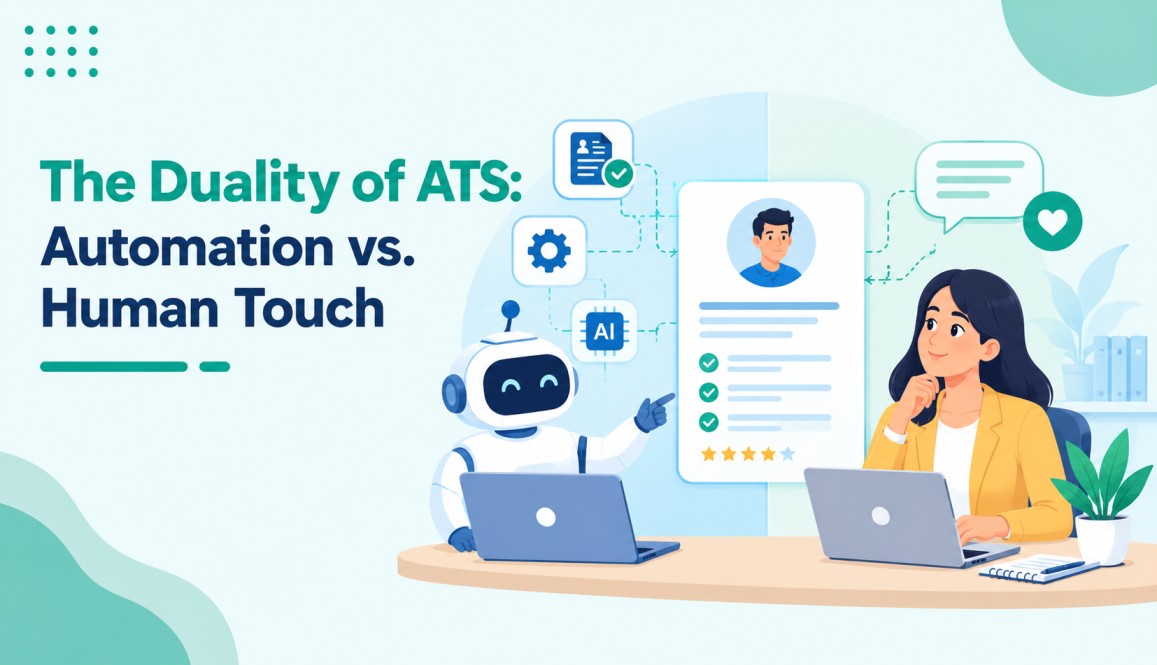
The Duality of ATS: Automation vs. Human Touch
Picture a developer with six years of freelance work and no formal job titles. The ATS finds no matching titles and ranks the profile low. A recruiter who opens it sees three shipped products and two repeat clients. Which one made the right call?
That gap is the center of the ATS automation vs. human touch debate. Automation clears repetitive work in minutes. People read context, motivation, and potential. Neither does the other’s job well.
In a February and March 2025 survey of 384 recruiters, published in The State of the Job Search in 2025, Jobscan found that over 99.7% use filters in their ATS or similar system to choose who gets an interview. Jobscan also notes that an ATS rarely rejects candidates on its own.
Recruiters set the filters and act on the results.
This guide shows which hiring tasks to automate, which to keep with recruiters, and how to set review rules so strong candidates do not slip through. It ends with a checklist you can use with any applicant tracking system.
Quick answer: Let the ATS handle sorting, parsing, scheduling, and status updates. Keep borderline candidates, interviews, feedback, offers, and the final hiring decision with people.
What ATS Software Automates Well
ATS software exists to take repetitive work off recruiters. In practice, that means four jobs:
- Parsing: pulling contact details, skills, and work history from resumes into structured records, which is the job of an ATS parser.
- Screening: ranking applicants against the requirements of a role.
- Scheduling: matching calendars and sending reminders.
- Tracking: moving candidates between stages and keeping one record per person.
That means human judgment enters the process when someone sets the filters. It quietly leaves when recruiters stop reading past the top of a ranked list.
Where Automation Falls Short in Hiring
Three problems show up again and again.
Rigid matching. Systems that match titles and keywords miss people whose experience does not follow the standard pattern: freelancers, bootcamp graduates, career changers. AI in resume screening reads more context than a plain keyword filter, but the criteria it scores against still come from people.
Silence. Candidates rarely object to automation itself. They object to never hearing back. A prompt automated acknowledgement beats three weeks of nothing. The damage starts when automation replaces the conversation after a live interview, when candidates expect a real person to reply.
Inherited bias. Structured criteria make evaluation more consistent, but AI-based resume screening can inherit bias from historical data. Consistency is not fairness. Anonymous screening and structured evaluations help, and the role of an ATS in diversity hiring depends on how those features are configured and reviewed.
ATS Automation vs Human Touch: Which Hiring Tasks Go Where
Use this table to split the workflow. The middle column shows what the system should handle. The right column shows where a person steps in.
| Hiring task | Automate | Keep with a recruiter |
| Resume parsing and data entry | Full automation | Spot-check odd formats and scanned files |
| First-pass screening | Rank and flag against set criteria | Read borderline scores, career changers, and non-standard profiles |
| Interview scheduling | Calendar matching and reminders | Handle exceptions and senior candidates personally |
| Status updates | Acknowledgements and stage changes | Personal feedback after interviews |
| Interview evaluation | Shared scorecard template | Run the conversation and ask follow-up questions |
| Culture add and motivation | Nothing | Recruiter and hiring team |
| Offer and negotiation | Documents and approvals | The conversation itself |
| Final decision | Nothing | Hiring manager |
A Five-Step Hybrid Workflow for Recruiters
1. Split must-haves from nice-to-haves
Agree with the hiring manager which requirements are hard gates, for example, work authorization or a required licence. Missing a nice-to-have should lower a rank, not remove the candidate.
2. Let the system parse and rank.
Resume screening using AI handles the volume, and nobody is rejected from a score alone. Teams still weighing AI against manual screening should run both on one role before deciding.
3. Set a human review band.
Read every profile in the top tier and every borderline score. Add a small weekly sample from the lowest-ranked pile to catch misses.
4. Automate messages, personalize the moments that matter.
Acknowledgements and stage updates can run on templates. Post-interview feedback should come from the interviewer or recruiter.
5. Audit every month.
Compare the AI shortlist with the candidates recruiters actually advanced. If recruiters keep pulling strong people from lower ranks, the criteria need work.
Illustration, not customer data: Assume 200 applicants for one role and three minutes per resume.
Reading all of them takes ten hours. With parsing and ranking, a recruiter reads the top 40 plus a sample of 20 from the rest.
That is 60 resumes, or three hours. The saved time goes to interviews and candidate conversations, the parts of the job that need a person.
Parsed records also feed a searchable candidate database, so a strong profile passed over for one role can be found for the next.
How a Free ATS Can Support a Hybrid Hiring Process
Hirium covers the automated half of this workflow for startups and small teams. Resume parsing turns applications into structured profiles.
The AI resume screening tool evaluates candidates against the job requirements the recruiter sets and ranks them. Interview management covers interview scheduling, reminders for candidates and interviewers, and feedback capture.
Workflow automation sends email responses and updates candidate status without manual effort.
Recruiters keep control of the criteria and the decision.
The platform’s Free Forever plan includes candidate management, resume parsing, AI resume screening, job posting, interview management, and recruitment workflow tools, so a team can test the hybrid setup before committing budget.
Common Mistakes When Balancing Automation and Human Review
- Rejecting on rank alone. A score is a sorting aid, not a verdict.
- Automating post-interview rejections. A candidate who met three people expects a person to reply.
- Never checking the bottom of the list. Errors stay invisible until someone reads there.
- Treating AI screening as bias-free. Test outcomes and keep people able to override results.
- Stacking disconnected tools. Separate screening, scheduling, and tracking tools create duplicate entry and raise recruiter workload.
Automate the Process, Own the Decision
The best hiring teams do not pick a side in the ATS automation vs human touch debate. They decide, task by task, what a system does faster and what only a person does well. Automate the sorting, the scheduling, and the status emails.
Keep the conversations, the judgment calls, and the final decision.
Hirium’s free ATS lets a small team start with that split today. Try the free ATS
FAQs: ATS Automation vs. Human Touch
Can an ATS make hiring decisions on its own?
Most ATS systems sort, filter, and rank. They do not decide. Jobscan notes that an ATS rarely rejects candidates automatically, since rejections usually follow filters that recruiters set. Even so, configure your process so no candidate is rejected on a score alone, and a person reviews borderline cases.
Does using an ATS make hiring feel impersonal to candidates?
Silence hurts candidate experience more than automation does. Prompt acknowledgements and clear status updates keep candidates informed. The impersonal moments come after interviews, so personal feedback from a recruiter is where the human touch matters most.
Which recruiting tasks should never be automated?
Final hiring decisions, offer negotiation, and post-interview feedback should stay with people. Judging culture add and motivation also belongs to recruiters and the hiring team. Automation can prepare information for these steps, such as scorecards and summaries, but a person should lead them.
How often should recruiters audit ATS screening results?
Monthly works for most teams, or after each high-volume role. Compare the AI shortlist with the candidates recruiters advanced, read a sample from the lowest-ranked pile, and adjust criteria when good candidates show up there. Frequent audits keep AI resume screening tools honest.
Is a free ATS enough for a hybrid hiring process?
For a small team, often yes. Hirium’s Free Forever plan lists candidate management, resume parsing, AI resume screening, job posting, interview management, and workflow tools. Check plan limits against your hiring volume before you rely on it, and confirm what the free tier covers on the pricing page.