What Is an ATS Parser: How Applicant Tracking Systems Read and Rank Resumes
What is an ATS parser? It is the part of an applicant tracking system that reads a resume, extracts details such as skills, job titles, education, and work history, and converts them into structured candidate data.
The ATS can then use this information for search, filtering, and candidate matching. It does not simply “read” a resume like a recruiter. Instead, it processes resume data so recruiters can find relevant candidates faster.
The need for this technology has grown with the volume of applications companies receive. Jobscan’s 2026 usage report detected an applicant tracking system on 487 of 500 Fortune 500 career sites, representing 97.4% of the companies reviewed.
So, how does an ATS parser read a resume, and what happens after the information is extracted? This guide explains the parsing process, how ATS platforms search and match candidates, common parsing errors, and what to check before choosing resume parsing software.
What Is an ATS Parser?
An ATS parser is the part of an applicant tracking system that reads a resume and converts it into structured data. A resume is a free-form document. Software cannot search a paragraph, but it can search fields like job title, employer, dates, skills, and degree.
The parser pulls those details out and files each one in the right field. That profile is what recruiters actually search, filter, and compare.
You will also hear the terms CV parser and resume parsing software. Names shift by region and vendor, but the job is the same: turn messy documents into clean candidate records. Some vendors also sell a standalone resume parser for ATS platforms that lack a built-in one, usually connected through an API.
How an ATS Parser Reads a Resume
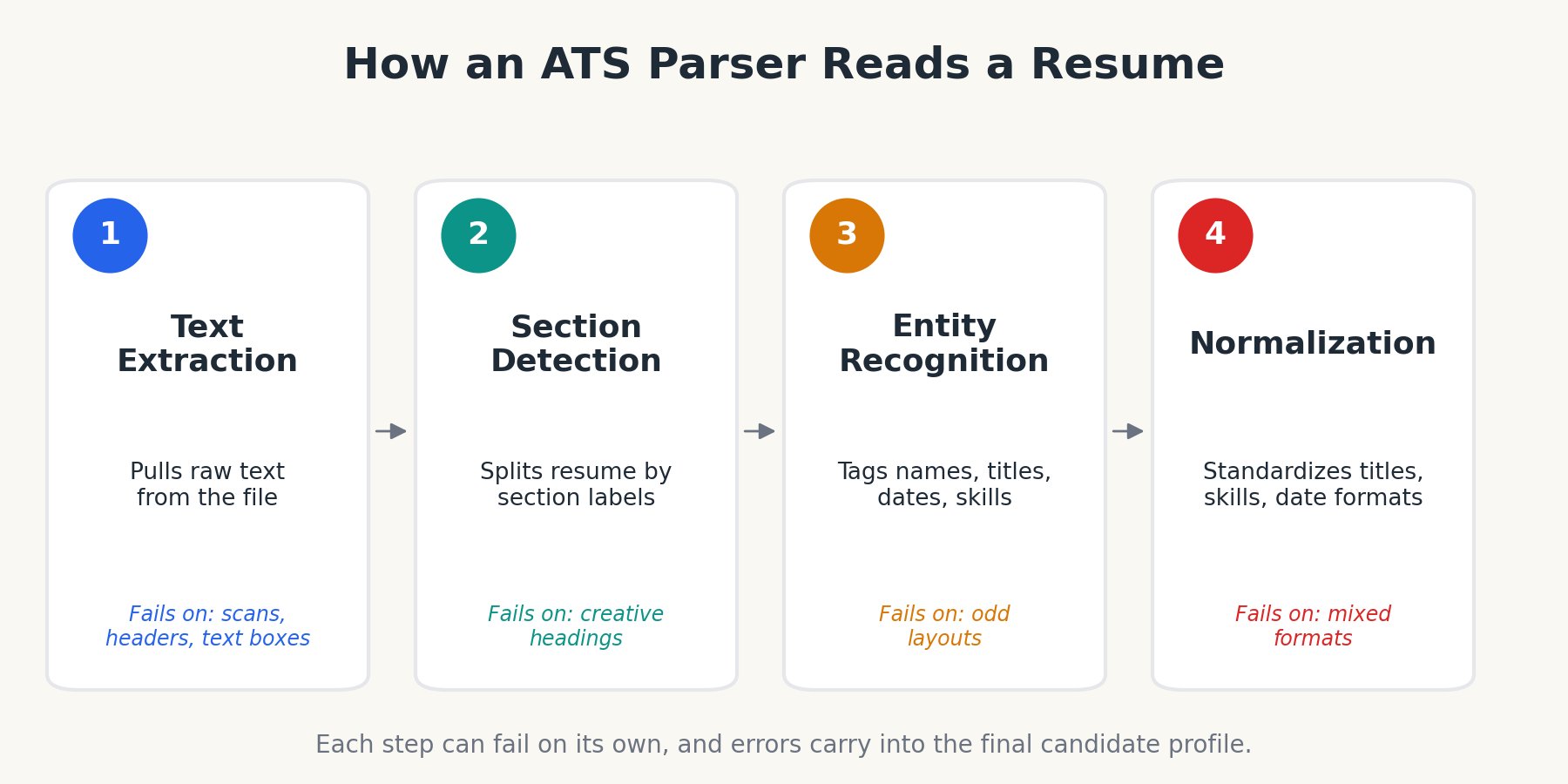
Parsing runs in four steps. Each one can fail on its own.
Step 1: Text Extraction
The parser first pulls raw text from the file. Text-based PDFs and DOCX files work well. Scanned images need optical character recognition, which guesses letters from pixels and makes more mistakes. Text inside headers, footers, or text boxes is often dropped.
Step 2: Section Detection
Next, the ATS parser scans for section labels like Experience, Education, and Skills. It splits the document into blocks based on those labels. A creative heading like “My Journey” gives it nothing to match, so the content beneath it may land in the wrong place.
Step 3: Entity Recognition
Then the parser tags entities: names, employers, titles, dates, degrees, and skills. Older tools rely on rules and keyword lists. Newer tools use an AI resume parser and read resumes quickly, built on machine learning models trained on huge resume sets, which handle odd layouts better.
Step 4: Normalization
Finally, the ATS parser standardizes the information extracted from the resume. It can identify different versions of the same job title, skill, or date format and organize them into consistent fields. This helps the ATS compare candidate profiles more accurately.
A good resume parser keeps these details structured and searchable, allowing recruiters to use the candidate data for filtering, search, and matching. This step is especially important when an ATS processes resumes with different writing styles, formats, and terminology.
How an ATS Ranks Resumes After Parsing
Here is the point most guides skip: parsing does not rank anyone. It only structures data. Ranking is a second layer that compares the parsed profile with the job.
Most systems rank in one or more of these ways:
- Keyword and Boolean search. Recruiters search parsed fields for terms like “Salesforce” or “CPA.”
- Knockout filters. Yes or no rules on work authorization, location, or a required license can move candidates out of the main pool.
- Match scores. The system compares parsed skills, titles, and experience with the job description, then assigns a percentage or star rating.
Match scoring is where AI enters the picture. Each candidate gets an AI resume screening score based on how closely the parsed profile fits the role.
Some platforms also use skills-based matching, which links related skills instead of exact words. A candidate who lists “Postgres” can still match a “PostgreSQL” requirement.
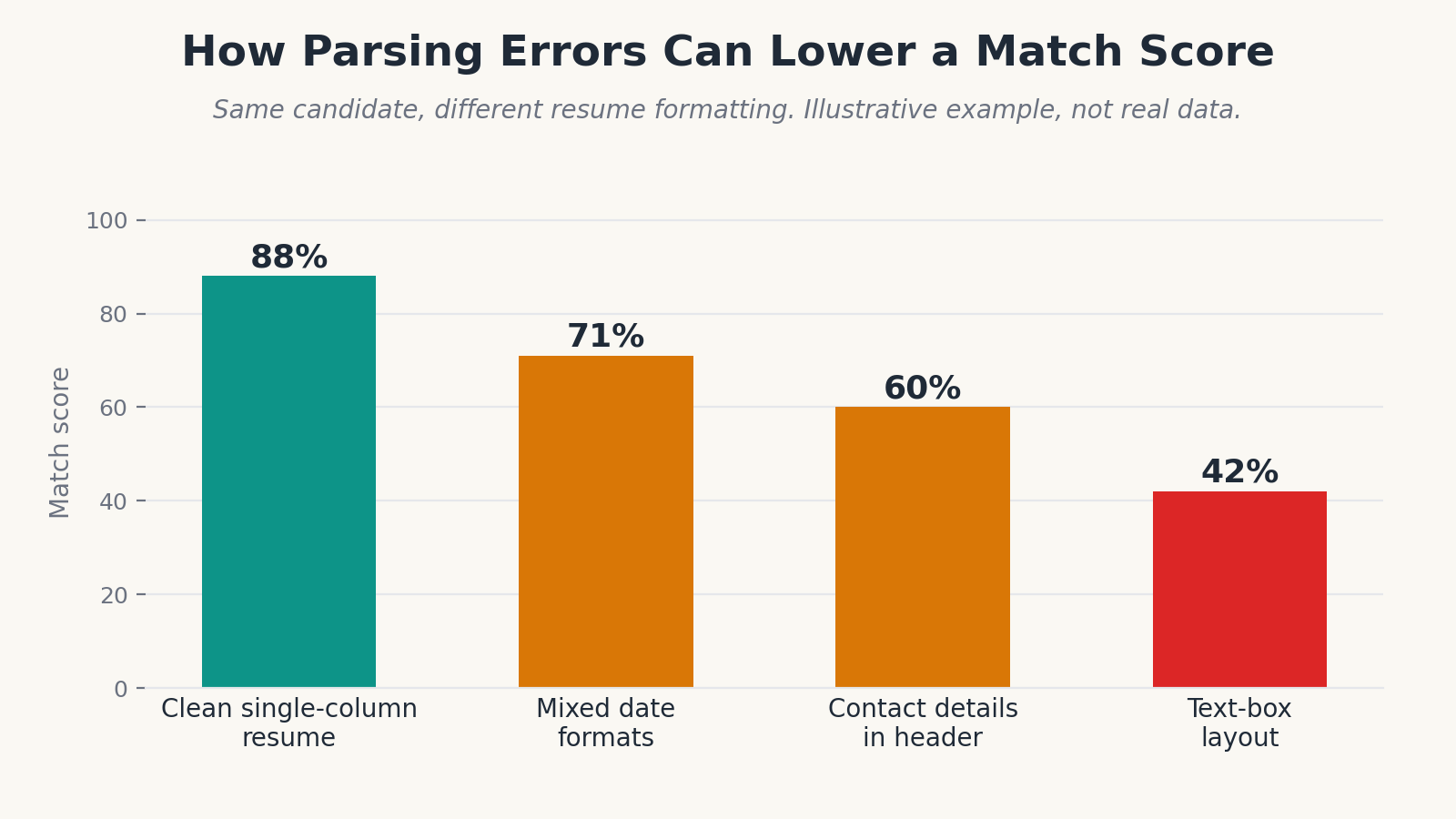
A popular myth says the ATS auto-rejects most resumes. In most setups, the software sorts and filters, and a recruiter still makes the call. The quieter risk is a badly parsed resume that ranks low because its data never reached the profile.
Where Resume Parsing Software Gets It Wrong
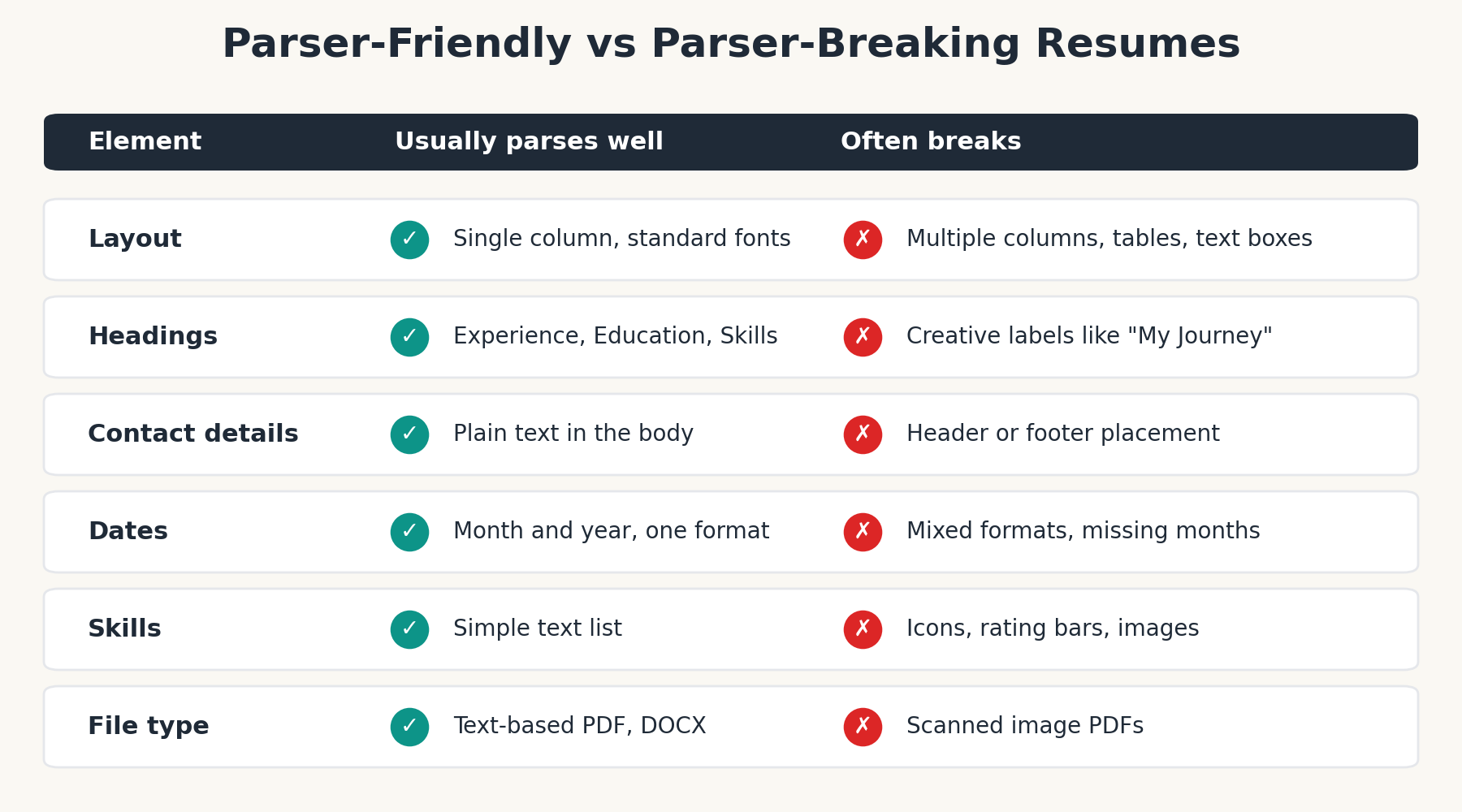
Layout and labeling cause most parsing failures. This table shows the usual pattern.
| Resume element | Usually parses well | Often breaks |
| Layout | Single column, standard fonts | Multiple columns, tables, text boxes |
| Headings | Experience, Education, Skills | Creative labels like “My Journey” |
| Contact details | Plain text in the body | Header or footer placement |
| Dates | Month and year, one format | Mixed formats, missing months |
| Skills | Simple text list | Icons, rating bars, images |
| File type | Text-based PDF, DOCX | Scanned image PDFs |
Even strong parsers miss fields. Accuracy varies by vendor, layout, and language, so run a resume parser accuracy test on 20 to 30 real resumes before committing.
Errors also affect fairness. A misread name, date, or career gap can flow into scoring and add AI resume screening bias, so keep a human check on every score.
Making Resumes and Job Descriptions Parser-Friendly
For Candidates
- Use a single-column layout with a standard font.
- Keep contact details in the body, not the header or footer.
- Stick to standard headings like Experience and Skills.
- Match the exact job title and key skills from the posting, where they are true.
- Submit a DOCX or text-based PDF, never a scanned image.
For Recruiters
Parsing works both ways. Vague titles and bloated requirement lists weaken matching. Resume parser-friendly job descriptions use clear titles, separate must-have skills from nice-to-have ones, and list tools by their common names.
How an ATS Parser Ranks Resumes
Parsing turns a resume into structured data. Ranking then scores that data against the job. Here is how an ATS parser and the ranking layer behind it order candidates.
1. Keyword Matching
The ATS compares skills, qualifications, certifications, and other relevant terms in a candidate profile with the requirements of the job. Relevant keyword matches help the system identify candidates whose experience aligns with the position.
2. Job Title Alignment
Job titles help the system understand a candidate’s role and level of experience. Normalization can connect different versions of similar titles, making candidate profiles easier to compare with the position being filled.
3. Skills and Experience Weighting
Not every field counts equally. Recruiters can label must-have skills high priority and nice-to-have skills low priority. Years of experience come directly from parsed dates, so a missing month or a mixed date format can quietly lower a candidate’s final score.
4. Knockout Filters
Knockout filters run before any scoring. They apply yes-or-no rules to fields like work authorization, location, required licenses, or minimum education. A candidate who fails one rule can drop out of the main pool, even with strong skills and years of relevant experience.
5. Match Scores and Ranked Lists
Finally, the system combines these signals into a match score, often a percentage or star rating. Candidates then appear in a ranked list. Recruiters usually review the top group first, so a low score can mean a resume gets read late or never.
6. Human Review Still Decides
Scores guide attention but rarely make the final call. Recruiters open profiles, correct parsing errors, and override rankings based on context. A strong candidate with an odd resume layout can still be found through manual search, which is why clean parsing matters.
What to Check Before You Choose Resume Parsing Software
Demos always look clean. Pressure-test these points instead:
- Field-level accuracy. Test titles, dates, and skills, not just names and emails.
- Format and language support. Confirm it handles PDF, DOCX, images, and the languages your candidates use.
- Editable profiles. Recruiters should see parsed fields and fix errors in one click.
- Duplicate handling. The system should merge repeat applicants instead of creating new records.
- Built-in or standalone. A built-in CV parser passes data straight to search and scoring. A separate tool needs an integration.
- Data privacy. Check retention rules, consent handling, and regional compliance.
Hirium builds parsing directly into its ATS, so parsed profiles feed search, scoring, and the candidate database without a separate tool. Those records also stay searchable after a role closes, which is how talent pools take shape.
Final Thoughts
So what is an ATS parser in practice? It is the quiet first step in every screening workflow. It decides which details the system can see, and every search, filter, and score builds on that.
Test your parser on real resumes, fix vague job descriptions, and treat match scores as a starting point for human review. Clean parsing means fewer missed candidates and faster shortlists.
Book A free demo of a resume parser for an AI-powered application tracking system.