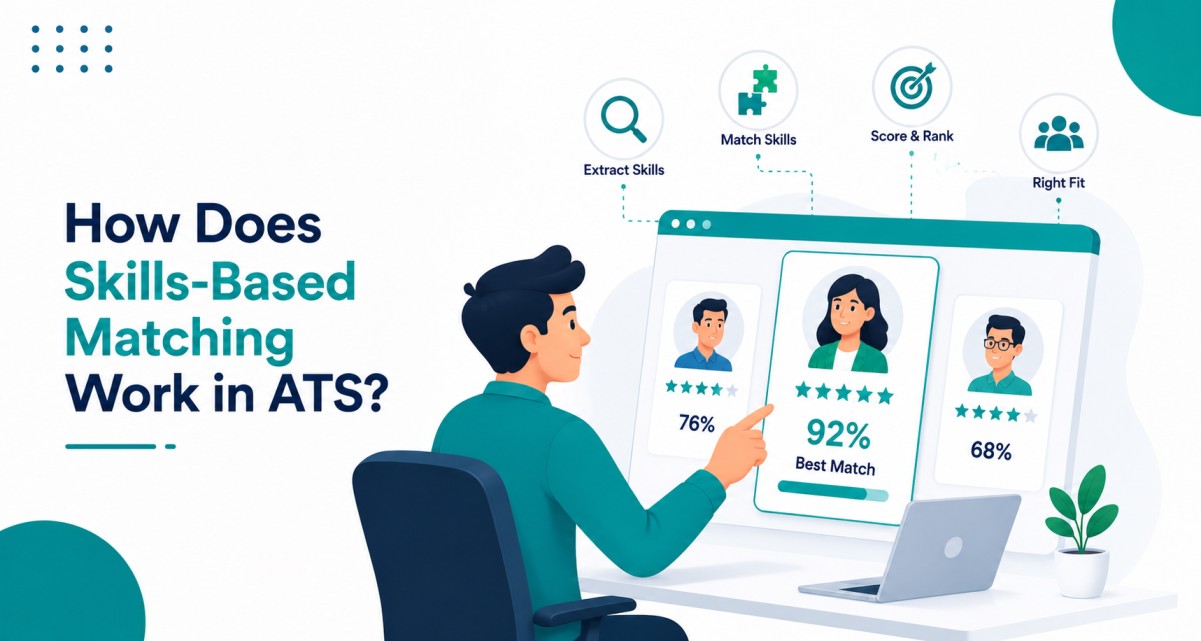
How Does Skills-Based Matching Work in ATS?
Hiring teams are changing how they approach candidate screening, and skills-based matching is becoming an important part of the process.
Instead of scanning resumes for job titles or years of experience, skills-based matching with ATS identifies actual abilities and matches them directly to what a role needs.
The shift is happening for a reason.
The World Economic Forum projects a 40% skills gap by 2027, meaning companies can no longer afford to rely on outdated screening methods that miss qualified people over a mismatched title or missing degree.
For startups growing their teams quickly, finding the right candidate can be difficult. An ATS for startups can make resume screening easier by helping recruiters focus on candidates with the right skills.
What Is Skills-Based Matching?
Skills-based matching is the process an ATS uses to compare a candidate’s actual abilities against what a job actually requires.
This is the core of how skills-based matching work in ATS: instead of judging someone by their last job title or how many years they’ve worked, the system looks at what they can genuinely do.
So instead of searching for someone with the title “Senior Developer,” the ATS breaks the role down into the real skills behind it, things like Python, API integration, or team leadership, and checks how closely a candidate’s background lines up with those specific requirements.
This makes it different from keyword matching, which just counts how many times a word appears on a resume without understanding the context behind it.
It’s also different from title matching, which focuses heavily on a candidate’s previous job titles and can overlook people whose experience matches the job posting but comes from a different role.
How Skills-Based Matching Work in ATS?
Skills-based matching runs on a few connected steps behind the scenes.
From reading a resume to producing a ranked shortlist, each stage plays a part in getting the right candidates in front of recruiters faster.
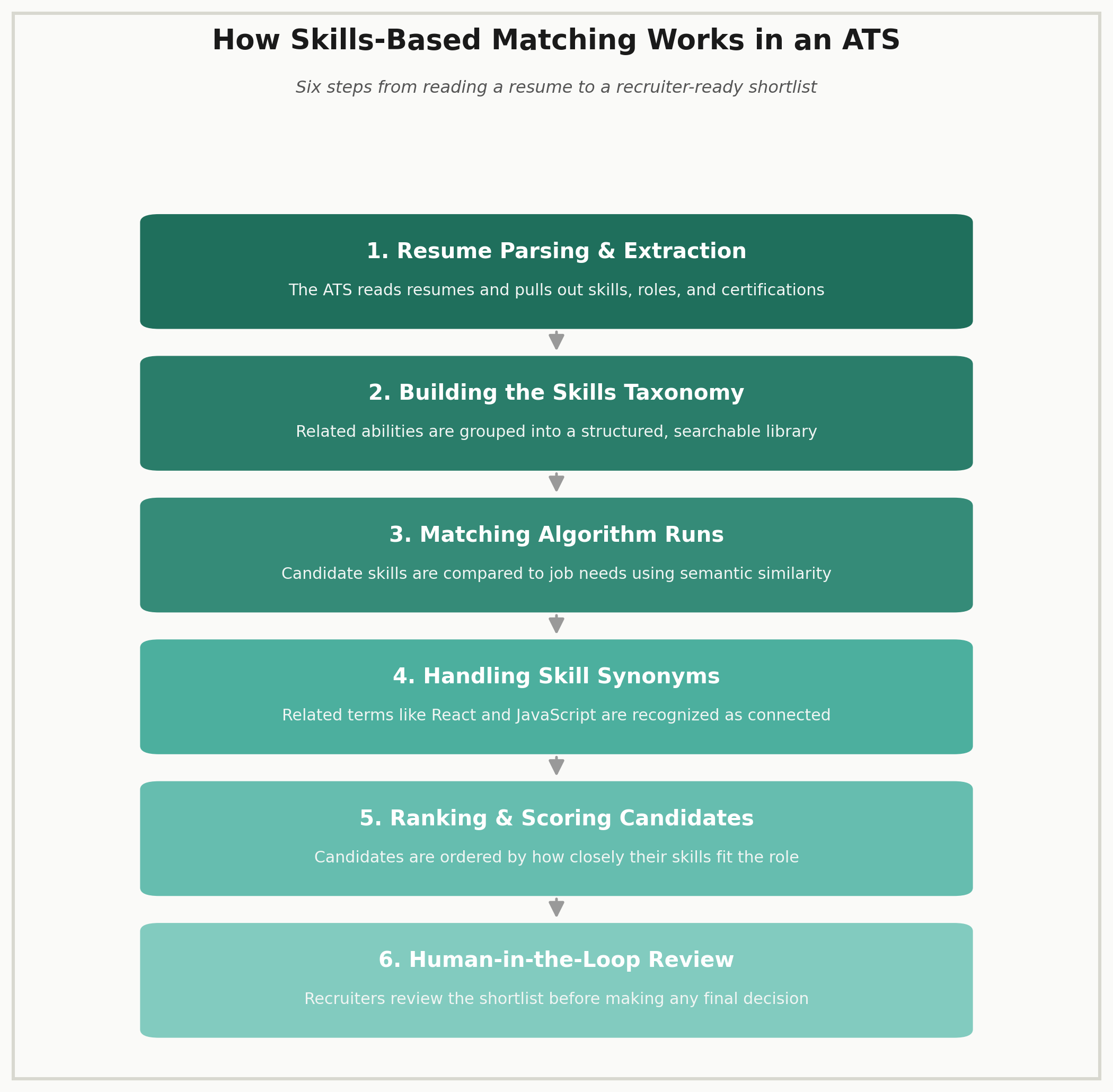
1. How Skills Get Extracted From Resumes
The process starts with resume parsing accuracy. The ATS reads through a resume and pulls out relevant information: job history, certifications, project descriptions, and skill mentions.
Natural language processing helps the system understand context, so it can tell the difference between a skill someone used daily and one mentioned only in passing.
2. Building a Skills Taxonomy
A skills taxonomy is a structured library that groups related abilities together and shows how they connect. It organizes technical skills, soft skills, and industry-specific terms into categories the system can reference.
Without this structure, the matching engine has no way to understand which skills relate to each other.
3. Matching Algorithm Logic
Once skills are identified, the algorithm compares them against the job requirements using semantic similarity rather than exact word matches. It looks at skill adjacency too, recognizing that certain abilities often appear together.
Each match gets a weighted score based on how closely it fits what the role actually needs.
4. Handling Skill Synonyms and Related Skills
Candidates rarely list skills the exact way a job description does. A strong system recognizes that someone skilled in React likely has working knowledge of JavaScript, even if they never typed the word. This kind of pattern recognition prevents good candidates from getting filtered out over minor wording differences.
5. Ranking and Scoring Candidates
After matching, candidates get ranked based on their overall fit score.
This considers not just how many skills match, but how central those skills are to the role. Recruiters see a shortlist ordered by relevance instead of sorting through every application manually.
6. Human-in-the-Loop Review
No matching system should make final decisions alone. Recruiters still review the shortlist, checking context the algorithm might miss, like career gaps or growth trajectory. This step keeps the process fair and gives skill-based hiring teams.
Where Skills-Based Matching Can Go Wrong?
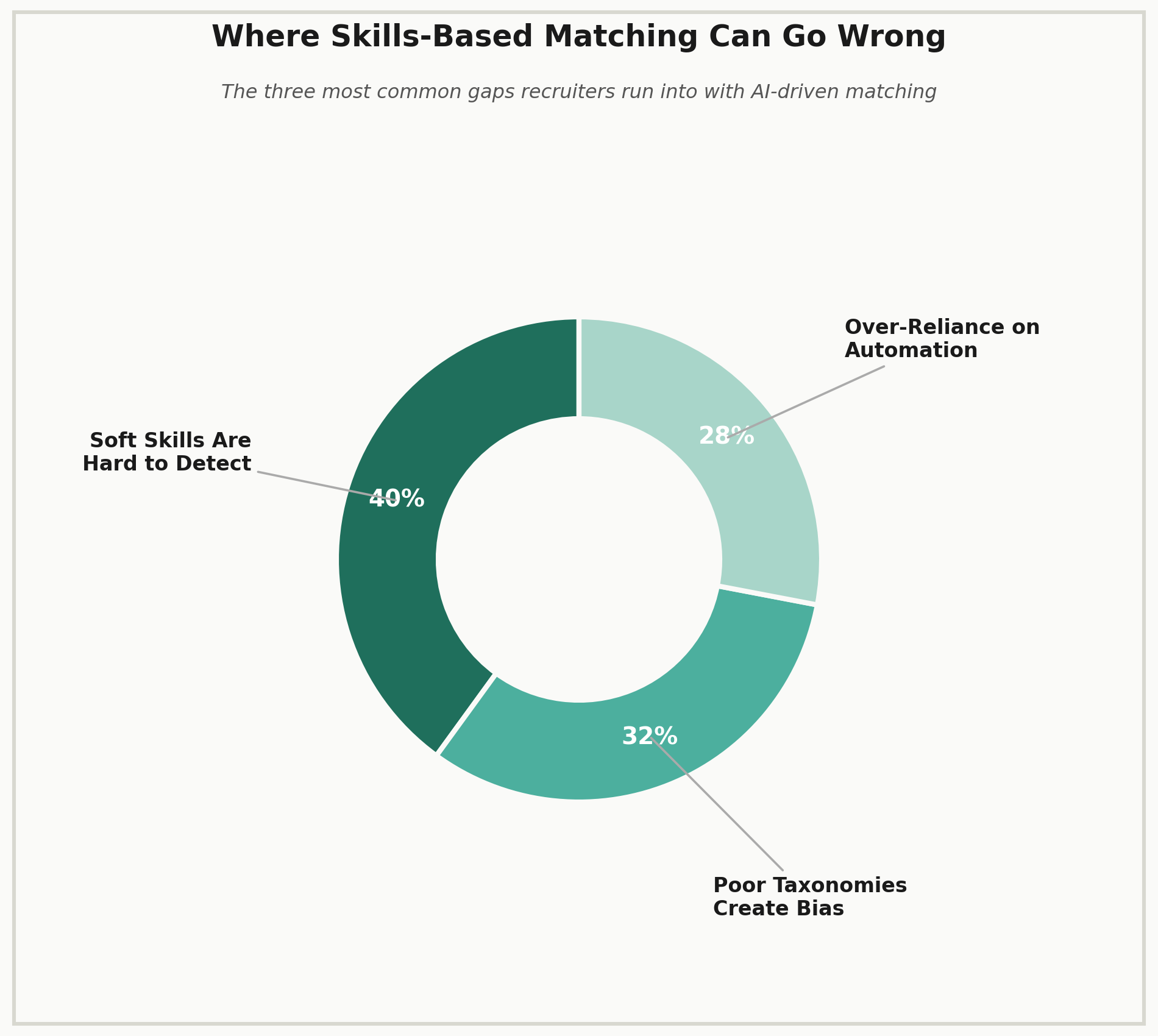
Understanding how skills-based matching work in ATS also means understanding its limits. No system is flawless, and recruiters relying on it fully without oversight can run into real problems.
Common gaps include:
- Soft skills stay hard to detect. Traits like communication or leadership rarely show up clearly in resume text, so the system may miss candidates who are strong in these areas.
- Poorly built taxonomies create new bias. If the skills library favors certain phrasing or backgrounds, it can quietly exclude good candidates in a different way than title filtering did.
- Over-reliance on automation. Skills-based matching works best as a support tool, not a replacement for recruiter judgment during final decisions.
Getting skills-based matching right in an ATS means pairing the technology with regular review, not letting it run unchecked.
Conclusion
How skills-based matching work in ATS is changing the way hiring teams find the right people. Instead of filtering candidates by job titles or how many times a keyword shows up, it looks at what someone can actually do and how well that fits the role.
This means fewer good candidates get missed, and fewer weak ones make it through on formatting alone.
Soft skills are still hard to measure through text, and taxonomies need regular review to stay fair. But paired with human judgment, skills-based matching gives recruiters a faster, more accurate way to build shortlists that actually reflect who can do the job.
At the end of the day, skills-based matching only works as well as the ATS behind it.
Hirium is built to look past titles and keywords, matching candidates based on what they can actually do, so recruiters spend less time filtering and more time interviewing people who fit the role.
Hirium offers a free plan, giving you a chance to see skills-based matching in action before committing to anything. Set up a role, review your shortlist, and judge the results for yourself.
FAQ
1. Does skills-based matching replace resume screening?
No. It changes how screening works by focusing on ability instead of keywords, but recruiters still review shortlists and make the final call. The system supports the process; it does not replace human judgment.
2. How accurate is AI skills matching?
Accuracy depends on how well the skills taxonomy is built and how much data the system has to work with. Most platforms get better over time as they process more resumes and job descriptions.
3. Can skills-based matching work for niche technical roles?
Yes, though it needs a taxonomy detailed enough to capture specialized skills. Niche roles often benefit the most, since qualified candidates for these positions frequently come from unconventional backgrounds that title-based filtering would miss.
4. Does skills-based matching help with diversity hiring?
It can. By judging candidates on actual abilities instead of degrees, past titles, or company names, it opens the door to candidates who took a different path into their field but still have the right skills.
5. Is skills-based matching only useful for large companies?
No. Small teams and startups often benefit the most, since they can’t afford to miss strong candidates over a title mismatch. It helps smaller hiring teams work faster without needing a large recruiting staff.