What Is an AI Resume Screening Score and How Should Recruiters Interpret It?
A corporate job posting attracts an average of 250 applications, and a recruiter spends roughly 6–7 seconds on the initial scan of each resume. Multiply that across 15–20 open requisitions and the math collapses: no human team can evaluate 4,000–5,000 resumes per quarter with any consistency. This is the gap the AI Resume Screening Score was built to close and the reason it is now one of the most consequential numbers in hiring.
It is also one of the most misread. Recruiters routinely treat an AI resume screening score of 88 as “interview immediately” and a 61 as “reject,” without knowing what the number actually measures, how it was weighted, or where it breaks. That misreading has real costs. A qualified engineer filtered out at 64 because their resume used “GCP” instead of “Google Cloud Platform” is a lost hire. An unqualified candidate advanced at 91 because of keyword density is 45–60 minutes of wasted interview time per panelist.
The score itself is neither the problem nor the solution. It is a compression of dozens of signals skills, tenure, recency, context into a single number, and like any compression, it loses information. Recruiters who understand what went into the number make faster, better decisions than teams screening manually. Recruiters who treat it as a verdict end up automating their own blind spots at scale.
According to recent 2026 recruiting benchmarks, application volumes have increased by over 90% while recruiting teams are operating with fewer resources, forcing recruiters to handle significantly higher workloads. This shift underscores the growing need for intelligent screening systems that can process large candidate pools with consistency and accuracy.
This guide covers exactly how an AI resume screening score is calculated, why a high score is not a hire guarantee, how to set score thresholds per role rather than globally, and a worked example with three sample candidates whose scores tell three very different stories.
What Is an AI Resume Screening Score?
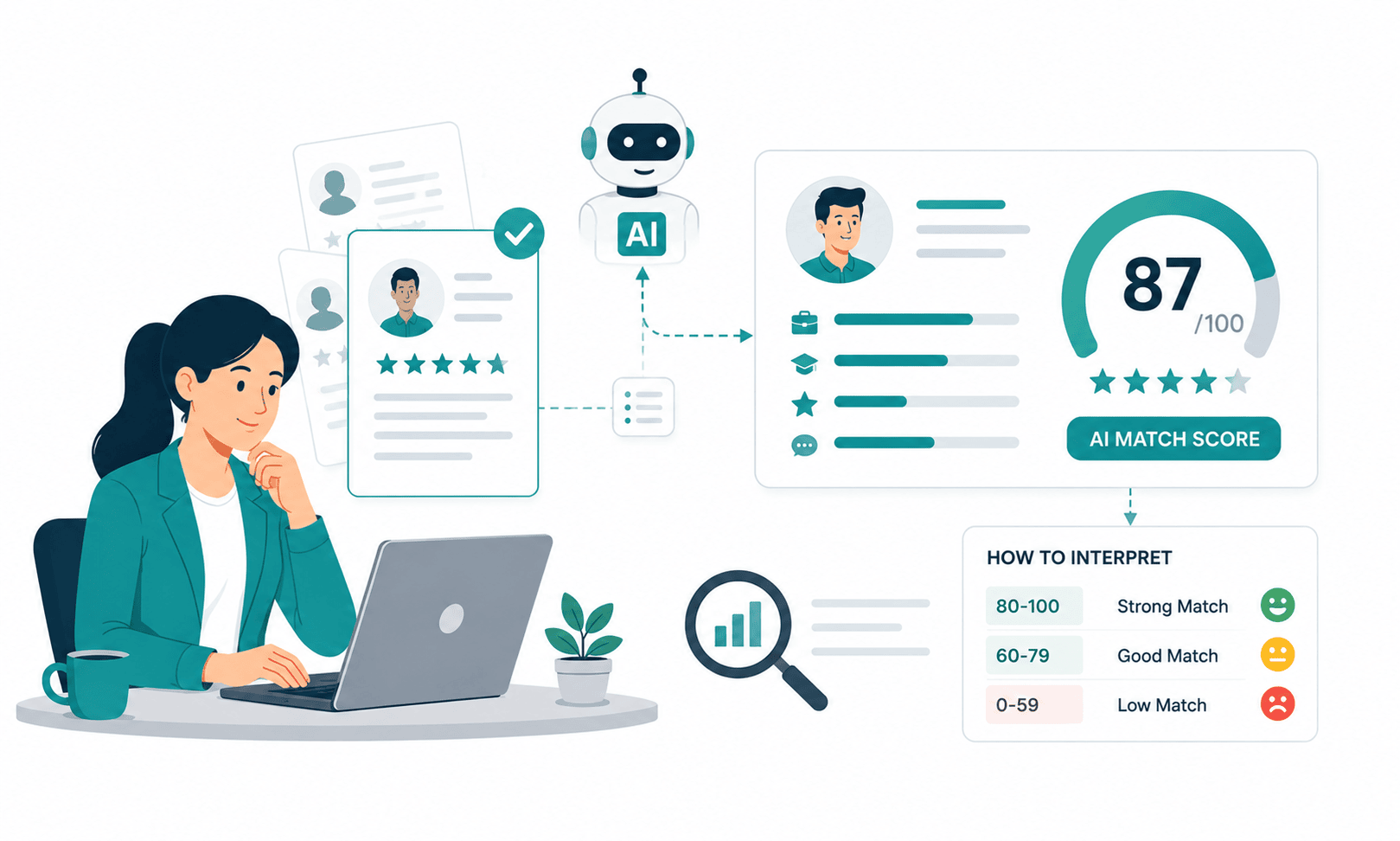
An AI resume screening score is a numerical rating typically 0–100 that an applicant tracking system (ATS) assigns to a resume by measuring how closely a candidate’s skills, experience, and qualifications match a specific job description. It ranks applicants for review priority; it does not predict job performance or replace human evaluation.
The Core Problem: Screening Volume Has Outgrown Human Capacity
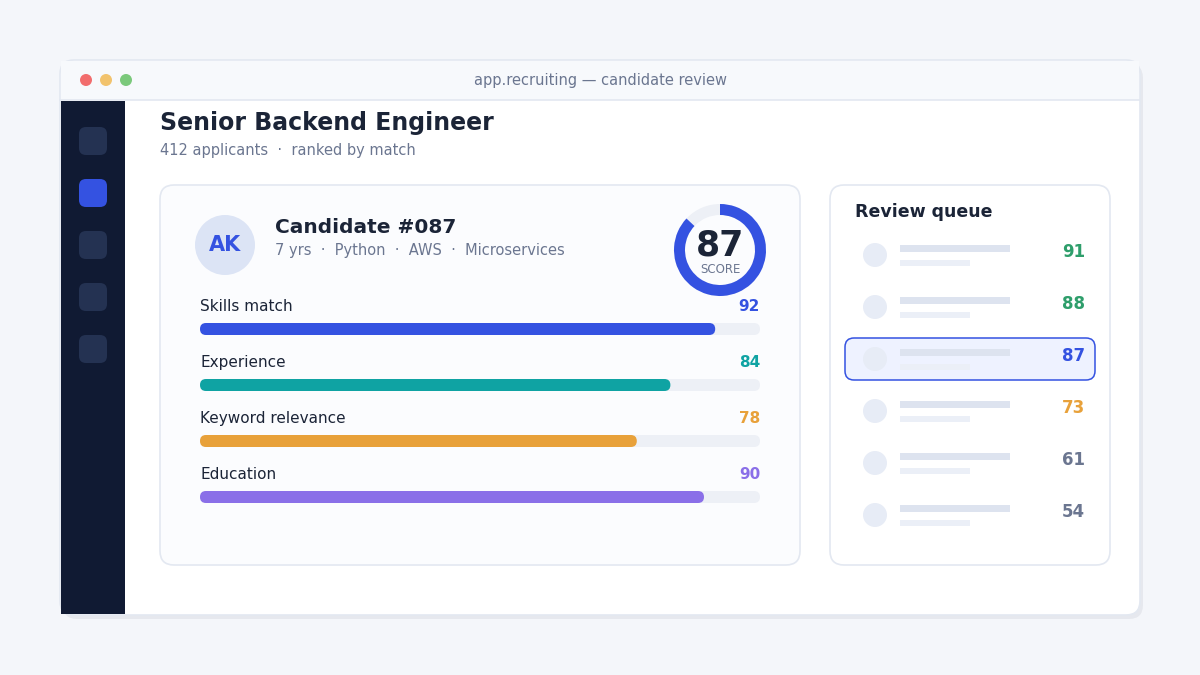
Application volume has grown roughly 2.5 — 3x faster than recruiting headcount over the last three years. Recruiters at startups and SMBs now carry 15–25 open roles simultaneously, and remote-friendly postings routinely pull 300–800 applicants in the first two weeks.
Manual screening does not scale to that volume it degrades, which is precisely the failure mode an AI resume screening score is designed to eliminate. Studies of recruiter behavior show consistency drops sharply after the first 40–50 resumes in a sitting: the same profile that earns a “yes” at 10:00 a.m. gets passed over at 4:30 p.m. Fatigue, ordering effects, and pattern-matching shortcuts creep in long before anyone notices.
The financial stakes compound the problem. With average time-to-fill sitting around 44 days and cost-per-hire near $4,700 for non-executive roles, every week a role stays open while resumes pile up unread carries a direct cost. For a 40-person startup hiring 12 people this year, a two-week screening delay per role adds roughly 5–6 months of cumulative vacancy time.
The AI resume screening score attacks exactly this problem: it evaluates every applicant against the same criteria, in the same way, at any volume, in seconds. Number 250 in the queue gets the same scrutiny as number 1. The catch and the subject of the rest of this guide is that the consistency is only as good as the criteria, the weights, and the recruiter reading the output.
How an AI Resume Screening Score Is Calculated
Under the hood, most scoring engines run a three-stage pipeline: extract, evaluate, weight. Understanding each stage tells you exactly where a score is trustworthy and where it can mislead you.
Stage 1: The AI Resume Parser Turns Documents Into Data
Before anything can be scored, the raw file has to become structured data. The AI resume parser reads the PDF or DOCX and extracts entities: job titles, employers, employment dates, education, certifications, skills, and location. Modern parsers use natural language processing rather than fixed templates, so they can handle a two-column design or an unconventional section order that would have broken older keyword-based systems.
Parsing accuracy is the silent ceiling on AI resume screening score quality. If the parser misreads “Jan 2021 – Present” or fails to associate “led a team of 8” with the correct role, every downstream calculation inherits that error. Top-tier parsers reach 90–95% field-level accuracy; older template-based tools can drop below 70% on non-standard layouts. When a strong candidate gets a baffling AI resume screening score, a parsing failure is the first thing to check; most platforms let you view the parsed profile side-by-side with the original document.
Stage 2: Three Signal Families Feed the Score
Once the resume is structured, the engine evaluates it against the job description across three core dimensions.
Skills match. The system compares extracted skills against the role’s required and preferred skills. Semantic models handle synonyms and adjacency “React” partially credits “front-end development,” and “PostgreSQL” maps to “relational databases.” A skills match percentage usually contributes the largest share of the final AI resume screening score, often 40–50% of total weight.
Experience weight. This measures years of relevant experience, seniority trajectory, recency, and domain fit. Five years in B2B SaaS sales scores differently from five years in retail sales for an account executive role. Better engines also weight recency: a skill used in the last 18 months counts more than one last touched in 2017.
Keyword and context relevance. Beyond discrete skills, the engine checks how the language of the resume aligns with the language of the job description industry terminology, tools, methodologies, and responsibilities. Crucially, modern systems score keywords in context, so “managed AWS infrastructure for 200+ services” outweighs a bare “AWS” in a skills list. This is what separates a genuine candidate ranking algorithm from a word counter.
Stage 3: Role-Specific Weighting Produces the Final Number
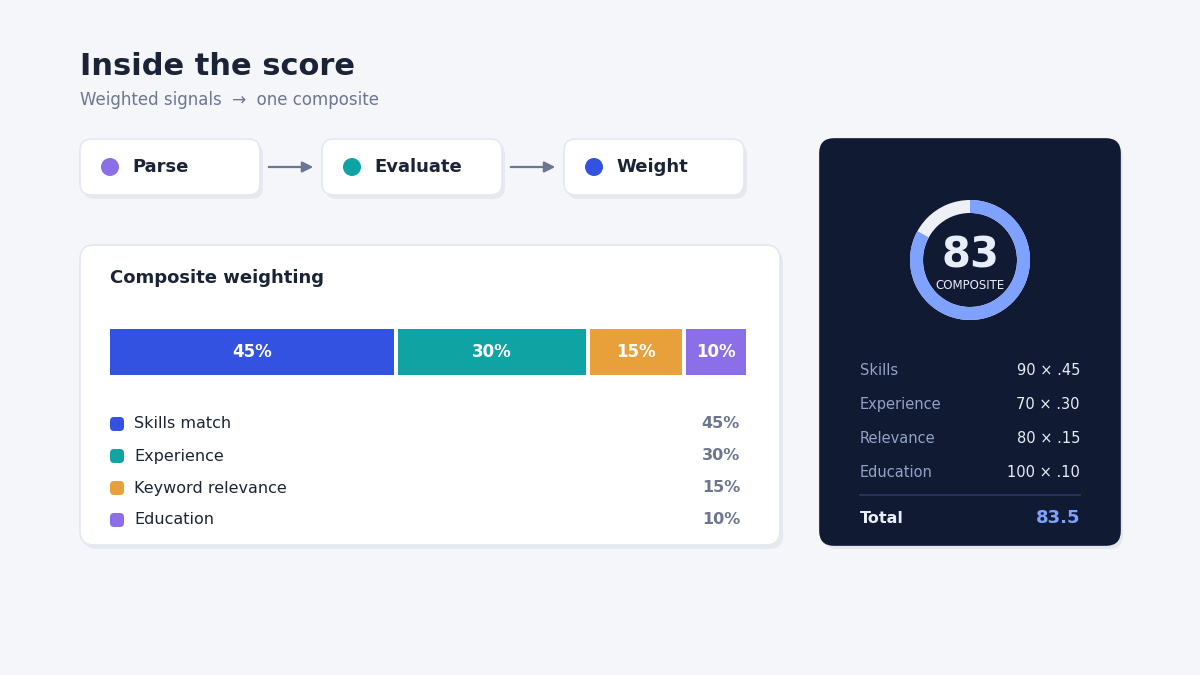
The three signal families are combined using weights either vendor defaults or recruiter-configured per role. A typical default looks like:
- Skills match: 45% alignment between extracted skills and the role’s requirements
- Experience weight: 30% relevant years, seniority, recency, and domain fit
- Keyword/context relevance: 15% job-description alignment in context
- Education and certifications: 10% degrees, licenses, and required credentials
A candidate scoring 90% on skills, 70% on experience, 80% on relevance, and 100% on education under those weights lands at: (90 × 0.45) + (70 × 0.30) + (80 × 0.15) + (100 × 0.10) = 83.5.
The immediate implication: an AI resume screening score is only meaningful relative to its weights. An 83 under skills-heavy weighting and an 83 under experience-heavy weighting describe different candidates. Any platform worth deploying shows you the sub-scores, not just the composite.
From Score to Decision: How AI Candidate Insights Add the Missing Context
The composite AI resume screening score answers “how well does this resume match the posting?” nothing more. This is where AI candidate insights matter: the explanation layer that surfaces why a candidate scored what they scored matched skills, missing requirements, employment gaps, career trajectory, and flagged inconsistencies.
The difference in practice is significant. A recruiter who sees only “72” makes a coin-flip call. A recruiter who sees “72 strong technical match, missing the required security clearance, 3-year career gap in 2019–2022” can make an informed decision in under a minute, including the decision to pick up the phone and ask about the gap. Platforms built for this workflow Hirium among them pair every score with this explanation layer precisely because the composite number alone compresses away the context recruiters actually need.
Why a High Score Is Not a Hire Guarantee
An AI resume screening score of 92 tells you the resume matches the job description exceptionally well. It tells you nothing about four things that decide whether the hire succeeds:
- Resume accuracy. The score evaluates claims, not verified facts. Roughly a third of candidates admit to embellishing resumes; the algorithm scores the embellishment at face value.
- Optimization gaming. Candidates increasingly use AI tools to tailor resumes to postings. A 94 may reflect excellent reverse-engineering of your job description rather than excellent qualifications, one reason interview no-show-on-substance rates have risen alongside average scores.
- Everything interviews exist to measure. Communication, judgment, collaboration, motivation, and culture-add are invisible to a document-matching engine.
- Job description quality. The AI resume screening score measures fit against what you wrote. If the posting lists ten “requirements” of which only four matter, the score faithfully measures the wrong thing.
Treat the number as what it is: a prioritization signal that determines review order and interview sequencing. The score decides who gets human attention first, not who gets hired.
Compliance, Cost, and Integration Considerations Before You Automate
Regulatory exposure scales with automation depth. NYC Local Law 144 requires annual bias audits and candidate notification for automated employment decision tools; the EU AI Act classifies hiring algorithms as high-risk systems with documentation and human-oversight obligations; and Illinois and Maryland impose consent requirements around AI-assessed interviews. If your workflow lets an AI resume screening score trigger rejection without human review, budget for audit and disclosure obligations from day one retrofitting compliance after a complaint costs 5–10x more than building it in.
Integration architecture matters just as much. Scoring bolted onto your ATS via a third-party plugin creates two failure points: parsed data can degrade in transit between systems, and sub-score explanations often don’t survive the handoff, leaving recruiters with a bare number. Natively integrated scoring where the parser, the candidate shortlisting engine, and the pipeline views share one data model preserves the explanation layer and keeps your hiring pipeline automation auditable end-to-end.
On cost: standalone screening add-ons typically run $200–600 per recruiter per month on top of ATS fees, while several modern platforms bundle AI screening into flat pricing, a meaningful difference for a 5-person talent team screening 1,000+ applications a quarter. Whatever you pay, insist on visible sub-scores and exportable audit logs; an AI resume screening score you cannot explain to a candidate, a hiring manager, or a regulator is a liability priced as a feature.
How to Set Score Thresholds Per Role
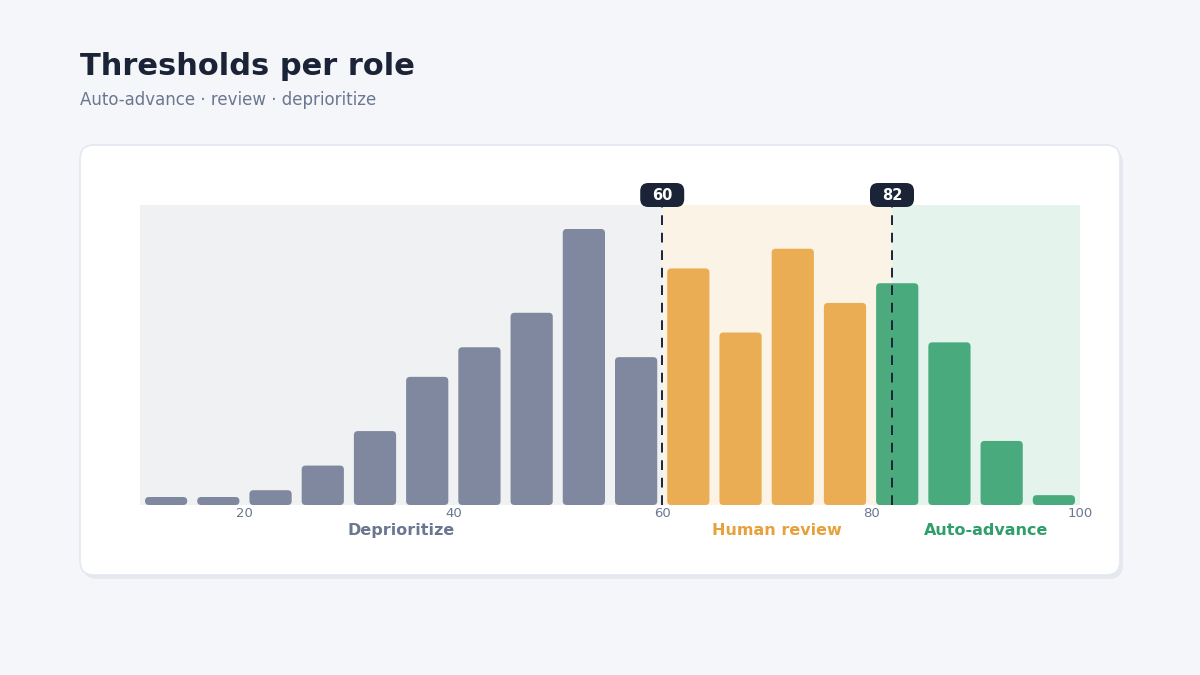
A global cutoff “advance every AI resume screening score above 75” is the single most common configuration mistake. Threshold setting should be a per-role calibration exercise, because AI resume screening score distributions differ dramatically by role type, seniority, and applicant pool.
A senior DevOps posting might draw 60 applicants clustered between 55 and 80, while an entry-level SDR posting draws 500 spread from 20 to 95. A 75 cutoff advances a reasonable shortlist for the first role and either floods or starves the second depending on the week.
A calibration process that works in practice:
- Run the first 50–100 applicants without a hard cutoff. Observe the actual AI resume screening score distribution for this specific role before automating anything.
- Manually review a stratified sample. Read 10 resumes each from the top, middle, and bottom bands. Find the score below which genuinely viable candidates stop appearing. That’s your evidence-based floor, and it is rarely a round number.
- Set two thresholds, not one. An auto-advance band (e.g., 82+ moves to recruiter review immediately) and a review band (e.g., 60–81 gets a human skim). Only the clear-miss band below is deprioritized, not silently auto-rejected.
- Adjust weights before adjusting thresholds. If good candidates keep landing at 65, the weighting is wrong for the role to fix the inputs rather than lowering the bar.
- Re-validate every 4–6 weeks or every 200 applicants. Applicant pools shift with seasonality, sourcing channels, and market conditions; thresholds set in January drift by April.
- Audit the rejected band monthly. Sample 10–15 profiles below the floor. If more than 1–2 look interview-worthy, your threshold or weights need revision. This audit is also your first line of defense against systematic bias.
Roles with scarce talent (senior engineering, niche compliance) warrant lower floors and wider review bands. High-volume roles with abundant supply (support, SDR, operations) can sustain higher floors provided the monthly audit confirms the floor isn’t filtering out non-traditional but capable candidates.
Worked Example: Three Candidate Scores Explained
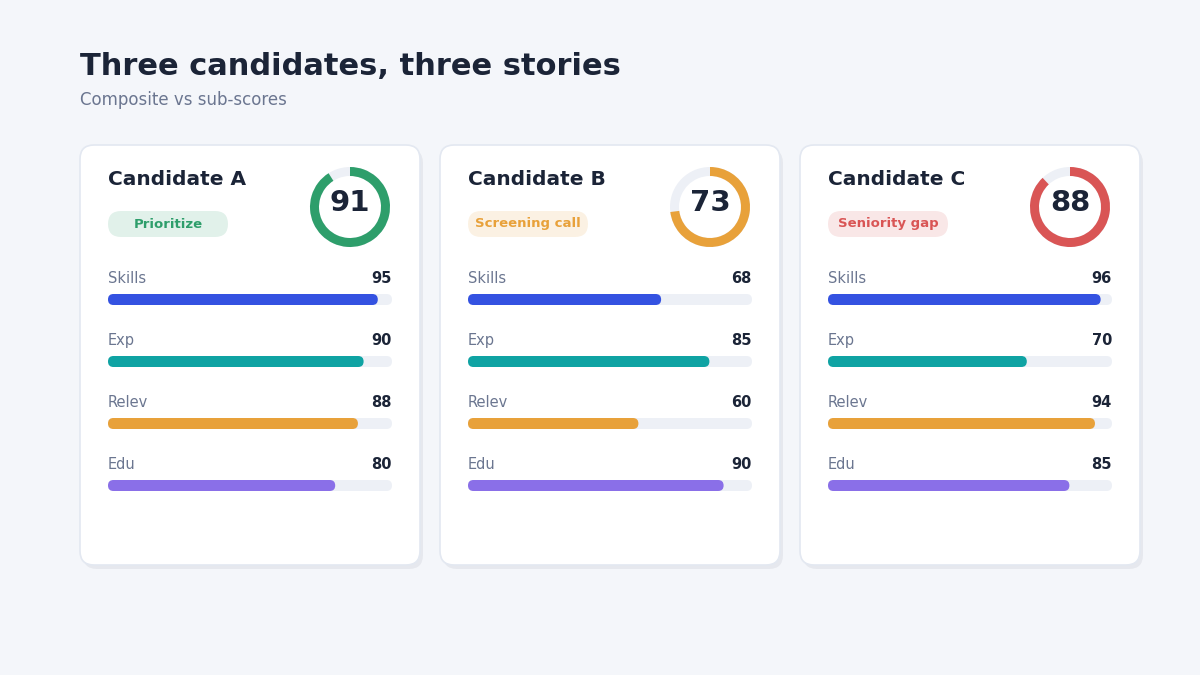
Consider a Series A startup hiring a Senior Backend Engineer (Python, PostgreSQL, AWS, 5+ years, microservices experience preferred). Weights: skills 45%, experience 30%, keyword/context relevance 15%, education 10%. Three real-pattern candidates show how the same AI resume screening score scale produces three very different decisions:
Candidate A AI resume screening score: 91. Sub-scores: skills 95, experience 90, relevance 88, education 80. Seven years of Python microservices work at two SaaS companies, AWS certification, resume language closely mirrors the posting. Interpretation: prioritize for immediate review but note the near-perfect textual alignment and verify depth in the technical interview rather than assuming it. A 91 earns the first interview slot, not a shortcut through the process.
Candidate B AI resume screening score: 73. Sub-scores: skills 68, experience 85, relevance 60, education 90. Eight years of backend experience but in Java and Oracle at a fintech enterprise, with Python appearing only in a side project. Interpretation: this is the classic “adjacent expert.” The skills gap is tooling, not fundamentals; distributed-systems experience at fintech scale may exceed Candidate A’s. Worth a screening call. A recruiter reading only the composite would wrongly file B eighteen points behind A.
Candidate C AI resume screening score: 88. Sub-scores: skills 96, experience 70, relevance 94, education 85. Every keyword present, skills list comprehensive but only 3.5 years of total experience across four employers, and the parsed profile shows no single system owned for more than a year. Interpretation: the high composite masks a seniority mismatch on a role requiring 5+ years. C may be a strong mid-level hire for a different requisition; advancing them for this one sets up a likely rejection at the hiring-manager stage and 3–4 hours of wasted panel time.
The lesson compresses to one sentence: A ranked C > B, but the right interview order was A, B, C-for-a-different-role. The sub-scores, not the composite, carried the decision-relevant information.
Real-World Application: Two Brief Case Studies
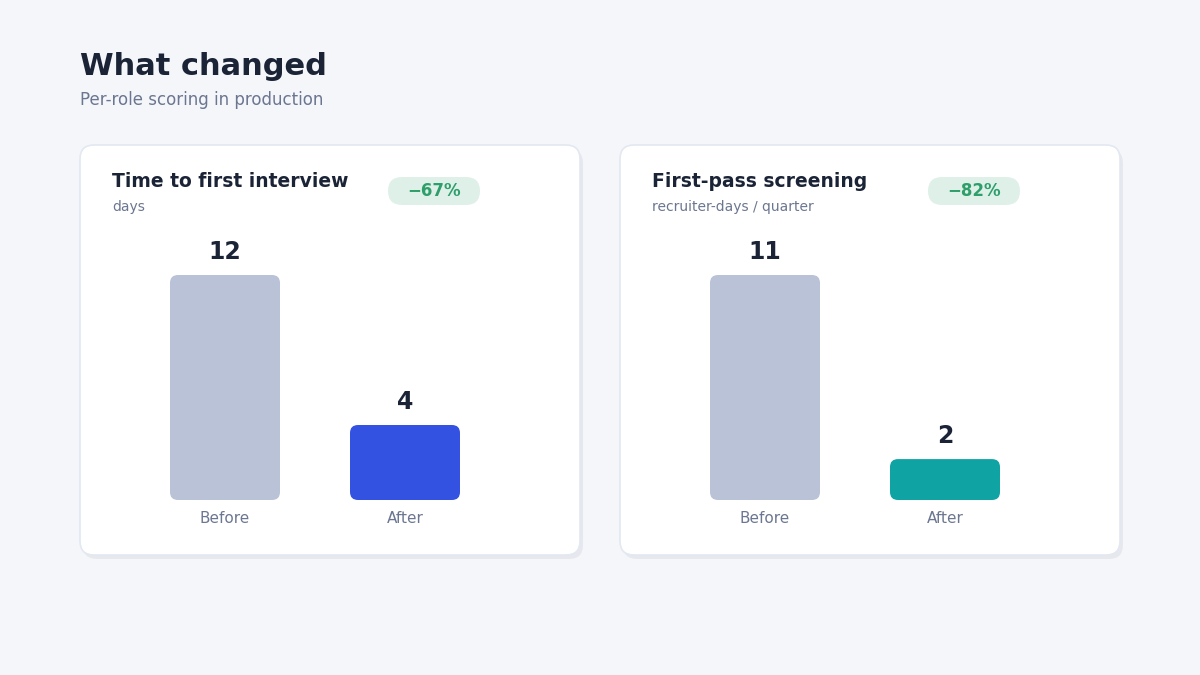
A 60-person logistics-tech startup screening 1,100 applications across 9 roles per quarter moved from manual review to AI resume screening score ranking with per-role thresholds inside their ATS. First-pass screening time dropped from roughly 11 recruiter-days to under 2 per quarter, and time-to-first-interview fell from 12 days to 4 while their monthly rejected-band audit caught and corrected a weighting error that had been under-scoring candidates from bootcamp backgrounds.
A 200-person SaaS company took the opposite lesson. They deployed a global 80 cutoff across all roles and auto-rejected below it. Within two quarters, offer rates for senior roles collapsed; the cutoff was discarding nearly every viable senior candidate, whose longer, less keyword-dense resumes scored 65–78. Recalibrating thresholds per role and adding a human review band recovered their senior pipeline within six weeks.
Decision Framework: Choosing How Scores Fit Your Workflow
The real decision isn’t “AI scoring: yes or no” , it’s how much authority the AI resume screening score gets in your talent acquisition workflow. Four operating models, in ascending order of automation:
| Operating Model | How It Works | Best For | Key Risk |
| Score as sort order | Scores rank the queue; humans review everyone | Low volume (<50 apps/role), senior/niche roles | Slowest; fatigue returns at scale |
| Score + review bands | Auto-advance top band, human review of middle, deprioritize bottom | Most SMB hiring (50–300 apps/role) | Band boundaries need per-role calibration |
| Score-gated automation | Bottom band auto-rejected with human audit sampling | High-volume roles (300+ apps/role) | Silent bias if audits lapse; compliance exposure |
| Fully automated rejection | AI rejects without human review | Rarely advisable | Legal risk (NYC LL144, EU AI Act), lost talent, brand damage |
For most startups and SMBs, the second model is the defensible default: it captures 70–80% of the time savings while keeping a human decision on every borderline candidate. Whatever model you choose, candidates in every band deserve timely communication. This is where recruitment status update software earns its keep, automatically triggering stage-change notifications so a deprioritized applicant hears back in days rather than never. Ghosted candidates talk: employers with slow or absent responses see measurable drops in application conversion within 6–12 months.
What Most Teams Get Wrong About Screening Scores
The pattern across hundreds of ATS implementations is consistent, and it is not the mistake most people expect. Teams don’t fail because the AI is inaccurate. They fail because they stop doing the human work the AI resume screening score was supposed to make room for.
The score was meant to free recruiter hours for deeper interviews, better candidate communication, and structured evaluation. Instead, many teams reinvest those hours in more requisitions and start treating the score as the evaluation itself. Within two quarters, nobody remembers what the weights are, nobody audits the rejected band, and the org has effectively delegated hiring judgment to a config file someone set up during onboarding and never revisited.
Three specific failure modes recur:
- Default weights, forever. Vendor defaults are tuned for a generic role. Teams that never adjust weights per role family are scoring their sales hires like engineers.
- Threshold set once, never re-validated. Applicant pools drift. A threshold calibrated on a January pool quietly misfires by summer.
- Composite worship. Recruiters compare candidates by a single number when the sub-scores as Candidate B above shows carry the actual signal.
The contrarian summary: the highest-ROI activity in AI screening is not tuning the model. It is the 90-minute monthly ritual of auditing the rejected band and re-reading your own job descriptions. Teams that do this outperform teams with fancier algorithms and no discipline, every time.
Put Your Scores to the Test on a Live Role
The fastest way to find out whether you’re interpreting an AI resume screening score well is not another article, it’s an audit of your own pipeline. Pull your last 100 scored applicants for one role, read ten resumes from each score band, and check whether the bands match your judgment. Most teams find at least one miscalibrated weight within the hour.
If you’d rather run that exercise on infrastructure built for it transparent sub-scores, per-role thresholds, and automated candidate communication out of the box Hirium’s free plan (used by 5,000+ businesses, 4.5/5 on G2) lets you score a live requisition end-to-end at zero cost. Set it up on your next opening, run the calibration, and let the distribution tell you where your thresholds actually belong.
Frequently Asked Questions
How is an AI resume screening score calculated?
The system parses each resume into structured data, then evaluates it against the job description across weighted dimensions typically skills match (40–50%), experience relevance (25–35%), keyword/context alignment (10–20%), and education or certifications (5–15%). The weighted sub-scores combine into a composite, usually on a 0–100 scale. Weights are configurable per role on most modern platforms.
What is a good AI resume screening score for recruiters to shortlist?
There is no universal “good” AI resume screening score distributions vary by role, seniority, and applicant pool. In practice, 80+ generally signals a strong match worth immediate review, 60–79 warrants a human skin, and below 60 suggests a significant gap. Calibrate these bands per role by manually sampling your first 50–100 applicants rather than adopting a global cutoff.
Can a candidate with a low AI resume screening score still be a good hire?
Yes, and it happens regularly. Low AI resume screening scores often reflect parsing failures, unconventional resume formats, synonym mismatches (writing “GCP” when the posting says “Google Cloud”), or transferable experience the algorithm undervalues. This is why monthly audits of the rejected band matter: sampling 10–15 low-scoring profiles catches systematic misses before they compound.
Do AI resume screeners reject candidates automatically?
Only if configured to. Surveys show about half of companies limit AI-driven rejection to the initial resume stage, while roughly a fifth allow it at any stage without human review, a practice that carries growing legal exposure under regulations like NYC Local Law 144 and the EU AI Act. The defensible setup is deprioritization plus human audit, not silent auto-rejection.
How does candidate profile management affect score accuracy over time?
Significantly. Strong candidate profile management, a centralized, deduplicated candidate database with enriched profiles, interview feedback, and outcome data lets you check scores against reality: did candidates with an AI resume screening score of 85+ actually convert to strong hires? Platforms that connect scoring to downstream outcomes give you the feedback loop; scattered spreadsheets guarantee you never find out whether your thresholds work.
Should AI resume screening score thresholds be the same for every role?
No. A global threshold is the most common and most damaging configuration error. Scarce-talent roles (senior engineering, specialized compliance) need lower floors and wider human-review bands; high-volume roles can sustain higher floors with regular audits. Re-validate each role’s threshold every 4–6 weeks or every 200 applicants, whichever comes first.
How can a small team implement score-based screening without a data scientist?
You don’t need one; you need an ATS with transparent sub-scores, per-role weight configuration, and built-in audit workflows, plus the calibration process outlined above. Hirium’s forever-free plan includes AI screening and shortlisting with no credit card required, which makes it a low-risk way to run the calibration exercise on your next real requisition before committing budget anywhere.