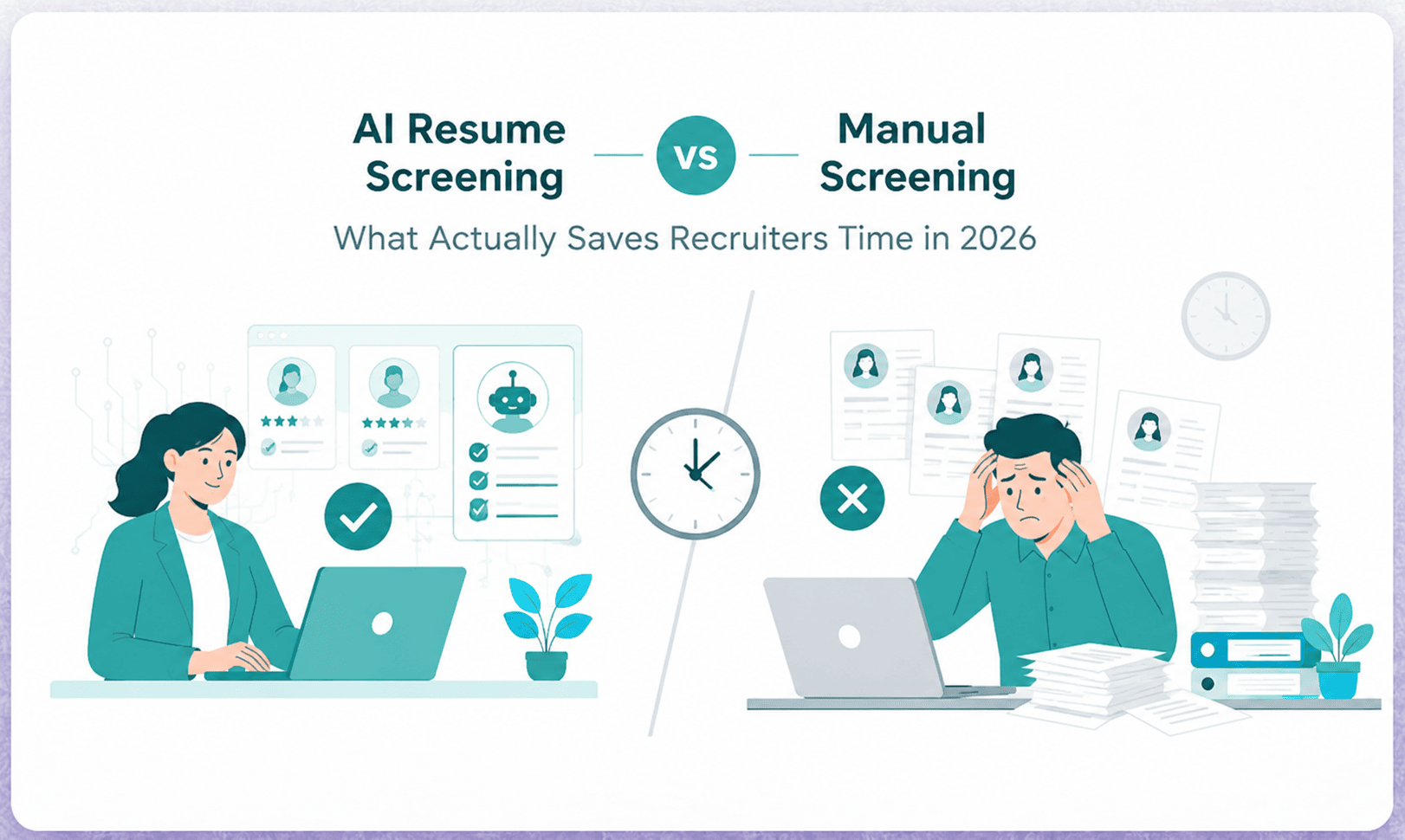
AI Resume Screening vs Manual Screening: What Actually Saves Recruiters Time in 2026
A recruiter filling one role with 200 applicants spends 10 to 15 hours reading resumes before a single interview is scheduled. Multiply that across the eight to twelve open requisitions a growing startup typically carries, and the screening stage alone consumes a full work week, every week, for one person.
That arithmetic is why AI resume screening stopped being an experiment and became the default hiring infrastructure. The question for 2026 is no longer whether to automate the first pass, but where automation genuinely returns hours and where it quietly creates rework that erases the gain.
LinkedIn’s Future of Recruiting report found that talent professionals using generative AI save roughly one full workday per week about a 20% workload reduction and 35% of them reinvest that recovered time directly into deeper candidate evaluation.
The contrarian point most vendor pages skip: time savings are not uniform. Automation crushes the repetitive triage that eats the most hours, but it adds friction in exactly the situations where human judgment is non-negotiable senior hires, ambiguous career paths, and roles where culture and trajectory matter more than keyword overlap.
This guide breaks down the real numbers behind both approaches, time per resume, cost per hire, and accuracy under bias scrutiny. It then gives you a five-step framework for deciding when a human still has to read the resume, a side-by-side comparison you can act on, and the mistakes that cause teams to overspend on tooling while their time-to-hire barely moves.
What Is AI Resume Screening?
AI resume screening is the automated process of parsing, analyzing, and ranking job applications using machine learning and natural language processing, so recruiters receive a scored shortlist instead of an unsorted inbox. It reads skills, experience, and role fit in seconds per resume rather than the two to three minutes a human spends, then surfaces the strongest matches for review.
It is not the same as a keyword filter. A traditional applicant tracking system rejects a backend engineer because the resume said “Python and Django” instead of the exact phrase “backend developer.” Context-aware screening reads the meaning, not just the string, which is the core reason it both saves time and reduces a specific class of false rejections.
The Real Problem: Screening Eats the Hours That Matter Most
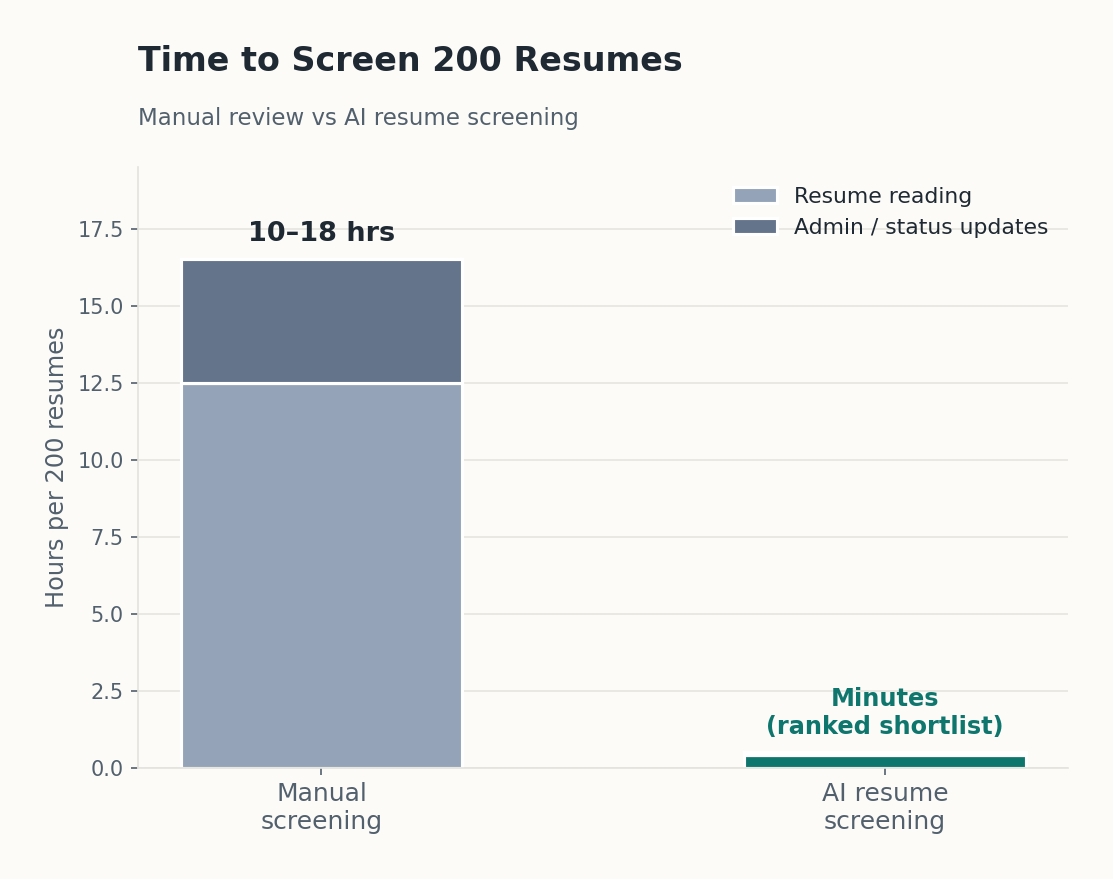
Resume review is the single most time-consuming step in the hiring funnel, and it is also the least strategic. Recruiters spend roughly 6 to 30 seconds on an initial skim and 3 to 5 minutes on resumes that pass that first cut. For a pool of 200 applications, even a conservative three-minute average equals 10 hours of pure reading.
Then the hidden tax arrives. Logging notes, updating candidate stages, and sending status emails pushes the real total to 12 to 18 hours per 100 resumes. None of that work moves a candidate closer to an offer; it is administration dressed up as evaluation.
The volume is not shrinking. Corporate roles now attract around 250 resumes each, and application volume across many markets has grown 2.6 to 3 times year over year. A recruiter who could once give every applicant a fair human read now physically cannot, so manual screening degrades into rushed triage that misses strong candidates buried below the fortieth resume.
Most teams underestimate this cost by 3 to 4 times because they only count the hours someone is actively reading. They ignore context-switching, the re-reads caused by inconsistent criteria, and the senior-recruiter time spent re-screening a junior’s shortlist. The result is a hiring process that feels busy and slow at the same timehigh recruiter workload, sluggish time-to-hire, and top candidates accepting other offers while your shortlist is still being assembled.
The Cost-Per-Hire Math Nobody Runs
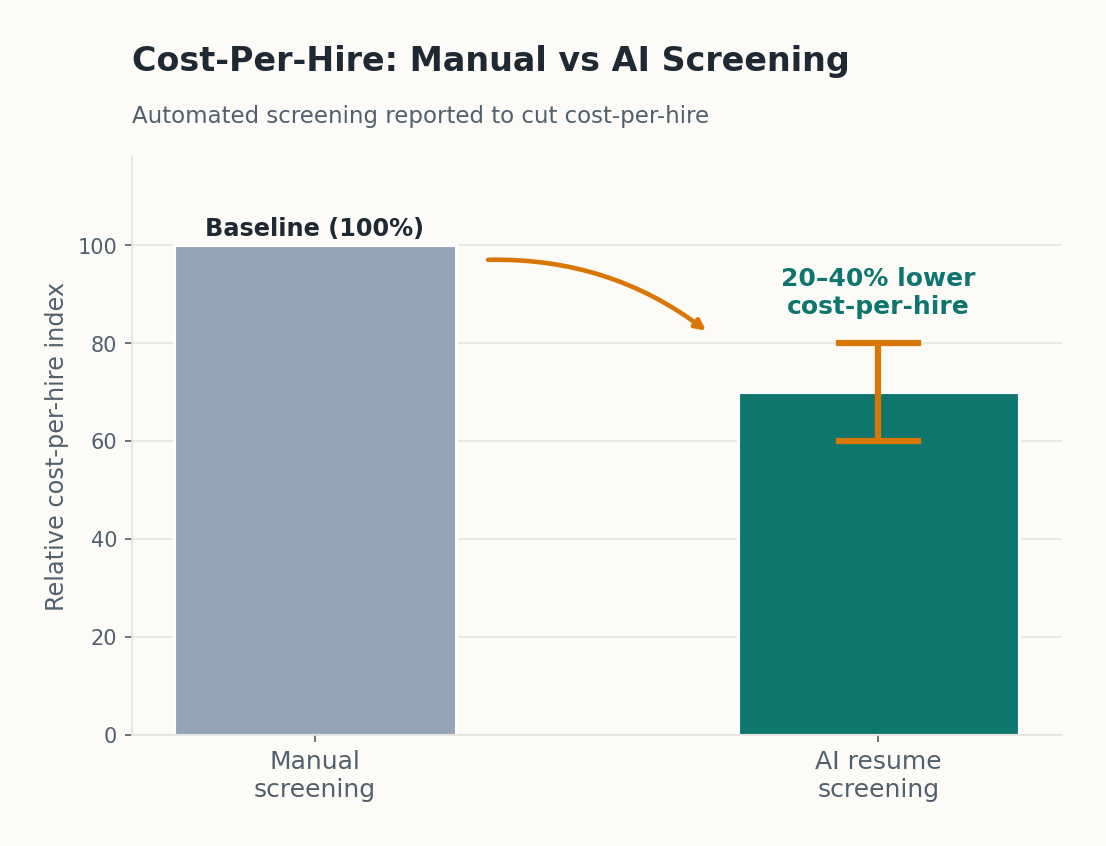
Translate those hours into money and the picture sharpens. A recruiter loaded at a fully burdened cost of roughly ₹12–18 lakhs annually (or the equivalent ~$45,000–$70,000 in many Western markets) is spending 10 to 18 hours of that salary screening a single high-volume role.
Across 30 roles a year, manual triage alone can consume the equivalent of one to two months of a recruiter’s paid time on work that produces no shortlist insight you couldn’t have generated in minutes.
This is the real cost-per-hire drag, and it rarely shows up in budgets because it hides inside salaries that are already being paid. The opportunity cost is sharper still: every hour spent dragging through resume number 180 is an hour not spent on candidate engagement, intake calibration, or closing the finalist who has two competing offers. Teams that adopt AI resume screening are not primarily buying software; they are reclaiming the most expensive, least leveraged hours in their talent acquisition function.
How AI Resume Screening Works (and Where the Hours Are Recovered)
This is where the time actually comes back, and understanding the mechanics tells you which parts to trust and which to supervise. AI resume screening compresses a linear, one-resume-at-a-time process into a parallel one, then hands recruiters a ranked list with reasoning attached.
From AI Resume Parser to Ranked Shortlist
The pipeline starts with an AI Resume Parser that extracts structured data roles, dates, skills, education, seniority from messy formats, including PDFs, scanned documents, and inconsistent layouts. Clean resume parsing is the unglamorous foundation everything else depends on: a parser that misreads a date range or drops a skill section poisons every downstream score.
Parsing edge cases are where cheap tools quietly fail. Two-column layouts, embedded tables, graphics-heavy designer resumes, non-English sections, and dates written as “Jan ’22–present” all break weak parsers, and a dropped skills section means a qualified candidate scores low for reasons that have nothing to do with their ability.
Before trusting any AI resume screening tool, feed it ten of your messiest real resumes and check whether the extracted fields actually match the documents. If parsing is unreliable, every score downstream is noise wearing the costume of precision.
From there the system matches parsed data against your defined requirements and scores each candidate. Strong tools score against structured screening criteria: you set must-have skills, minimum experience, location, work authorization rather than opaque “fit” guesses, which keeps the logic auditable.
The better platforms also separate hard gates (work authorization, a required certification) from weighted preferences (years of experience, domain overlap), so a candidate missing a nice-to-have is ranked lower rather than silently eliminated.
Scoring, AI Candidate Insights, and the Human Handoff
Good platforms now surface AI Candidate Insights: short, evidence-linked summaries explaining why a candidate ranked where they did, with the supporting line from the resume attached. This is the difference between a black box and a decision aid, and it is the single feature that determines whether AI resume screening earns recruiter trust or quietly gets ignored. A recruiter can confirm “8 years back, led a 6-person team, shipped two payment systems” in five seconds instead of re-reading the whole document.
The handoff is the critical design choice. The system should rank and explain; the recruiter should decide. Teams that let the tool auto-reject below a score threshold trade a few minutes of review for the risk of silently discarding qualified people and, in regulated markets, for compliance exposure.
This is the operating principle that separates teams who get value from AI resume screening from teams who get burned by it. The tool’s output is a prioritized reading order with evidence attached, not a verdict. When recruiters internalize that distinction, the technology compounds their judgment; when they outsource the decision to a score, it compounds their blind spots at machine speed.
Workflow Automation: Recruitment Status Update Software and Beyond
The second pool of recovered time sits outside scoring entirely. Recruitment Status Update Software and broader hiring workflow automation handle the admin tax: moving candidates between stages, triggering rejection and next-step emails, scheduling, and nudging interviewers who haven’t submitted feedback.
Automating candidate communications and FAQs alone saves recruiters an estimated 4 to 8 hours per week. Combined with centralized Candidate Database management, one searchable record of every applicant, past and present, with deduplication teams stop losing strong silver-medalist candidates to scattered spreadsheets and re-sourcing the same people for the next role.
Cost, Integration, and Compliance Considerations
The economics of AI resume screening have shifted sharply in favor of smaller teams. Pricing models now range from per-recruiter seat licenses to usage-based tiers to flat or forever-free plans, and the right structure depends on your hiring cadence rather than your headcount. A startup hiring in bursts is penalized by per-seat pricing during quiet quarters; a high-volume staffing team is penalized by usage caps. Map your real monthly screening volume before comparing price tags, because the cheapest sticker price often hides the most expensive scaling penalty.
Integration is the second cost that rarely appears on the invoice. AI resume screening only returns its full time savings when it lives inside your applicant tracking system rather than beside it if recruiters are exporting CSVs to feed the tool and re-importing results, the admin tax simply moved. Prioritize tools with native parsing, in-platform scoring, and supported migration from your existing ATS, so adopting screening does not create a new data-shuffling job for someone.
Compliance is no longer an optional context. New York City’s Local Law 144 mandates annual bias audits for automated employment decision tools, Illinois and Maryland regulate video and facial-recognition use with consent requirements, and the EU AI Act classifies hiring AI as high-risk with documentation and human-oversight obligations.
Any AI resume screening deployment in 2026 should assume audit-readiness from day one: logged decisions, explainable scores, redacted identifying details, and a documented human in the loop on consequential calls. Treating compliance as a feature you bolt on later is how a time-saving tool becomes a legal liability.
A Numbered Process: When Manual Resume Review Is Still Necessary
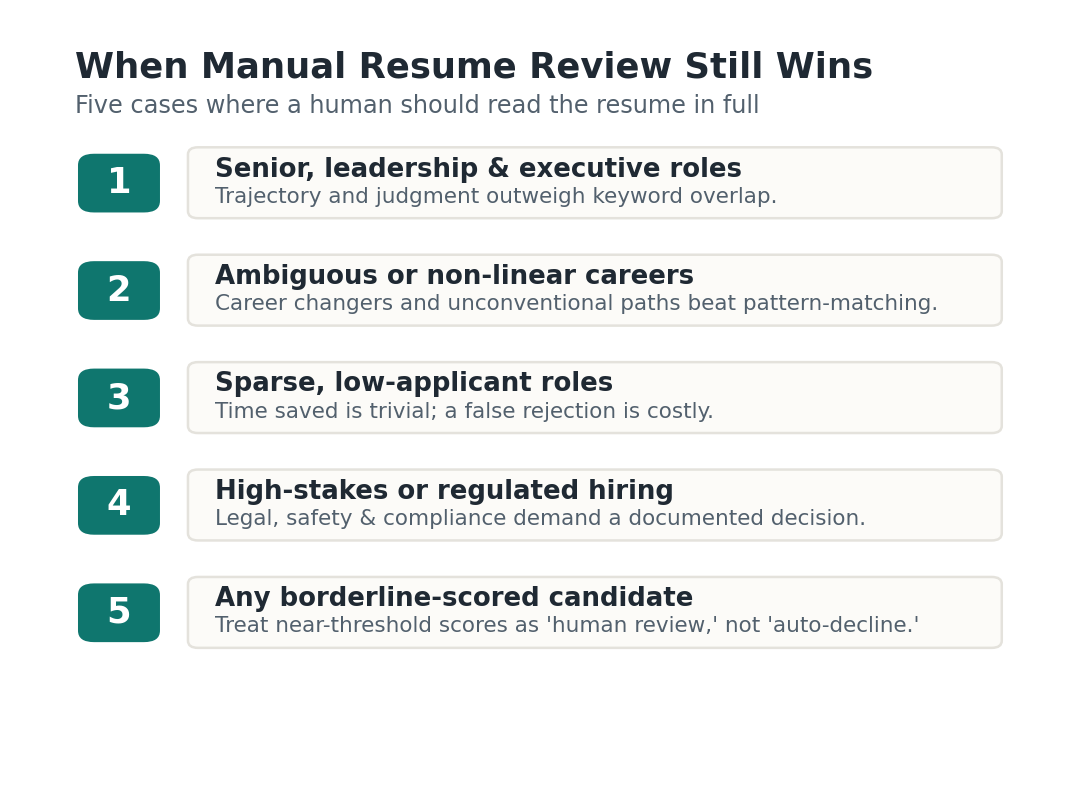
Automation is a scalpel, not a replacement. Use this five-step framework to decide when a human still has to read the resume in full:
- Senior, leadership, or executive roles. Above roughly the manager level, trajectory and judgment outweigh keyword overlap. Use AI to organize the pool, then review every finalist’s resume by hand.
- Ambiguous or non-linear careers. Career changers, portfolio careers, returnships, and unconventional paths are exactly where pattern-matching underperforms and human context wins.
- Sparse or low-applicant roles. When a niche role draws 15 applicants, the time saved by automation is trivial and the cost of a false rejection is high. Read them all.
- High-stakes or regulated hiring. Roles with legal, safety, or compliance weight demand a documented human decision, not an automated cutoff especially under bias-audit regimes like NYC Local Law 144 or the EU AI Act.
- Any candidate the model flags as borderline. Treat scores near your threshold as “human review required,” not “auto-decline.” This is where AI resumes screening and human judgment compounds instead of competing.
Case Study: Resumes Screened Per Hour, With and Without AI
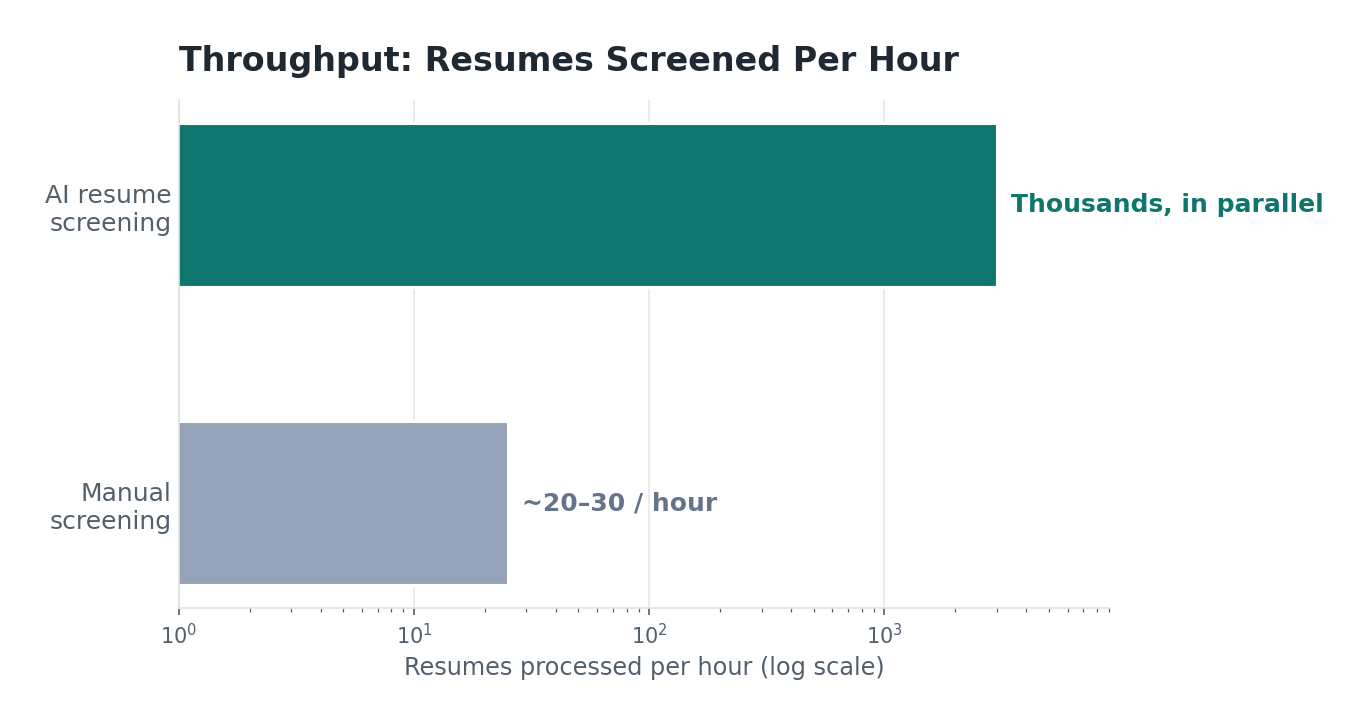
Consider a 12-person staffing team hiring for a high-volume support role that drew 600 applicants in a week. Working manually, each recruiter cleared roughly 20 to 30 resumes per hour at a usable triage quality meaning the full pool consumed about 25 recruiter-hours before shortlisting even began. With AI resume screening, handling , parsing and ranking, the same 600 resumes produced a scored shortlist in under 20 minutes, and recruiters spent their time reviewing the top 40 candidates instead of all 600.
The team cut screening effort by more than 10 hours on that single role and filled it four days faster. Crucially, they did not skip human review, they concentrated it on the 40 candidates most likely to matter, which is where recruiter judgment earns its keep.
A second pattern shows up at the SMB level. A 40-person startup running its hiring on one founder-led ATS replaced spreadsheet tracking with automated workflows and centralized candidate records after migrating to a platform like Hirium. The measurable change was not just speed: by reusing past applicants from a searchable database, the team filled its next two roles partly from candidates already screened, cutting sourcing time and lowering cost-per-hire while keeping a human on every final decision. Their time-to-hire dropped, but the more durable gain was institutional memory: every role they fill now makes the next one cheaper to source.
The throughput gap is the headline, but the reusable database is the quieter compounding win. Manual screening produces a decision and discards the context; AI-assisted screening produces a decision and keeps the structured data, so every future role starts ahead. A team that has run AI resume screening across a year of hiring is not just faster per role, it owns a growing, searchable asset that manual processes never accumulate.
Comparison: AI Resume Screening vs Manual Screening in 2026
The honest comparison weighs time and cost against accuracy and fairness, because optimizing only for speed is how teams ship biased or sloppy decisions at scale.
| Dimension | Manual Screening | AI Resume Screening |
| Time per 200 resumes | 10–15 hours of reading, plus 2–6 hours admin | Minutes to a ranked shortlist; review focused on top candidates |
| Effective throughput | ~20–30 resumes/hour at usable quality | Thousands parsed and scored in parallel |
| Cost impact | High recruiter hours per hire | Reported 20–40% lower cost-per-hire when screening is automated |
| Consistency | Drifts with fatigue and reviewer; the 200th resume gets less than the 2nd | Same criteria applied uniformly to every applicant |
| Bias profile | Human bias, inconsistent and undocumented | Scalable bias if trained on skewed data; auditable and correctable |
On screening accuracy, the nuance matters. AI applies identical structured screening criteria to every candidate, which removes the fatigue-driven inconsistency of a human on resume number 200. But it can also scale bias: studies have found that some models favored certain name groups far more often than others when demographic signals leaked into the data.
The fix is not “trust the human” or “trust the machine”; it is redacting identifying details, auditing outcomes for adverse impact, and keeping a documented human decision on consequential calls.
It helps to separate two kinds of accuracy. Precisionhow many shortlisted candidates are genuinely strong is where well-configured AI resume screening tends to match or beat a rushed human, because it never tires and never lowers its bar on the last batch. Recall how many strong candidates it surfaces rather than misses is more fragile, and it degrades fastest on exactly the non-linear careers and senior profiles the five-step framework flags for manual review. A keyword filter has poor recall by design; context-aware screening improves it but does not perfect it. This is why the auto-reject setting is so dangerous: it converts every recall failure into a permanent, invisible rejection, whereas a ranked list converts the same miss into a candidate sitting lower in a queue a human can still scan.
The decision rule is simple. For high-volume, well-defined roles, AI resume screening wins on time, cost, and consistency, and it does so without contest. For low-volume, senior, or judgment-heavy roles, manual review remains the better instrument. Most teams need both, sequencedAI to organize and surface, humans to decide.
The mistake is framing it as a binary. The 2026 question is not “AI resume screening or manual screening” but “which step belongs to which.” Let automation own the parsing, ranking, deduplication, and status updates of the parts that are repetitive, high-volume, and rule-bound. Reserve human attention for the parts that are contextual, consequential, and relational. Teams that draw that line deliberately recover the most time without trading away the judgment that determines whether a fast hire is also a good one.
What Most Teams Get Wrong
The most common failure is buying speed and skipping calibration. Teams switch on AI resume screening, accept the default scoring, and never feed it which of its shortlisted candidates actually performed in interviews. A model that never learns from your outcomes is just a faster version of someone else’s assumptions, and no amount of AI resume screening sophistication compensates for criteria you never tuned to your own roles.
The second mistake is treating the score as a verdict instead of a ranking. The score’s job is to decide the reading order, not to make the hiring decision. Configuring the tool to auto-reject below a threshold is where teams quietly lose qualified people and acquire legal risk. The time saved is real, but it is borrowed against future bad hires and possible audit findings.
A third, subtler error: optimizing the screen while ignoring the funnel around it. Shaving eight hours off resume review means little if candidates then wait nine days for a first interview because scheduling and status updates are still manual. The compounding wins come from pairing screening with hiring workflow automation and clean Candidate Database management, so a faster shortlist actually translates into a faster offer.
Finally, teams over-index on the parser and under-invest in candidate experience. The same automation that ranks resumes should be closing the loop with applicants, respectful status updates because the cost of a silent rejection is a damaged employer brand that makes the next role harder to fill.
There is one more trap worth naming, because it is the most expensive and the least obvious: measuring the wrong success metric. Teams celebrate a faster shortlist and declare victory, but speed-to-shortlist is a vanity metric if quality-of-hire holds flat or drops. The screen exists to improve who you hire, not just how fast you sort. The teams getting real returns from AI resume screening track downstream signals, offer-acceptance rates, 90-day retention, hiring-manager satisfaction with shortlisted candidates and feed those outcomes back into their criteria. Without that loop, you have automated the production of a shortlist nobody has verified is actually better than the one a careful recruiter would have built.
Pressure-Test Your Screening Before You Commit
If you are weighing AI resume screening against your current manual process, run the comparison on your own numbers before signing with any vendor: count your real hours per 200 resumes, your cost-per-hire, and how many strong candidates currently fall below the fortieth applicant. Then test a real pool against an automated shortlist and check whether the ranked candidates match the ones your recruiters would have chosen by hand.
Hirium offers a forever-free plan with no credit card and no per-recruiter fees, plus supported migration from tools like Zoho Recruit, so you can benchmark AI resume screening on your live pipeline without budget risk. Start a free trial, screen your next role both ways, and let the time-to-hire numbers settle the question.
Frequently Asked Questions
Is AI resume screening better than manual screening?
Neither is universally better; they solve different problems. AI resume screening is decisively better for high-volume, well-defined roles where it delivers ranked shortlists in minutes with consistent criteria. Manual review wins for senior, niche, or non-linear roles where human judgment outperforms pattern-matching. The strongest 2026 setups sequence both automation to organize the pool, humans to decide the finalists.
How much time does AI resume screening save recruiters?
On high-volume roles, teams routinely recover more than 10 hours per position, since a 200-applicant pool that took 10 to 15 hours of reading collapses into a ranked shortlist generated in minutes. Broader workload studies put the gain near one full workday per week. Savings shrink on low-applicant roles, where automation’s overhead outweighs the benefit.
How accurate is AI resume screening compared to a human?
On structured, skills-based criteria, AI resume screening is more consistent than a fatigued human applying judgment across hundreds of resumes, because it scores every applicant against the same definition. Its weakness is context: unconventional careers and senior roles still favor human reading. Accuracy depends heavily on clean parsing and well-defined criteria, so a poorly configured tool can underperform a careful recruiter.
Does AI resume screening reduce hiring bias?
It can, and it can also amplify biasboth are true. Applied to structured criteria with identifying details redacted, it removes inconsistent human bias and applies one standard to everyone. But models trained on skewed historical data can scale discrimination, which is why bias audits, adverse-impact monitoring, and a human decision on consequential hires are essential rather than optional.
Can AI resume screening replace recruiters entirely?
No, and treating it that way is the failure mode. It replaces the repetitive triage that consumes recruiter hours, not the judgment, relationship-building, and final decisions that determine hire quality. The recovered time is meant to be redirected into candidate engagement and assessment which is exactly where most teams that adopt it report reinvesting it.
How many resumes can AI screen per hour?
Effectively, the limit is the system’s processing capacity, not a human attention span. Thousands of resumes can be parsed and scored in parallel within minutes, where a recruiter manages 20 to 30 per hour at usable triage quality. The practical takeaway is not the raw number but the reallocation: instead of reading 200 resumes, a recruiter reviews the 30 to 40 the system ranked highest, which is where human judgment delivers the most value.
What should startups look for in AI resume screening software?
Prioritize transparent, auditable scoring with AI Candidate Insights you can verify, accurate parsing across messy formats, and tight integration with workflow automation and a centralized database so the time saved in screening is not lost again in admin. For early-stage teams, flat or free pricing without per-recruiter fees and supported migration from your existing ATS reduce the cost of switching to near zero.