Candidate Profile Management for Remote Teams: Keeping Hiring Managers in Sync
Nearly six in ten recruiters say their hiring managers take two or more working days just to debrief after an interview. When your panel is scattered across four time zones, that lag does not stay at two days. It consists of a delayed scorecard here, an unread comment there, a decision that waits for a call nobody scheduled until the strongest candidate has already signed elsewhere.
Candidate Profile Management for Remote Teams is the discipline that closes that gap. It is not a nicer inbox or a shared spreadsheet with more tabs. It is the operating layer that lets a distributed panel evaluate the same person, from the same evidence, without ever being online at the same moment. Get it right and time-to-hire tightens even as your team spreads out. Get it wrong and every open role becomes a slow leak of good applicants.
Gartner names AI and cost pressure as the two forces reshaping talent acquisition in 2026 with high-volume recruiting going AI-first and emerging tools such as interview intelligence and recruiter AI agents entering the workflow. Gartner also predicts that by 2027, 75% of hiring processes will include certifications and tests for workplace AI proficiency, and that by 2030 half of enterprises will face irreversible skill shortages in critical roles.
Those numbers were collected before remote hiring became the default for most startups and SMBs. Layer in asynchronous work, and the friction multiplies which is why Candidate Profile Management for Remote Teams has moved from a nice-to-have to a core operating requirement. This guide breaks down where distributed hiring actually breaks, how shared profiles and async feedback fix it, and a checklist your team can adopt this week.
What Is Candidate Profile Management for Remote Teams?
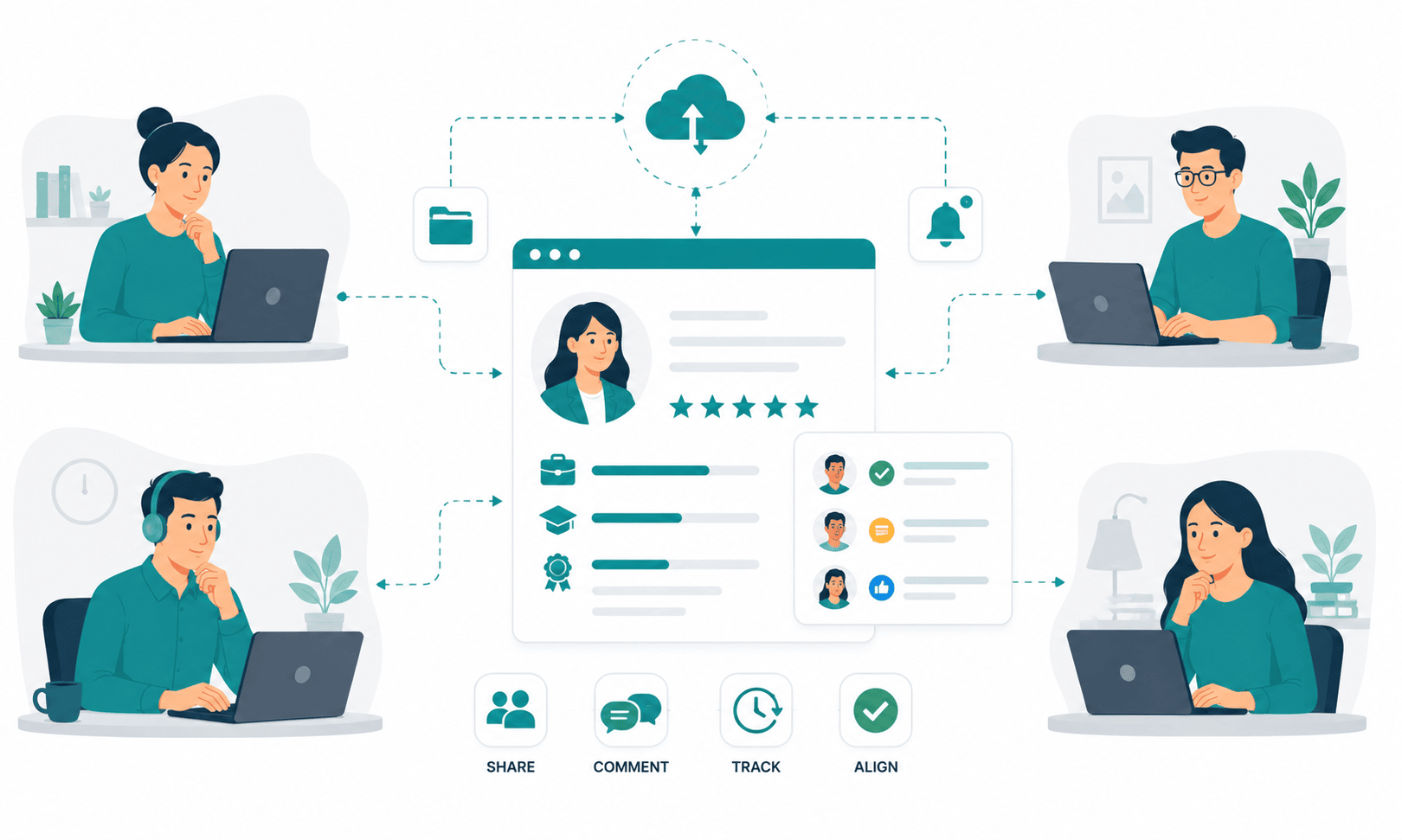
Candidate Profile Management for Remote Teams is the practice of maintaining one authoritative, continuously updated record for every applicant resume, notes, interview scorecards, and status inside a shared system so a distributed panel can evaluate, comment, and decide asynchronously without duplicate versions or lost context.
That definition matters because most teams think they already do this. They do not. A resume in a Slack thread, a scorecard in a Google Doc, and a “yes/no” in someone’s DMs are three fragments of one candidate and no single person can see all three at once. Effective Candidate Profile Management for Remote Teams collapses those fragments into one record that every stakeholder reads from.
Why Remote Hiring Breaks Down: The Real Collaboration Challenge
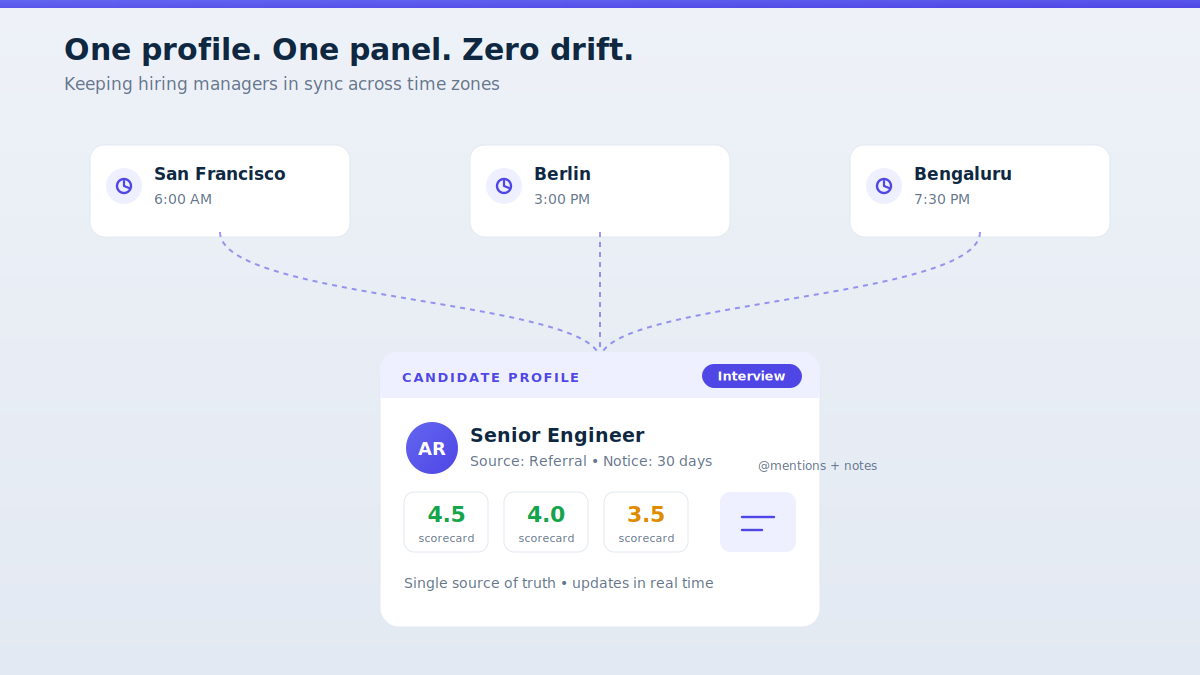
The core problem is not that remote hiring managers are slow. It is that they are working from different fragments of the same conversation. A recruiter screens a candidate, forms an impression, and passes along a summary. The hiring manager reads a resume out of context. A panelist runs an interview but records nothing structured. Each holds a partial picture, and the picture never assembles in one place.
Distance turns small delays into structural ones. When a panel shares an office, a stalled decision gets resolved by a hallway conversation. Remote, that hallway does not exist so a missing scorecard blocks the pipeline for days, not minutes.
The math is unforgiving. Time-to-hire now runs roughly 44 days globally and stretches past 60 days from job posting to accepted offer in several sector benchmarks. SHRM’s 2025 talent research found that around 69% of organizations struggle to recruit for full-time roles, and misalignment between recruiters and hiring managers is a recurring driver. Meanwhile, 26% of candidates walk away from offers because of poor communication during the process, exactly the failure mode a distributed panel is most prone to.
Three visibility gaps show up again and again in distributed hiring teams:
- Feedback latency. No shared deadline means feedback arrives whenever each manager gets to it often after the candidate has cooled or accepted elsewhere.
- Version drift. Notes live in personal docs, so nobody trusts they are looking at the current record.
- Silent duplication. The same applicant enters the funnel through two channels and gets screened twice, wasting hours and creating conflicting statuses.
Harvard Business Review research has found that roughly 38% of managers consider team collaboration harder to sustain remotely. Hiring is collaboration under a deadline, so it feels the strain first. The fix is not more meetings, it is a system where the record does the coordinating.
There is a cost line under all of this that most teams never total up. An open engineering or sales role does not sit at zero while the panel deliberates it carries a real carrying cost in lost output, overloaded teammates, and stalled roadmaps.
When a distributed panel adds a week of avoidable feedback latency to a role that was already running 44-plus days, that week is pure waste, and it repeats on every requisition. Strong Candidate Profile Management for Remote Teams is, in plain financial terms, a way to stop paying that recurring tax.
It also protects something harder to measure: candidate goodwill. A remote candidate experiences your hiring process entirely through its responsiveness. Silence between stages reads as disinterest, and disinterest gets reciprocated. The panels that keep candidates warm are almost always the ones whose internal record keeps the panel itself in sync.
Building Candidate Database Management That Survives Distance
Candidate Database Management is where remote hiring is won or lost. The goal is a single centralized candidate database that behaves as the source of truth: every profile, every comment, every status change in one place, visible to everyone with permission, updating in real time. Everything below is a decision about how to make that record trustworthy across time zones.
Before choosing tools, settle the architecture. A durable setup for Candidate Profile Management for Remote Teams rests on four pillars: one canonical profile per candidate, structured evaluation instead of freeform opinion, asynchronous-by-default communication, and role-based access that protects data without slowing the panel down.
Shared Candidate Profile Views and Comment Threads
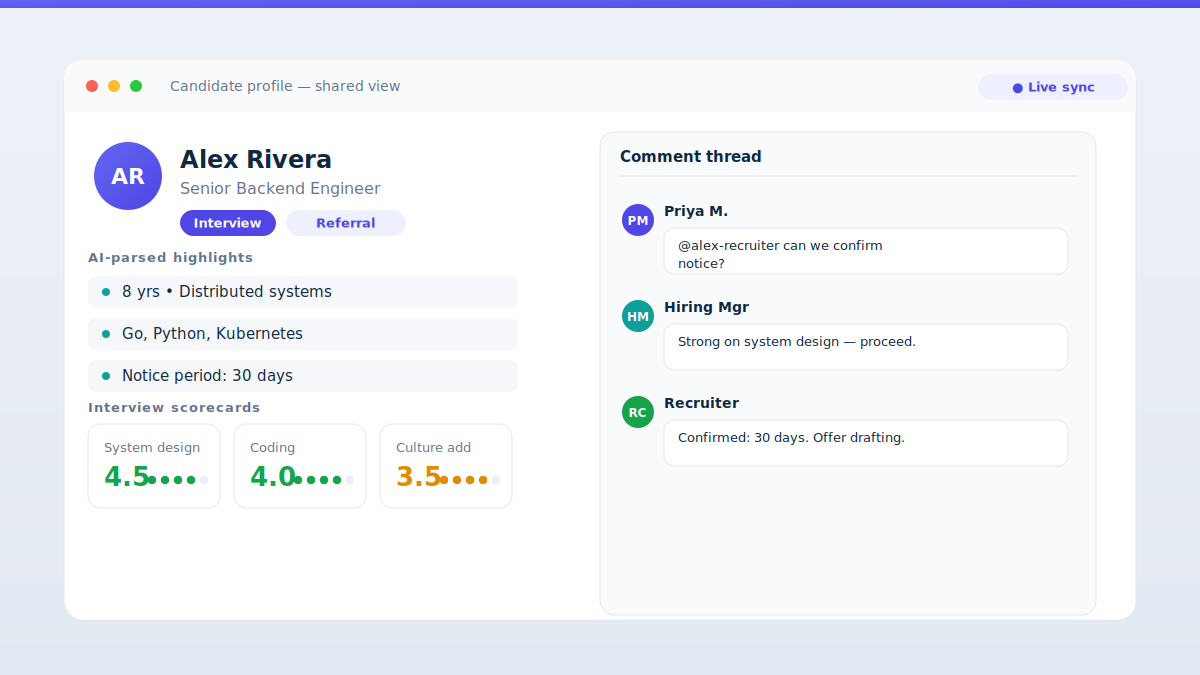
Shared candidate profiles replace the forwarded resume. Instead of emailing a PDF, the recruiter points the panel to one profile that carries the resume, parsed highlights, screening notes, and every scorecard. Anyone added to the loop sees the complete history instantly.
Comment threads live on the profile itself, not in private chats. When a hiring manager @mentions a recruiter with a question about a candidate’s notice period, the exchange stays attached to that candidate forever. Six weeks later, when the same person reapplies for a different role, the context travels with them. This is the practical core of Candidate Profile Management for Remote Teams: the conversation and the evidence occupy the same surface.
One design choice deserves attention: whether panelists can see each other’s scorecards before submitting their own. Allowing it speeds debate but invites anchoring bias, where the first strong opinion pulls the rest of the panel toward it. For distributed teams, the safer default is to hide scores until each evaluator submits, then reveal them side by side.
Async Feedback Workflows for Distributed Hiring Teams
Asynchronous feedback is not “feedback, but later.” It is a structured commitment that removes the need for everyone to be online together. Each interviewer scores the candidate against the same pre-agreed criteria after their session, and the system collects those scorecards and displays them together surfacing consensus and disagreement so the panel decides on evidence rather than on whoever speaks loudest.
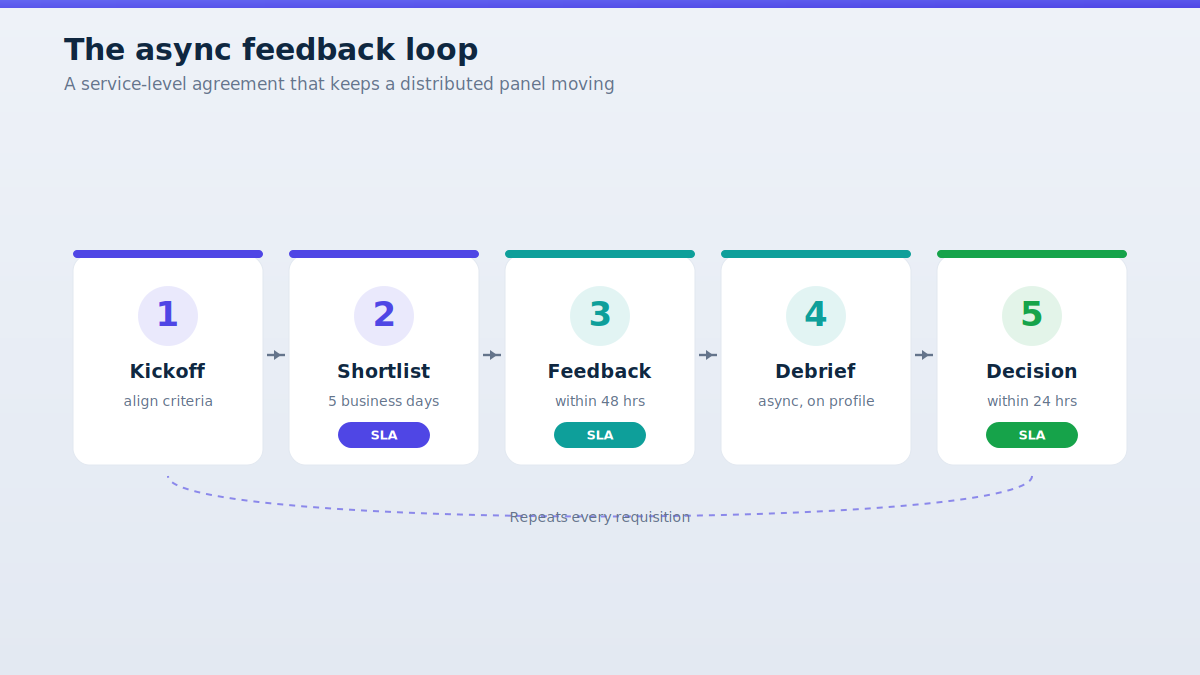
The mechanism that makes async work is the service-level agreement. In Candidate Profile Management for Remote Teams, a simple mutual SLA turns vague good intentions into a rhythm the whole team can trust:
- Kickoff alignment. Recruiter and hiring manager agree on must-have criteria and the scorecard before sourcing begins.
- Shortlist submission. Recruiter presents scored candidates on shared profiles within an agreed window commonly five business days.
- Structured feedback. Each panelist submits a scorecard within 48 hours of their interview, scoring 1–5 against the pre-set criteria, never a bare “not a fit.”
- Async debrief. Scores unlock for comparison; disagreements are resolved in a threaded discussion on the profile, not a synchronous meeting.
- Decision. A named decision-owner records the outcome within 24 hours of the final interview, and the status updates automatically for everyone.
That five-step loop is the difference between a panel that drifts and one that moves. It also gives you a clean answer to how to manage candidate profiles across time zones: you stop trying to synchronize calendars and start synchronizing the record.
Choosing Recruitment Status Update Software
Recruitment Status Update Software solves the “where does this candidate stand?” question that eats remote teams alive. When a candidate moves from screening to interview to offer, that change should propagate to every stakeholder automatically with no status ping, no “just checking in” message. Real-time candidate tracking means a hiring manager in Bengaluru and a recruiter in Berlin always see the same stage for the same person.
The buying criterion is not feature count. It is whether status is a shared fact or a private note. If a status change requires someone to remember to tell someone else, the software has already failed the remote test and Candidate Profile Management for Remote Teams lives or dies on that single distinction.
Using AI Candidate Insights to Cut Review Time
AI Candidate Insights attack the 67% figure of the resume reviews that stall for two-plus days. AI resume parsing extracts and standardizes the details a manager actually needs, and AI shortlisting surfaces the strongest matches against the role criteria so the panel spends its limited attention on the top of the pile rather than the whole stack.
Used well, these insights are a first-pass filter, not a verdict. They compress the busywork that causes latency while leaving judgment with the humans. For a distributed panel drowning in application volume, many postings now draw 100-plus applicants and compression is often the single biggest lever on time-to-hire.
Workflow Automation Software That Removes Manual Chasing
Workflow Automation Software is what keeps the async loop honest. Automated status updates, reminder nudges when a scorecard is overdue, and auto-emails to candidates at each stage remove the manual chasing that quietly consumes recruiter hours. Roughly 35% of recruiter time can disappear into scheduling and follow-up alone; automation reclaims most of it.
This is where a purpose-built applicant tracking system earns its place over a patchwork of docs and chat apps. A modern ATS such as Hirium bundles the shared database, real-time tracking, AI screening, and automated workflows into one record which is the point, because coordination that lives in one system does not need a human to relay it. On integration and cost, favor tools that migrate your existing data for free and price per company rather than per recruiter seat; seat-based pricing quietly punishes the collaboration you are trying to encourage.
A word on compliance and permission controls. A centralized database concentrates candidate personal data, so role-based access, an audit trail of who viewed and changed what, and clear data-retention rules are not optional extras; they are the price of doing distributed hiring responsibly, especially across regions with different privacy regimes.
A remote panel spanning India, the EU, and the US touches three different data expectations at once, and the system of record is where you enforce them consistently rather than hoping each manager remembers the rules.
Integration is the other quiet decision. Candidate Profile Management for Remote Teams only works if the profile is the place the panel already lives so the record needs to connect cleanly to calendars for scheduling, to email for candidate communication, and to your existing career pages so applicants land in the same database from day one. Every disconnected tool is another place the truth can fork.
When you evaluate a platform, count the integrations you will actually rely on, not the length of the marketing list.
Turning Recruitment Analytics Into a Feedback Loop
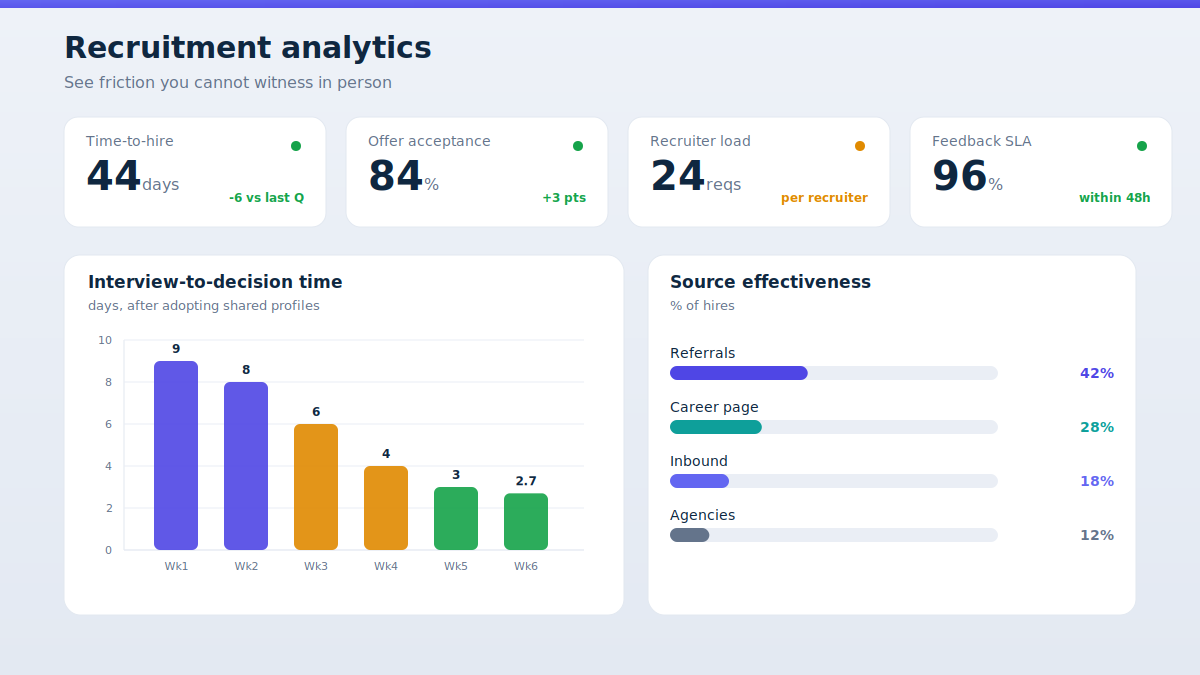
Recruitment analytics is the part remote teams skip and later regret. Because the profile captures every status change and scorecard timestamp, it can tell you exactly where your loop slows: time-to-hire by role, offer-acceptance rate, recruiter load, and which sources produce the candidates who actually advance. For a distributed team, this is the only reliable way to see friction you cannot witness in person.
The practical use is diagnostic. If scorecards consistently arrive late for one hiring manager, the data shows it before it becomes a pattern of lost finalists. If one sourcing channel floods the funnel with mismatches, the source-effectiveness view exposes it. Analytics turns Candidate Profile Management for Remote Teams from a filing habit into a system that improves itself each quarter.
Case Studies: Remote Hiring in Practice
A 40-person fintech startup hiring across three countries replaced its email-and-spreadsheet process with shared profiles and a 48-hour feedback SLA. Interview-to-decision time fell from roughly nine days to under three, and the team stopped losing finalists to faster-moving competitors during the debrief gap.
A high-volume SMB recruiter fielding 100-plus applicants per role added AI parsing and shortlisting on top of a centralized candidate database. First-pass review time per requisition dropped by more than half, and duplicate-candidate incidents where the same person screened twice by different team members effectively disappeared once every applicant resolved to one profile.
A third example runs the other way, a cautionary one. A distributed SaaS team kept its “system” as a shared spreadsheet plus a hiring Slack channel. Two recruiters unknowingly advanced the same senior candidate through different stages; the candidate received conflicting messages, lost confidence, and withdrew. The failure was not an effort. It was the absence of a single profile that both recruiters were bound to update.
Neither of the first two outcomes required a bigger team, and the third would have been prevented by no extra headcount at all. All three point the same direction: mature Candidate Profile Management for Remote Teams comes from making the record, rather than a meeting or a message, the place where hiring managers stay in sync.
Comparison Framework: How to Evaluate Your Setup
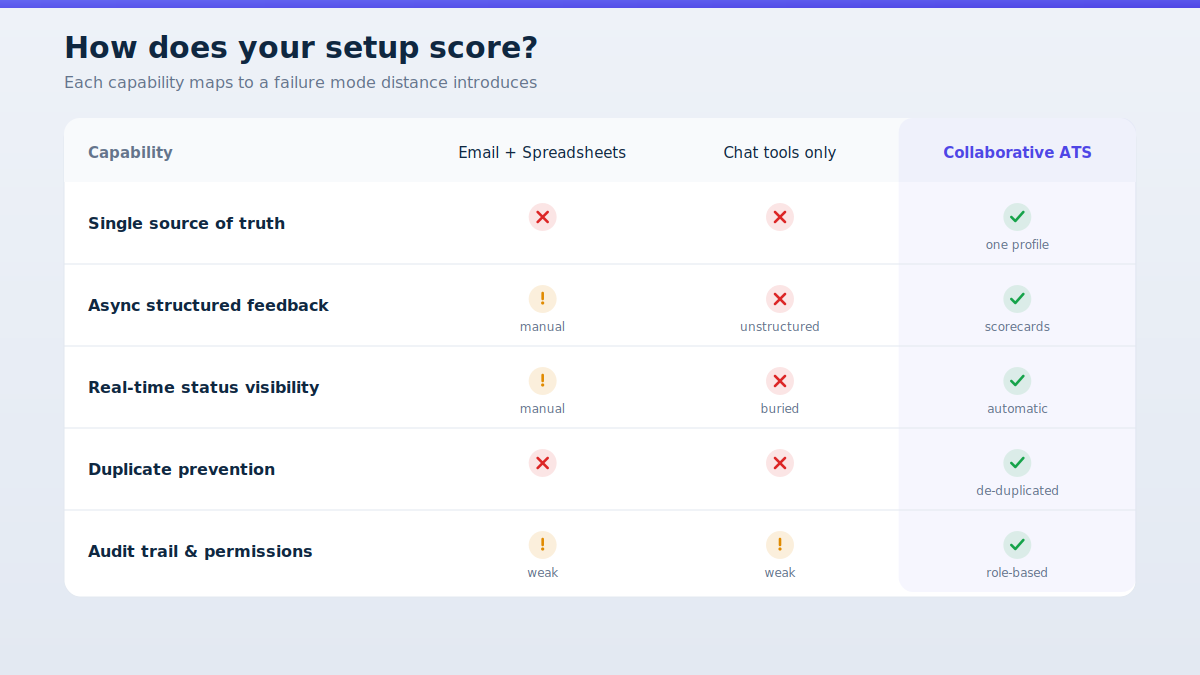
Before committing to a vendor or a workflow, score your current approach honestly against what remote hiring actually demands. The table below is worth using because it maps each failure mode to the capability that fixes it.
| Capability | Email + Spreadsheets | Chat Tools Only | Collaborative ATS |
| Single source of truth | No versions drift | No fragments in threads | Yes one profile per candidate |
| Async structured feedback | Manual, inconsistent | Unstructured | Built-in scorecards |
| Real-time status visibility | Requires manual updates | Buried in messages | Automatic for all |
| Duplicate prevention | None | None | De-duplicated database |
| Audit trail & permissions | Weak | Weak | Role-based, logged |
If your honest answers cluster in the first two columns, your process is not remote-ready; it is co-located hiring performed at a distance, which is exactly the mismatch that stretches time-to-hire. Real Candidate Profile Management for Remote Teams lives in the third column, and every capability there exists to remove one specific failure that distance introduces.
What Most Remote Hiring Teams Get Wrong
The most common mistake is treating async as a downgrade from “real” collaboration, a compromise you tolerate because the team is spread out. That framing is backwards. Well-run asynchronous hiring is often more rigorous than a live debrief, because it forces every evaluator to commit an independent, structured judgment before groupthink sets in. The remote constraint, handled deliberately, produces better decisions.
The second mistake is buying tools to fix a process problem. Teams add another chat channel, another spreadsheet, another integration, and wonder why coordination stays broken. The real fix is upstream: agree on criteria at kickoff, commit to a feedback SLA, and make one profile the source of truth. Software should enforce that agreement, not substitute for it.
The third and quietest mistake is confusing activity with progress. A busy hiring channel feels like momentum. But messages are not decisions, and a thread full of opinions is not a scored panel. The teams that win at Candidate Profile Management for Remote Teams measure the loop: how long from interview to submitted scorecard, from scorecard to decision, from decision to offer. What gets measured on the record gets faster; what lives in chat stays slow.
A fourth pattern shows up in fast-growing startups specifically: over-inviting the panel. When five people weigh in on every candidate to “get buy-in,” each added voice adds latency, and consensus becomes the bottleneck. Distributed hiring works best with a tight panel, clear scoring, and one accountable decision-owner not a committee that debates asynchronously and forever. Wide input feels inclusive; it usually just means the strongest candidate waits longer while your competitor moves.
A Collaboration Checklist for Distributed Hiring Teams
Use this sample collaboration checklist for remote hiring teams as a starting operating standard for Candidate Profile Management for Remote Teams. Adapt the timings to your roles, but keep the structure every item removes a specific way distributed panels fall out of sync.
- One profile per candidate. Every applicant resolves to a single record; no forwarded resumes, no side documents.
- Criteria agreed at kickoff. Must-haves and scorecard defined before sourcing starts, so nobody evaluates against a moving target.
- Feedback SLA in writing. Scorecards due within 48 hours of each interview; decision within 24 hours of the final round.
- Scores hidden until submitted. Reveal side by side only after each evaluator commits, to blunt anchoring bias.
- Comments on the profile, not in DMs. All discussion attaches to the candidate and persists.
- Status changes automated. Stage moves propagate to every stakeholder without a manual ping.
- A named decision-owner per role. One person accountable for recording the outcome and unblocking the loop.
- Access and audit reviewed quarterly. Permissions match current roles; the audit trail is checked; stale data is retired per policy.
Print it, pin it to the requisition, and treat it as the definition of “done” for how your team collaborates, not as advice.
Where to Take This Next
If you are evaluating Candidate Profile Management for Remote Teams and want to close the feedback-latency gap before your next hiring sprint, start by scoring your current process against the checklist above then fix the single worst bottleneck first, usually the missing feedback SLA or the absence of one source of truth. Most distributed teams recover several days of time-to-hire from that one change alone.
Hirium runs this model for 5,000+ startups and SMBs, one centralized database, real-time tracking, AI screening, and automated workflows on a forever-free plan with no per-recruiter fees. If you want to see how your remote hiring loop would look on a single shared record, put one open role through it and compare the timeline. That is a lower-risk way to test the approach than rebuilding your whole stack up front.
Frequently Asked Questions
What is candidate profile management?
It is the practice of keeping one authoritative, continuously updated record for each applicant’s resume, notes, scorecards, and current status in a shared system. For distributed teams it becomes the coordination layer: the record everyone evaluates from, so no hiring manager works off a stale or partial version of the candidate.
How do remote teams keep hiring managers in sync?
By making the profile, not the meeting, the point of synchronization. Shared candidate profiles hold all context, comment threads keep discussion attached to the candidate, and automated status updates broadcast every stage change. A written feedback SLA scorecard within 48 hours ensures the panel moves at one pace even across time zones.
What is the best software for managing candidate profiles?
The best tool for Candidate Profile Management for Remote Teams is a collaborative applicant tracking system that gives you a centralized database, real-time status tracking, structured scorecards, and workflow automation in one place. Prioritize company-based over seat-based pricing, free data migration, and strong permission and audit controls. Feature count matters less than whether status is a shared fact.
How do you give interview feedback asynchronously?
Each interviewer scores the candidate against pre-agreed criteria on a 1–5 scorecard immediately after their session, without seeing others’ scores first. The system collects and displays scorecards side by side, and disagreements are resolved in a threaded discussion on the profile. This produces more independent, less biased judgments than a live debrief.
How do you avoid duplicate candidate records across a distributed team?
Use a single centralized candidate database that de-duplicates on entry, matching new applications against existing profiles by email and other identifiers. When every channel funnels into one record, the same person cannot be screened twice by different team members, the most common source of conflicting statuses and wasted review hours in remote hiring.
What should a remote hiring collaboration checklist include?
At minimum: one profile per candidate, criteria agreed at kickoff, a written feedback SLA, hidden-until-submitted scoring, profile-based comments, automated status changes, a named decision-owner, and a quarterly access and audit review. If you are building this out and want to pressure-test your workflow before committing to tooling, a short review against these items usually reveals the one or two gaps costing you the most time.
How does AI improve candidate management for distributed teams?
AI removes the review latency that distance amplifies. Resume parsing standardizes every application into the same comparable fields, and AI shortlisting ranks candidates against the role criteria so a remote panel starts with the strongest matches instead of the full pile. Some systems add an unbiased first-round screen. The judgment stays human AI simply compresses the busywork that used to stall profiles for days.