
Candidate Profile Management Mistakes That Cost You Top Talent
Recruiters lose strong candidates before an interview is ever scheduled not because of weak job postings, but because of what’s happening inside the database. A candidate who applied six months ago, got tagged “not a fit,” and reapplies for a better-suited role today is often invisible to the very system meant to surface them. Candidate profile management mistakes like this don’t show up in a hiring report. They show up in silence: a strong applicant who never hears back, a recruiter who re-screens someone twice, a hiring manager who asks “didn’t we already talk to this person?”
The scale of the problem is backed by data. According to recruitment statistics and hiring trends report, a growing number of recruiters report that inefficiencies in candidate data management and communication gaps directly impact hiring speed and candidate experience. As application volumes continue to rise in 2026, teams that fail to maintain structured and updated candidate profiles risk losing qualified talent simply due to internal process gaps rather than external competition.
According to SHRM’s 2025 recruiting benchmarking research, the average time-to-fill across organizations now sits at roughly six weeks based on SHRM’s 2025 recruiting executives benchmarking research, which calculated average time-to-fill at approximately six weeks. A large share of that delay isn’t sourcing its recruiters re-doing work that a clean, well-tagged candidate database would have already answered. When candidate data is fragmented, every recruiter on the team pays the same tax: repeated screening, duplicated outreach, and lost trust with candidates who feel forgotten.
This piece breaks down the seven most common candidate profile management mistakes, the real cost each one creates, and a short audit checklist recruiters can run today with no new tooling required to start.
What Is Candidate Profile Management?
Candidate profile management is the ongoing practice of creating, updating, tagging, and maintaining accurate candidate records inside a recruiting system so that recruiters can find, evaluate, and re-engage applicants without duplicated effort. It covers data entry standards, consent tracking, activity history, and status accuracy across the entire candidate lifecycle not just at the point of application.
Done well, it turns a recruiting database into a searchable, trustworthy asset. Done poorly, it becomes a graveyard of stale, duplicated, and untraceable records that actively works against the recruiter using it.
The Core Problem: Your Database Is Quietly Losing You Candidates
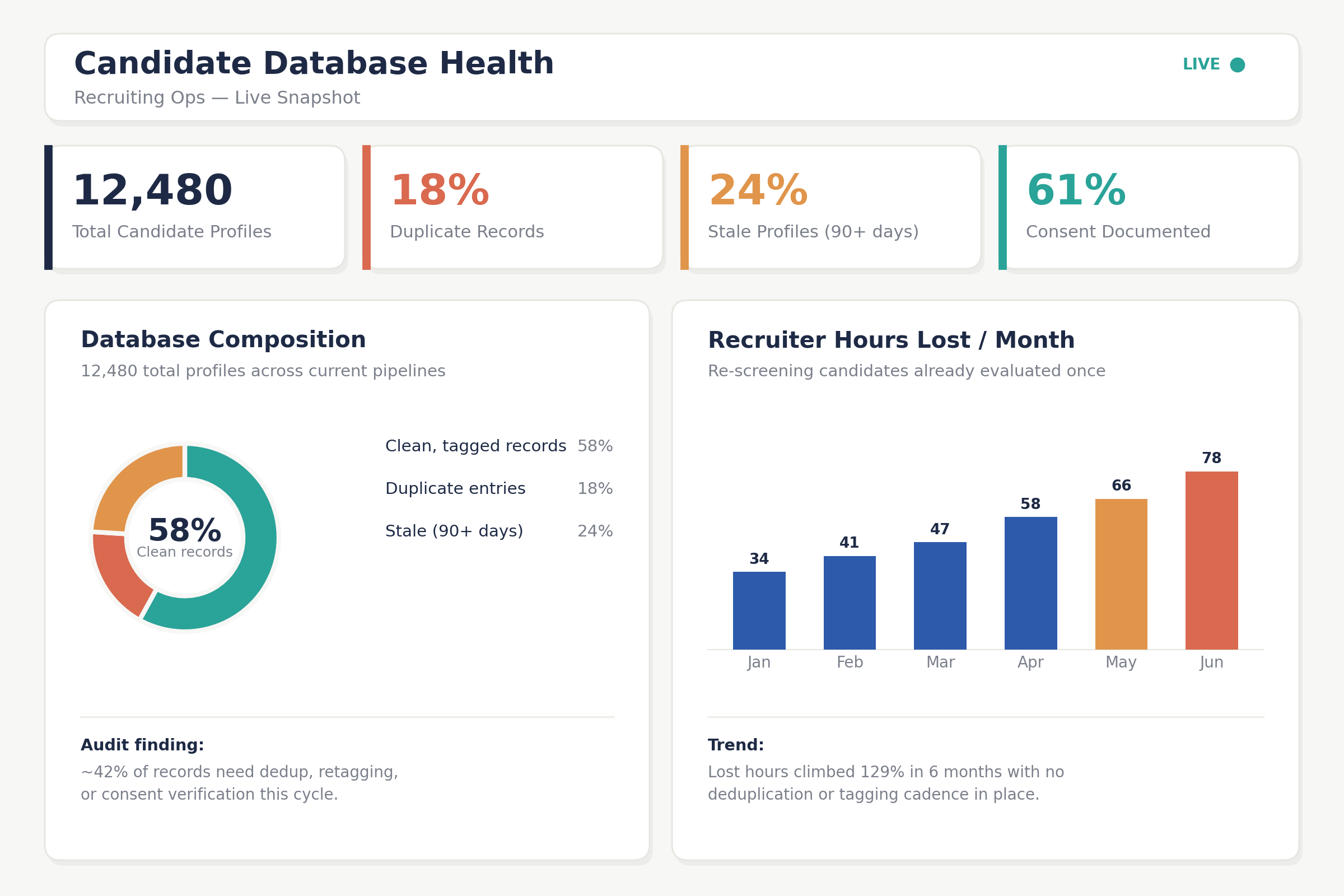
Most hiring teams treat the candidate database as a filing cabinet where resumes go after a role closes. That mental model is the root problem. A candidate database management system that isn’t actively maintained degrades fast, and most teams underestimate how fast by 3–4x.
Consider the arithmetic. A startup running 15 open roles a quarter, each attracting 100–150 applicants, adds 1,500–2,250 new candidate touchpoints every 90 days. Without active tagging and deduplication, industry data suggests 15–20% of records in a mid-sized ATS become duplicates or stale entries within a single hiring cycle. That’s not a rounding error, it’s hundreds of candidates a recruiter can no longer trust.
The downstream effects are specific:
- Recruiters re-screen candidates already evaluated, adding 20–30 minutes of redundant work per repeat candidate.
- Hiring managers lose confidence in the shortlist because “already rejected” candidates resurface.
- Compliance exposure grows when there’s no record of what a candidate consented to, or for how long their data can legally be retained.
- Silver-medalist candidates strong applicants who lost out narrowly for a previous role become permanently invisible instead of being fast-tracked for the next opening.
None of this is a sourcing failure. It’s a maintenance failure, and it compounds every quarter it’s left unaddressed.
There’s also a cost dimension teams rarely calculate directly. If a recruiter spends even 90 minutes a week re-screening candidates who were already evaluated, that’s roughly 78 hours a year per recruiter; nearly two full work weeks spent redoing work a clean candidate database management process would have eliminated. Multiply that across a five-person recruiting team, and the annual cost of poor data hygiene starts to rival the cost of a full-time hire.
Sourcing budgets get scrutinized constantly. Database maintenance rarely does, even though it’s often the cheaper fix with the faster payback.
The 7 Candidate Profile Management Mistakes Costing You Talent
This is the section worth bookmarking. Each mistake below is common, quietly expensive, and fixable without a system overhaul.
1. Duplicate Candidate Entries
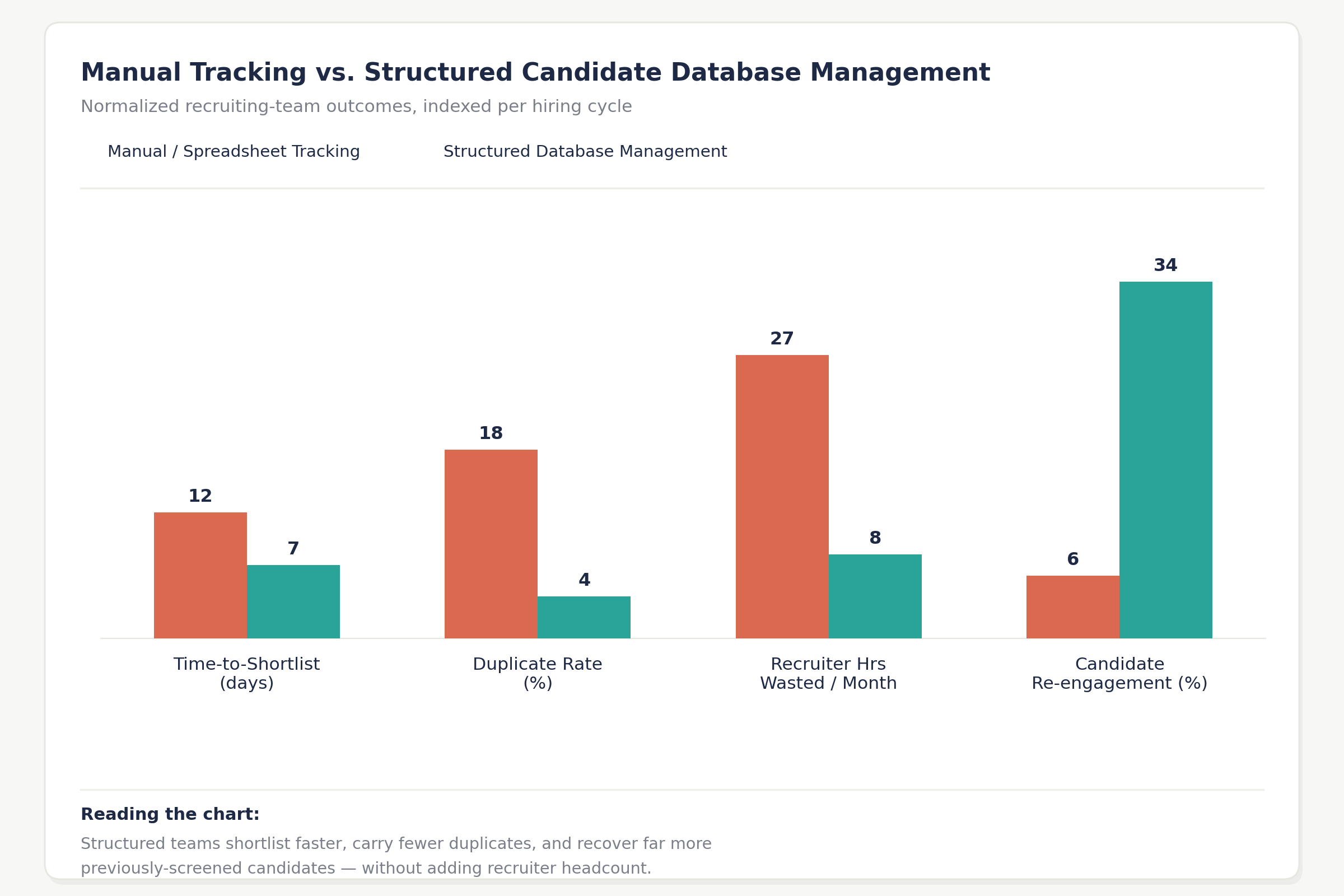
A candidate applies through the careers page, gets referred by an employee, and later reapplies via a job board creating three separate records with three different histories. Nobody owns the “true” profile.
Real consequence: Recruiters contact the same person twice with conflicting messages, or reject one duplicate while the other sits untouched in a pipeline. Candidate experience takes a direct hit; nothing signals disorganization faster than a duplicate rejection email after an interview.
This mistake compounds quietly because each duplicate record accumulates its own partial history. One version might show an interview note, another might show only the original application and neither reflects the full picture a hiring decision actually needs.
2. Outdated Notes and Stale Status Tags
Interview notes from eight months ago still show the candidate’s “current status.” A recruiter reads “not ready needs more experience” without realizing the candidate has since taken a senior role elsewhere.
Real consequence: Good candidates get filtered out based on information that’s no longer true. Teams lose access to candidates who were rejected on timing, not fit the most re-hireable segment in the entire database.
This is one of the most reversible mistakes on this list, because the data usually already exists somewhere. The failure is that nobody revisits or timestamps it, so a six-month-old assessment quietly gets treated as current.
3. No Tagging or Segmentation
Candidates are stored, but never categorized by skill, seniority, past-stage-reached, or source. Searching the database becomes a keyword guessing game instead of a structured filter.
Real consequence: Sourcing effectively restarts from zero for every new role, even when a perfect-fit candidate already exists three clicks away. Recruiter time that should go toward outreach goes toward manual searching instead.
Without a shared tagging standard, the same candidate might be labeled “backend engineer” by one recruiter and “senior developer, Python” by another making both records effectively unsearchable to anyone but the recruiter who created them.
4. Missing Consent Records
A candidate’s resume and contact details sit in the system indefinitely with no record of what they agreed to whether their data can be shared with other departments, stored beyond a specific period, or used for future roles.
Real consequence: This is the mistake with the sharpest legal exposure. Under frameworks like GDPR and similar state-level data protection laws, recruiters are expected to demonstrate a documented, timestamped consent basis for holding personal data. Without it, a single audit or candidate complaint can turn into a compliance investigation.
The exposure isn’t theoretical. If a candidate requests their data be deleted and the company can’t confirm what was collected, when, or under what terms, the response time alone can breach regulatory requirements. Teams that treat consent as a checkbox at signup rather than a structured, queryable field usually discover the gap only when a candidate or regulator asks a direct question they can’t answer quickly.
5. No Activity History or Audit Trail
There’s no visible record of who contacted the candidate, when, what was said, or what the outcome was. Every recruiter starts from a blank slate on every touchpoint.
Real consequence: Handoffs between recruiters break down. A candidate who already declined an offer six months ago might get approached again with the same pitch, an easily avoidable, entirely preventable error that damages the employer brand.
It also makes performance conversations harder internally. Without a logged history, it’s difficult to tell whether a slow pipeline is a sourcing problem, a screening bottleneck, or simply undocumented recruiter follow-up.
6. Inconsistent or Missing Status Updates
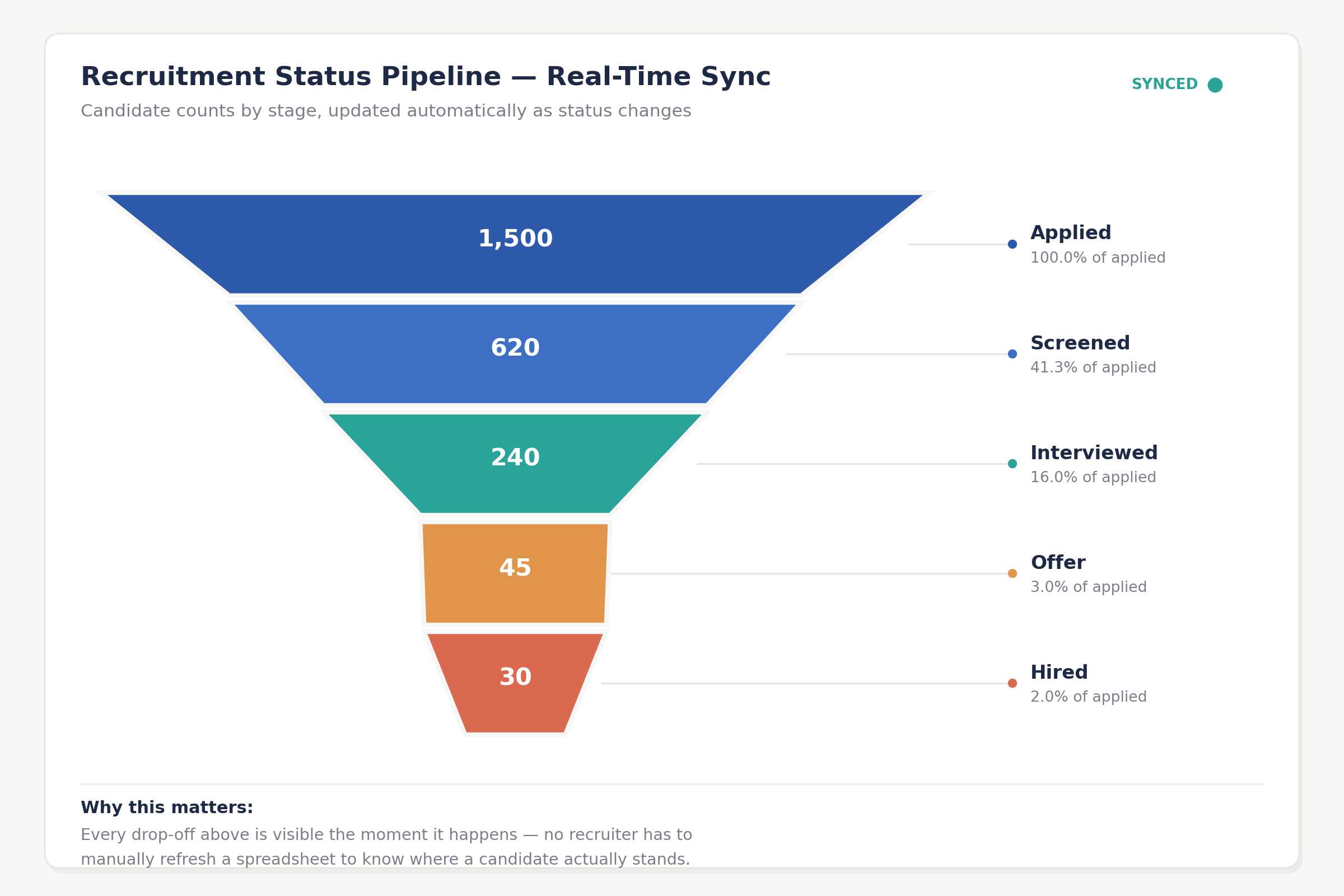
The candidate’s stage in the pipeline screened, interviewed, offer-stage, and rejected isn’t updated in real time. Hiring managers work off stale dashboards, and recruiters manually cross-check spreadsheets to know what’s actually true.
Real consequence: Decision delays stack up. If five people need to independently confirm a candidate’s real status before acting, that’s 5x the coordination overhead on every single hire, a major contributor to the six-week average fill time cited earlier.
This mistake is especially costly at the offer stage. A hiring manager who doesn’t know a candidate has already accepted a competing offer may keep an interview slot open unnecessarily, delaying the whole requisition by days.
7. No Centralized Ownership of Candidate Data
Different recruiters keep private notes in personal spreadsheets, Slack threads, or email folders instead of the shared system. The “real” candidate picture is scattered across five tools that don’t talk to each other.
Real consequence: When a recruiter leaves the team, their candidate context leaves with them. Institutional knowledge about strong past candidates disappears overnight, and the company effectively re-sources talent it already found once.
This mistake tends to surface hardest during team growth or turnover exactly the moments when losing candidate context is most expensive, because there’s no time to rebuild it manually.
Fixing the Foundation: A Practical Process for Clean Candidate Data
Fixing these seven mistakes isn’t a one-time cleanup, it’s a maintenance discipline built into how the recruiting stack is structured. Here’s the practical sequence that holds up across fast-scaling teams.
Step 1: Establish a Single Source of Truth
Every candidate should have exactly one record, in one system, regardless of how they applied. This requires the ATS to run automatic duplicate detection at the point of intake matching on email, phone number, and resume fingerprint rather than relying on recruiters to catch overlaps manually.
Assign clear ownership too. Someone on the team, whether a recruiting coordinator or ops lead, should be accountable for reviewing flagged duplicates weekly, rather than leaving it to whichever recruiter happens to notice first.
Step 2: Standardize Tagging Before Volume Scales
Build a tagging taxonomy (skill, seniority, source, pipeline stage, past-outcome) before the database grows past a few hundred candidates. Retrofitting tags onto thousands of untagged records later is 5–10x more time-consuming than defining the structure early.
Step 3: Automate Consent Capture at the Point of Application
Consent shouldn’t be a policy buried in a PDF. It should be a timestamped, structured data field captured the moment a candidate submits an application including what they consented to and for how long that consent is valid.
Step 4: Turn On Real-Time Status Syncing
Status updates should propagate automatically as a candidate moves through stages, visible to every stakeholder without a manual refresh. This is where recruitment status update software earns its place not as a nice-to-have dashboard, but as the mechanism that keeps five different stakeholders working off the same facts.
The practical test is simple: if a hiring manager can’t answer “where does this candidate stand right now” without messaging the recruiter, the syncing isn’t real-time enough yet.
Step 5: Log Every Touchpoint Automatically
Every email, call note, and interview outcome should attach to the candidate record automatically, not depend on a recruiter remembering to write it down. This builds the audit trail that protects both the candidate experience and the company’s compliance position.
Step 6: Use AI to Surface Patterns Humans Miss
This is where AI candidate insights change the economics of database maintenance. Instead of a recruiter manually re-screening a database of 5,000 candidates to find silver-medalist matches for a new role, AI-driven screening tools can flag previously-evaluated candidates whose skill profile now matches an open requisition surfacing hires that would otherwise require re-sourcing from scratch. The same logic applies to AI resume screening: parsing and structuring resume data consistently at intake prevents half the tagging and duplication problems from ever forming.
Step 7: Schedule Recurring Data Hygiene, Not One-Time Cleanups
Set a recurring cadence monthly for high-volume teams, quarterly for smaller ones to run deduplication checks, archive stale records past their consent window, and re-validate tags against current hiring needs. Database decay is continuous, so the fix has to be too.
Why AI Candidate Insights Change the Maintenance Math
The reason AI candidate insights matter here isn’t novelty, it’s scale. A human recruiter can reasonably tag and review a few hundred profiles a week by hand. A database of 8,000–10,000 candidates makes manual maintenance mathematically impossible to sustain, regardless of team size.
AI-assisted screening changes the unit economics in three specific ways. First, it standardizes resume parsing at intake, so skills, seniority, and location are extracted consistently instead of depending on how each recruiter fills in a field. Second, it can flag likely duplicates automatically by matching on resume content, not just exact email matches, catching the near-duplicates that manual review typically misses. Third, it can re-surface previously screened candidates against new job requirements automatically, turning a static archive into a searchable talent pool that gets more valuable over time instead of less.
The cost implication matters for smaller teams specifically. Building this kind of matching logic in-house is a multi-month engineering investment most startups can’t justify. Adopting it through an existing ATS that already includes AI resume screening as a core feature rather than as an add-on module is usually the more realistic path for teams under 50 employees.
Case Study: What Clean Candidate Data Actually Saves
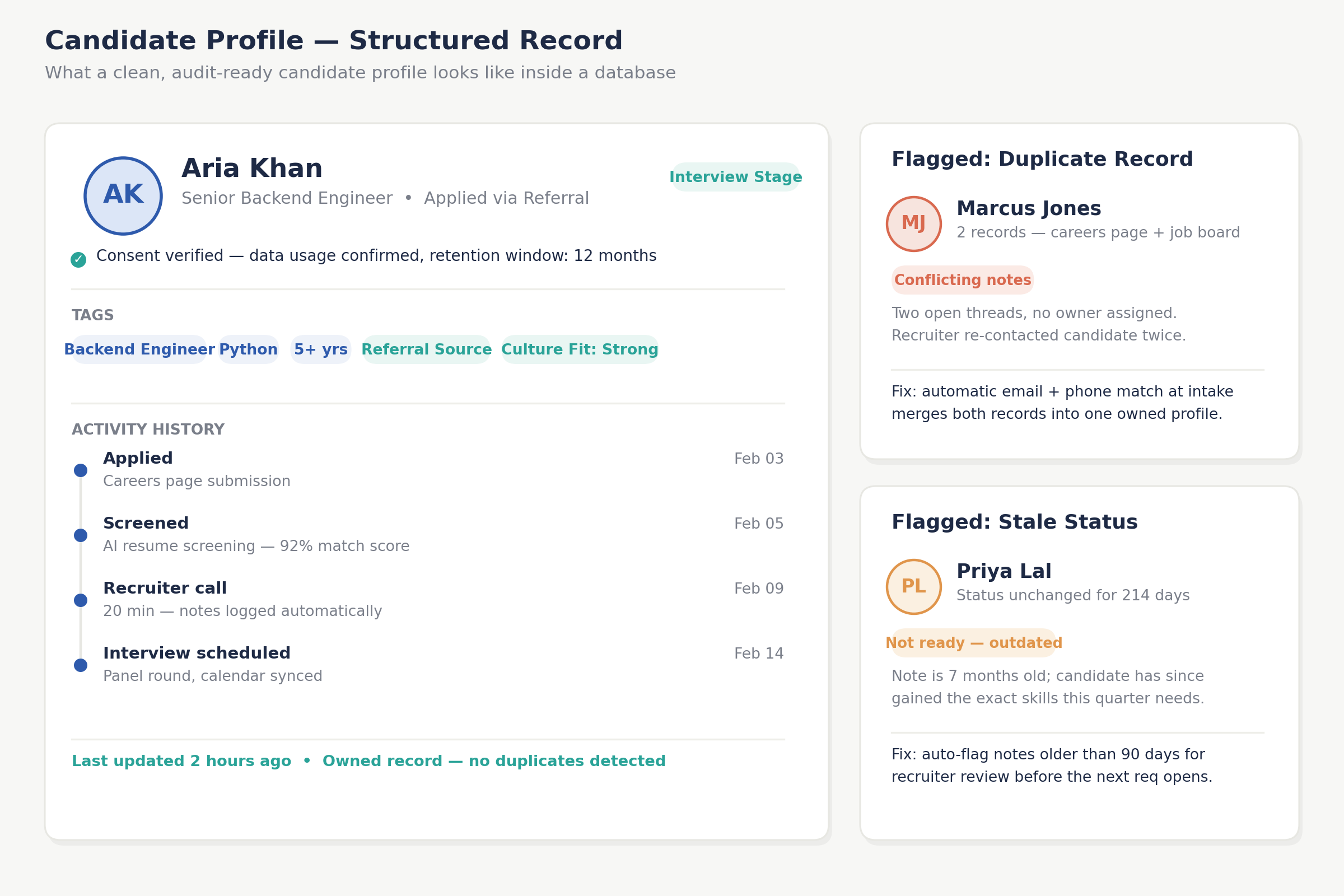
A 40-person SaaS startup hiring across six departments simultaneously found that 28% of its candidate database consisted of duplicate or near-duplicate records after a structured audit. Following deduplication and a standardized tagging pass, recruiter time spent on manual candidate search dropped by roughly 35%, and time-to-shortlist for three open roles fell from 12 days to 7 within a single hiring cycle without adding headcount to the recruiting team.
A separate case involved a 20-person recruiting agency managing candidate data across five recruiters using individual spreadsheets alongside a shared ATS. After consolidating activity history and consent tracking into one centralized system, the agency reduced candidate-contacted-twice complaints to near zero within two months and recovered 14 previously “lost” candidates who were re-matched to new roles through tag-based search rather than fresh sourcing.
A third example comes from a 90-person fintech company scaling its engineering team from 12 to 30 within a year. Its recruiting team discovered that 41% of “rejected” candidates in the database had been rejected for timing or budget reasons, not skill gaps meaning nearly half of a large rejected pool was actually re-hireable. After introducing structured tagging that separated “not a fit” from “good candidate, wrong timing,” the team filled four engineering roles directly from previously rejected applicants, cutting sourcing costs for those roles to near zero.
Comparison: Manual Tracking vs. Structured Candidate Database Management
Most teams don’t consciously choose manual tracking; they inherit it, one spreadsheet and one Slack thread at a time, until it becomes the default. The table below makes the practical difference concrete.
| Factor | Manual / Spreadsheet Tracking | Structured Database Management |
| Duplicate detection | Manual, error-prone, discovered late | Automated at point of intake |
| Consent records | Often missing or undocumented | Timestamped, structured, auditable |
| Status visibility | Delayed, inconsistent across stakeholders | Real-time, shared across the team |
| Candidate re-engagement | Requires re-sourcing from scratch | Tag-based search surfaces past fits |
| Recruiter handoff | Context lost when a recruiter leaves | Activity history persists with the record |
The gap isn’t about tool sophistication, it’s about whether candidate data is treated as a living asset or a static archive. Teams that make this shift usually notice the difference first in recruiter workload, not in a headline metric.
What Most Teams Get Wrong
The most common misconception is treating candidate database cleanup as an IT project instead of a recruiting habit. Teams schedule a one-time “data cleanup sprint,” feel good about it for a quarter, and watch the same duplication and staleness creep back in by the next hiring wave.
The second, less obvious mistake: teams over-invest in sourcing new candidates while under-investing in the candidates they already have. It’s common for a database with 10,000+ records to contain dozens of previously-screened, qualified candidates for a role that’s about to be posted from scratch. Pattern recognition across fast-scaling teams shows this isn’t rare; it’s closer to the default state of an unmaintained database.
Finally, many teams assume consent and compliance are “legal’s problem,” not a recruiting workflow issue. In practice, the only reliable way to maintain compliant candidate records is to build consent capture directly into the applicant intake flow not as an afterthought, but as a required field at the same level as name and resume upload.
There’s a subtler version of this same mistake worth naming directly: teams often equate “having an ATS” with “having clean candidate data.” The two aren’t the same thing. An ATS is infrastructure. Whether that infrastructure produces a trustworthy database depends entirely on the intake standards, tagging discipline, and automated checks layered on top of it. A well-built system with lazy data entry habits will still degrade into the same mess a spreadsheet would just with a nicer interface around it.
Quick Candidate Profile Audit Checklist
Run this in under 30 minutes on a sample of 50–100 recent candidate records:
- Search for duplicate entries by email and phone number flag anything matching.
- Check the last-updated date on notes and status tags flag anything older than 90 days for review.
- Confirm every record has a documented consent timestamp and retention window.
- Verify tagging exists for skill, seniority, and source on each profile.
- Check whether activity history (calls, emails, interview notes) is visible in one place per candidate.
- Identify “rejected” candidates from closed roles who might now fit an open requisition.
- Confirm status updates reflect the candidate’s actual current pipeline stage, not a stale snapshot.
Where to Go From Here
Fixing candidate profile management mistakes isn’t about switching tools for the sake of it, it’s about deciding whether your candidate database is an asset you actively maintain or an archive you occasionally dig through. The audit checklist above is a reasonable starting point regardless of what system you’re using today, and it’s worth running before deciding whether a bigger change is even necessary.
If the audit turns up more duplicate records, missing consent fields, or stale statuses than expected, that’s usually the signal that the underlying system, not just recruiter habits, needs a closer look.
If your team is evaluating whether your current setup can actually support clean, centralized candidate data deduplication, consent tracking, real-time status visibility, and AI-assisted resume screening, Hirium has built its applicant tracking system around exactly this problem for startups and SMBs hiring at scale. Its free plan is a low-friction way to see whether structured candidate data changes how much re-sourcing your team has to do every quarter.
FAQ
What is candidate profile management?
Candidate profile management is the practice of creating, updating, and maintaining accurate, structured candidate records within a recruiting system throughout the hiring lifecycle. It includes deduplication, tagging, consent tracking, and activity logging not just initial resume intake. Strong candidate profile management directly reduces redundant recruiter work and protects compliance.
How often should recruiters clean their candidate database?
High-volume teams should run deduplication and tagging reviews monthly; smaller teams can manage with a quarterly cadence. Waiting longer than a quarter typically allows duplicate and stale records to accumulate to a point where cleanup takes significantly longer than routine maintenance would have.
What happens if you don’t record candidate consent?
Without documented consent, organizations can’t demonstrate a lawful basis for storing or using candidate data under regulations like GDPR. This creates real audit and legal exposure, and it also erodes candidate trust if someone requests to know how their information is being used or asks for it to be deleted.
How do duplicate candidate profiles affect hiring outcomes?
Duplicates cause recruiters to re-screen the same person, send conflicting communications, or reject one version of a candidate while another sits active in a different pipeline. Beyond wasted time, this directly damages candidate experience and employer brand candidates notice when a company seems disorganized about their own application.
What should a candidate profile audit include?
A solid audit checks for duplicate records, outdated status tags, missing consent documentation, absent activity history, and inconsistent tagging. It should also flag previously-rejected candidates who might now be strong fits for newly opened roles, since these candidates represent recoverable value already in the database.
Can AI fix a messy candidate database?
AI-driven tools can meaningfully accelerate cleanup flagging likely duplicates, standardizing resume data through AI resume screening, and surfacing previously-screened candidates who match new requisitions. AI reduces the manual effort involved, but it works best on top of a defined tagging structure and consent process, not as a total substitute for one.
Is a recruitment status update software worth adopting for a small team?
Even small teams benefit once they’re running more than two or three roles at once, since manual status tracking across spreadsheets and inboxes breaks down quickly at that volume. The return shows up mainly in reduced coordination time between recruiters and hiring managers, rather than in headline recruiting metrics.