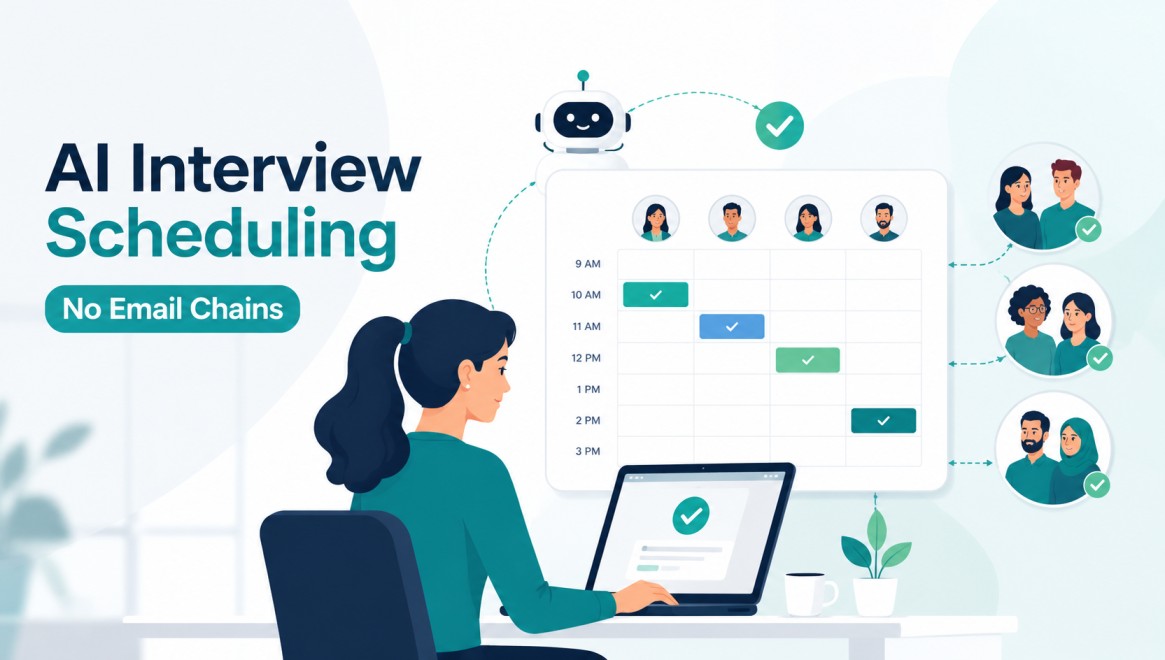
AI Interview Scheduling for Panel Interviews: No Email Chains
A single panel interview loop involving four interviewers can generate 15–20 back-and-forth emails before a time is confirmed, and that’s before anyone accounts for a reschedule.
For a startup running three open roles at once, that’s not an isolated headache. It’s a recurring tax on every single hiring manager’s calendar, every week, for as long as the role stays open.
Companies using automated or AI-driven interview scheduling were 1.6x more likely to hit near-perfect hiring goal attainment, with 13% hitting 90–100% of goals, vs. 8% for manual-scheduling teams.
Most hiring teams treat this as an unavoidable cost of running structured interviews. It isn’t. AI interview scheduling for panel interviews exists specifically to remove the manual coordination layer the emails, the “does 2 pm work for everyone,” the double-booked conference rooms without lowering the bar on interview structure or interviewer involvement.
Panel interviews specifically make this worse than one-on-one scheduling, because the math isn’t additive; it’s combinatorial.
A one-on-one interview needs two calendars to align. A four-person panel needs five (including the candidate’s), and every additional interviewer added to a loop increases the odds that at least one person has a conflict on any given day.
This piece breaks down why panel scheduling is structurally harder than single-interviewer scheduling, how automated multi-interviewer availability matching solves it, what a realistic panel scheduling workflow looks like end to end, and how to collect feedback that’s actually usable once the panel is done.
What Is AI Interview Scheduling for Panel Interviews?
AI interview scheduling for panel interviews is a tool that helps recruiters coordinate interviews involving multiple interviewers and candidates.
Instead of checking everyone’s calendars one by one, the software looks at the availability of the candidate and all panel members at the same time. It finds a suitable time, handles scheduling conflicts, and sends the confirmed meeting details automatically.
The real difference comes down to assistance vs. automation. A scheduling tool that only suggests available time slots still requires a recruiter to check, confirm, and send invitations. That can reduce some work, but the recruiter is still stuck in the middle of the process.
With true automation, the system can check calendars, find a common slot, book the interview, and send confirmations without the recruiter having to manage every step.
This allows recruiters to focus on exceptions, such as an interviewer becoming unavailable or a candidate requesting a different time, instead of spending hours coordinating routine interviews.
The Core Problem: Why Panel Scheduling Breaks Down
Scheduling an interview with one candidate and one interviewer is usually straightforward. You just need to find a time that works for both people.
Panel interviews are different because you have to find a time that works for the candidate and several interviewers at once. The more people involved, the harder it becomes to find a common slot.
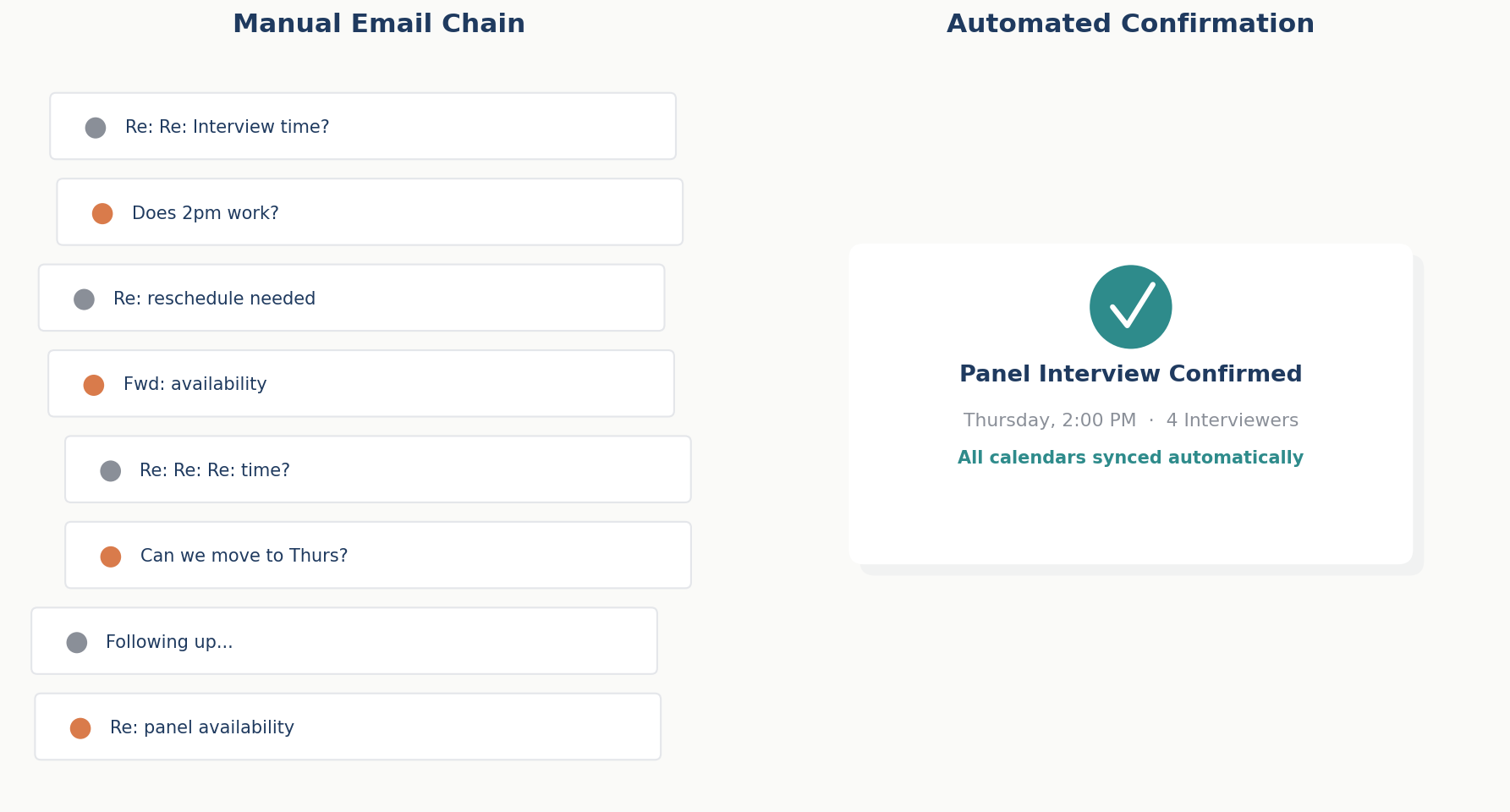
In many hiring teams, this quickly turns into a long email chain.
A recruiter may have to ask several interviewers for their availability, compare different time slots, go back to the candidate, and then start the process again if someone is unavailable.
A simple interview can suddenly take several rounds of messages before everyone agrees on a time. If someone needs to reschedule, the process becomes even more complicated.
Scheduling is not the only challenge. Collecting feedback after a panel interview can also slow down the hiring process. Once the interview is over, each interviewer needs to share their feedback while the conversation is still fresh.
Without a proper process, recruiters often have to send reminders and follow up with individual interviewers. This can delay the final hiring decision and leave candidates waiting longer than expected.
There is also the issue of rooms and other resources. For in-person interviews, recruiters need to make sure a suitable meeting room is available when the entire panel is free. If the room is already booked, the interview may need to be moved or rescheduled.
These small issues can create unnecessary last-minute work for recruiters and a frustrating experience for candidates.
All of this adds up to a significant amount of recruiter time spent on scheduling. When several roles are being hired at the same time, coordinating multiple panels can take hours each week.
Recruiters may find themselves checking calendars, sending reminders, arranging rooms, updating meeting invitations, and handling rescheduling requests instead of focusing on candidates and hiring decisions.
The impact is also visible from the candidate’s side. Receiving several emails with different time options, followed by changes or rescheduling requests, can make the hiring process feel disorganized. A smooth scheduling experience, on the other hand, gives candidates a better impression of the company.
This is where AI interview scheduling can help.
By coordinating candidate and interviewer availability in one place, automating calendar checks, and handling routine scheduling tasks, AI can reduce the back-and-forth and make panel interviews easier to manage for everyone involved.
How Automated Multi-Interviewer Availability Matching Works
This is the mechanical core of solving panel scheduling, and it’s worth understanding the architecture, not just the outcome.
1. Calendar Integration as the Foundation
The system needs live, two-way calendar integration (Google Calendar, Outlook, or both) for every interviewer in the loop, not just the recruiter.
Without this, the tool is still relying on someone manually inputting availability, which reintroduces the exact bottleneck it’s meant to remove.
This is a non-negotiable architecture decision: a scheduling tool without live calendar sync is, functionally, a slightly faster spreadsheet.
Two-way sync also matters for a reason teams often miss: it needs to write confirmed interviews back to each interviewer’s calendar automatically, not just read their availability.
A one-way integration that only checks free/busy status still leaves a manual step where someone has to add the confirmed event to four separate calendars, which is exactly the kind of small gap where a double-booking slips through.
2. Constraint-Based Matching Logic
Once calendars are connected, the matching engine needs to solve for multiple constraints simultaneously: interviewer availability, candidate availability (often collected as a set of preferred windows), room or video-link availability, and any sequencing rules (for example, a technical round needing to happen before a culture-fit round).
This is a constraint-satisfaction problem, and it’s the reason simple “find a mutual free slot” logic breaks down once more than two or three people are involved the system needs to weigh trade-offs, not just intersect calendars.
Well-built matching logic also needs to account for interviewer preferences, not just raw availability. An interviewer who’s technically free at 8am but never wants interviews before 10am creates a false positive if the system treats all open calendar time as equally usable. Teams evaluating scheduling tools should confirm whether preference weighting is supported, or whether the tool only checks hard availability.
3. Automated Interviewer Assignment
For teams running high interview volume, the system can also handle AI interviewer selection, not just scheduling rotating interviewers based on availability and load to prevent the same one or two people from being pulled into every panel. This directly addresses recruiter workload and interviewer burnout, which is a common reason panel-heavy hiring processes slow down over a multi-month hiring push.
This matters more at growth-stage companies than it might seem. When the same senior engineer sits on every technical panel because they’re the most consistently available, that person’s own work gets displaced by interviewing a cost that rarely shows up in a hiring dashboard but shows up clearly in that person’s own delivery timelines.
4. Candidate-Facing Self-Scheduling
The candidate-facing layer matters as much as the backend logic. A candidate should be able to select from a small set of pre-validated time slots ones that are already confirmed to work for the full panel rather than proposing times that then need to be re-checked against everyone’s calendar.
This single design choice removes an entire round-trip from the process.
The design detail that separates a genuinely useful self-scheduling flow from a cosmetic one is validation timing. If slots are generated once and go stale as interviewer calendars fill up, a candidate can select a time that’s no longer actually available, which recreates the exact back-and-forth the tool was meant to eliminate.
Slots need to be re-validated in real time, right up to the moment of selection.
5. Integration, Rollout, and Compliance Considerations
Rolling out automated panel scheduling isn’t purely a software decision it requires interviewers to actually connect their calendars, which is the step where adoption most commonly stalls.
A tool with a clunky or optional calendar-connection flow ends up half-adopted: some interviewers synced, others still being scheduled manually, which defeats the purpose and creates confusion about which process to follow for which panelist.
Rollout tends to go more smoothly when calendar connection is required at onboarding rather than treated as an opt-in step added later.
Teams that mandate it for all interviewers from day one see faster time-to-value than teams that roll it out gradually and end up running two parallel scheduling processes for months.
On the compliance side, calendar data and interview scheduling records fall under the same data-handling considerations as other candidate information; access should be limited to people involved in that specific hiring loop, and retention policies should apply consistently across scheduling data and interview notes rather than treating scheduling metadata as somehow lower-stakes.
This matters more for companies operating across regions with different data-protection requirements, where calendar and scheduling data can be subject to the same rules as resumes and interview feedback.
Cost Implications of Manual vs. Automated Scheduling
The cost comparison here is straightforward once it’s broken into components.
Manual panel scheduling costs recruiter or coordinator time directly, roughly 45–60 minutes of active coordination per panel loop once reschedules are factored in, multiplied across every open role running panel interviews simultaneously.
Automated scheduling shifts that cost to a fixed software cost, but more importantly, it converts a cost that scales with hiring volume into one that doesn’t, which matters most for teams planning to scale headcount aggressively over the next 6–12 months.
Scheduling automation solves half the panel interview problem. The other half is making sure the panel’s collective judgment actually gets captured while it’s still accurate.
The most effective structure uses a standardized scorecard tied to the same evaluation criteria across every interviewer: technical competency, communication tool, and role-specific criteria rather than a free-text box that produces five paragraphs of unstructured impressions.
Free-text feedback is harder to compare across candidates and more prone to recency bias when a hiring manager reviews it days later.
Automated, time-boxed feedback requests work better than open-ended reminders. A request sent immediately after the interview, with a 24-hour submission window enforced through automated reminders, produces meaningfully higher completion rates than an informal “whenever you get a chance” ask, and the feedback quality is higher because it’s captured while details are still fresh.
There’s a sequencing decision worth making deliberately here: whether panelists can see each other’s feedback before submitting their own. Sequential visibility where a scorecard is locked until every panelist has submitted independently tends to produce more honest, less anchored feedback than a shared, editable document where the first strong opinion in the room shapes everyone else’s written notes.
Consolidation is the final step, and it’s where Recruitment Status Update Software earns its keep beyond just candidate-facing updates. Once all panelists submit, the system should aggregate scores against a consistent rubric and flag disagreement automatically.
A candidate who scores a 4/5 from three panelists and a 1/5 from a fourth is a different decision-making situation than a candidate who scores consistently in the middle, and that signal is easy to miss if feedback is just stacked in a folder rather than compared.
A sample panel scheduling workflow, in order:
- Recruiter creates the panel loop and adds interviewers, whose calendars sync automatically
- System calculates all overlapping availability windows across every panelist, room, and video link
- Candidate receives a shortlist of 3–5 pre-validated time slots via automated recruitment email templates
- Candidate selects a slot; system confirms with all interviewers and blocks calendars instantly
- Automated reminders go out to interviewers and the candidate 24 hours and 1 hour before the interview
- If a reschedule is needed, the system re-runs the matching logic instead of restarting the email chain
- Post-interview, structured feedback forms are triggered automatically to each panelist
- Consolidated feedback appears in the candidate’s record in Candidate Database Management, visible to the full hiring team
Case Studies: Panel Scheduling Fixed at Scale
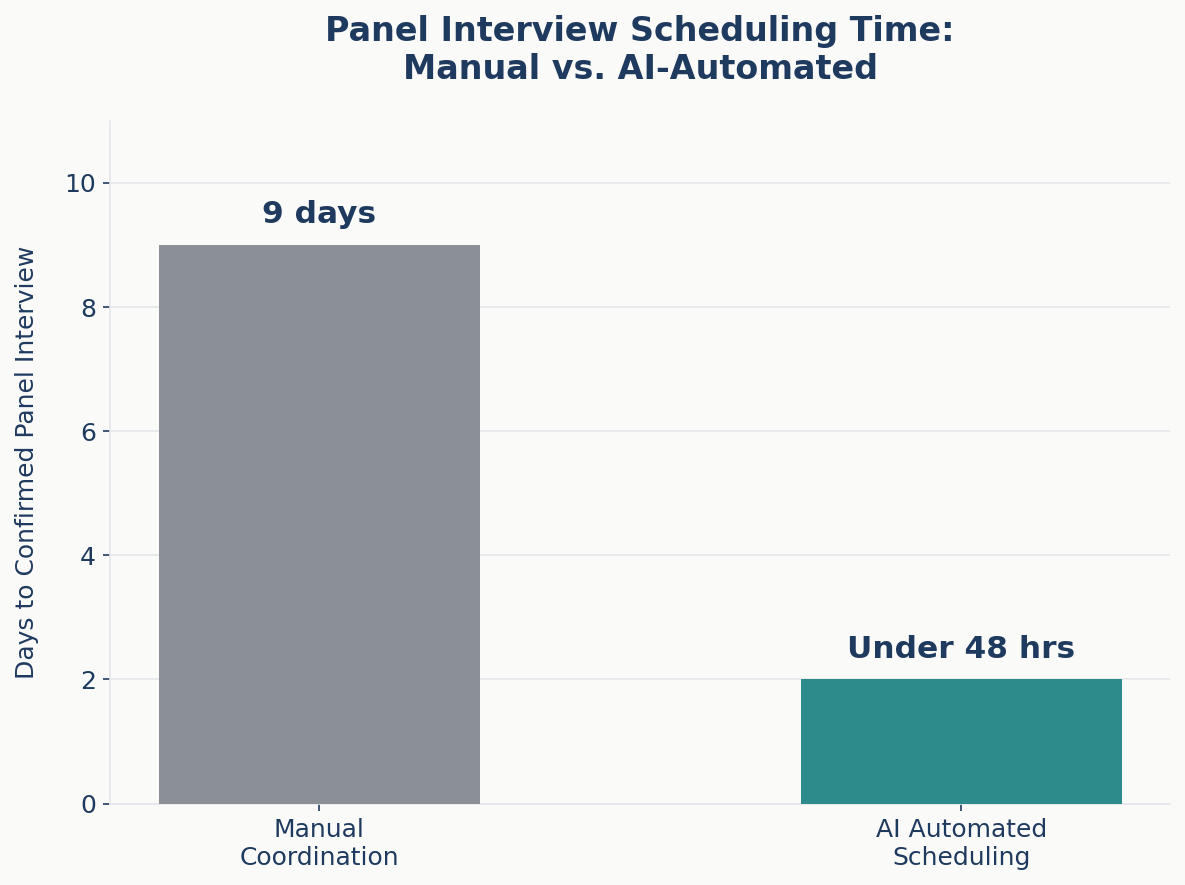
A 60-person tech company running four-person panel loops for senior engineering hires was averaging 9 days between initial screen and confirmed panel interview, almost entirely due to manual calendar coordination across four busy calendars.
The recruiting team had tried assigning a dedicated scheduling coordinator, which helped modestly but still relied on manual email checking against each interviewer’s calendar.
After introducing automated multi-interviewer availability matching, that window dropped to under 48 hours, and the team reported completing 30% more interview loops per month with the same recruiting headcount.
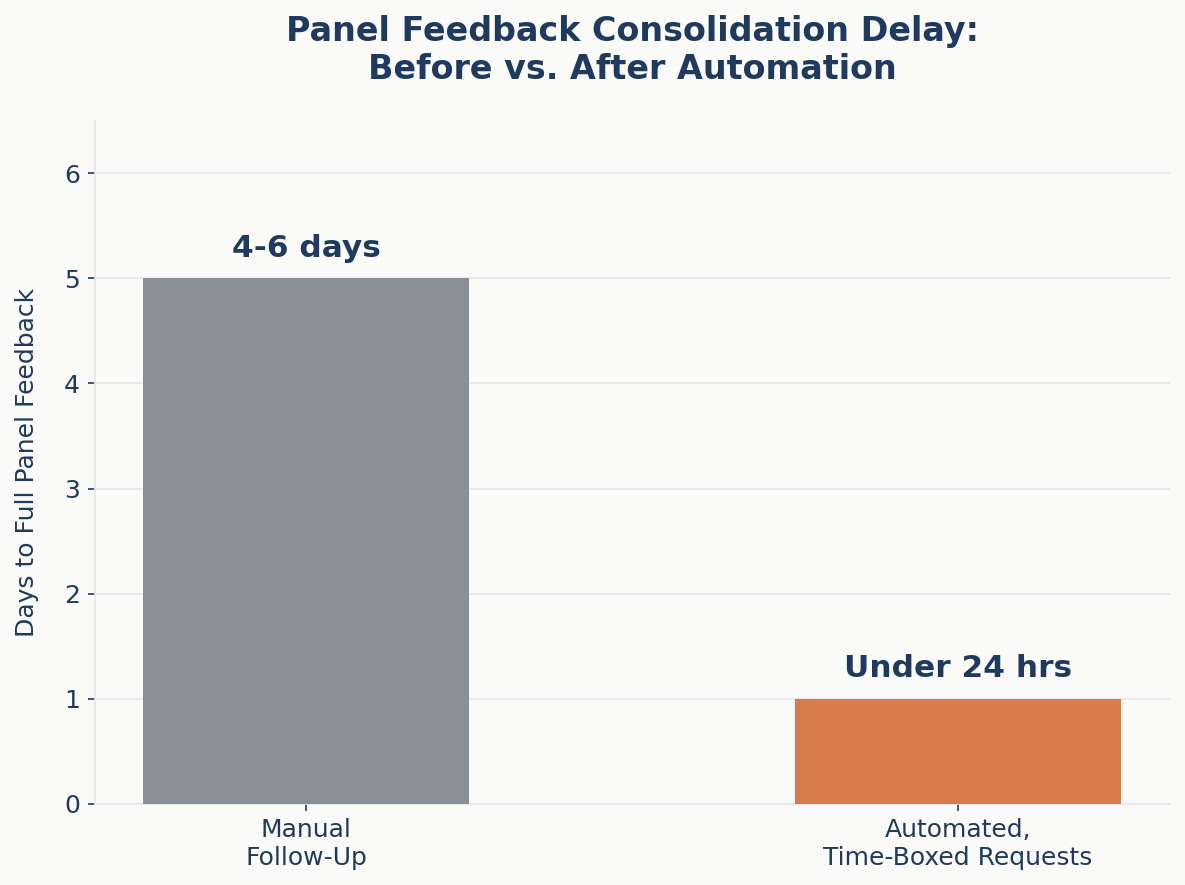
A 25-person startup hiring across three functions simultaneously was losing an average of 4–6 days per hire to feedback consolidation delays, with panelists submitting notes days apart, sometimes after the hiring manager had already moved on to reviewing the next candidate.
In several cases, a panelist’s memory of a candidate had noticeably faded by the time feedback was finally submitted, leading to vaguer, less useful notes.
Automated, time-boxed feedback requests cut that consolidation window to under 24 hours and shortened overall time-to-offer by roughly a third across the following two quarters.
Choosing a Panel Scheduling Approach: What Actually Matters
Not every scheduling feature affects outcomes equally. Some directly reduce coordination time; others are secondary conveniences that matter less for teams running high interview volume.
| Capability | Impact on Scheduling Speed | Why It Matters |
| Live calendar sync for all panelists | High | Removes manual availability checking entirely |
| Candidate self-scheduling from pre-validated slots | High | Cuts a full round-trip out of confirmation |
| Automated feedback request triggers | High | Prevents feedback delay from stalling decisions |
| Interviewer rotation/load balancing | Medium | Reduces burnout on frequently-used interviewers |
| Custom branded scheduling emails | Low | Improves polish, doesn’t change speed |
What Most Teams Get Wrong About Panel Scheduling
Most teams assume the fix for slow panel scheduling is hiring a dedicated coordinator.
That solves a headcount problem, not a structural one a human coordinator manually checking four calendars is still doing combinatorial matching by hand, just with a job title attached to it.
The coordination bottleneck doesn’t disappear; it just gets a salary, and it still doesn’t scale past a certain number of simultaneous open roles.
The more common and costlier mistake is automating scheduling but leaving feedback collection manual.
Teams that solve half the problem fast scheduling, slow consolidation often don’t realize their time-to-offer hasn’t actually improved, because the bottleneck simply moved from “getting people in a room” to “getting people to submit notes afterward.”
The other pattern worth naming: teams over-index on interview panel size as a signal of rigor. A five-person panel isn’t inherently more thorough than a three-person one; it’s often just harder to schedule, with diminishing returns on decision quality past three or four well-chosen interviewers.
Reducing panel size is sometimes the more effective fix, even when better scheduling software is also in place.
A final mistake worth flagging:
Treating scheduling automation as a one-time setup rather than something that needs occasional tuning.
Interviewer preferences change, teams grow, new rooms and video tools get added, and a matching configuration that worked well for a 15-person company can start producing worse slot suggestions once headcount doubles and the pool of available interviewers gets more fragmented across time zones or hybrid schedules.
Revisiting the configuration every couple of hiring quarters catches this before it quietly reintroduces the delays the system was meant to remove.
FAQ
1. Why is scheduling panel interviews harder than one-on-one interviews?
Panel scheduling requires matching availability across every interviewer simultaneously rather than just one, and the number of possible conflicts increases with each additional person added to the loop. A four-person panel involves substantially more coordination than four separate one-on-one interviews scheduled independently, because the group has to align on a single shared window rather than four separate ones.
2. How does AI help schedule interviews with multiple interviewers?
AI-driven scheduling tools sync directly with every interviewer’s calendar, calculate overlapping availability automatically, and present the candidate with pre-validated time slots that are already confirmed to work for the full panel removing the manual back-and-forth of checking calendars one at a time. The system also handles conflict resolution and rebooking automatically when a reschedule is needed.
3. How long should it take to schedule a panel interview?
With automated multi-interviewer availability matching, a panel interview can typically be confirmed within 24 – 48 hours of the request being initiated. Manual coordination for the same panel size often takes 6-10 days once reschedules and email delays are factored in, and that gap widens further as panel size grows past three or four interviewers.
4. What’s the best way to collect feedback after a panel interview?
Structured scorecards tied to consistent evaluation criteria, sent automatically to each panelist immediately after the interview with a defined submission window, produce faster and more comparable feedback than open-ended requests sent informally after the fact. Locking scores until every panelist has submitted independently also reduces anchoring bias between interviewers.
5. Can small hiring teams automate interview scheduling without a dedicated coordinator?
Yes. Automated calendar matching and candidate self-scheduling are specifically designed to remove the need for a dedicated scheduling coordinator, which makes panel scheduling manageable for lean teams running multiple searches without added headcount. This is often where the software pays for itself fastest, since a coordinator’s time is the direct cost being replaced.
Conclusion
If panel interviews are consistently the slowest stage in your hiring process not because interviewers are unavailable, but because coordinating them eats days every single loop that’s a scheduling infrastructure problem, not a staffing one.
Hirium’s workflow automation is built to handle exactly this kind of multi-interviewer coordination for lean teams running several searches at once.