AI Interview Scheduling and No-Shows: Data-Backed Tactics to Cut Drop-Offs
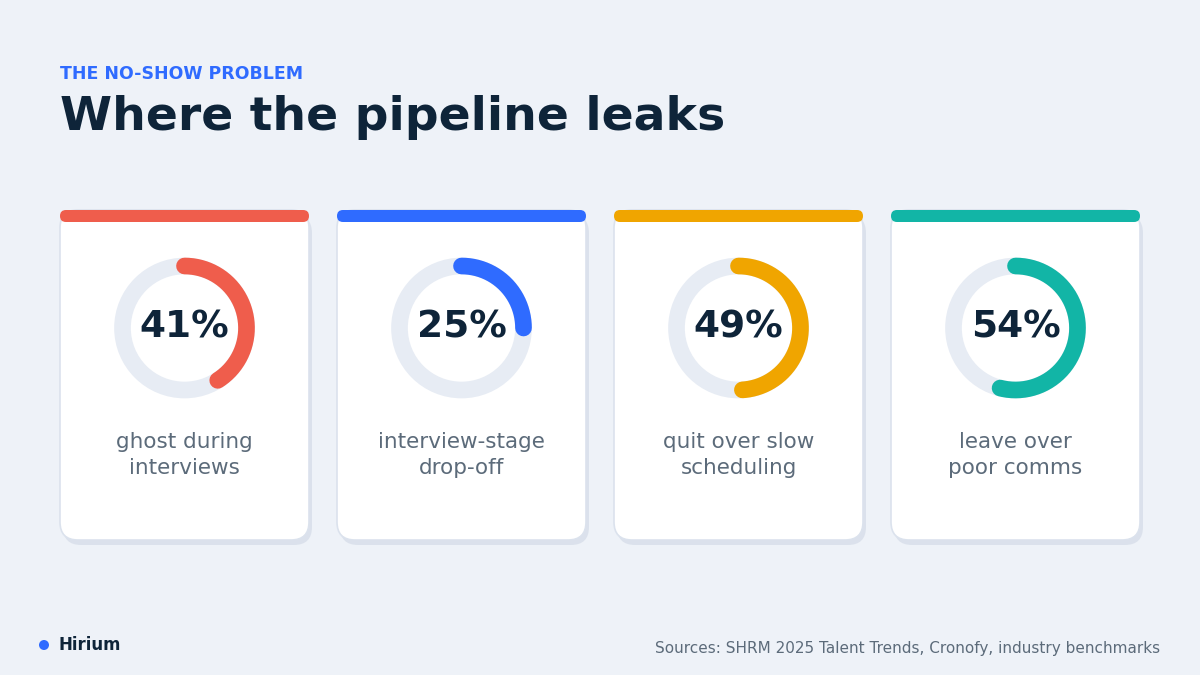
Forty-one percent of organizations that struggle to fill roles now report the same specific problem: candidates who vanish partway through the interview process. It has climbed into the top three hiring obstacles, sitting alongside thin applicant pools and competition from rival employers. For a team running 40 interviews a week, that pattern can mean ten empty chairs, ten interviewers pulled off other work, and ten candidates who quietly moved on.
The instinct is to blame the market. The data points somewhere more uncomfortable: much of the drop-off is manufactured by the process itself. Long gaps between application and interview, silence after the invite, and vague logistics give candidates every reason to disengage and no reason to confirm. AI interview scheduling no-shows are, in most pipelines, a design flaw rather than a talent-quality problem.
According to recent 2026 recruiting insights, nearly 28% of candidates fail to attend scheduled interviews, with poor communication and long response times cited as key reasons. For more data on hiring challenges and trends, explore the latest recruiting statistics and benchmarks.
That gap between “invited” and “attended” is where measurable money leaks out of a hiring budget. It also happens to be one of the most fixable stages in the entire funnel. The tactics below are drawn from appointment-adherence research and recruiting operations data, and they focus on the three levers that actually move show rates: lead time, reminder cadence, and logistical clarity.
The good news is that none of this requires a bigger team. It requires a tighter system.
What Is AI Interview Scheduling?
AI interview scheduling is the use of automated software to book, confirm, remind, and reschedule candidate interviews without manual back-and-forth. It syncs interviewer calendars, offers candidates self-serve time slots, sends timed reminders, and updates status automatically, replacing the email chains that stall pipelines and drive interview drop-offs.
The Core Problem: A Quarter of Your Pipeline Vanishes at the Interview
A 25% drop-off rate at the interview stage is now the working benchmark, and it is the single largest point of candidate loss in the hiring funnel. Teams that assume their number is lower are usually not measuring it. Left unaddressed, AI interview scheduling no-shows compound: every missed slot restarts sourcing, stretches the role open, and pushes the next candidate’s interview further out, which raises the odds they miss too.
Most recruiting dashboards track offer acceptance and time-to-hire, but very few isolate the invite-to-attend ratio, so the leak stays invisible until interviewers start complaining about empty calendars.
The financial math is blunt. If a recruiter spends 25 minutes coordinating each interview and 30% never happens, a team scheduling 200 interviews a month burns roughly 25 recruiter-hours reconciling slots that produce nothing. That is before counting the interviewer time and the roles that stay open longer because the pipeline keeps resetting.
Three root causes explain most of the damage, and they are rarely candidate loyalty.
Excessive lead time is the quiet killer. Roughly 31% of interviews are scheduled two to three weeks after a candidate applies, and another 14% land a month or more out. Candidate intent decays fast; a person who was excited on Tuesday has three other processes running by the following Friday. The Cronofy Candidate Expectations Report found that 49% of candidates abandoned a recruitment process because scheduling took too long, up from 38% the year before.
No reminder system is the second failure. An invite sent once, ten days out, competes with hundreds of other messages. Without a structured interview reminder sequence, the calendar entry fades from memory well before the day arrives.
Unclear logistics are the third. A candidate who cannot immediately see where to go, who they are meeting, how long it will take, or what “video link” actually means will hesitate, and hesitation converts to attrition. Poor communication alone drives 54% of candidates to abandon a process. Fixing these three levers is where reductions in AI interview scheduling no-shows actually come from.
The Strategic Playbook to Reduce Interview No-Shows
This is where most of the leverage lives. Cutting drop-offs is less about persuasion and more about removing friction and reinforcing commitment at the right moments. The tactics below stack: each one helps on its own, and together they compound.
How to Reduce Interview No-Shows by Compressing Lead Time
The strongest predictor of attendance is how quickly the interview follows the candidate’s peak interest. Successful candidates behave accordingly: 84% schedule their interview within 24 hours of receiving an invitation. The lesson is to book while intent is hot.
Aim to offer interview slots within 48 to 72 hours of a positive screen, not the following week. Self-scheduling links, where the candidate picks from pre-approved openings, remove the two-to-three-day email volley that inflates lead time in the first place. When a modern applicant tracking system handles this automatically, the scheduling window collapses from days to minutes, and candidate engagement stays high because momentum never breaks.
There is a real trade-off worth naming: compressed lead time can strain interviewer availability. The fix is calendar-hold automation, covered below, which keeps a rolling set of interview windows permanently open so speed never depends on chasing hiring managers. Get lead time right and you have already removed the largest structural driver of AI interview scheduling no-shows before any reminder fires.
The Best Time to Schedule Candidate Interviews
Timing is not only about how soon; it is also about when. Interview slot placement has a measurable effect on attendance, and the patterns are consistent enough to build into defaults.
Around 61% of senior executives consider 9 a.m. to 11 a.m. the optimal interview window, when both sides are fresh and the day has not yet derailed. Mid-morning slots also sit before the lunch-hour conflicts and end-of-day fatigue that quietly inflate cancellations. For working candidates, early-morning, lunchtime, and immediately-after-work windows reduce the friction of stepping away from a current job, which is a common unspoken reason interviews get skipped.
Two practical defaults help. Avoid Monday-morning and Friday-afternoon slots, which carry the highest flake risk, and never schedule a first-round conversation more than a week out when a nearer slot exists. When self-scheduling is switched on, candidates naturally gravitate to the windows that fit their lives, which is itself a quiet reducer of AI interview scheduling no-shows because the candidate, not the calendar, owns the choice.
The 3-Touchpoint Interview Reminder Sequence
Reminders are the highest-ROI intervention available, and the evidence is strong even outside recruiting. A study from Imperial College London found that SMS reminders cut appointment no-shows by 38%, and a broad systematic review confirmed that a simple notification made people 25% less likely to no-show and 23% more likely to attend. Interviews behave the same way: forgetting and fading intent, not deliberate rejection, cause most misses.
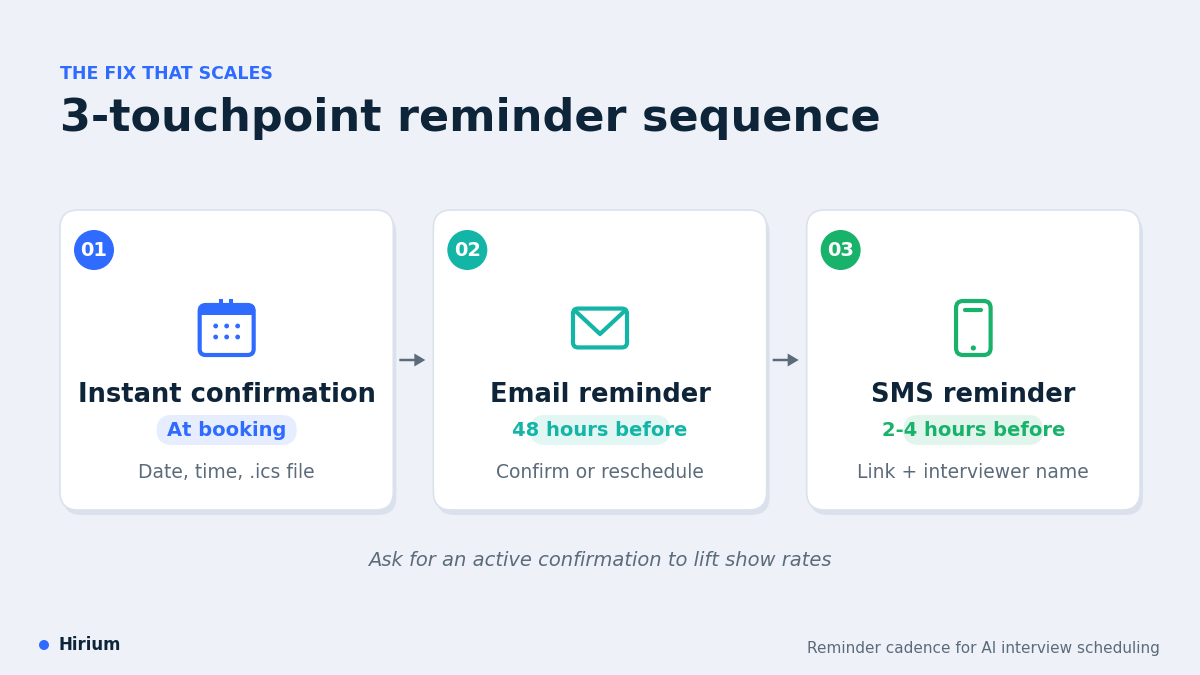
The sequence that works is not “send more emails.” It is three deliberate touchpoints, each with a distinct job:
- Instant confirmation (at booking): The moment a slot is chosen, send an automatic confirmation with the date, time, timezone, interviewer name, format, and a one-click calendar file (.ics). This turns a vague plan into a concrete commitment.
- 48-hour reminder (email): Two days out, restate the logistics and add a single low-friction action, a “Confirm” or “Reschedule” button. This is the planning-stage nudge, catching candidates while they can still adjust their week.
- Same-day reminder (SMS or text, 2–4 hours before): A short message with the link or address and the interviewer’s name. Texts are read within minutes, which is why the research sweet spot pairs a 48-hour reminder with a same-day one.
Adding a confirmation-request step matters more than volume. Appointment research shows that reminders which ask the recipient to actively confirm lift confirmation rates by around 26% over passive “just so you know” messages. The goal of the interview reminder sequence is not to nag; it is to convert a soft booking into an explicit yes, which is the mechanism that turns AI interview scheduling no-shows into confirmed attendance.
Well-built recruitment email templates carry this load without adding recruiter work. A confirmation template, a 48-hour template, and a same-day text template each merging in candidate and interviewer details automatically mean the entire cadence runs on autopilot once the slot is booked.
Calendar-Hold Automation for Interviews
Speed and reminders both depend on interviewer availability being visible and reserved. Calendar-hold automation solves the bottleneck that quietly reintroduces lead time: the recruiter waiting on a hiring manager to confirm they are free.
The mechanics are straightforward. Interviewers designate recurring weekly windows, say, Tuesday and Thursday afternoons that the system treats as pre-approved interview inventory. When a candidate self-schedules, the tool books directly into an open hold, sends the calendar invite to both sides, and removes the slot from the pool. No email, no double-booking, no “let me check with the team.”
Two configuration choices protect the system from breaking down. First, buffer time between slots (10–15 minutes) so a running-long interview does not cascade into the next candidate’s no-show. Second, an automatic release rule: holds that go unbooked converts back to free time 24 hours out, so interviewers never feel their calendar is hostage to hiring. This is also where recruitment status update software earns its place every booking, cancellation, and release updates candidate status in real time, so no coordinator is manually moving cards between stages.
Writing a Reschedule-Friendly Interview Policy
A rigid process treats every cancellation as a loss. A smart one treats a reschedule as a save. A large share of AI interview scheduling no-shows are not rejections at all; the candidate had a conflict and felt too awkward to say so, so they simply disappeared. Giving them an easy, guilt-free path to move the time recovery pipeline that would otherwise vanish.
A sample reschedule-friendly policy:
- One-click rescheduling in every reminder, letting candidates rebook themselves into open holds without emailing anyone.
- A stated grace window for example, “reschedule any time up to two hours before” so candidates know moving the slot is welcome, not a black mark.
- One free reschedule, no explanation required, with a second reschedule triggering a short human check-in rather than an automatic drop.
- A warm re-engagement message after a true no-show: a single automated note offering new times before the candidate is marked inactive. A meaningful share of missed interviews rebook when simply asked.
This policy pairs naturally with strong candidate profile management. When every touchpoint, reschedule, and note lives on one candidate record, recruiters see history at a glance and never re-send a slot the candidate already declined. Clean records are also what make automated reminders accurate; a reminder sent to a stale phone number is a no-show waiting to happen.
Where AI Screening Fits Before Scheduling Ever Starts
Some no-shows are seeded upstream, at the point of poor matching. When under-qualified or poorly-fit candidates get pushed to interview, they have little invested and disappear easily. AI resume screening and AI shortlisting raise the average intent of who reaches the calendar by prioritizing genuinely relevant applicants, which quietly lifts show rates before a single reminder goes out. Better inputs mean fewer wasted slots downstream, and fewer wasted slots is the definition of fewer AI interview scheduling no-shows.
Integration and Compliance Considerations
The tactics above only hold up if the plumbing is right. Two-way calendar sync with Google and Outlook is non-negotiable; without it, holds go stale and double-bookings reappear. Reminder channels also carry obligations.
Text reminders require consent capture and a clear opt-out, and candidate contact data must be handled under the relevant privacy regime GDPR for European candidates, and comparable data-protection rules elsewhere.
Storing timezones explicitly, rather than assuming the recruiter’s, prevents the classic cross-border miss where a candidate shows up an hour late or a day early. These are small engineering details, but each one, left unhandled, becomes a fresh source of AI interview scheduling no-shows that no reminder cadence can rescue.
Measuring What Predicts AI Interview Scheduling No-Shows
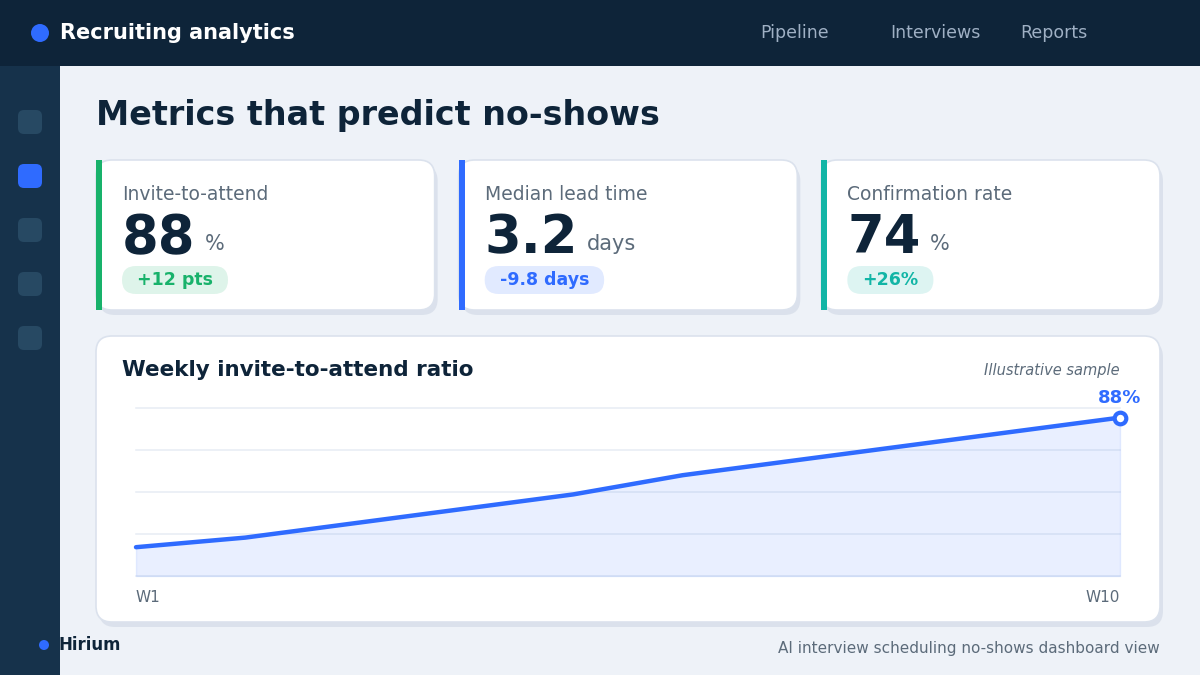
You cannot manage what you never chart. Most recruiting dashboards surface time-to-hire and offer acceptance rate but skip the one stage where a quarter of the pipeline disappears. Adding three metrics to your recruitment analytics closes that gap and turns AI interview scheduling no-shows from a vague frustration into a number you can move.
Track the invite-to-attend ratio first the share of scheduled interviews that actually happen, segmented by role type and source. High-volume roles will run lower than specialized ones, so a blended average hides the problem.
Track median lead time second, because it is the leading indicator; when the gap between screen and interview creeps past a week, drop-off follows within a cycle.
Track confirmation rate third the proportion of candidates who actively acknowledged the slot since it predicts attendance earlier and more reliably than any activity count.
Reviewed weekly, these three numbers tell you whether a spike in AI interview scheduling no-shows is a lead-time problem, a reminder problem, or a sourcing problem, and each has a different fix.
A source that consistently produces low show rates, for instance, is a sourcing issue disguised as a scheduling one. Recruitment analytics that break drop-off down by stage give recruiters the visibility to intervene in weeks rather than discover the leak a quarter later.
Case Studies: What Cutting Drop-Offs Looks Like in Practice
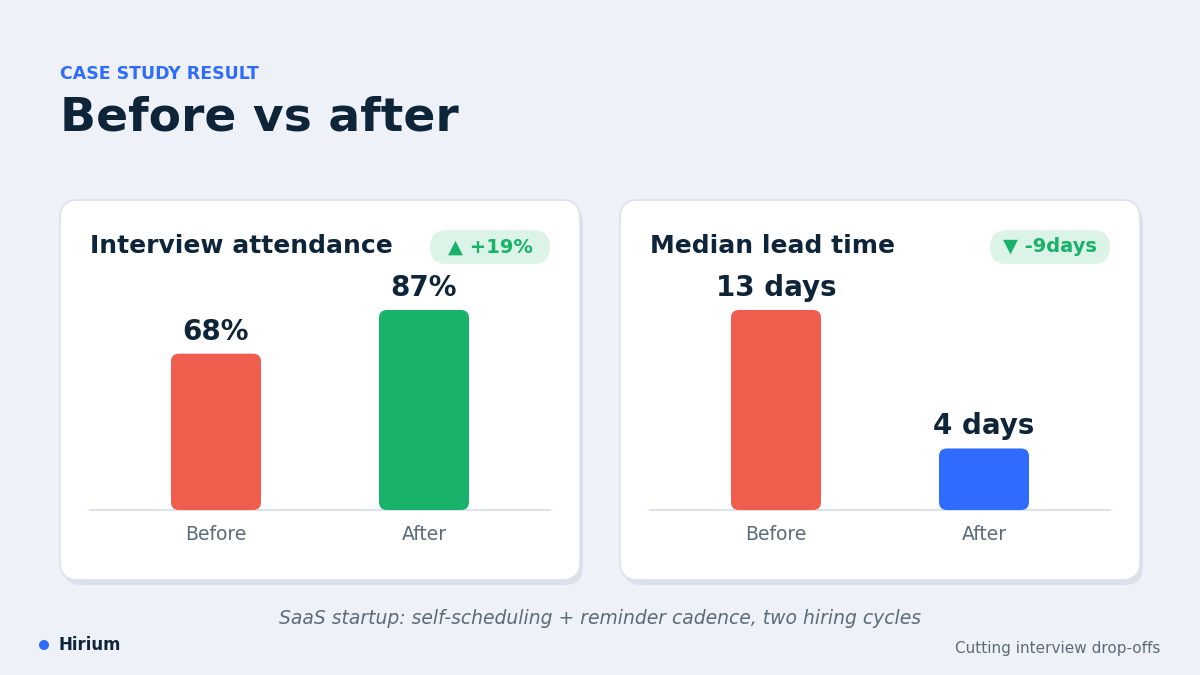
A 60-person SaaS startup hiring engineers at volume was running interviews 12–14 days after screening and losing roughly a third of scheduled candidates. Moving to self-scheduling within 72 hours and a three-touchpoint reminder cadence pulled median lead time down to under four days. Interview attendance climbed from about 68% to the high 80s within two hiring cycles, and time-to-hire dropped by nearly two weeks per role because the pipeline stopped resetting.
A regional staffing team filling high-volume support roles faced entry-level no-show rates near 40%, consistent with industry patterns for that segment. Adding a same-day SMS reminder with the interviewer’s name and a one-click reschedule button plus an automated re-engagement message after misses recovered a meaningful slice of “lost” candidates who simply rebooked. The measurable win was recruiter productivity: coordinators reclaimed roughly a day a week previously spent chasing confirmations.
The cost logic generalizes. If a recruiter spends 25 minutes coordinating each interview and a third never happens, cutting AI interview scheduling no-shows from 30% to 12% on 200 monthly interviews returns roughly 15 recruiter-hours a month before counting reclaimed interviewer time and shorter time-to-hire. Neither team hired more recruiters. Both changed the system around the interview, and the drop-off numbers followed.
Decision Framework: How to Evaluate a Scheduling Approach
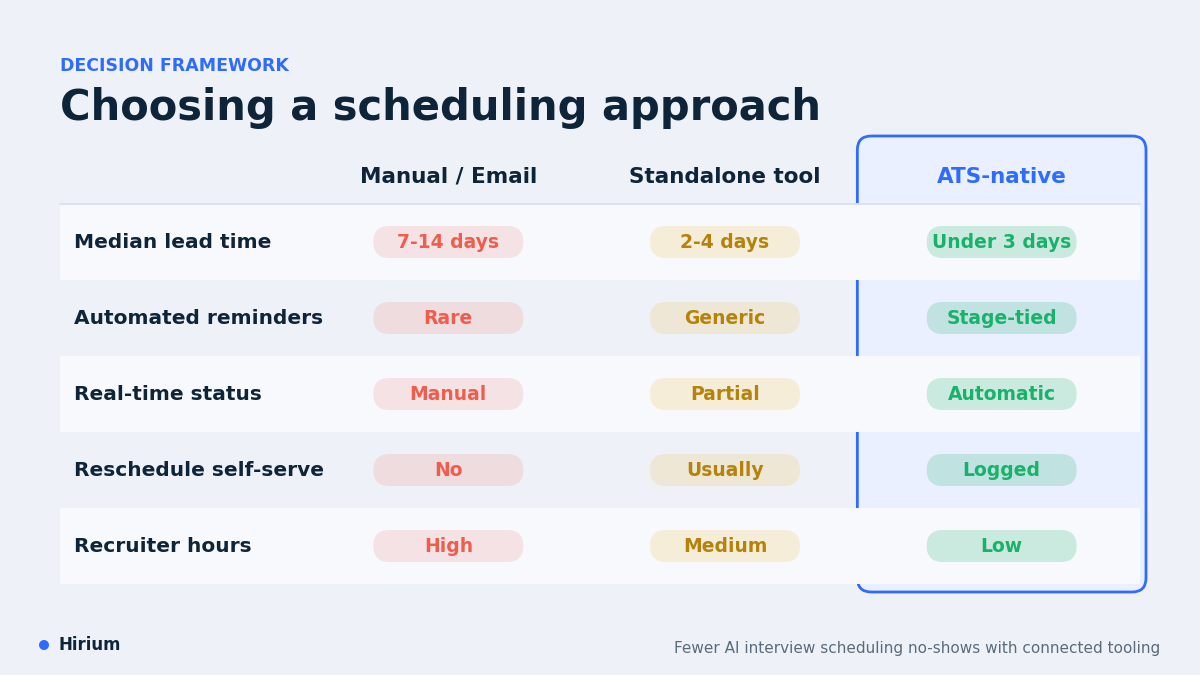
When comparing manual coordination, a standalone scheduling tool, or scheduling built into your applicant tracking system, the deciding factor is how tightly reminders, status updates, and candidate records connect. A disconnected tool fixes booking but leaves status tracking and profile history manual, which is where errors and stale data creep back in.
| Capability | Manual / Email | Standalone Scheduler | ATS-Native Scheduling |
| Median lead time | 7–14 days | 2–4 days | Under 3 days |
| Automated reminder sequence | Rare, inconsistent | Yes, generic | Yes, tied to candidate stage |
| Real-time status updates | Manual | Partial | Automatic |
| Reschedule self-service | No | Usually | Usually, logged to profile |
| Recruiter hours per 100 interviews | High | Medium | Low |
The pattern is consistent: the closer scheduling sits to the candidate record and the reminder engine, the lower the drop-off and the administrative load. A tool that only books slots solves a third of the problem. Teams that consolidate booking, reminders, and status tracking in one system routinely report the steepest reductions in AI interview scheduling no-shows, precisely because nothing falls through the seams between disconnected tools.
What Most Teams Get Wrong About Interview No-Shows
The most common mistake is treating no-shows as a candidate character issue rather than a process signal. When a quarter of your interviews evaporate, the honest read is not that candidates got flakier, it is that the process gave them permission to leave. Teams that internalize this stop moralizing and start engineering.
The second mistake is over-indexing on the reminder and ignoring lead time. Sending three polished reminders for an interview booked twelve days out is treating the symptom. By the time the reminders fire, the candidate has often already mentally committed elsewhere. Compressing the gap between screen and interview does more than any reminder ever will; reminders are the reinforcement, not the fix.
The third, and most counterintuitive, is confusing more messages with better communication. A candidate buried in five generic reminders is not more likely to attend than one who received a clear confirmation, a single well-timed nudge, and an obvious way to reschedule. Volume without a confirmation task is noise.
The metric to watch is not “reminders sent” but confirmation rate of the share of candidates who actively acknowledged the slot. That number, tracked weekly, predicts attendance far better than any activity count and is the truest early warning for AI interview scheduling no-shows.
The last blind spot is not measuring the invite-to-attend ratio at all. Teams optimize offer acceptance and source effectiveness while the biggest, cheapest win sits unmeasured one stage earlier. You cannot fix a leak you never put on the dashboard, and AI interview scheduling no-shows are the leak most teams never chart.
Put that one ratio on the weekly review and the problem stops being invisible which is the precondition for solving it at all.
Cutting Drop-Offs: Your Next Step
If you are tightening your interview process and want to pressure-test it before committing to new tooling, start by measuring three numbers this week: median lead time from screen to interview, your invite-to-attend ratio, and your confirmation rate. Those three tell you exactly how much pipeline you are losing and where.
From there, the fixes are mechanical: compress lead time, run a three-touchpoint reminder sequence, automate calendar holds, and make rescheduling effortless. Hirium’s applicant tracking system runs each of these on autopilot self-scheduling, automated reminders, real-time status updates, and one profile per candidate with a forever-free plan and no credit card required, so you can benchmark the impact on your own pipeline before scaling.
Reducing AI interview scheduling no-shows rarely needs a bigger team; it needs a tighter system, and that system is worth building before your next hiring push.
Frequently Asked Questions
Why do candidates not show up for interviews?
Most no-shows come from fading intent and friction, not disinterest. Long lead times let candidates accept competing offers 20% of ghosting candidates cite a better offer elsewhere. Unclear logistics, no reminders, and no easy way to reschedule remove any nudge to attend. In short, most AI interview scheduling no-shows trace back to a process that never reinforced the commitment it created, so candidates quietly drift away.
How can AI reduce interview no-shows?
AI-driven scheduling compresses lead time with self-serve booking, runs a timed reminder sequence automatically, and updates candidate status without manual work. It reserves interviewer availability through calendar holds and offers one-click rescheduling. By removing the coordination lag and reinforcing the booking with well-timed touchpoints, it attacks the three real causes of drop-off at once. That combined effect is why teams adopting it see AI interview scheduling no-shows fall without adding a single coordinator.
What is a good interview no-show rate?
The working benchmark for interview-stage drop-off is around 25%, so any rate meaningfully below that is outperforming the market. High-volume and entry-level roles run higher, sometimes near 40%, while specialized or senior roles run lower. The more useful move than chasing a universal target is measuring your own invite-to-attend ratio by role type and tracking AI interview scheduling no-shows over time against your own baseline.
How many reminders should you send before an interview?
Three touchpoints is the reliable pattern: an instant confirmation at booking, a reminder about 48 hours out, and a short same-day message two to four hours before. Adding a confirmation request lifts confirmation rates by roughly a quarter. More messages rarely help; a clear confirmation, one timely nudge, and an easy reschedule option outperform a flood of generic reminders.
Does interview lead time affect no-show rates?
Significantly. Nearly half of candidates abandon a process when scheduling drags, and 84% of strong candidates book within 24 hours of an invite, signaling how quickly intent peaks. Interviews booked one to two weeks out compete against every other opportunity a candidate is pursuing. Booking within 48 to 72 hours of a positive screen is one of the single most effective ways to protect show rates.
What should a reschedule policy include?
A candidate-friendly policy offers one-click self-rescheduling in every reminder, a clear grace window, one free reschedule with no explanation required, and an automated re-engagement message after a genuine no-show. The aim is to convert conflicts into saved interviews rather than lost candidates. Pairing this with clean candidate profile management keeps history visible so recruiters never re-offer a declined slot.
How do I know if scheduling is my biggest hiring bottleneck?
Track your invite-to-attend ratio and median lead time for one month. If more than 20–25% of scheduled interviews don’t happen, or if the average gap between screen and interview exceeds a week, scheduling is almost certainly costing you more than sourcing. If you’d like a second read on those numbers, a short benchmarking conversation with a recruitment-tech specialist can pinpoint where the leak is worst.