How to Use AI Candidate Insights to Reduce Time-to-Hire by 30%
The average U.S. hiring process now stretches to roughly 42 days from job posting to accepted offer, and screening plus interviewing alone eat up 16 to 18 of those days before a decision is even made. That single fact explains why most “faster hiring” initiatives fail: teams optimize the parts of the funnel that were never the bottleneck.
Most time-to-hire strategies focus on sourcing more candidates. But sourcing was rarely the problem. The real drag lies in evaluating the days spent manually reading resumes, comparing notes across interviewers, and waiting for a hiring manager to circle back with a decision. Fix that layer, and the other 30 days of the process compress on their own.
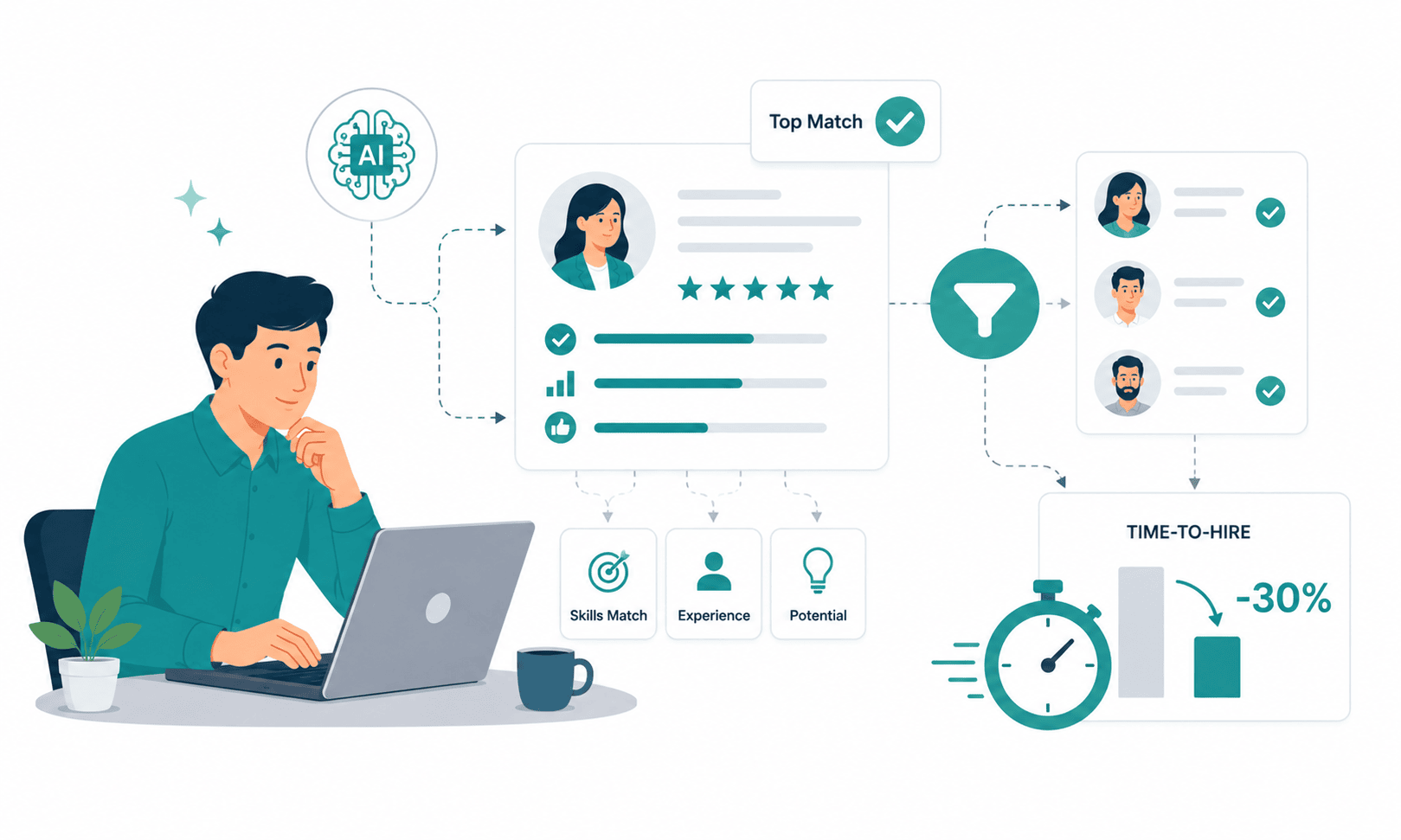
According to recent 2026 recruiting data, organizations using AI-driven recruitment tools report up to a 30% reduction in time-to-hire, highlighting the growing impact of AI on hiring efficiency. To explore more supporting data, refer to the latest recruiting statistics and benchmarks.
This is where AI Candidate Insights for Time-to-Hire change the math. Instead of asking recruiters to read faster, insight-driven systems surface who is worth reading in the first place before a human ever opens a resume.
This blog breaks down exactly where time-to-hire gets lost, which AI-driven signals compress it, what a realistic before/after timeline looks like, and three steps a hiring team can apply this week without replacing their entire tech stack.
The gap between teams that hire in 30 days and teams stuck at 55–60 days is rarely about candidate supply. It’s about how quickly a team can turn a stack of applications into a confident decision and that gap is exactly what AI Candidate Insights for Time-to-Hire is built to close.
What Are AI Candidate Insights for Time-to-Hire?
AI Candidate Insights for Time-to-Hire is the practice of using machine-generated signals resume ranking, skill-match scoring, and predictive fit models to shorten the evaluation stage of recruitment. Instead of manual resume review, recruiters act on pre-ranked, scored candidate data, cutting decision time without cutting decision quality.
It’s worth separating this from adjacent terms teams often use interchangeably. Workflow Automation Software speeds up the logistics around a hiring decision: who gets notified, when an interview gets booked, when a status email goes out. AI Candidate Insights for Time-to-Hire speeds up the decision itself, by surfacing which candidates deserve attention first. Both matter, but only one of them touches the 16–18 days typically lost to screening and interviewing.
The Core Problem: Where Time-to-Hire Actually Gets Lost
Most hiring teams assume time is lost in sourcing waiting for enough applicants to trickle in. That assumption is wrong more often than it’s right, and it sends teams optimizing the wrong stage of the funnel.
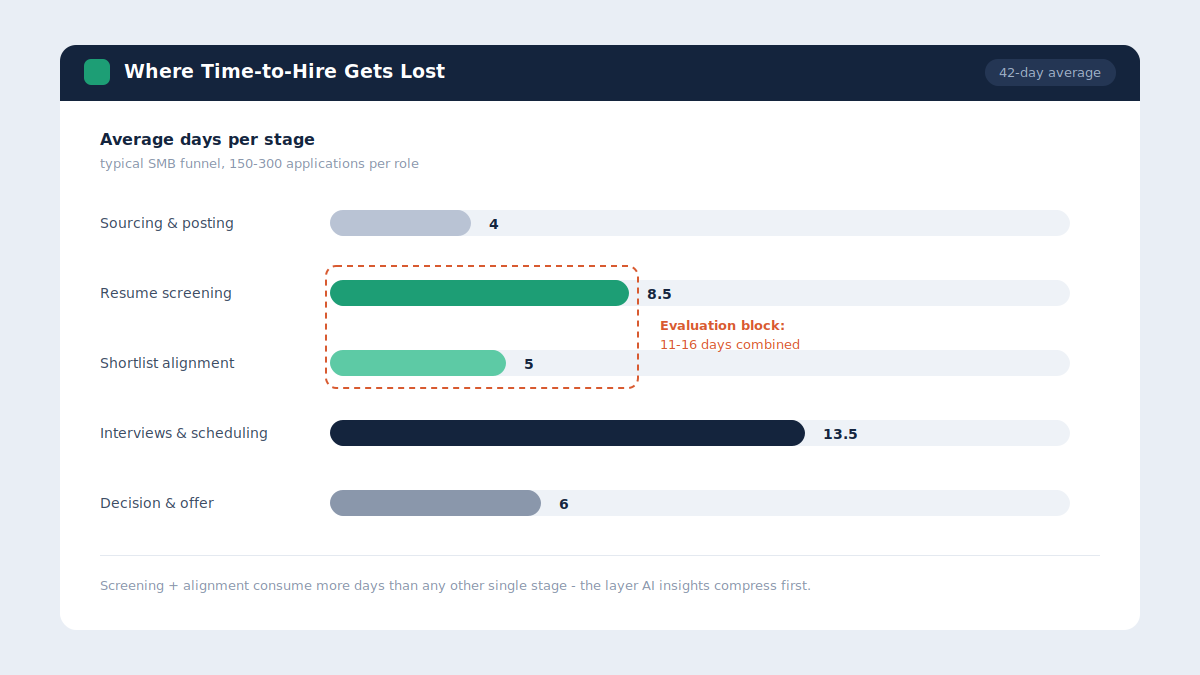
Here’s the more accurate breakdown, based on typical SMB hiring funnels handling 150–300 applications per role:
- Sourcing and posting: 3–5 days. Rarely the bottleneck once a job board or referral pipeline exists.
- Resume screening: 7–10 days. A recruiter manually reviewing 200 resumes at roughly 3–4 minutes each needs 10–13 hours of pure reading time, spread across a week of competing priorities.
- Shortlist alignment: 4–6 days. Multiple stakeholders, hiring manager, recruiter, sometimes a department head need to agree on who advances, and calendars rarely align quickly.
- Interview scheduling and rounds: 12–15 days. Coordination overhead, not interview time itself, drives this number.
- Decision and offer: 5–7 days. Internal approval chains and reference checks add friction here.
Most teams underestimate the screening-plus-alignment block by 3–4x, because it doesn’t feel slow the moment it’s spread across many small delays rather than one visible bottleneck. Add it up, and evaluation-stage delay (screening plus alignment) accounts for 11–16 of the 42 average days, more than any other single stage.
The second underestimated cost: recruiter workload. A recruiter managing 15–20 open requisitions simultaneously cannot give each candidate pool the same scrutiny on day one that they gave it on day thirty. Quality of screening degrades as volume increases which is exactly where AI-driven scoring holds a structural advantage over manual review.
There’s also a compounding cost that rarely shows up in time-to-hire dashboards: every additional day a role sits open costs an organization between roughly ₹3.3 lakh and ₹7.5 lakh a month in lost productivity, overtime coverage, and delayed project timelines, depending on role seniority. Ten open roles sitting an extra 20 days past benchmark isn’t just a scheduling inconvenience; it’s a five- or six-figure monthly drain that most finance teams never connect back to recruiting process design.
Why Stakeholder Alignment Is the Hidden Bottleneck
Screening delay is visible when a recruiter can point to a backlog of resumes. Alignment delay is not, because it’s distributed across calendars, inboxes, and Slack threads instead of sitting in one queue. A hiring manager reviewing a shortlist on day 12 instead of day 5 doesn’t look like a bottleneck from any single person’s seat, but it adds a full week to the funnel every time it happens.
This is precisely why Candidate Database Management matters as much as scoring itself. Without a single shared record, alignment delay hides in plain sight, everyone assumes someone else is reviewing, and no one is accountable for the clock.
Which AI Signals Actually Compress Time-to-Hire
This is the section that separates real time-to-hire reduction from cosmetic automation. Not every AI feature touches the clock. The signals below do and the reasoning behind why each one matters.
1. Resume Ranking and Skill-Match Scoring
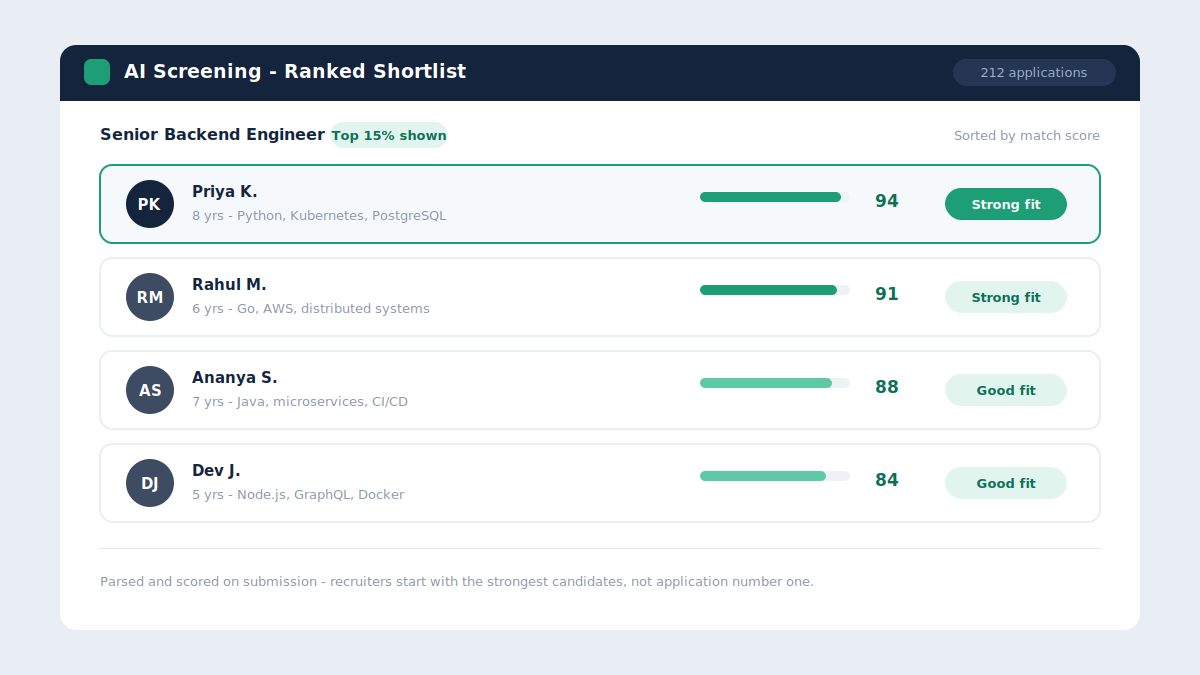
AI Resume Screening works by parsing resumes against a role’s required skills, experience thresholds, and keywords, then assigning a match score before a human ever opens the file. Instead of reading 200 resumes in the order they arrived, a recruiter opens a ranked list where the top 20–30 candidates have already surfaced.
The time saved isn’t in reading, it’s in sequencing. A recruiter who starts with the strongest 15% of applicants makes a shortlist decision in a single sitting instead of across multiple partial reviews spread over a week.
2. Predictive Fit Modeling
Ranking tells you who matches the job description. Predictive fit modeling goes further, using historical hiring data which candidate profiles converted into successful hires, and which stalled or churned within 90 days to weight scores accordingly. This reduces a second, less visible cost: mis-hires that force teams to restart the search 60–90 days later.
Predictive models are only as good as the historical data feeding them. Teams with fewer than 50 past hires in a role category should treat predictive scores as directional, not definitive, until more hiring history accumulates.
3. Centralized Candidate Database Management
Fragmented candidate records spreadsheets here, email threads there, a folder of PDFs somewhere else are a hidden tax on alignment speed. Candidate Database Management centralizes every application, note, and interview score in one searchable record, so a hiring manager reviewing a shortlist sees the full picture instantly instead of requesting context from three different people.
This matters most at the alignment stage, where 4–6 days are typically lost waiting for stakeholders to compare notes. A shared, structured database collapses that waits to the same-day in most cases.
4. Workflow Automation for Status and Scheduling
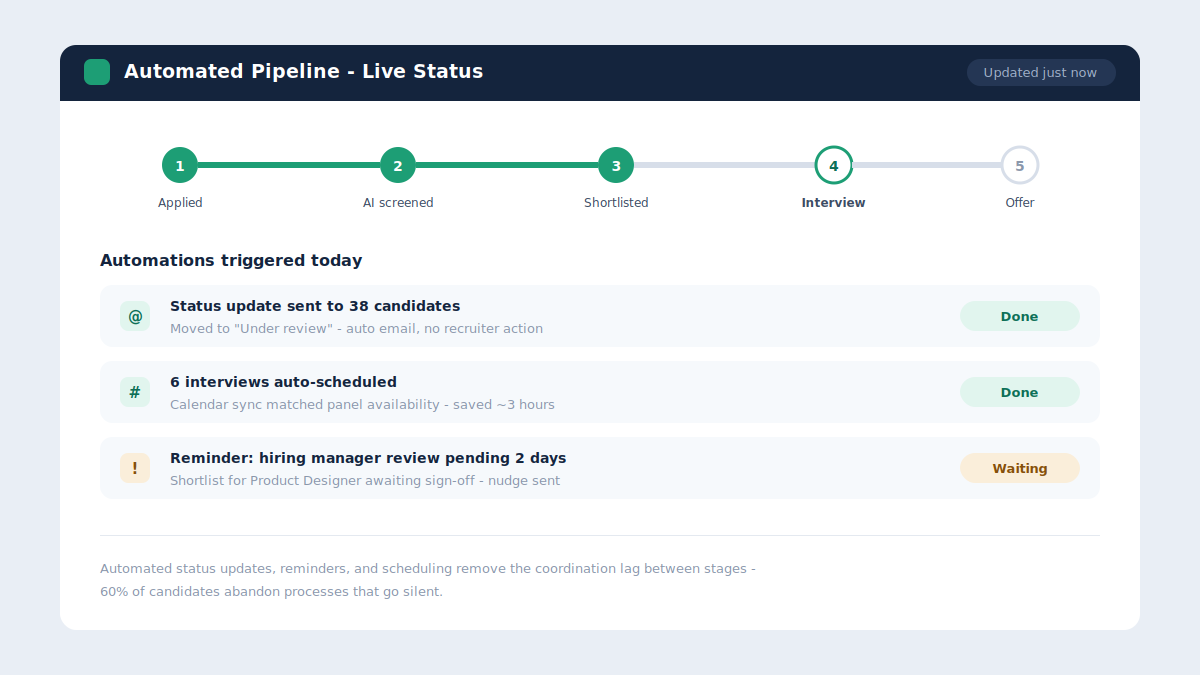
Workflow Automation Software and Recruitment Status Update Software don’t score candidates. They remove the coordination lag around scheduling, reminders, and candidate communication. Automated status updates alone can cut candidate drop-off from unanswered applications, since 60% of job seekers abandon processes that feel unresponsive during a slow, silent application review.\
5. AI-Assisted First-Round Interviewing
A structured first-round interview run by an AI interviewer applies the same evaluation criteria to every candidate, removing the variance that comes from five different recruiters asking five different questions in five different orders. This doesn’t replace later human rounds; it standardizes the first filter, so the candidates who reach a hiring manager have already cleared a consistent bar.
For SMBs hiring at volume, this matters twice over. It removes scheduling friction (no coordinating a live 30-minute slot for every applicant) and it reduces the unconscious bias risk that comes from inconsistent, unstructured first-round conversations.
6. Recruitment Analytics for Stage-by-Stage Visibility
Insight signals only compress time-to-hire if a team can see which stage is actually slow. Recruitment analytics that track time-to-hire, offer acceptance rate, recruiter load, and source effectiveness by stage not as one blended average turn a vague sense of “hiring feels slow” into a specific, fixable number. Without stage-level tracking, teams tend to fix the stage that feels slow rather than the one that measurably is.
Numbered Process: Applying AI Insights to a Live Requisition
- Parse and score every incoming resume against role-specific criteria the moment it’s submitted not in a weekly batch review.
- Auto-shortlist the top-ranked 15–20% for recruiter review, rather than starting review at application number one.
- Run structured, AI-assisted first-round screening to standardize evaluation criteria across every candidate, reducing interviewer bias and rework.
- Centralize notes and scores in one candidate record so hiring managers can align without a status meeting.
- Automate status updates and scheduling so candidates and interviewers move through the pipeline without manual chasing.
- Track time-to-hire by stage using recruitment analytics, not just the total number, so the next bottleneck is visible before it costs another week.
Compliance and Bias Considerations
Any scoring system that influences who progresses in a hiring process is subject to the same anti-discrimination scrutiny as a human recruiter’s decision. Automation doesn’t remove that responsibility, it just shifts where the audit trail needs to live.
Teams adopting AI resume screening should confirm the vendor can document what criteria a score is based on, since an unexplainable ranking is a liability the moment a rejected candidate asks why.
Two practical safeguards matter more than any marketing claim about “bias-free AI”: first, scoring models should be trained or configured on job-relevant criteria only skills, experience, certifications never on proxies correlated with protected characteristics.
Second, every score should remain visible and overridable by a human recruiter, not a hidden gate that silently removes candidates before anyone sees them. Platforms that centralize candidate database management alongside scoring make this auditability far easier, since every decision and its underlying data sit in one traceable record rather than scattered across tools.
Cost and Integration Considerations
Most AI-driven ATS platforms priced for startups and SMBs run on flat monthly pricing rather than per-recruiter or per-hire fees, which matters once a team scales past 3–4 open roles at a time. Migration from a legacy ATS is the biggest adoption friction point. Teams should confirm free, supported data migration is available before switching, since re-entering candidate history manually erases most of the time savings in month one.
Case Study: Before and After AI Candidate Insights
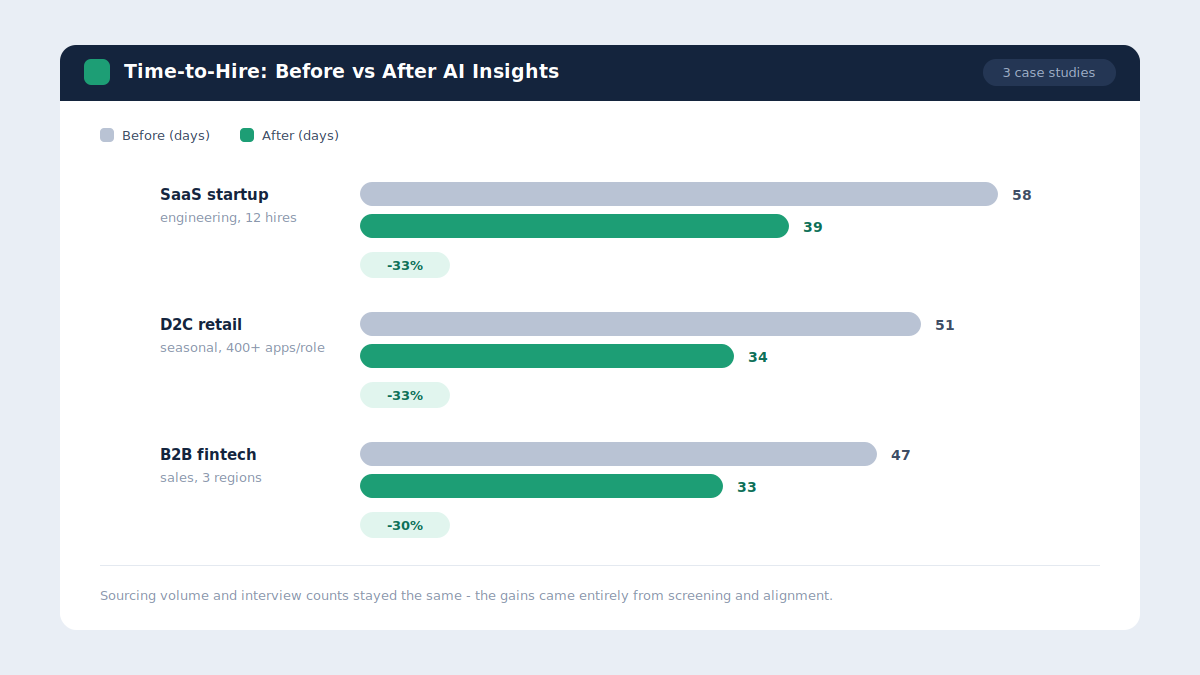
Case 1 Series A SaaS startup, 40 employees. A 12-person engineering hiring push was averaging 58 days per hire, largely stuck in a 14-day resume-screening backlog managed by one recruiter. After introducing AI resume ranking and centralized candidate database management, screening time dropped to 4 days and total time-to-hire fell to 39 days, a 33% reduction across the hiring cycle.
Case 2 D2C retail brand, seasonal hiring at scale. Handling 400+ applications per store-manager opening, the team’s alignment stage alone consumed 9 days waiting on multi-stakeholder sign-off. Predictive fit scoring and automated status updates compressed alignment to 2 days, cutting time-to-hire from 51 to 34 days ahead of a peak season launch.
Case 3 B2B fintech, sales hiring across three regions. A distributed recruiting team was losing roughly 6 days per hire simply reconciling candidate notes across three separate spreadsheets maintained by three regional recruiters. Moving to a single centralized candidate database with shared scoring cut that reconciliation delay to under a day, and the broader shift toward AI-ranked shortlists brought overall time-to-hire down from 47 to 33 days, a reduction large enough to close two competitive sales-hire offers the team had previously lost to faster-moving competitors.
Across all three cases, the pattern holds: the reduction wasn’t driven by a single feature, but by evaluation and alignment stages compressing together once scoring, centralized records, and automated updates operated on the same candidate data rather than as disconnected tools.
It’s also worth noting what didn’t change in any of the three cases: sourcing volume, interview count, and offer-approval chains stayed roughly the same. The gains came entirely from the stages between application and shortlist which is the strongest evidence that evaluation, not sourcing, is where most SMB hiring teams should look first when time-to-hire climbs past a 35–40 day benchmark.
Taken together, these cases point to a broader pattern worth stating plainly: teams don’t need to overhaul sourcing, headcount, or interview panels to see a meaningful drop in time-to-hire. The stages that respond fastest to AI-driven insight screening and alignment are also the stages every SMB hiring team already controls internally, without needing buy-in from candidates, the job market, or hiring managers outside the recruiting function.
Comparison Framework: Choosing an Approach to Reduce Time-to-Hire
| Approach | Time-to-Hire Impact | Best Fit |
| Manual resume review only | Minimal; screening stays 7–10 days | Very low hiring volume (under 20 applications/role) |
| Scheduling automation only | Moderate; saves 3–5 coordination days | Teams with strong screening but slow logistics |
| AI resume ranking + scoring | High; screening drops to 2–4 days | High-volume SMB hiring, 100+ applications/role |
| Full AI ATS (screening + database + workflows) | Highest; 25–35% total reduction | Startups and SMBs scaling multiple roles at once |
The table makes one thing clear: point solutions solve one stage’s delay while leaving the others untouched. The largest time-to-hire gains come from insights and automation working across the same candidate record, not from stitching together separate tools for scoring, scheduling, and status updates.
When evaluating options, weigh integration cost as heavily as feature depth. A scoring tool that doesn’t share data with the scheduling tool just moves the coordination burden from one stage to another; a recruiter still has to manually copy a ranked shortlist into a separate calendar system, which erases a meaningful share of the time saved upstream.
The platforms that move the needle most are the ones where AI Resume Screening, database management, and workflow automation sit on one shared record from the start.
What Most Teams Get Wrong About AI and Time-to-Hire
Most teams treat AI screening as a replacement for judgment rather than an input to it. That’s backwards. Scoring and ranking exist to narrow the field faster; the hiring decision itself still belongs to a human, and treating a score as a final verdict is how teams end up with compliance risk and weaker hires, not faster ones.
The second mistake: measuring time-to-hire as one number instead of by stage. A team that only tracks “42 days average” has no idea whether the bottleneck is screening, alignment, or scheduling which means the fix gets applied to the wrong stage, and the next hiring cycle looks identical to the last one.
The third, quieter mistake is skipping the quality of hire feedback loop. Only 20% of organizations currently measure quality of hire, according to SHRM’s 2025 benchmarking data, which means most teams optimizing purely for speed have no signal on whether faster hires are also good hires. Predictive fit models degrade without that feedback; they need outcome data flowing back in, not just applications flowing out.
The fourth mistake is rolling out AI insights on top of a fragmented process instead of a centralized one. Adding a scoring model to a hiring workflow that still runs on scattered spreadsheets and email threads produces a ranked list nobody trusts, because the underlying candidate record it’s scoring against is incomplete. AI Candidate Insights for Time-to-Hire work best as a layer on top of a single, centralized system of record, not as a patch on top of disconnected tools.
Getting Started This Week
Three steps don’t require a platform migration to start showing results:
- Pull your last 10 hires and map time-to-hire by stage sourcing, screening, alignment, interview scheduling, decision. Most teams find the biggest surprise isn’t the total number, but which single stage accounts for a third or more of it. This alone usually reveals which stage is the real bottleneck, not the assumed one.
- Rank your current open applications by skill match before reading them in order. Even a basic scoring pass matching required skills, years of experience, and role-specific keywords changes which 20 resumes a recruiter reads first, and that reordering alone typically shaves 2–4 days off the screening stage without touching any other part of the process.
- Centralize candidate notes and interview scores in one record accessible to every stakeholder in the decision, so alignment stops requiring a meeting. A shared record turns a multi-day email thread into a five-minute review, and it’s usually the single highest-leverage change a team can make before evaluating any new software.
None of these three steps require a new platform to start. They require treating time-to-hire as a stage-by-stage metric rather than a single number, and applying AI Candidate Insights for Time-to-Hire even in a lightweight form to the stages actually causing delay.
If you’re evaluating AI Candidate Insights for Time-to-Hire and want to pressure-test where your own funnel is losing days before committing to a new ATS, Hirium’s team has mapped this exact breakdown across 5,000+ hiring workflows. You can review the free plan and run the stage-by-stage analysis yourself at hirium.com no credit card required to see where your 42 days are actually going.
Frequently Asked Questions
What is time-to-hire and why does it matter?
Time-to-hire is the number of days between a candidate entering the pipeline and accepting an offer. It matters because every extra day increases the risk of losing a candidate to a competing offer, and research consistently shows top candidates are typically off the market within 10 days of becoming available. A slow process doesn’t just delay hiring, it actively filters out the strongest applicants first, leaving weaker options by the time a decision finally gets made.
How does AI reduce time-to-hire?
AI reduces time-to-hire primarily by compressing the screening and alignment stages of the two slowest, most manual parts of the funnel. Resume ranking, skill-match scoring, and predictive fit models let recruiters start with the strongest candidates instead of reading applications in arrival order. Centralized candidate records and workflow automation then remove the coordination lag that stretches scheduling and stakeholder sign-off, compounding the time saved in evaluation.
What is a good time-to-hire benchmark to target?
For SMB roles below senior management, 25–35 days is a realistic, competitive benchmark once evaluation and alignment stages are compressed with insight-driven screening. Entry-level and specialist roles should trend toward the lower end of that range; technical and mid-management roles often land closer to 35–40 days even with strong automation in place, since interview volume for skilled roles tends to run higher regardless of screening speed.
Can AI screening replace human recruiters?
No. AI screening narrows and ranks candidates by fit and skill match; it does not make the final hiring decision, and it shouldn’t. Teams that treat a score as a final verdict rather than a starting point for human judgment introduce both compliance risk and weaker hiring outcomes, since context, culture fit, and nuance still require a person in the loop.
Is AI recruitment software affordable for small businesses and startups?
Yes several AI-powered ATS platforms now offer forever-free tiers with no credit card required, using flat monthly pricing instead of per-recruiter or per-hire fees. That structure makes AI-driven screening and candidate database management accessible well before a company scales to enterprise hiring volume, removing the usual cost barrier that keeps early-stage teams on spreadsheets and manual review for longer than they should be.
What’s the difference between time-to-hire and time-to-fill?
Time-to-hire starts when a specific candidate enters the pipeline and ends at offer acceptance, making it the metric most directly affected by AI screening and scoring. Time-to-fill starts earlier, at requisition approval, and includes the sourcing lag before any candidate is identified at all, which is why time-to-fill numbers are typically 15–20 days higher than time-to-hire figures for the same role.
How quickly can a hiring team start seeing time-to-hire improvements after adopting AI insights?
Most teams see measurable screening-stage improvement within the first 2–3 open roles, since ranking and scoring apply from the first batch of applications. Alignment and scheduling gains typically show up by the second hiring cycle, once the team adjusts its review habits around a ranked shortlist instead of a raw applicant list.