Candidate Profile Management : How Recruiters Build a Single Source of Truth
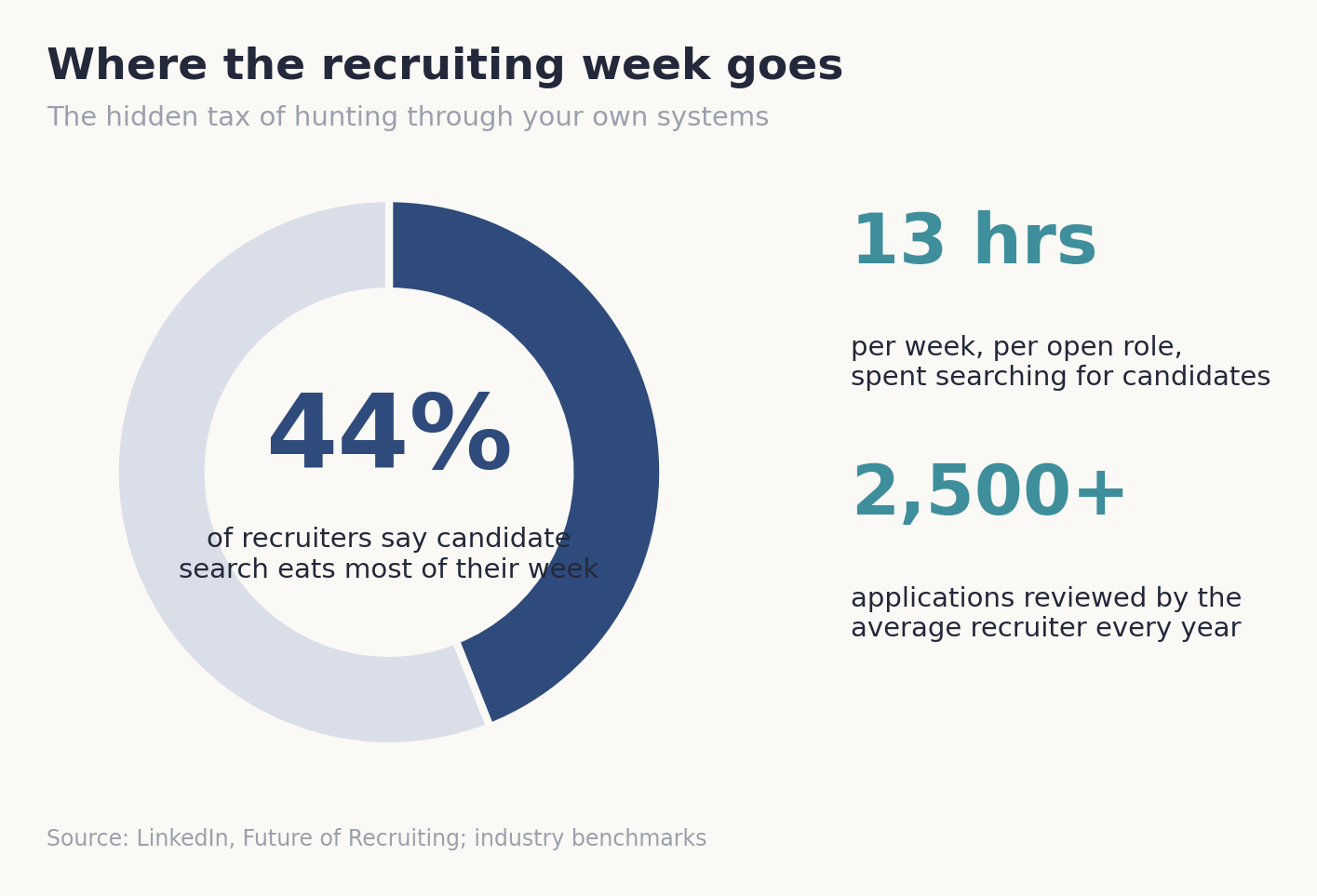
Recruiters spend an average of 13 hours per week, per open role, just searching for candidates and 44% say searching now consumes the largest share of their time. The detail that should bother every hiring leader is where that search happens: a large slice of it is internal, with recruiters hunting through their own systems for records they already own.
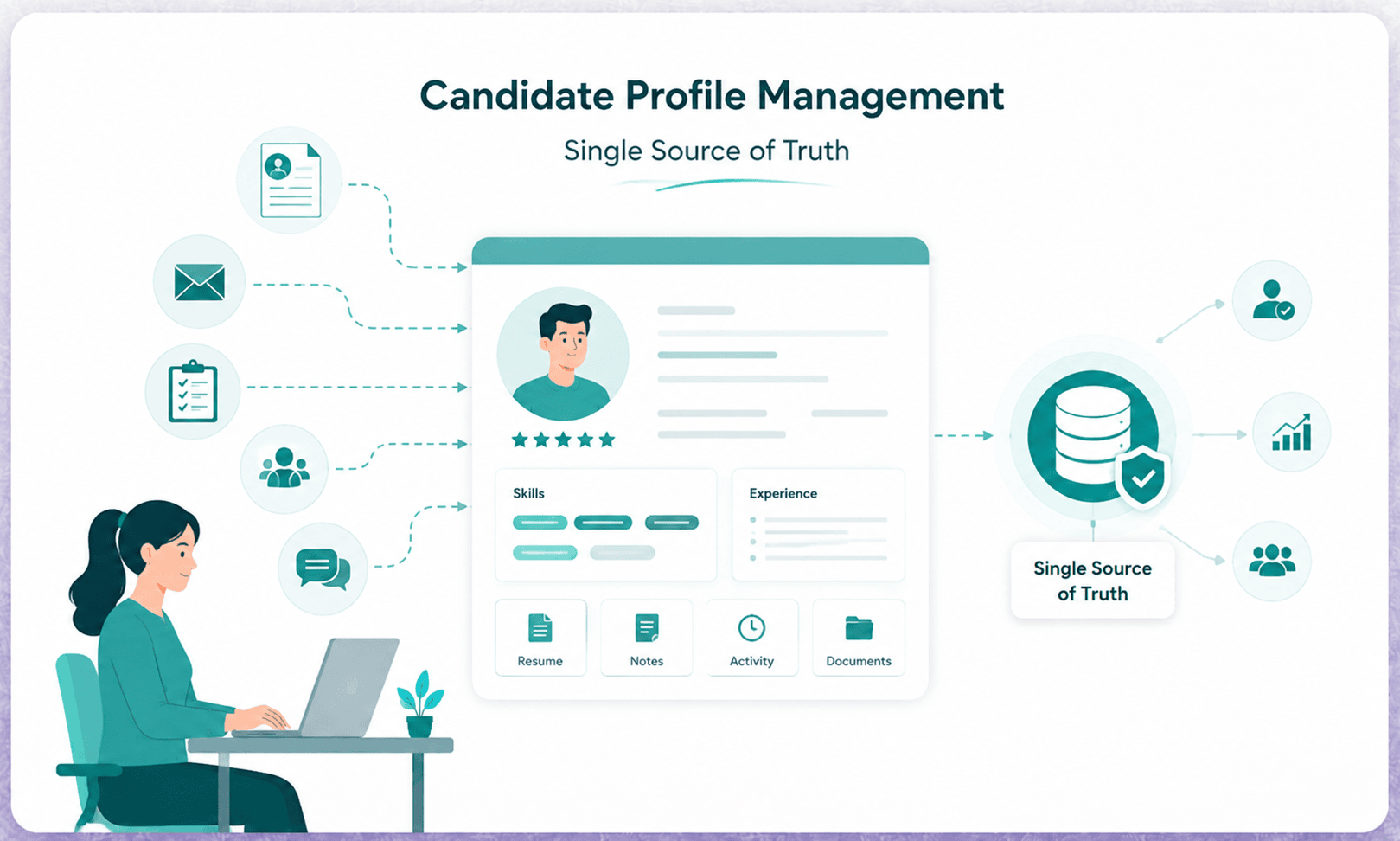
That hunt is the symptom. The disease is fragmented data. When the same person exists as three half-finished records one from a job-board import, one from a referral, one from a LinkedIn export no recruiter can trust what they see. This is exactly the gap that disciplined Candidate Profile Management closes. Done well, it turns scattered fragments into one authoritative record per person, so the next recruiter who opens that file inherits context instead of confusion.
LinkedIn’s Future of Recruiting research found that recruiters spend roughly 13 hours per week per role on candidate search, and 44% report that search activity takes up most of their time.
The cost compounds quietly. A duplicate record means a candidate gets emailed twice, screened twice, or worse rejected by one recruiter while another is mid-conversation with them. Multiply that across 2,500+ applications the average recruiter now reviews each year, and the cracks become a structural leak in your hiring pipeline.
The recruiters who escape this don’t simply work harder inside a messy system. They rebuild the system so every candidate maps to a single, trustworthy file. The sections below cover what belongs in that file, how duplicates sneak in, a profile-health checklist you can run this week, and how modern parsing turns a raw resume into a structured record without manual data entry.
What Is Candidate Profile Management?
Candidate Profile Management is the practice of creating, organizing, enriching, and maintaining a single accurate record for each candidate covering skills, work history, contact details, notes, and status so recruiters work from one trusted source of truth instead of scattered, duplicated, or outdated data across multiple tools.
That definition is deliberately narrow. It is not “storing resumes,” and it is not “having an ATS.” Plenty of teams have both and still operate on bad data. The discipline is in the maintenance: keeping each candidate record current, deduplicated, and complete enough that a hiring decision can rest on it. In short, Candidate Profile Management is less about software and more about a standard you hold every record to.
The Core Problem: Fragmented Data Is Expensive, and Most Teams Underestimate It
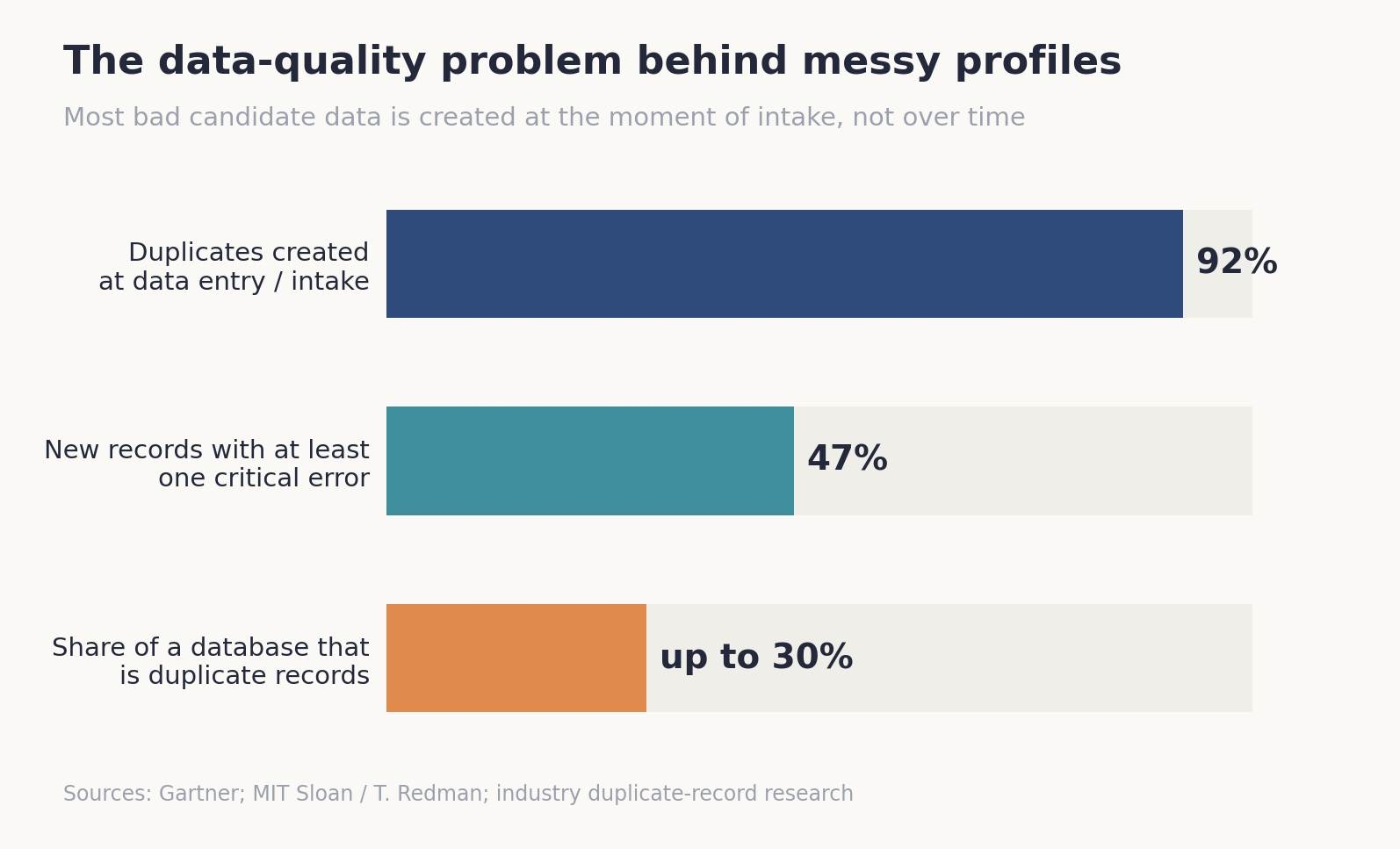
The numbers around data quality are unforgiving. Gartner estimates that poor data quality costs the average organization $12.9 million per year, and research compiled across industries puts duplicate records at 10–30% of a typical business database. In a recruiting context, that means up to one in three candidate files may be a duplicate, a stale fragment, or both.
The decay rate makes it worse. Contact data goes out of date fast phone numbers change, people switch companies, emails die. A candidate you sourced eight months ago may now have a new title, a new employer, and a new email, while your system still shows the old one. Without active Candidate Database management, your “talent pool” slowly becomes a graveyard of records nobody trusts.
Here is the part teams routinely miss: the error rate is highest at the moment of creation, not over time. MIT Sloan research with data expert Thomas Redman found that 47% of newly created records contain at least one critical error. So the problem isn’t only old data going bad it’s new data entering broken. If your intake process lets a recruiter spin up a fresh record instead of matching to an existing one, you are manufacturing duplicates on day one.
The downstream effects are concrete and measurable. Time-to-fill in the U.S. has climbed to roughly 44 days, up about 33% from 33 days in 2021. Some of that increase is market-driven, but a meaningful share is self-inflicted: recruiters re-screening people they already evaluated, re-sourcing candidates already sitting in the database, and rebuilding context that should have lived in a single profile all along.
There is a quieter cost too: trust. Once recruiters learn that the database can’t be relied on, they stop using it. They keep private spreadsheets, screenshot conversations, and route status updates through chat instead of the system. Every workaround fragments the data further, which erodes trust further, a doom loop that no amount of new software fixes until the underlying records are made dependable.
This is the business case in one line. Strong Candidate Profile Management doesn’t just tidy your data it directly attacks the two metrics every hiring leader is judged on: time-to-fill and recruiter capacity. Treating it as a strategic data discipline, rather than administrative cleanup, is the shift that separates teams that scale hiring from teams that drown in it.
The Strategic Build: From Raw Resumes to a Single Source of Truth
This is where the work actually happens. Building a defensible system of record requires decisions about what each profile contains, how data enters, how duplicates are prevented, and how the record stays alive after the first touch. Treat the following as an architecture, not a checklist of nice-to-haves. Effective Candidate Profile Management is the sum of these decisions, not any single feature.
What Fields a Strong Candidate Profile Should Contain
A profile that supports real decisions needs more than a parsed resume. The goal is structured candidate data information stored in consistent, searchable fields rather than buried in attachments. At minimum, a strong profile should carry:
- Identity and contact: Full name, primary email, phone, location/time zone, and links (LinkedIn, portfolio, GitHub). One canonical email is the anchor used for deduplication.
- Skills and competencies: Tagged, structured skills not just keywords in a PDF. “Python, 5 yrs” as a field beats “Python” buried on page two.
- Work history: Roles, employers, dates, and a one-line scope per role, so seniority is readable at a glance.
- Source and consent: Where the candidate came from (referral, career page, job board, sourced) and any consent/GDPR status critical for compliance and for measuring source effectiveness.
- Status and stage: Where the person sits in the recruitment pipeline right now, with timestamps.
- Notes and feedback: Structured interview notes and scorecards, attributed to who wrote them and when.
- Tags: Free but governed labels “senior backend,” “open to relocation,” “silver-medalist Q1” that power fast filtering and talent rediscovery later.
The tags field deserves emphasis. Tags are how a database stays re-searchable. They are also the first thing to descend into chaos without a shared taxonomy, which is why governance matters more than volume.
How Duplicate Candidate Profiles Happen
Duplicates are rarely one person’s fault; they are a process failure. Understanding the mechanics is the first step to preventing them. Research on duplicate records found that 92% are created during the initial data-entry or intake phase when an overloaded recruiter creates a new record rather than searching for the existing one.
The common culprits in recruiting are specific and recurring:
- Multi-channel intake. The same candidate applies through your career page, gets referred by an employee, and is sourced on LinkedIn three entry points, three records.
- Inconsistent identifiers. “Jon Smith” with a personal Gmail and “Jonathan Smith” with a work email read as two people to a naive system.
- Bulk imports. Migrating from an old tool or uploading an event list without a match-on-import rule dumps duplicates straight into the database.
- Re-applications. A strong candidate from last year reapplies and a brand-new file is created, severing the history and notes you already paid to gather.
The fix is matching logic at the point of entry: deduplication that checks email, name, and phone against existing records before a new profile is allowed to exist. Data hygiene is cheapest when enforced at creation and most expensive when retrofitted in cleanup.
A Candidate Profile Health Checklist
Run this audit against a sample of 50 records. If more than a handful fail any line, you have a maintenance problem worth fixing before you buy anything new.
- Uniqueness: No duplicate exists for this person (matched on email and phone).
- Completeness: All critical fields populated email, phone, current title, source, and status.
- Recency: Contact data and status touched within a reasonable window for an active candidate.
- Attribution: Every note and rating shows who added it and when.
- Consent: Source and data-retention/consent status are recorded.
- Tag integrity: Tags follow the shared taxonomy, not ad-hoc free text.
- Single status: The candidate shows one current stage, not conflicting statuses across tools.
A profile passing all seven is “trustworthy.” Anything below five is a record you cannot safely make decisions on.
What a Clean Profile Layout Looks Like
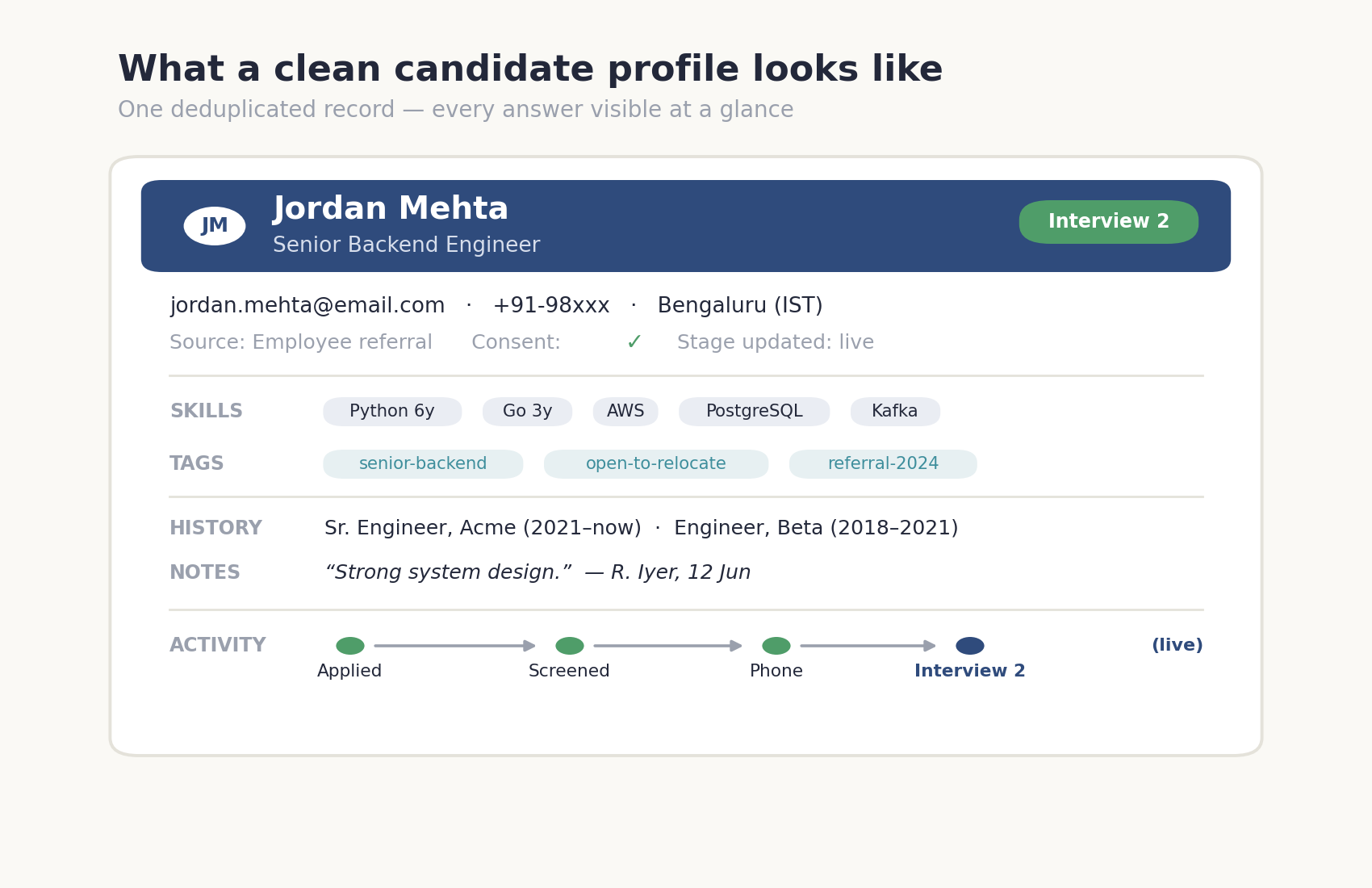
A clean layout makes the seven checklist items visible at a glance, so a recruiter never has to dig. The structure below is the practical target and the kind of view a well-built ATS renders by default.
┌─────────────────────────────────────────────────────────────┐
│ ● Jordan Mehta [Senior Backend Engineer] │
│ jordan.mehta@email.com · +91-98xxx · Bengaluru (IST) │
│ Source: Employee referral · Consent: ✓ · Stage: Interview 2 │
├─────────────────────────────────────────────────────────────┤
│ SKILLS Python (6y) · Go (3y) · AWS · PostgreSQL · Kafka │
│ TAGS senior-backend · open-to-relocate · referral-2024 │
├─────────────────────────────────────────────────────────────┤
│ HISTORY Sr. Engineer, Acme (2021–now) · Engineer, Beta… │
├─────────────────────────────────────────────────────────────┤
│ NOTES “Strong system design.” R. Iyer, 12 Jun │
│ ACTIVITY Applied → Screened → Phone → Interview 2 (live) │
└─────────────────────────────────────────────────────────────┘
Suggested image alt text for the published version: “Candidate Profile Management view showing a clean, deduplicated candidate record with skills, tags, history, and status.”
Notice what the layout does: identity and dedup-anchors sit at the top, decision data (skills, tags) is structured, and the activity trail proves there is exactly one status no guessing whether someone else is already talking to this person. This layout is the visible output of good Candidate Profile Management: the record answers a recruiter’s questions before they have to ask them, which is the entire point of building a single source of truth in the first place.
How an ATS Auto-Builds Profiles From Parsed Resumes
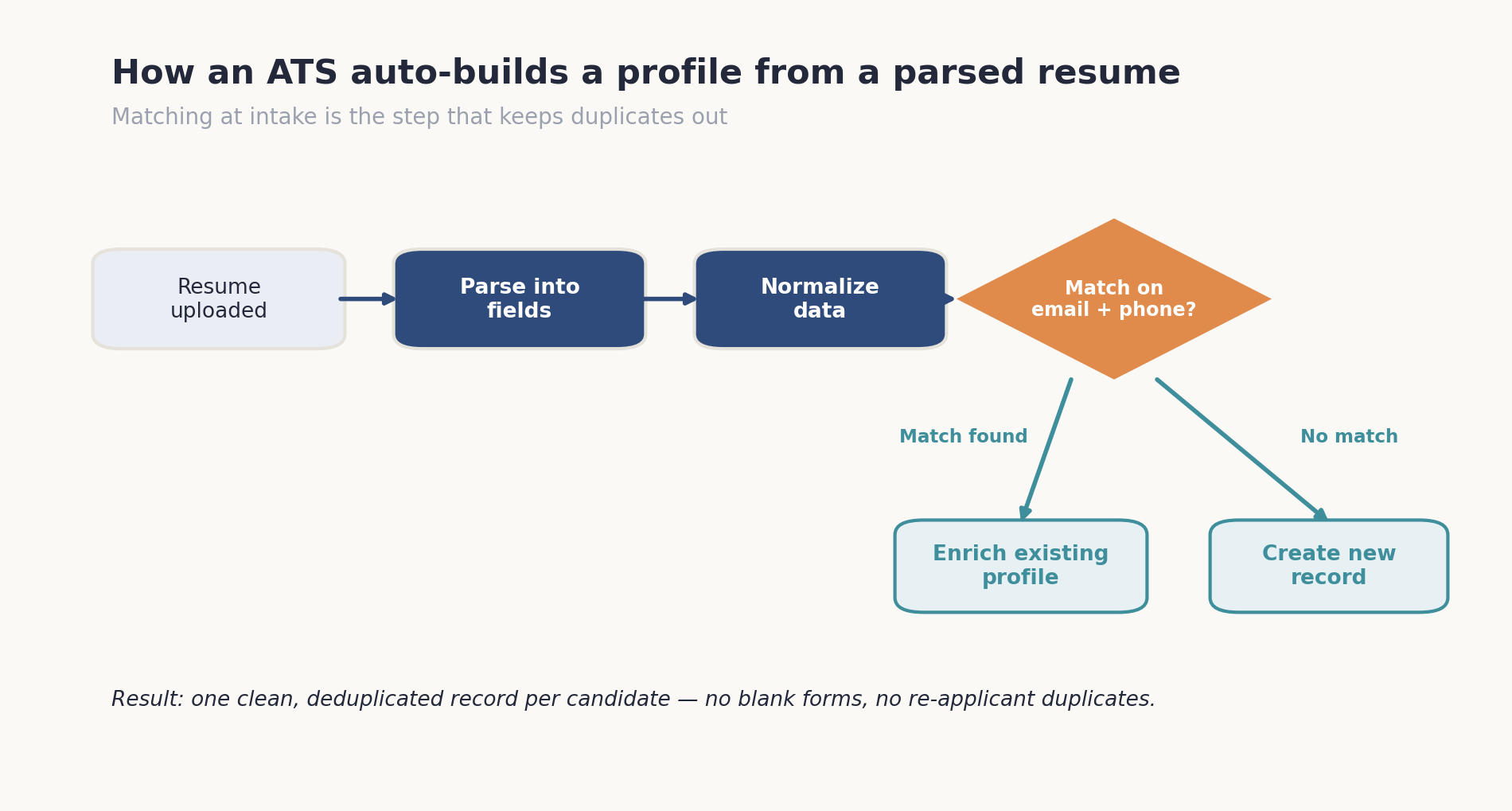
Manual data entry is where errors and duplicates are born, so the highest-leverage move is to remove the manual step. Modern resume parsing reads an uploaded CV and maps it into structured fields name, contact, skills, employers, dates then checks that data against the existing applicant tracking system before creating a record.
The sequence that prevents duplicates looks like this: parse the resume into fields, normalize the data (consistent date formats, deduplicated skills), match against existing records on email and phone, then either enrich the existing profile or create a new one. The match step is what separates a tidy database from a bloated one.
This is also where Hirium’s parsing is designed to help: it builds a structured profile from the parsed resume automatically and matches it against the database on intake, so a re-applicant updates an existing record rather than spawning a fresh duplicate. The recruiter starts with a complete, deduplicated file instead of a blank form.
Compliance, Consent, and Integration Considerations
Clean profiles are also a compliance asset, not just an efficient one. Privacy regimes such as GDPR and similar frameworks require that you know what candidate data you hold, why you hold it, and for how long, which is impossible when the same person exists as five scattered records with conflicting consent flags. A consolidated profile makes data-retention rules enforceable: you can honor a deletion request or an opt-out against one authoritative record instead of hunting for fragments across tools.
Integration is the other half of the equation. Most teams don’t run hiring from a single app candidate data flows in from career pages, job boards, referral tools, and sometimes an HRIS. Without a system that treats one of these as the source of record and matches everything else against it, every integration becomes a new duplicate-generation engine. The architectural decision that matters most is naming the master record and routing all inbound data through a match-on-entry rule before it lands. Sound Candidate Profile Management is what makes those integrations safe to switch on rather than a liability.
The cost implications are straightforward. Manual cleanup of a bloated database is the most expensive path; it consumes recruiter hours that should go to sourcing, and the duplicates return within months. Prevention at the point of entry, by contrast, is close to free once configured, because the system simply refuses to create a record it already has. The return isn’t theoretical: it’s recovered hours, fewer re-screens, and a talent pool you can actually search.
A Six-Step Process to Consolidate Your Candidate Database
For teams inheriting a messy system, the path to a single source of truth follows a repeatable sequence. Working through it in order to skip the prevention step at the end is why most cleanups fail.
- Audit a sample. Run the profile-health checklist against 50 random records to quantify your duplicate and incompleteness rates before touching anything.
- Define the match key. Decide what makes two records “the same person” usually canonical email plus phone, with name as a secondary signal.
- Standardize the fields. Agree on a tag taxonomy, date formats, and required fields so consolidated records are consistent.
- Deduplicate and merge. Merge matched records, preserving the richest notes, history, and earliest source attribution. Never delete the history, it’s the asset.
- Backfill gaps. Enrich incomplete profiles with missing contact and skill data so the consolidated record passes the health check.
- Enforce prevention at intake. Turn on match-on-entry so future applications, imports, and referrals update existing records instead of creating new ones.
The first five steps clean the present; the sixth protects the future. A consolidation project that stops at step five is the treadmill described earlier clean today, duplicated again by next quarter.
Real-World Application: What Cleaner Profiles Actually Change
The payoff shows up in two recurring patterns at startups and SMBs hiring under volume pressure.
Talent rediscovery. One mid-size SaaS team sat on roughly 8,000 past applicants but kept sourcing net-new for every role. After deduplicating the database and standardizing tags, they began filling a meaningful share of roles from existing records mirroring the broader industry shift in which 44% of sourced hires in 2024 came from existing ATS/CRM records, up from 29% in 2021. The candidates were already there; they simply weren’t findable.
Re-screen elimination. A 20-person recruiting team discovered that duplicate profiles were causing the same candidates to be screened by two recruiters. Consolidating to one record per person removed the redundant screens and recovered hours each week that went straight back into outbound sourcing the activity that, per benchmark data, makes a sourced candidate roughly 5x more likely to be hired than an inbound applicant.
Neither outcome required hiring more recruiters. Both came from making the existing database trustworthy.
A third pattern shows up in fast-scaling startups: status confusion at handoff. When a recruiter goes on leave or a role is reassigned, the incoming recruiter inherits the candidate database and if statuses live across spreadsheets and inboxes, they effectively start from zero. One Series-A team cut their handoff ramp from days to hours simply by enforcing one live status per candidate inside a single system. The lesson generalizes: Candidate Profile Management is what makes a recruiting team resilient to turnover, not just efficient on a good day.
A Decision Framework: How to Evaluate Your Current Approach
Before adopting any tool, score how you handle profiles today. The table below compares three common maturity levels so you can place your team honestly.
| Dimension | Manual / Spreadsheet | Basic ATS | AI-Assisted ATS |
| Profile creation | Hand-keyed; high error rate | Resume upload, partial fields | Auto-parsed into structured fields |
| Deduplication | None duplicates accumulate | Manual merge after the fact | Match-on-intake prevents duplicates |
| Status visibility | Lives in someone’s head | Single tool, manual updates | Real-time, automated updates |
| Rediscovery | Near impossible | Keyword search only | Tag + skill search with insights |
| Maintenance cost | Highest (cleanup is constant) | Moderate | Lowest (prevention at entry) |
If most of your reality sits in the left two columns, the issue isn’t effort, it’s architecture. The right column is where AI Candidate Insights earn their keep: surfacing the strongest existing records for a new role instead of leaving recruiters to remember who they liked last quarter.
One dimension deserves a closer look because it’s the one teams feel daily: status visibility. Real-time candidate tracking where a stage change is reflected everywhere the instant it happens is the operational payoff of Candidate Profile Management. When status is a live field rather than a thing recruiters update by memory, automated reminders fire correctly, hiring managers see accurate pipelines, and nobody chases a candidate who already declined. The moment status lives in one record, the rest of the hiring workflow becomes trustworthy enough to automate.
What Most Teams Get Wrong
The most common mistake is treating profile quality as a cleanup project instead of an intake discipline. Teams schedule a quarterly “database scrub,” merge a few hundred duplicates, feel productive and then watch the duplicate count climb right back because nothing changed at the point of creation. Cleanup without prevention is a treadmill.
The second mistake is over-investing in sourcing while under-investing in the database they already have. With 44% of sourced hires now coming from existing records, the cheapest candidate is almost always one you’ve already met. Teams that pour budget into net-new sourcing while their past-applicant database rots are paying twice for the same talent.
The third, and most expensive, is confusing “we have an ATS” with “we have clean data.” An applicant tracking system is a container. If your intake allows duplicates, your tags are ungoverned, and statuses live in three places, the container is full of the same mess just better organized to look at. Good Recruitment Status Update Software keeps one live status per candidate; without that single source, automation simply amplifies the confusion. The discipline of Candidate Profile Management is what makes the tool worth its license fee, not the other way around.
A practical tell: if two recruiters can independently reach contradictory conclusions about a candidate’s stage by looking at different screens, you do not yet have a single source of truth you have synchronized guessing. Fixing that is the whole job of Candidate Profile Management.
Where to Start: Turn Your Database Into a Single Source of Truth
There’s a fast way to find out whether your database is an asset or a quiet liability: run the seven-line profile-health check above on a 50-record sample. The result tells you whether your real problem is intake duplicates forming at the source maintenance, where each candidate record slowly decays, or tooling, where an applicant tracking system stores a mess instead of preventing it. Knowing which of the three you’re fighting is what lets you fix the right thing first instead of throwing software at a process problem. Strong Candidate Profile Management is less a one-time project than a standard you hold every profile to.
If the audit points to architecture rather than effort, the next step is concrete. See what a parsed, deduplicated, single-source profile looks like on your own data before you commit to any vendor. Comparing your current records side by side with a clean, auto-built profile is the clearest way to seize the prize: recovered recruiter hours, shorter time-to-fill, fewer re-screens, and a database you can finally mine for talent rediscovery instead of paying to re-source people you already met.
Teams hiring at volume tend to reach the same conclusion. The cheapest, fastest hire is usually someone already sitting in the system, waiting to be found behind a duplicate or a stale field. Hirium offers a forever-free plan and supported migration from your existing ATS, so you can pressure-test your data hygiene and see a true single source of truth on your own candidates: no contract, no credit card, no recruiter fees.
So make the next move a small, evidence-based one. Run the health check, map your duplicates, and let the numbers decide whether your fix is intake, maintenance, or tooling. Disciplined Candidate Profile Management compounds quietly every clean profile you build today is context your team inherits on every future role, and your next great hire may already be in your database.
Frequently Asked Questions
What is candidate profile management?
It is the ongoing practice of building and maintaining one accurate, deduplicated record per candidate covering skills, history, notes, source, and live status so recruiters make decisions from a single source of truth. It spans creation, enrichment, deduplication, and maintenance, and it’s the discipline that determines whether an ATS actually saves time or just stores mess more neatly.
How do duplicate candidate profiles happen?
Most duplicates form at intake. Research shows about 92% of duplicate records are created during data entry, typically when a candidate enters through multiple channels (career page, referral, sourcing), uses different email addresses, reapplies later, or arrives via a bulk import with no match-on-entry rule. Prevention means checking new data against existing records before a profile is created.
What should a strong candidate profile include?
Identity and one canonical contact email, structured skills with experience levels, dated work history, source and consent status, current pipeline stage with timestamps, attributed notes and scorecards, and governed tags. Storing this as structured fields rather than as a buried PDF is what makes the record searchable and decision-ready, and it’s the foundation everything else in Candidate Profile Management is built on.
What is a single source of truth in recruiting?
It means every candidate maps to exactly one authoritative record that all recruiters and hiring managers reference. No conflicting statuses, no duplicate files, no “which version is current?” A genuine single source of truth is what lets Workflow automation software send reminders, status updates, and emails confidently because automation built on duplicated data just multiplies the errors.
How does an ATS build candidate profiles automatically?
It parses an uploaded resume into structured fields, normalizes the data, matches it against existing records on email and phone, and then either enriches the matching profile or creates a new one. The matching step is the safeguard that prevents a re-applicant from becoming a duplicate, so the recruiter starts with a complete file rather than a blank form.
How often should you clean your candidate database?
Continuous prevention at intake matters more than periodic scrubbing, but a focused audit each quarter against a profile-health checklist covering uniqueness, completeness, recency, and tag integrity keeps quality from drifting. Mature Candidate Profile Management treats cleanliness as a standing process, not an event. If your duplicate rate climbs back after a cleanup, the fix belongs at the point of entry, not in another scrub cycle.
Can better profile data reduce time-to-hire?
Yes, indirectly but materially. With time-to-fill near 44 days and recruiters losing roughly 13 hours a week to search, eliminating duplicate records, re-screens, and lost context removes friction at several stages at once. Teams that consolidate to one trustworthy record per candidate typically redirect recovered hours into sourcing the activity most correlated with faster, better hires. If you want to pressure-test your own numbers, a short audit is the place to start.