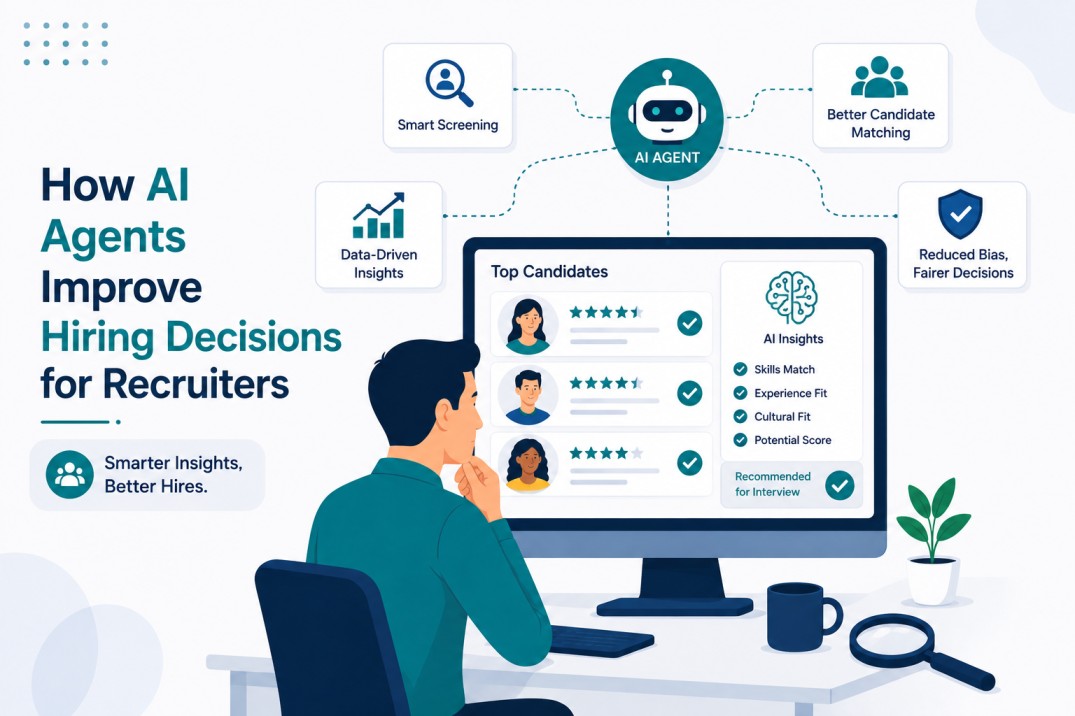
How AI Agents Improve Hiring Decisions for Recruiters
A recruiter reviewing 250 applications for a single mid-level role spends an average of 6 seconds on each resume before deciding to reject or advance it.
Multiply that across 15 open requisitions and the math stops working, not because recruiters aren’t skilled, but because volume has outpaced human bandwidth. This is the gap AI agents were built to close, and it’s why AI Agents Improve Hiring Decisions has become one of the most searched questions among startup and SMB talent teams in 2026.
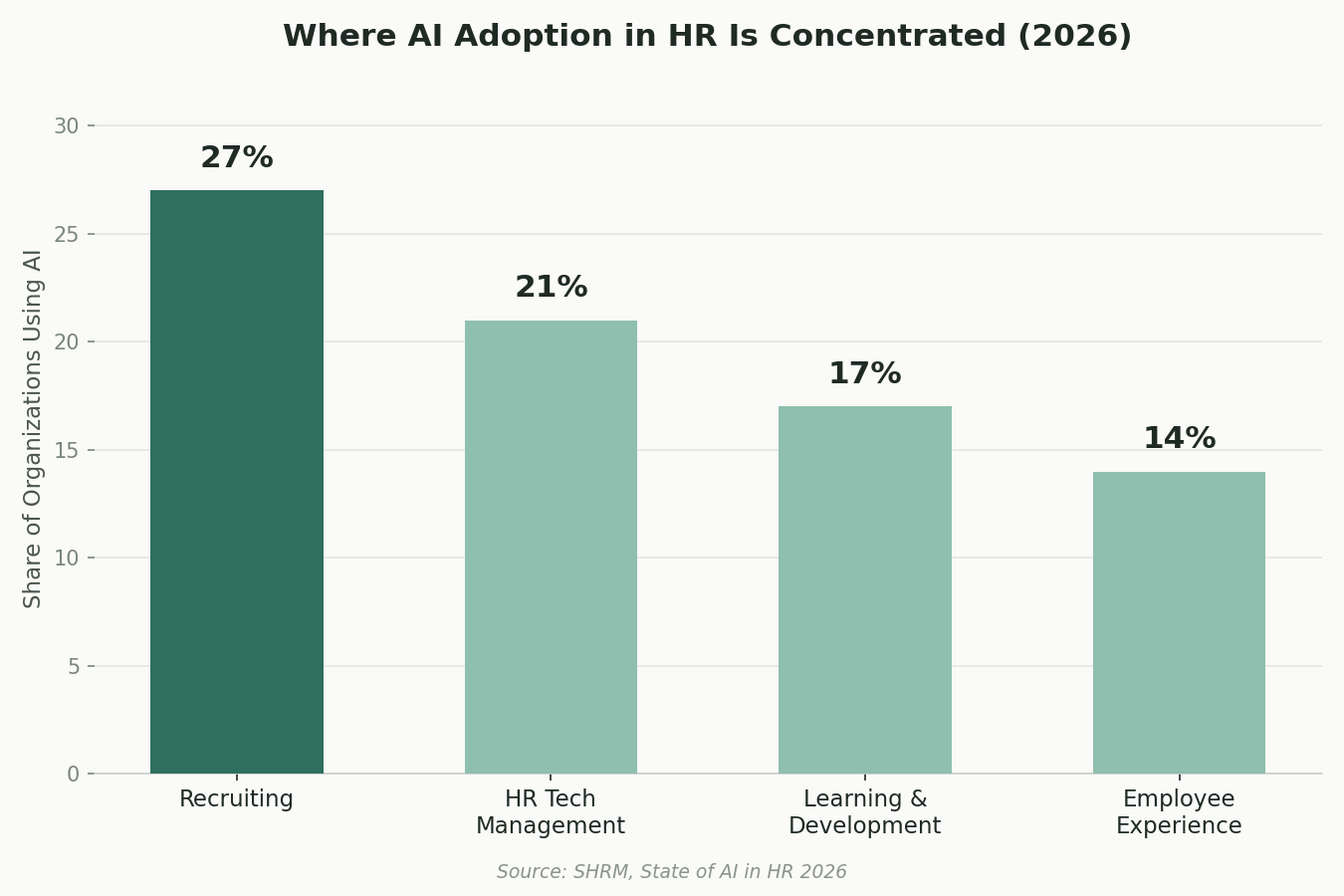
The shift isn’t theoretical. According to SHRM’s State of AI in HR 2026 report, recruiting is now the leading function for AI adoption within HR, with 27% of organisations using AI specifically in their hiring workflows, ahead of learning and development, employee experience, and other HR use cases.
That concentration matters. It means the tools maturing fastest right now are the ones recruiters touch every day: resume parsing, candidate matching, and first-round screening.
This piece breaks down what AI agents in recruitment actually do, where they genuinely improve hiring decisions, where they fall short, and how a hiring team should evaluate them without falling for a feature list dressed up as a strategy.
We’ll cover the mechanics of AI recruitment agents, the process changes teams need to make, and the oversight structures that keep AI-assisted hiring decisions fair and legally defensible, along with an AI recruitment software checklist to help teams evaluate the right tools.
For startups and SMBs specifically, the stakes around getting this right are higher than they look. A single bad hire at a 40-person company affects a much larger share of the org chart than the same mistake at a 4,000-person enterprise, and a lean talent team rarely has the headcount to absorb a mis-hire’s ripple effects.
Understanding precisely how AI Agents Improve Hiring Decisions and where they don’tis less about following a trend and more about protecting a hiring process that has almost no slack in it to begin with.
What Are AI Hiring Agents?
AI hiring agents are software systems that use machine learning and natural language processing to perform specific recruiting tasks- parsing resumes, ranking candidates against a job profile, scheduling interviews, or conducting structured first-round conversations with defined decision boundaries and human checkpoints built in.
They are task-specific tools, not autonomous decision-makers; final hiring calls remain a human responsibility.
That distinction is the one most vendors blur, and most buyers miss.
An agent that surfaces the top 20 candidates from a pool of 800 is not the same as an agent that decides who gets hired.
The first is AI hiring automation applied to a bottleneck. The second doesn’t legally or practically exist in a defensible hiring process today.
The Core Problem: Recruiters Are Drowning in Screening Volume
The real challenge isn’t that recruiters lack judgment. It’s that judgment doesn’t scale linearly with application volume, and most teams underestimate the gap by 3–4x when they’re budgeting recruiter time.
A single startup job posting on a general job board now draws 200–400 applications within the first 10 days, according to patterns across ATS platforms serving early-stage companies.
A recruiter working through that volume manually, at even a generous 90 seconds per resume, needs 5–10 hours just to produce a first-pass shortlist before a single interview is scheduled. Run that across 8–12 open roles in a growth quarter, and screening alone consumes more hours than most talent teams have.
The downstream cost compounds.
Every extra week in that funnel raises the odds a strong candidate accepts a competing offer, and it raises hard cost: SHRM’s 2025 benchmarking work puts average cost-per-hire in the US at roughly $4,700, a figure that climbs the longer a requisition stays open.
There’s a second, quieter problem- one of the clearest ways AI Agents Improve Hiring Decisions which is consistency.
Two recruiters screening the same pool of resumes, using the same job description, routinely disagree on who advances, not because either is wrong, but because manual screening is inherently subjective under time pressure.
AI candidate screening doesn’t remove judgment from hiring; it standardises the first pass so every application gets evaluated against the same criteria, every time, regardless of what time of day or how many resumes a recruiter has already reviewed.
There’s a third problem that rarely shows up in budget conversations: opportunity cost.
Every hour a recruiter spends on first-pass resume triage is an hour not spent on candidate outreach, interview coaching for hiring managers, or building the kind of employer brand that shortens future sourcing cycles.
Startups and SMBs competing against better-funded companies for the same talent pool often lose not because their offer is worse, but because their process is slower and less attentive at exactly the stages candidates notice most: response time and interview experience.
Screening volume isn’t just a time problem; it’s a competitiveness problem that compounds every quarter a team stays understaffed relative to its hiring goals.
How AI Agents Improve Hiring Decisions: Inside the Workflow
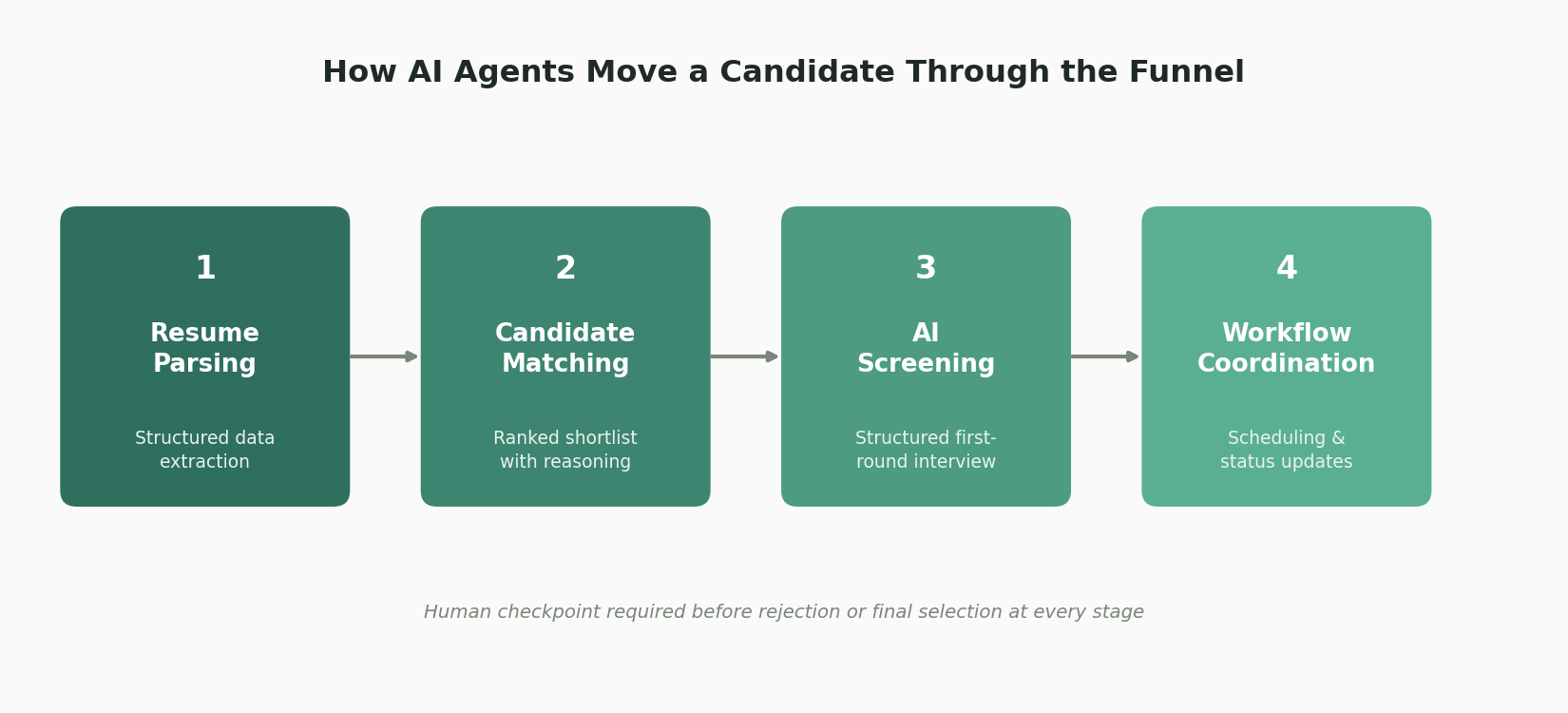
This is where the mechanics matter more than the marketing. AI Agents Improve Hiring Decisions by compressing four specific stages of the hiring funnel- parsing, matching, first-round screening, and coordination- while leaving judgment-heavy decisions (final selection, offer terms, culture fit calls) with humans.
Resume Parsing and Structured Data Extraction
The foundation of any AI recruiting agent is parsing: converting an unstructured resume (PDF, Word doc, scanned image) into structured fields- job titles, tenure, skills, education, certifications- that can be searched, filtered, and compared.
A well-built parser handles format inconsistency (varied date formats, nonstandard section headers, embedded tables) with 90%+ field-level accuracy, which is the baseline needed before any downstream matching is trustworthy.
Poor parsing is the single most common failure point in AI recruiting tools. If a system misreads “5 years” as “5 months” or drops a certification because it sat in a sidebar column, every decision built on that data inherits the error.
This is worth testing directly during any vendor evaluation, using a batch of real, messy resumes, not the clean sample data a vendor demos with.
AI-Assisted Candidate Matching and Ranking
Once data is structured, matching engines score candidates against a job’s requirements: required skills, experience thresholds, location, and often inferred signals like career trajectory.
The output isn’t a single “best candidate” but a ranked shortlist with visible reasoning: why a candidate scored where they did, and against which criteria.
This visibility matters for two reasons.
First, it lets recruiters override the ranking when the model misses context a human would catch: a nonlinear career path, a relevant side project, an industry-adjacent skill set.
Second, it creates an audit trail, which is no longer optional. Colorado’s SB 24-205 requires bias audits for AI tools used in employment decisions starting February 1, 2026, and the EU AI Act classifies employment-related AI as high-risk, with enforcement obligations that took full effect on August 2, 2026.
A ranking system that can’t explain its own output isn’t compliant in either jurisdiction.
AI Interviewer for Structured First-Round Screening
The newest layer of AI workflow automation is the AI-conducted first-round interview: a structured, consistent conversation, usually 10–15 minutes, that asks every candidate the same core questions, scores responses against a rubric, and flags standout or concerning answers for recruiter review.
Done well, this removes a specific bias source: interviewer fatigue, where the 40th candidate of the week gets less attentive questioning than the 4th.
This is also the stage where oversight matters most.
An AI interviewer should never issue a pass/fail verdict on its own. Its job is to produce a consistent, reviewable record that a human recruiter reads before deciding who advances to a live conversation.
Workflow Automation Across the Funnel
Beyond scoring, agents handle the coordination work that eats recruiter time without requiring judgment: status update emails, interview reminders, rejection notifications, and calendar syncing across recruiter and candidate availability.
None of this improves decision quality directly, but it protects the time recruiters need to spend on the decisions that do matter.
Integration, Data Ownership, and Cost Considerations
Adopting AI recruitment agents isn’t just a workflow change; it’s a data and budget decision. Most platforms price on a per-seat or flat-fee basis rather than per-hire, which matters for startups where hiring volume is lumpy- heavy in a funding-driven growth quarter, quiet the rest of the year.
A per-hire or per-resume pricing model can quietly cost more than a flat-fee ATS once volume climbs past 200–300 applications a month, so it’s worth modelling both structures against last year’s actual hiring volume, not a projected one.
Data ownership is the second consideration teams skip past too quickly.
Every candidate resume processed by an AI agent becomes part of a searchable database, which is valuable for future re-engagement, but only if that data stays exportable and doesn’t get locked into a proprietary format.
Before signing with any vendor, confirm candidate data can be exported in a standard format (CSV or JSON, not a PDF report) and that migration support exists if you switch tools later. Teams migrating off legacy ATS platforms consistently underestimate this step; a free, supported migration path is worth more in practice than a marginally better parsing accuracy score.
Integration depth also determines how much of the manual coordination work actually disappears. An AI agent that can’t sync with the calendar tools your interviewers already use, or that requires manual CSV exports to update a hiring dashboard, only automates part of the funnel; the rest reverts to manual work anyway. Ask any vendor for a live demo of calendar sync and status-update automation specifically, not just the resume-screening feature that gets top billing in a sales pitch.
A practical rollout sequence for teams adopting AI agents in recruitment typically follows this order:
- Audit current screening criteria: write down, explicitly, what a “qualified” candidate looks like for each open role before automating anything against it.
- Pilot parsing and matching on one requisition: compare AI-ranked shortlists against a recruiter’s manual shortlist for the same role.
- Calibrate the scoring rubric: adjust weighting where the AI shortlist diverges meaningfully from recruiter judgment, and document why.
- Introduce structured AI screening for high-volume roles only; entry-level and high-applicant-volume roles benefit most; senior and niche roles need more human-led evaluation earlier.
- Set a mandatory human review checkpoint before any candidate is rejected based primarily on an AI score.
- Run a quarterly bias audit comparing pass-through rates across demographic groups where legally permissible to track.
- Expand to additional requisitions only after the pilot role’s time-to-hire and quality-of-hire metrics hold steady or improve.
This sequencing matters because teams that automate everything at once lose the baseline needed to catch problems. A phased rollout gives you a control group.
Case Study or Real-World Application
A 60-person fintech startup hiring for 14 open roles in a single quarter, mostly engineering and customer success, was averaging 38 days time-to-hire and had two recruiters manually screening roughly 3,000 combined applications.
After introducing AI-assisted resume parsing and ranking on eight high-volume roles, first-pass shortlist time dropped from an average of 5.5 hours per role to under 40 minutes, and time-to-hire on those roles fell to 24 days.
The recruiting team redirected the recovered hours toward candidate outreach and interview prep- the parts of the job that had been getting squeezed.
A 200-person B2B SaaS company piloted an AI interviewer for a customer support hiring surge: 180 applicants for 6 openings within three weeks.
Every candidate received the same structured first-round interview instead of a subset getting phone screens based on resume triage alone.
The company reported that 22% of candidates who advanced to a live interview would not have been shortlisted under the team’s prior resume-only screening process, because the AI interview surfaced relevant experience the resume format hadn’t captured clearly.
Both examples share a pattern: the gains came from compressing volume-heavy stages, not from removing human decision-making. Recruiters still made every final call.
A third pattern shows up in slower-moving industries adopting the same approach later than tech.
A regional logistics company hiring warehouse supervisors- a role with historically high applicant volume but low resume differentiation- used AI-assisted matching to rank candidates by verified certifications and shift-availability match rather than resume keyword density alone.
Time spent on unqualified applications dropped by roughly 65%, and the team reported fewer late-stage dropouts because the shortlist better reflected candidates who actually met the role’s hard requirements from the start.
This case illustrates a point that gets lost in tech-sector coverage of AI hiring automation: the gains aren’t unique to software hiring.
Any role with high application volume and clear, checkable requirements is a strong candidate for this kind of screening.
Comparison or Decision Framework
Teams evaluating how to introduce AI into smart hiring generally choose between three approaches. Here’s how they compare on the factors that matter most for startups and SMBs.
| Approach | Speed Gain | Bias Risk if Unmonitored | Best Fit |
| Manual screening only | None baseline | Low volume, high individual variance | Very low volume, executive or highly specialised roles |
| AI-assisted screening (agent ranks, human decides) | High: 60–70% faster shortlisting | Low, if audited quarterly | Most startup and SMB hiring, including high-volume roles |
| Fully automated screening (AI rejects without review) | Highest, but risky | High; no human checkpoint to catch errors | Not recommended under current regulation in most jurisdictions |
The middle row is where nearly every defensible, well-run hiring process sits in 2026. Fully automated rejection, where no recruiter reviews a candidate before they’re screened out, is both the riskiest option and, increasingly, the one regulators are targeting directly.
Beyond this three-way split, teams also need a framework for deciding which roles get AI-assisted screening first.
The clearest signal is applicant-to-hire ratio: a role drawing 150+ applicants for one opening benefits far more from AI-assisted ranking than a role drawing 12 applicants, where a recruiter can reasonably review every resume by hand within an hour.
A second signal is requirement clarity: roles with well-defined, checkable requirements (certifications, years of experience, specific tools) are easier for an AI agent to score accurately than roles evaluated primarily on subjective fit, portfolio quality, or cultural signals that resist structured scoring.
Roles that score high on both signals- high volume and high requirement clarity- are the strongest starting point for any AI hiring automation pilot.
Measuring Whether AI Agents Are Actually Improving Your Hiring Decisions
Adoption alone isn’t proof of impact. Teams should track a small, specific set of metrics before and after rollout rather than relying on anecdotal impressions that a tool “feels faster.”
The four worth tracking consistently are: time-to-shortlist (from job posting to first ranked candidate list), time-to-hire (offer accepted to requisition opened), offer-acceptance rate (a proxy for whether the process is surfacing candidates who actually want the role), and 90-day retention of hires sourced through the AI-assisted process versus those sourced manually.
That last metric is the one most teams skip, and it’s the one that actually answers whether AI Agents Improve Hiring Decisions or just improve hiring speed.
A faster shortlist that produces the same quality of hire is a time-savings story, which is valuable but limited. A faster shortlist that also produces hires who ramp faster and stay longer is a decision-quality story, and it’s the stronger case for expanding AI-assisted screening to more of the funnel.
Run this comparison for at least one full quarter before concluding; a single hiring cycle isn’t enough data to separate signal from normal variance in a small hiring team’s outcomes.
What Most Teams Get Wrong About AI Agents in Recruitment
- The most common mistake isn’t under-adopting AI; it’s adopting it without changing the review process around it. Teams install an AI screening tool, keep every downstream step exactly as it was, and then treat the AI’s shortlist as final because it feels more “objective” than a recruiter’s gut call.
It isn’t automatically more objective; it’s only as fair as the data and criteria it was trained and configured on. SHRM’s own research found that 19% of organisations using AI or automation in hiring reported their tools had overlooked or screened out qualified applicants- a number that should sit at the centre of every vendor conversation, not the footnote.
- A second pattern: teams pilot AI screening on senior or highly specialised roles first, because those are the roles leadership cares most about.
This is backwards. Senior and niche roles have low application volume and need nuanced judgment, exactly where AI adds the least value and where errors are hardest to detect because there’s no large comparison pool.
High-volume, early-career, and high-turnover roles are where AI candidate screening does its best work, and where a bad match is easiest to catch and correct.
- Third, teams underestimate how much a scoring rubric needs ongoing calibration.
A rubric built in January against one job description drifts out of relevance by the time a role’s requirements shift mid-year.
Treat the rubric as a living document a recruiter owns, not a one-time setup step a vendor configures and disappears.
- A fourth, less-discussed mistake: treating AI agents in recruitment as a one-time software purchase rather than a process change that needs its own owner.
Tools that sit unmonitored after rollout tend to drift: a rubric goes stale, a bias audit gets skipped for a quarter, an integration breaks silently and reverts the team to manual coordination without anyone noticing until time-to-hire creeps back up.
The teams seeing the strongest results assign a named person- usually a senior recruiter or the head of talent acquisition- to own quarterly review of the AI screening process, the same way a team would own review of any other core operating system.
FAQ
1. Do AI agents make the final hiring decision?
No. In a properly governed process, AI agents rank, score, and surface candidates, but a human recruiter or hiring manager makes the final call. Fully automated rejection without human review carries significant legal and quality risk under current regulations, including NYC’s Local Law 144 and the EU AI Act’s high-risk classification for employment AI.
2. How accurate is AI resume screening compared to manual review?
Well-configured AI parsing and matching typically achieves 90%+ field-level accuracy on structured data extraction, and ranking consistency that manual review can’t match at scale, since human attention degrades with fatigue. Accuracy depends heavily on rubric calibration; an untested or poorly weighted scoring model can underperform a careful human reviewer.
3. Can AI hiring tools introduce bias instead of removing it?
Yes, if the underlying data or scoring criteria reflect historical hiring patterns that were themselves biased. This is why quarterly audits and a mandatory human review checkpoint before rejection are treated as non-negotiable by most compliance frameworks, not optional best practices.
4. What’s the difference between AI hiring automation and an AI interviewer?
AI hiring automation typically refers to the full set of workflow tasks- parsing, matching, scheduling, status updates- that run without requiring a live conversation. An AI interviewer is a specific application: a structured, first-round conversation that asks every candidate the same questions and produces a reviewable transcript and score.
5. Is AI hiring automation only useful for large companies?
The volume problem it solves shows up fastest at startups and SMBs, where one or two recruiters often handle hiring across every department. Smaller teams frequently see a larger relative time-to-hire improvement because they had the least slack to begin with.
6. How do we know if our AI screening tool is compliant with current regulations?
At minimum, the tool should support bias audits with demographic pass-through comparisons, provide explainable scoring (not a black-box output), and require a human checkpoint before any rejection. Jurisdictions including Colorado, New York City, and the EU now have specific, enforceable requirements for the use of AI in employment. Check current rules for every state or country where you hire.
7. How long does it take to see measurable results from AI-assisted hiring decisions?
Most teams see the first measurable shift in shortlist turnaround time within the first two to three requisitions, typically 2–4 weeks after rollout. Downstream metrics like time-to-hire and quality-of-hire take longer to stabilise, usually one full hiring quarter, since they depend on interview and offer-stage factors the AI tool doesn’t control.
8. Do candidates respond negatively to AI involvement in hiring?
Candidate sentiment is mixed and worth taking seriously. Pew Research has found a meaningful share of job seekers say they wouldn’t apply to a role at a company that uses AI in hiring decisions. In practice, sentiment improves when companies are transparent about where AI is used (typically screening and scheduling) and clear that a human makes the final decision, rather than leaving candidates to assume the process is fully automated.
Closing Thoughts
If your team is evaluating AI-assisted hiring decisions and trying to figure out where automation genuinely helps versus where it just shifts risk around, the honest starting point is auditing your current screening criteria before you touch a tool.
Hirium’s AI resume screening and AI interviewer features are built around exactly the human-checkpoint model described above, ranking and structuring candidates without removing recruiter judgment from the final call.
If you want to pressure-test your current screening process against what a phased AI rollout would actually look like for your hiring volume, you can start with the free plan at hirium.com, no credit card required.