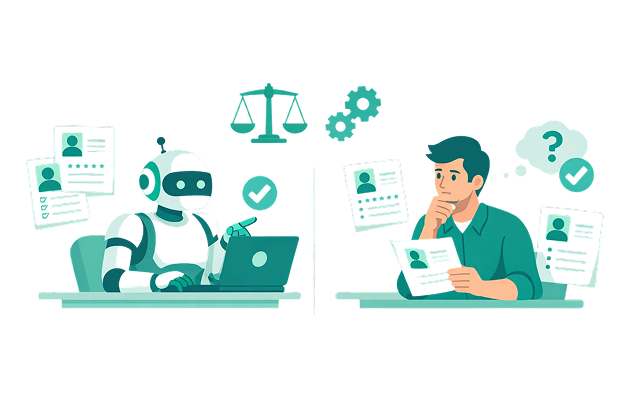
AI vs Human Hiring Decisions: What Works Better?
Hiring the right people has never been easy. Every year, companies spend huge amounts of time and money trying to get it right, yet bad hires still happen more often than they should. The pressure on hiring teams is growing, and now there’s a bigger question everyone is asking: should you rely on AI or trust human judgment when making hiring decisions?
The debate around AI vs human hiring is no longer theoretical. It is happening right now, inside your ATS, on your interview platform, and in your sourcing pipeline. As AI-powered tools become more capable and more embedded in the recruitment life cycle, hiring managers, CHROs, and founders need a clear, honest answer not a sales pitch.
In this blog, we’ll look at where AI helps speed things up, where human judgment still matters the most, and how companies in 2026 are combining both to make smarter hiring decisions.
What Is AI Hiring and How Does It Work?
AI hiring simply means using technology to support or automate parts of the hiring process. It uses machine learning and data to help with tasks like screening resumes, finding candidates, scheduling interviews, running skill assessments, and even analysing video interviews.
But in 2026, automated hiring tools are much more advanced than basic keyword filters. Platforms like Eightfold AI, HireVue, Paradox, Beamery, and Greenhouse can now understand candidate profiles in a deeper way. Instead of just matching keywords, they can:
- Match candidates to roles based on skills they likely have, even if not clearly listed
- Predict how well a candidate might perform and how long they may stay
- Run initial interviews through chat or video
- Spot biased language in job descriptions before they go live
Because of these benefits, more companies are adopting automated hiring tools to save time and reduce hiring costs. In fact, the global AI in HR market was valued at around USD 6.25 billion in 2026 and is expected to grow rapidly in the coming years.
Where AI Outperforms Human Recruiters
Speed and Scale
The single biggest advantage of AI in the hiring process is its ability to process volume without fatigue. Teams using AI screening report up to 40% faster time-to-shortlist for volume roles, and chatbots can automate over 90% of end-to-end hiring tasks while increasing candidate conversions by 10x in high-volume roles.
For enterprise companies receiving thousands of applications per open role, this is not a convenience it is a necessity.
Cost Reduction
Over 65% of recruiters have already implemented AI, primarily to save time, improve candidate sourcing, and reduce hiring costs by up to 30% per hire. For teams scaling quickly, that cost reduction directly impacts hiring budgets and overall workforce ROI.
Consistency and Fairness
A common belief is that AI in hiring is biased. But recent research is starting to challenge that idea.
According to The State of AI Bias in Talent Acquisition 2025 report by Warden AI, AI systems actually perform better than humans when it comes to fairness. They scored 0.94 on fairness metrics, compared to 0.67 for human-led hiring decisions.
The study also found that AI can improve outcomes for underrepresented groups. In some cases, it delivered up to 39% fairer treatment for women and 45% fairer treatment for candidates from racial minority groups.
This is important because human bias is often unconscious. It’s hard to spot and even harder to fix. With AI, bias can be measured, tracked, and improved over time making the hiring process more transparent and consistent.
Quality of Hire
Organisations using AI for recruiting see a 31% increase in quality of hire. Candidates selected by AI also have an 18% higher chance of accepting a job offer when extended. This means AI does not just filter faster it filters better.
Where Human Recruiters Still Win
Relationship Building and Candidate Experience
No algorithm can replace the intuition a skilled recruiter develops over years of conversations. Senior candidates, passive talent, and niche specialists often respond to personal outreach, storytelling, and the sense that a real person understands their career goals.
58% of recruiters feel AI reduces busywork, letting them focus on candidate relationships which reveals the correct mental model. AI is not a replacement; it is a time-liberator that gives human recruiters more capacity for the work that actually requires human presence.
Evaluating Culture Fit and Soft Skills
Things like culture fit, leadership potential, and team dynamics are hard to measure with data alone. They depend on context, how a team works, how people communicate, and what the company actually needs at that moment.
This is where human judgment still matters. A recruiter who knows the hiring manager, understands the team’s working style, and has experience from many past interviews can pick up on things that tools often miss.
They can sense whether someone will truly fit in, grow into a leadership role, or add value beyond what’s written on a resume. That kind of insight is still something AI can’t fully replace.
Navigating Ambiguity and Edge Cases
Some of the best hires in history looked wrong on paper. Career changers, self-taught engineers, candidates with non-linear paths these profiles require a human to look past the resume and see the potential. Around 35% of recruiters worry that AI may exclude candidates with unique skills and experiences, a concern that is backed by real patterns in how screening models are trained.
The Problem With Relying Solely on Either Approach
| Factor | AI-Only Hiring | Human-Only Hiring |
| Speed | Extremely fast | Slow at scale |
| Consistency | High | Variable |
| Bias | Measurable and auditable | Unconscious and hard to correct |
| Relationship | Weak | Strong |
| Cost | Low per application | High for volume |
| Nuance and Judgement | Limited | Strong |
| Candidate Trust | Low | High |
Only 29% of companies currently maintain full human oversight on all AI rejection decisions, and 21% allow AI to reject candidates at all stages without human review, a pattern that introduces legal and reputational risk for organisations that do not design their AI recruitment decisions workflow carefully.
On the other side, teams that refuse to adopt AI at all are falling behind. Automation adopters fill 64% more jobs and submit 33% more candidates per recruiter than non-adopters.
AI Hiring Accuracy: What the Data Actually Shows
When evaluating AI hiring accuracy, it is important to separate the use case from the claim. AI does not perform equally well across all hiring tasks.
Here is what the evidence shows across specific functions:
- Resume Parsing: 94% accuracy in extracting structured data from CVs
- Skill Matching: 89% accuracy in matching candidate skills to job requirements
- Job Performance Prediction: 78% accuracy using advanced analytics models
- Retention Likelihood Forecasting: 83% accuracy with predictive models
- AI-led Interview Assessments: Up to 22% error rates for some speaker demographics due to speech-to-text limitations
The accuracy picture is strong for structured, data-rich tasks. It weakens significantly when AI is asked to evaluate interpersonal qualities, cultural alignment, or potential.
How Leading Companies Are Combining AI and Human Judgment in 2026
The most effective hiring strategies in 2026 do not choose between AI vs Human hiring; they build a model where each does what it does best.
Here is the framework top-performing talent teams are using:
Stage 1: AI-Led Sourcing and Initial Screening
Use AI to identify, rank, and shortlist candidates from large applicant pools. Tools like Eightfold, SeekOut, and Findem use semantic search to surface candidates that keyword-based ATS systems miss entirely.
Stage 2: AI-Assisted Structured Assessment
Deploy standardised skills tests, work samples, or structured async video interviews scored by AI. This creates consistent, auditable evaluation data.
Stage 3: Human-Led Interviews for Shortlisted Candidates
Recruiters and hiring managers take over for final-stage conversations, cultural alignment, and offer negotiation. This is where human EQ matters most.
Stage 4: Collaborative Final Decision
AI provides a data summary predicted performance score, skills match percentage, red flags while the hiring manager makes the final call. Only 31% of recruiters let AI make final hire decisions, and 75% want humans involved.
Stage 5: Continuous Feedback Loop
Track new hire performance data and feed it back into the AI model to improve future predictions. This is where the system gets smarter over time.
Key Risks to Manage When Using AI in Hiring
Using AI in hiring can improve efficiency, but without the right checks in place, it can also create serious problems. Here are some key risks every HR leader should be aware of:
Algorithmic Bias
AI systems learn from past data. If that data includes bias related to age, gender, or background, the system can repeat those patterns without anyone noticing. This can quietly affect hiring decisions if not regularly monitored.
Candidate Trust Issues
Many job seekers are still unsure about AI-led hiring. Some may avoid applying altogether if they feel the process is not transparent or fair. This makes clear communication and transparency very important.
Regulatory Compliance
Governments are starting to regulate AI in hiring. For example, New York City’s Local Law 144 requires companies to conduct yearly bias audits for automated hiring tools. Similarly, the EU AI Act treats hiring AI as high-risk, with stricter rules coming into effect through 2026 and 2027.
Over-Reliance on AI
Relying too much on AI without human involvement can lead to missed opportunities. When AI rejects candidates at different stages of the hiring process, strong talent can get filtered out too early without proper evaluation.
What Decision-Makers Should Do Right Now
If you are a hiring leader evaluating your current approach, here are the immediate steps that align with where the industry is heading:
- Audit your current AI use: Identify which stages of hiring involve automated decisions and whether human review exists at each point
- Define what AI can decide vs. what needs human approval: Build a clear RACI for hiring decisions
- Run a bias audit on your screening tools: Particularly for resume parsing and AI interview scoring
- Train recruiters to work alongside AI: The most effective teams treat AI output as a starting point, not a final answer
- Be transparent with candidates: 79% of candidates want transparency when AI is used in the hiring process Taleva Blog, and disclosure is increasingly a legal requirement
Conclusion
The real question in the AI vs human hiring debate isn’t about choosing one over the other. In 2026, the smarter approach is understanding how to use both effectively.
AI brings speed, consistency, and the ability to handle large volumes of data. Human recruiters bring judgment, empathy, and a deeper understanding of people and team dynamics something technology still can’t fully replace.
Companies that treat AI vs human hiring as a competition often make avoidable mistakes. But those that combine both using AI to manage scale and humans to make final decisions consistently hire better, faster, and at a lower cost.
The future of AI vs human hiring isn’t about replacement. It’s about working together to make smarter hiring decisions.
FAQs
1. Is AI more accurate than humans in hiring?
For structured tasks like resume parsing and skills matching, AI accuracy ranges from 89–94%. For predicting job performance, accuracy is around 78%. Human recruiters outperform AI when evaluating soft skills, culture fit, and candidate potential.
2. What are the biggest risks of AI hiring tools?
The main risks are algorithmic bias, lack of transparency with candidates, regulatory non-compliance, and over-reliance on AI for decisions that require human judgment.
3. Should AI make the final hiring decision?
No. The data is consistent 75% of hiring professionals want humans involved in final decisions. AI should inform and support the decision, not replace the human making it.
4. How do I know if my AI hiring tool is biased?
Conduct a regular bias audit using third-party tools or frameworks like those recommended under NYC Local Law 144. Track selection rates by gender, age, and ethnicity across AI-screened pools.
5. What is the best way to combine AI and human hiring?
Use AI for sourcing, initial screening, and structured assessment. Reserve human involvement for final-stage interviews, cultural evaluation, offer conversations, and all rejection decisions. Platforms like Hirium are built around exactly this model giving hiring teams AI-powered efficiency without removing the human judgment that final decisions deserve.