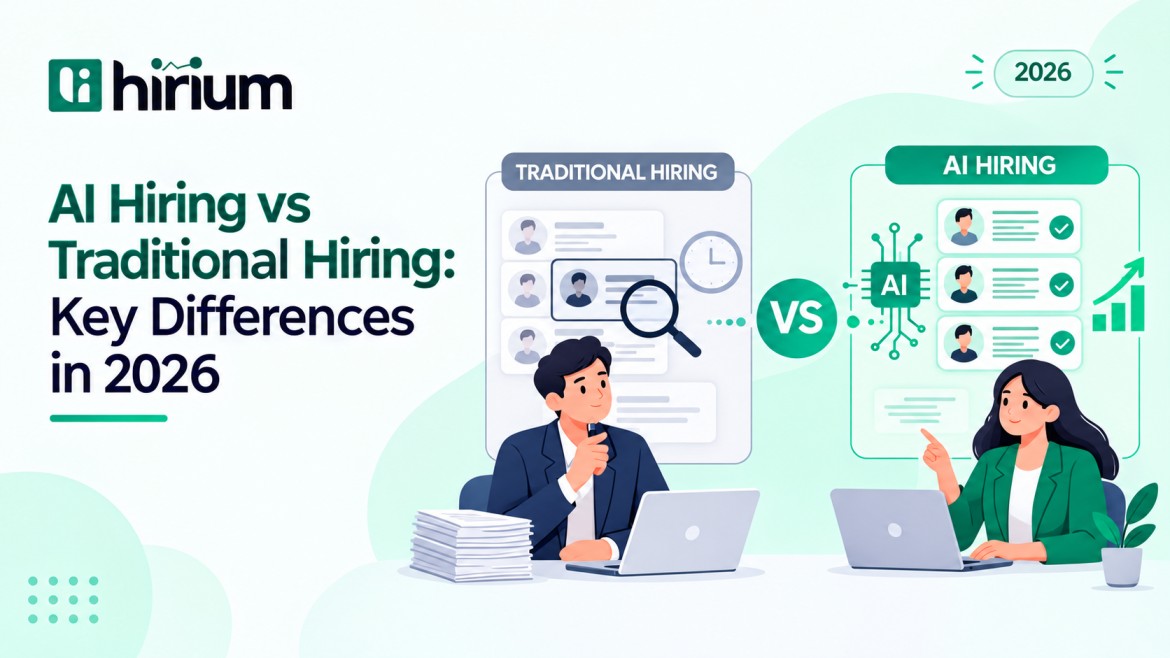
AI Hiring Vs Traditional Hiring: Key Differences in 2026
AI hiring vs traditional hiring is now a workflow and budget decision for every HR team, not a future debate.
SHRM’s State of AI in HR 2026 report puts AI use in recruiting at 27% of organisations, the most common HR use of AI. SHRM’s 2026 figures show about 33% of companies under 100 employees using AI in HR, compared with 60% of firms with 5,000+ staff.
AI hiring uses software to sort resumes, match candidates, and schedule interviews. The traditional hiring process relies on recruiters for every step. Each has a place, and the right mix depends on role type and hiring volume.
This blog compares AI hiring vs traditional hiring on speed, cost, bias, candidate trust, and compliance, then shows how startups and SMBs can use both.
AI Hiring vs Traditional Hiring?
AI hiring uses software to handle repeatable recruitment tasks like resume screening, candidate matching, interview scheduling, and candidate messaging, with recruiters reviewing the output.
The traditional hiring process relies on people for each step: posting jobs, reading resumes, phoning candidates, and running interviews. AI hiring is faster at volume. Traditional hiring is stronger on judgment and relationships.
Here are key diffrences of AI Hiring Vs Traditional Hiring:
| Factor | Traditional hiring | AI hiring |
| Resume screening | Recruiter reads every resume | Software ranks and flags matches; recruiter reviews |
| Speed on high volume | Slow, and grows with every applicant | Fast, ranks a full pool in one pass |
| Judgment on soft skills | Strong, through conversation | Weak, needs human interviews |
| Consistency | Varies by recruiter and by day | Same rules for every applicant |
| Bias risk | Unconscious bias and snap judgments | Bias from training data and loosely set criteria |
| Candidate experience | Personal, but replies can be slow | Quick updates, but can feel impersonal |
| Compliance load | Standard equal-employment rules | Same rules, plus notice and audit duties in some places |
| Best fit | Senior, niche, and culture-critical roles | High-volume and repeatable roles |
How Does the Traditional Hiring Process Work Today?
The traditional hiring process has five stages: job posting, manual resume review, phone screen, interviews, and reference checks before the offer. Every stage depends on recruiter time.
Its strength is judgment. A recruiter can read hesitation, follow an unexpected answer, and change the criteria mid-search when a role shifts. That flexibility matters for executive, creative, and first-hire roles in a startup.
-
Is AI Hiring Faster and Cheaper Than Traditional Hiring?
It can be, but only when screening is the slow part. If your team spends days reading resumes and booking interviews, AI hiring cuts that time quickly. If the delay comes from slow interviewer feedback or late offers, software will not fix it.
Cost works the same way. AI saves money when recruiter hours go into repetitive work. It adds cost when a team pays for a tool nobody uses properly, or spends weeks correcting poor matches.
Before buying anything, note your current time to hire and the hours your team spends on screening for each hire. Check the same numbers after three months. Without that baseline, nobody can say whether AI hiring is faster or cheaper than traditional hiring in your case.
-
Does AI Hiring Reduce Bias or Make It Worse?
Both methods carry bias, just in different forms. Human screeners bring unconscious bias in hiring: a familiar college name, a similar background, a strong first impression in the opening minute.
AI screeners inherit bias from the data they learn from. If past hires mostly came from one group, the tool may quietly prefer that group.
Research on AI resume ranking has shown that a name alone can change who gets shortlisted. That does not mean every tool behaves this way, but it is reason enough to test yours.
Legal risk follows. Courts in the US are already hearing cases where applicants say automated screening rejected them unfairly. The worst setup is software rejecting candidates with no recruiter reviewing the decision.
Fix it simply by keeping a person in charge of every rejection the software suggests, and compare shortlist results across age, gender, and background groups every month. Teams that do this catch problems early.
How Can You Combine AI Hiring vs Traditional Hiring Without Losing the Human Touch?
Record your baseline. Note time to fill, applicants per role, and screening hours per hire.
Pick one bottleneck. Start with screening or scheduling, not the whole process.
Set human checkpoints. A recruiter approves every shortlist and every rejection.
Tell candidates. State where AI is used and how to reach a person.
Audit monthly. Compare pass-through rates across age, gender, and background groups, and adjust the criteria.
Conclusion
An ATS like Hirium can hold AI screening, interview scheduling, and candidate communication in one workflow, with recruiters approving the output. For the balance itself, this look at automation versus the human touch in an ATS covers where to draw the line.
FAQs
1. Is AI hiring better than traditional hiring?
Neither wins on every role. AI hiring is stronger on high-volume screening and consistency. Traditional hiring is stronger on judgment, trust, and unusual roles. Most teams get the best result by giving software the repetitive steps and keeping people on interviews and final decisions.
2. What is AI candidate sourcing?
AI candidate sourcing uses software to search job boards, public profiles, and your past applicants, then shortlists people who match a role, often before they apply. It works best for roles with clear skill requirements. A recruiter still reviews the list and makes the first contact.
3. Will AI replace recruiters?
No. AI for hiring takes over sorting, scheduling, and routine candidate updates. Recruiters still run interviews, judge culture fit, handle negotiation, and build relationships. The job shifts toward more conversation and less admin work.
4. What is the traditional hiring process?
The traditional hiring process is the manual path: posting the job, reading resumes, phone screening, interviews, reference checks, and the offer. People handle each step. That gives flexibility and a personal touch, but it takes much longer when applications pile up.
5. Can a small startup use AI-powered recruitment without losing the human touch?
Yes. Start with one slow step, like resume screening or interview scheduling. Let a recruiter approve every shortlist and every rejection, and tell candidates where AI is used. The balance between automation and the human touch in an ATS matters more than the tool itself.
Conclusion
The AI hiring vs traditional hiring choice comes down to task fit. Software is faster at screening and scheduling. People are better at judgment, trust, and fairness checks. Teams that measure a baseline, add AI to one bottleneck, and keep a person on every decision get the speed without the risk.
If screening and scheduling eat most of your week, book a Hirium demo to see AI screening and human review in one workflow.