Recruitment Status Updates for Employer Branding: Guide 2026
Sixty-five per cent of candidates say they never received consistent communication during a hiring process, not from a small, disorganised company, but across the market as a whole.
Only 1 in 5 organisations (20%) measure quality of hire at all in 2026, the metric most tied to whether communication quality is even being tracked.
Put those two numbers next to each other, and the connection stops being abstract: the silence candidates experience during hiring is the same silence that shows up as one-star reviews six months later.
Most hiring teams treat recruitment status updates for employer branding as an afterthought, a “nice to have” buried under sourcing, screening, and interview logistics. That’s a mistake with a measurable cost.
Candidate communication isn’t a courtesy layer on top of recruiting. It’s the most consistent, highest-volume touchpoint a company has with the outside world, and it’s almost entirely self-inflicted when it goes wrong.
This isn’t a branding problem that needs a bigger marketing budget. It’s a workflow problem ne that recruitment status update software solves more directly, and more cheaply, than almost any other line item in a hiring budget.
Most companies spend far more on employer-branding content, culture videos, careers-page redesigns, and sponsored LinkedIn posts than on fixing the communication gap that undoes that content for every candidate who applies and hears nothing back.
The rest of this piece breaks down why status updates function as a branding channel, what a defensible update cadence looks like, where a handful of well-known employers have built communication into their process rather than leaving it to individual recruiter discipline, and where most teams, even well-funded ones, still get it wrong.
What Are Recruitment Status Updates?
Recruitment status updates are the automated or manual notifications a hiring team sends to candidates at each stage of the applicant journey: application received, under review, interview scheduled, moving forward, not selected.
When delivered consistently, they function as an employer branding recruitment tech channel, shaping how candidates describe the company to others regardless of hiring outcome.
The definition is simple; the execution rarely is. Most companies have a status-update process in theory, a rejection template sitting in a shared drive, a confirmation auto-reply on the careers page, but no system enforcing that every candidate at every stage actually receives one.
The gap between “we have templates” and “every candidate gets contacted” is where employer brand damage actually happens, and it’s rarely visible until a candidate posts about it publicly.
The Core Problem: Silence Is the Default, Not the Exception
Most teams underestimate how much of their candidate pool goes completely unacknowledged.
Talent Board’s CandE benchmark data, tracked across more than 200,000 candidates annually, shows the share of applicants reporting a poor experience has climbed from roughly 10% in 2013 to over 12% by 2023, and “poor experience” in that research is driven overwhelmingly by lack of communication, not compensation or role fit.
The real number is worse than it looks on a dashboard. A hiring manager who believes they respond to “most” candidates is usually underestimating their own drop-off rate by 3-4x, because the candidates who never hear back don’t file a complaint; they just don’t reapply, don’t refer friends, and don’t recommend the company.
That’s a silent leak, not a visible failure, which is exactly why it goes unaddressed for years at a time.
For startups and SMBs hiring at volume 50, 150, 500 applications for a single role the math compounds fast.
A recruiter manually tracking candidate stages across spreadsheets and inboxes will lose track of someone within the first two weeks of a high-volume req. That’s not a discipline problem. It’s a workflow automation software gap: the process was never built to scale past a handful of concurrent candidates.
The gap gets worse, not better, as headcount grows. A five-person team hiring one role at a time can usually cover communication through sheer attentiveness.
A twenty-five-person team running four to six open reqs simultaneously the typical profile of a funded startup mid-growth- is managing dozens of candidates at overlapping stages, and manual tracking starts failing precisely when the stakes of a bad candidate experience are highest, because volume is the moment a company’s reputation is being formed with the largest number of people at once.
The downstream cost shows up in three places at once. Candidates who felt ignored are less likely to reapply for a future, better-fit role. They’re less likely to refer people in their network, the cheapest source of quality hires most companies have.
And a rising share leave a public review naming the exact failure: “never heard back,” “ghosted after final round,” “no rejection email.” Those reviews sit on Glassdoor for years, read by every future applicant doing exactly the research the 86% statistic describes.
None of this shows up on a standard recruiting dashboard. Time-to-hire and offer-acceptance rate measure the candidates who made it through.
They say nothing about the candidates who dropped out silently because nobody told them where they stood, which is exactly why the problem persists at companies that otherwise consider themselves data-driven about hiring.
There’s a compounding effect specific to startups and SMBs that larger enterprises don’t face in the same way: a small company’s applicant pool overlaps heavily across roles and hiring cycles.
A candidate rejected without explanation for one role is often a plausible applicant for a different role six months later, but a poor first experience removes that option before it’s ever considered, shrinking a talent pool that was already smaller than a large enterprise’s to begin with.
For companies competing against better-known employers for the same limited pool of qualified candidates, that shrinkage has an outsized effect on time-to-hire and recruiter workload in every subsequent cycle.
How Recruitment Status Updates for Employer Branding Actually Work
Employer branding is usually discussed as a top-of-funnel activity: careers page design, culture videos, LinkedIn content. But candidates who never make it past screening never see that content again after they apply. The only employer branding touchpoint that reaches every single candidate, whether hired or not, is the communication they receive (or don’t) during the process itself.
1. The Link Between Status Updates and Glassdoor Sentiment
Review platforms exist because candidates need somewhere to put the experience a company didn’t acknowledge.
Analysis of review-driven candidate behavior drawing on Harvard Business Review, LinkedIn Talent Solutions, and Glassdoor Economic Research found that a 0.5-star rating increase drives roughly 20% more job clicks and 16% more application starts.
The inverse is also true: unaddressed candidate silence is one of the most common root causes cited in negative employer reviews, second only to compensation disputes.
The mechanism is direct, not correlational. A candidate who applies, interviews, and hears nothing for three weeks doesn’t file that experience away neutrally; they write it down somewhere, usually within days of giving up on the process. Candidate profile management systems that automatically move a candidate’s status and trigger a corresponding email close that gap before it becomes a review.
There’s also a timing dimension most teams miss: reviews written immediately after a bad experience are more detailed and more visible than reviews written months later, because the platform’s own ranking tends to surface recent, specific reviews over vague older ones.
That means the window to prevent a negative review isn’t “eventually follow up”; it’s the 48–72 hours immediately after a candidate’s last touchpoint with the process, while the experience is still fresh enough to shape their decision to write something public.
2. Brands Known for Getting Candidate Communication Right
A handful of employers are consistently cited in candidate experience research for treating status updates as core infrastructure rather than an afterthought:
- Southwest Airlines has built a reputation, referenced repeatedly in Talent Board CandE award citations, for sending timely rejection notices with specific, personalized feedback rather than generic templates a practice tied to consistently high reapplication rates among previously rejected candidates.
- Zappos is frequently cited for closing every application loop, including candidates rejected at the resume-screen stage, which contributes to the company’s above-average Glassdoor interview-experience ratings relative to retail peers.
- Marriott International uses structured, stage-based candidate messaging across high-volume seasonal hiring, an approach credited with maintaining applicant satisfaction scores even during periods with thousands of concurrent applicants per property.
The pattern across all three: none of them rely on recruiters manually remembering to follow up.
The communication is built into the workflow, not dependent on individual diligence. That distinction matters more for a 30-person startup than for a Fortune 500 company, because a startup doesn’t have the recruiter-to-candidate ratio to absorb inconsistent follow-up the way a large TA team can.
One overloaded recruiter covering three open reqs is the norm, not the exception, and workflow-level automation is the only way communication stays consistent when headcount doesn’t scale with hiring volume.
3. A Simple Update-Cadence Template You Can Copy
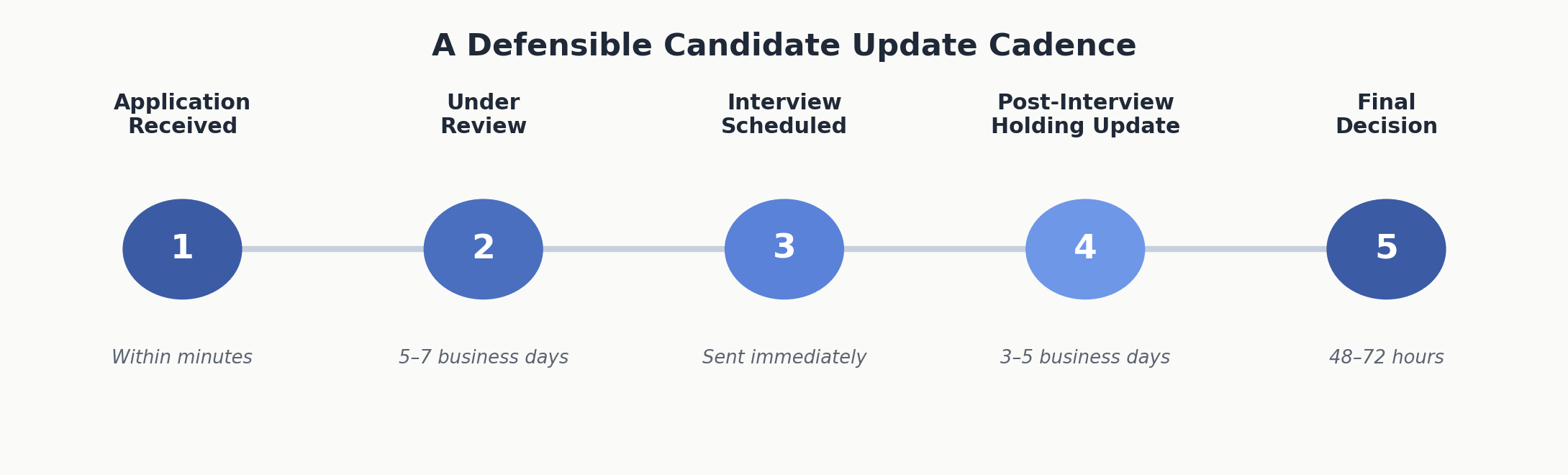
A defensible cadence doesn’t require a dedicated communications hire; it requires five checkpoints tied to pipeline stage changes:
- Application received: automated confirmation within minutes, not days.
- Under review: a status touchpoint within 5–7 business days if no stage change has occurred, so candidates aren’t left guessing.
- Interview schedule confirmation with logistics, sent immediately after scheduling, not batched.
- Post-interview holding update: a brief note within 3–5 business days of the interview, even if the decision isn’t final, acknowledging where the candidate stands.
- Final decision: offer, next round, or rejection, sent within 48–72 hours of the decision being made internally, not weeks later.
Each checkpoint maps to a status change in an applicant tracking system, which means the update can trigger automatically the moment a recruiter moves a candidate’s stage no separate task, no manual email draft.
The cadence above is a floor, not a ceiling. Roles with longer interview loops (four or more rounds) benefit from an additional mid-process checkpoint between rounds two and three, since that’s typically where candidate anxiety about “did I make it through” peaks and drop-off risk is highest.
Teams hiring for a single role at a time can extend these windows slightly; teams running concurrent high-volume reqs should tighten them, since candidate patience for silence drops as market competition for the same role increases.
Recruitment Email Templates That Reduce Ghosting Complaints
Recruitment email templates matter less for their wording than for their trigger logic. A template that fires the moment a stage changes closes the loop; a template that exists in a folder but requires someone to remember to send it does not.
Post-interview ghosting is the most damaging single failure point; industry survey data puts the share of candidates ghosted after an interview at 61%, up from the prior year, precisely because that’s the stage where a candidate has invested the most time and expects the fastest response.
The fix isn’t better copywriting. It’s a recruiter SLA a defined maximum window (48–72 hours is standard for post-interview stages) paired with pipeline monitoring that flags any candidate who hasn’t been contacted within that window, regardless of whether a human remembered to check.
-
Turning Rejections Into Brand-Builders
Rejection is the stage most teams handle worst, and it’s also the highest-leverage moment for recruitment status updates for employer branding, because it’s the last impression a candidate walks away with.
A generic auto-rejection (“we’ve decided to move forward with other candidates”) closes the loop technically but does nothing for sentiment.
A rejection that includes one specific, honest reason even something as simple as “we moved forward with a candidate whose background matched a specific technical requirement more closely” measurably changes candidate willingness to reapply. Candidates who receive a personalized rejection are meaningfully more likely to apply to a future role at the same company than those who receive a form letter or nothing at all.
This is also where AI candidate insights earn their keep beyond scoring and shortlisting. A system that has already parsed a candidate’s resume and interview notes can surface the one or two specific data points a recruiter needs to personalize a rejection he skill gap, the experience mismatch, the round where scoring dropped without requiring the recruiter to reread the full application to find something honest to say. That turns a two-minute manual task most recruiters skip under time pressure into a ten-second edit on a pre-drafted note.
Case Studies: What Consistent Updates Change in Practice
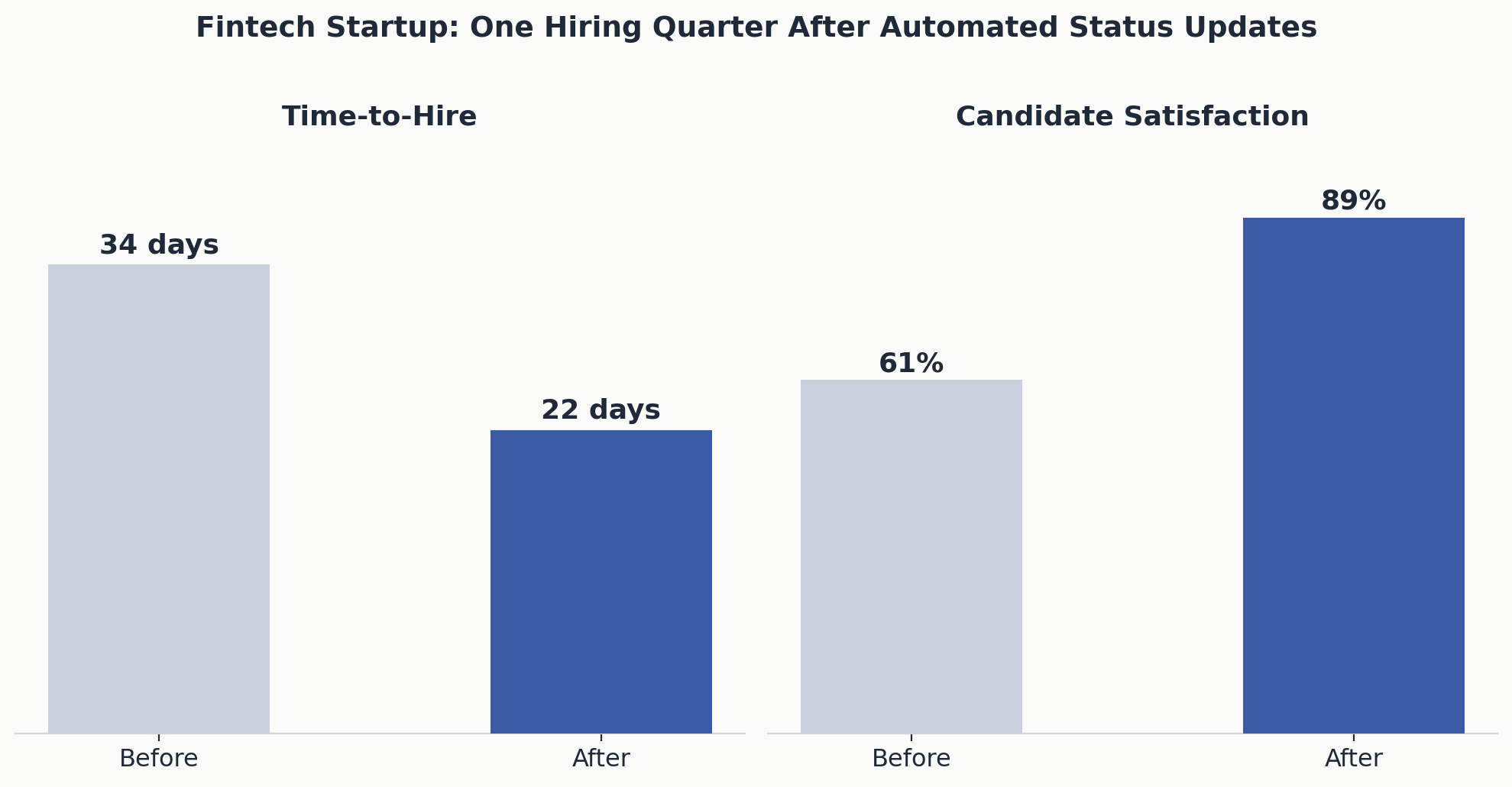
A 40-person fintech startup hiring for six concurrent engineering roles was losing an estimated 15–20% of qualified candidates to unexplained pipeline drop-off, discovered only after exit interviews with declined offers referenced “confusing” or “silent” communication.
After implementing stage-triggered status updates and a 72-hour post-interview SLA, time-to-hire dropped from roughly 34 days to 22 days, and candidate-reported satisfaction (measured via a short post-process survey) rose from 61% to 89% within one hiring quarter.
A SaaS SMB running high-volume seasonal support hiring (200+ applicants per role) had one recruiter manually tracking candidate stages in a spreadsheet, resulting in an average 11-day gap between interview and any follow-up communication.
Moving to automated status tracking and templated, stage-triggered emails cut that gap to under 3 days and reduced recruiter administrative time spent on manual follow-up by approximately 40%, freeing capacity for sourcing instead of chasing candidate status.
A 90-person logistics-tech company migrating off a legacy spreadsheet-based process had no visibility into how many rejected candidates ever received a response; an internal audit found roughly 30% of non-advancing applicants across the prior two quarters had gotten no message at all.
After centralizing candidate data in a single system with automatic stage-triggered notifications, that figure dropped to near zero within the first hiring cycle, and the company’s
Glassdoor interview-experience rating rose by 0.4 stars over the following two quarters, a shift the internal recruiting lead attributed directly to closed-loop communication rather than any change in the interview process itself.
Choosing the Right Workflow Automation Software
Not every workflow automation software option handles candidate communication the same way.
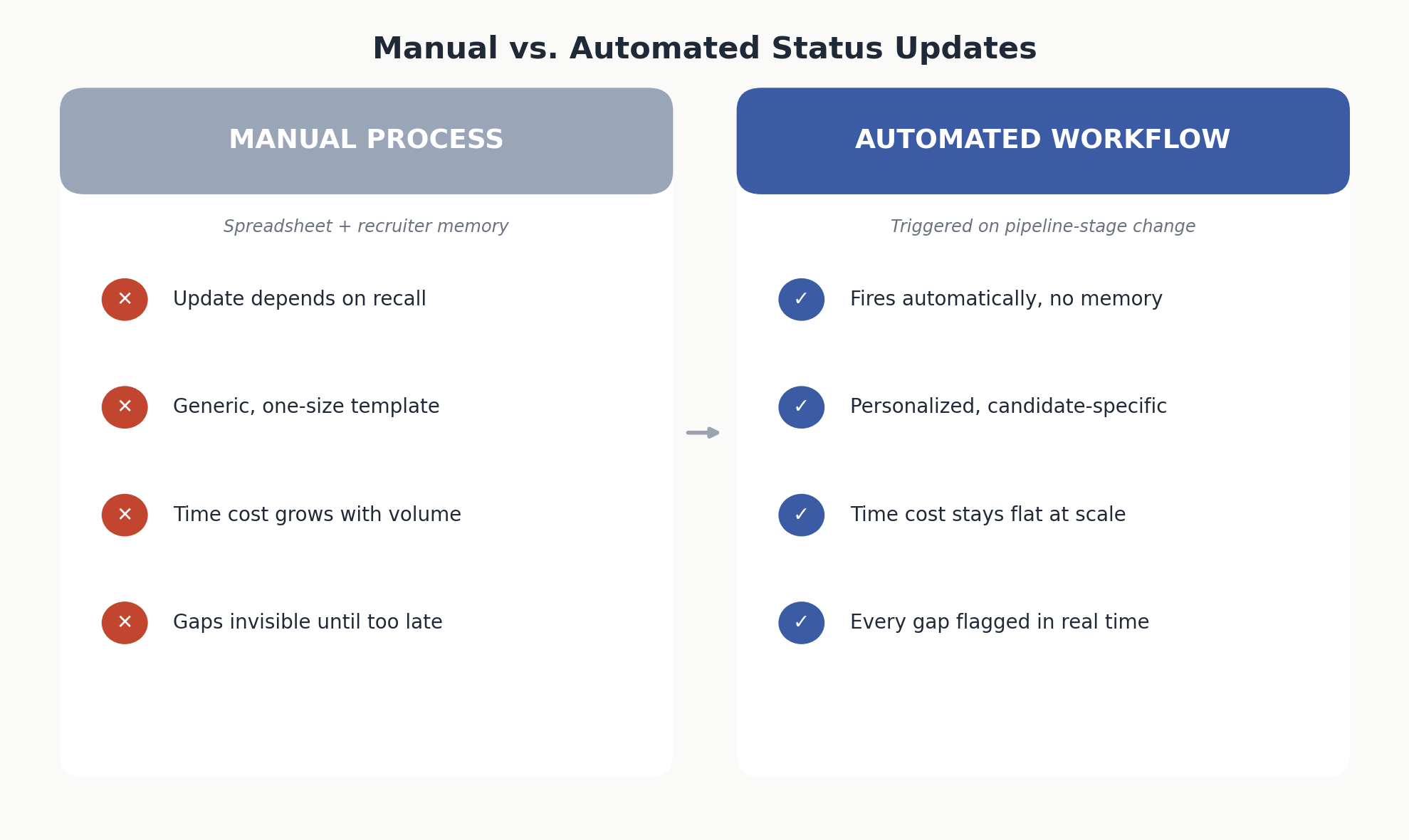
The differences that matter most for startups and SMBs aren’t feature checklists; they’re whether updates trigger automatically off pipeline-stage changes, whether messaging can be personalized without manual drafting, and whether the system centralizes candidate history so nobody has to reconstruct where a candidate stands from memory.
| Approach | Update Trigger | Personalization | Recruiter Time Cost |
| Manual spreadsheet + email | Recruiter remembers to send | Fully manual, inconsistent | High grows with volume |
| Basic ATS with static templates | Manual send, template pre-written | Limited, generic per stage | Medium still requires manual send |
| AI-powered ATS with stage automation | Automatic on stage change | Dynamic fields, candidate-specific detail | Low scales without added headcount |
| Standalone email tool (no ATS link) | Manual trigger, disconnected from pipeline | Depends on integration effort | Medium-high data lives in two places |
Candidate Profile Management tied directly to a centralized database is what makes the automatic-trigger row possible; the system knows a candidate’s stage changed because that’s where the recruiter is already working, not a separate step bolted on afterward.
The evaluation question worth asking any vendor isn’t “does it send emails?” Most tools do. It’s “does sending the email require a human to remember to do it?
A tool that generates beautiful templates but still requires a recruiter to manually select a candidate and hit send has the same failure mode as no tool at all under time pressure: it gets skipped when the recruiter is busy, which is precisely when candidates are most likely to fall through.
The systems that hold up under real hiring volume are the ones where the update is a side effect of doing the recruiter’s actual job, moving a candidate through the pipeline, not an additional task layered on top of it.
Migration friction is a legitimate concern for teams currently on a spreadsheet or a legacy ATS, and it’s worth factoring into the evaluation alongside the automation question.
Free-tier options with supported data migration reduce the switching cost that otherwise keeps teams on a broken manual process simply because moving off it feels like a project rather than a fix.
What Most Teams Get Wrong About Recruitment Status Updates for Employer Branding
- The most common mistake isn’t neglecting communication entirely; it’s treating it as a manual task that competes with sourcing and screening for recruiter attention for recruitment status updates for employer branding.
When a recruiter is choosing between reviewing ten new resumes and sending five status update emails, the resumes almost always win, because they feel like forward progress and the emails feel like overhead.
- The second mistake is assuming automation means impersonal. Teams that avoid automated status updates because they “feel robotic” often end up sending nothing at all, which is worse for candidate sentiment than a well-templated, personalized-field automated message.
A template with the candidate’s name, the specific role, and one honest sentence about status outperforms silence in every candidate experience study that has measured the comparison.
- The third, subtler mistake: measuring the wrong thing. Teams track time-to-hire and cost-per-hire religiously but rarely measure candidate-reported experience or track how many rejected candidates reapply for future roles.
Without that data, the cost of poor communication stays invisible; it shows up eighteen months later as a lower application volume, and nobody connects it back to the hiring process that caused it.
- The fourth mistake is treating communication automation as a one-time setup rather than an owned process. Teams that build a cadence template, implement it, and never revisit it tend to see quality drift within two or three hiring cycles.
Templates go stale, and edge cases (internal referrals, boomerang candidates, roles that get cancelled mid-process) get handled inconsistently because nobody assigned ownership of updating the logic.
The tool doing the sending doesn’t remove the need for someone to own the process; it removes the need for that person to personally execute every message.
FAQ
1. What is a recruitment status update?
Recruitment Status Updates for Employer Branding are messages, automated or manual, sent to a candidate reflecting where they stand in the hiring process: applied, under review, interviewing, or decided. It’s distinct from a rejection or offer letter in that it can be sent at any stage, including when there’s no final decision yet, simply to close the information gap.
2. How do status updates affect employer branding?
Status updates are often a candidate’s only ongoing touchpoint with a company after applying. Consistent, timely updates shape how candidates describe the process to others and what they write in public reviews, directly influencing employer brand sentiment on platforms like Glassdoor.
3. How often should recruiters send candidate updates?
A defensible minimum is one touchpoint every 5–7 business days during active review, with immediate updates at every stage change (interview scheduled, moved forward, rejected). Candidates rarely complain about too much communication; the complaint is almost always about gaps longer than a week with no explanation.
4. Can a rejection email actually improve employer brand?
Yes. A rejection that includes one specific, honest reason for the decision measurably increases the likelihood a candidate reapplies for a future role and reduces the likelihood they leave a negative public review, compared to a generic template or no response at all.
5. What software sends automated recruitment status updates?
Modern applicant tracking systems with built-in workflow automation, including AI-powered platforms, can trigger status emails automatically when a recruiter moves a candidate’s pipeline stage, removing the dependency on someone remembering to send a manual message.
6. How do we know if our candidate communication process is actually broken?
The clearest signal isn’t complaint; it’s silence. If nobody on the team can say, without checking manually, how many candidates haven’t been contacted in the last 10 days, the process is already broken; it just hasn’t shown up in a review yet.
7. Is candidate communication automation worth it for a small hiring team?
Yes, and arguably more than for large teams. A small team has fewer recruiters absorbing the same candidate volume, so the failure points are more frequent per person, not less.
A five-person hiring team running two concurrent reqs is exactly the profile where a single missed follow-up during a busy week compounds into a visible pattern of candidate complaints within a quarter.
Where to Start
If your team is evaluating recruitment status updates for employer branding as a fix rather than a feature request, the starting point isn’t a new communications hire; it’s mapping where your current pipeline stages fail to trigger any candidate-facing message at all.
Hirium’s stage-based workflow automation handles that trigger logic natively, with a free forever plan that makes it possible to test the cadence template above without a procurement cycle. If you want to pressure-test your current candidate communication gaps before committing to any tool, that mapping exercise is worth doing first with or without new software.