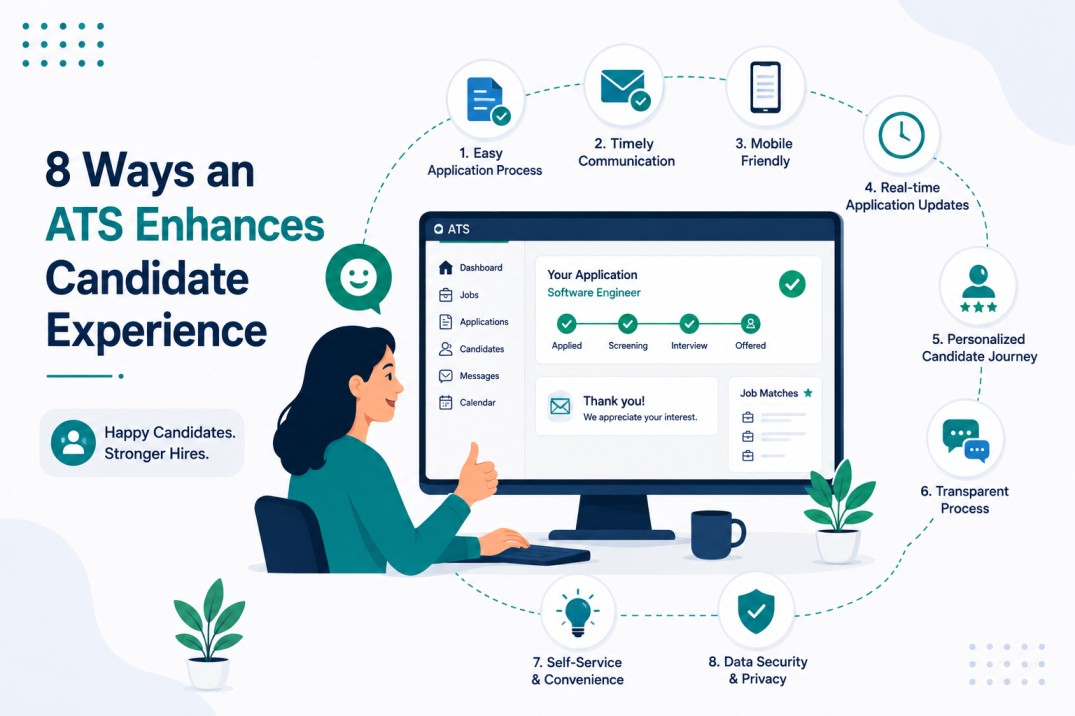
8 Ways an ATS Enhances Candidate Experience
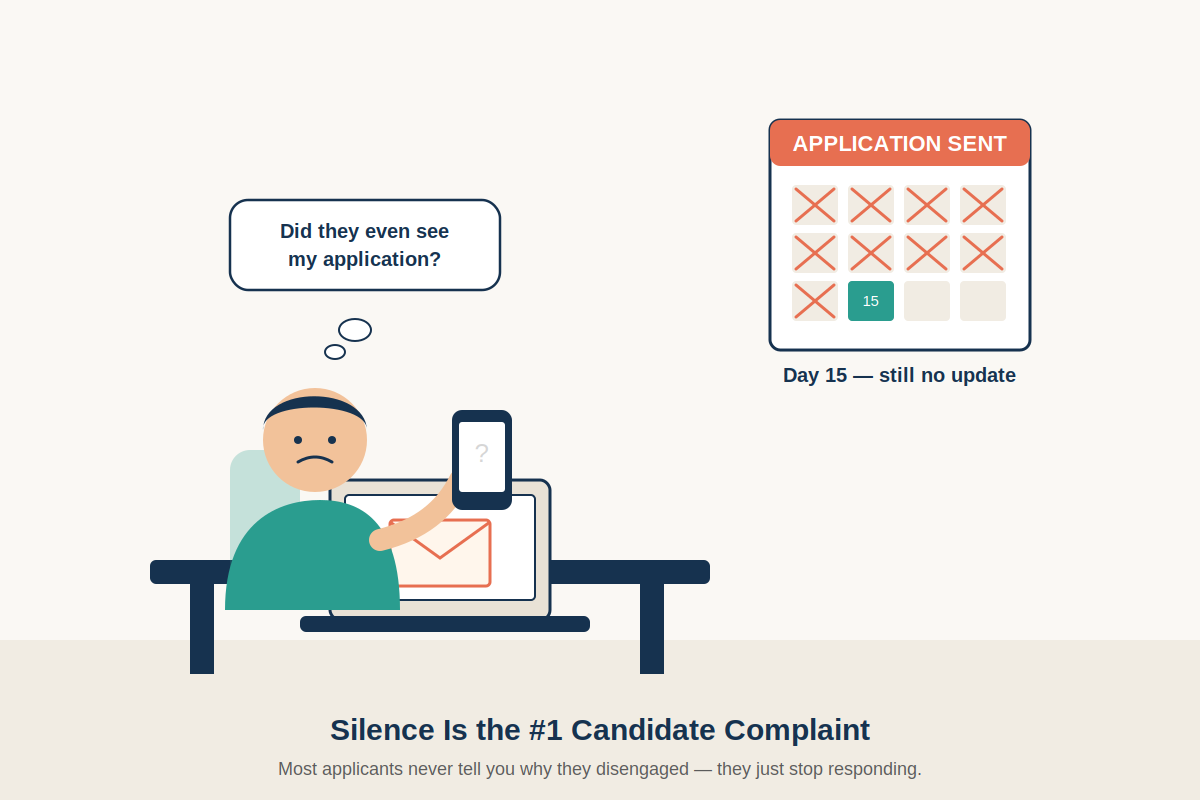
60% of candidates report having had a poor candidate experience during a job search, and most of them never tell the recruiter why they disengaged; they just stop responding.
For a startup running three open roles with one recruiter and 400 applications to sort through, that silence is expensive. It shows up months later as a weaker employer brand, a smaller referral pool, and offers that get quietly declined.
Most hiring teams treat candidate experience as a “nice to have” layered on top of the real work of screening and interviewing. That ordering is backwards. The systems a company uses to manage applications, not the intent behind them, are usually what decide whether a candidate feels respected or ignored.
An ATS enhances candidate experience by removing the operational gaps that cause candidates to fall through the cracks in the first place: the unanswered application, the interview that gets rescheduled three times, the status that never updates.
This isn’t a branding problem that a careers-page redesign fixes. It’s an infrastructure problem.
Startups and SMBs hiring at volume, often without a dedicated recruiting ops function, feel this most acutely, because every manual step (a spreadsheet update, a status email, a scheduling back-and-forth) is a point where a candidate can be forgotten.
This piece walks through eight specific, mechanical ways an ATS closes those gaps, where teams still get it wrong even with software in place, and how to evaluate whether a given
ATS Enhances Candidate Experience or is just built for recruiter convenience.
What Is Candidate Experience in an ATS Context?
Candidate experience is how an applicant perceives and reacts to every interaction with a company during hiring, from the job post and application form through interviews, status updates, and the final decision.
In an ATS context, it is shaped less by tone or messaging and more by speed, consistency, and transparency of process.
That distinction matters for how a hiring team should approach fixing it. If candidate experience were primarily about tone, the fix would be better email copy.
Because it’s primarily about process mechanics, the fix is closer to infrastructure: the systems and defaults that determine how quickly and consistently a candidate hears back, regardless of who’s handling their application that week.
This is the lens the rest of this piece uses: not “how do we sound friendlier,” but “where in our process does a candidate wait longer than they should, and what fixes that structurally.”
The Core Problem: Where Candidate Experience Actually Breaks Down
Most hiring teams assume candidate experience breaks down at the interview stage: an awkward panel, a rude interviewer, a confusing take-home test. In practice, the damage is usually done earlier and more quietly than that.
Internal hiring benchmarks across early-stage companies show that candidates wait an average of 10–15 business days between application and any status update, and a large share of applicants never hear back at all. That’s not a tone problem. That’s a process gap: no one owns the follow-up because the applicant’s status lives in a spreadsheet cell, not a live pipeline.
Teams also underestimate how much this compounds.
A single missed follow-up looks like an oversight. Ten missed follow-ups a week, every week, for a year, is a pattern that shows up in Glassdoor reviews and shrinks the applicant pool for the next open role.
Startups hiring for 4–6 roles simultaneously, with a recruiter also handling onboarding and vendor coordination, hit this ceiling 3–4x faster than they expect, because volume exposes manual processes almost immediately.
The second underestimated cost is interview scheduling. A hiring manager coordinating five interviewer calendars by email routinely adds 3–5 days to a hiring timeline per candidate. For a competitive candidate with two other offers in play, that delay alone can end the process before a decision is even made.
There’s a third, quieter cost that rarely shows up until months later: hiring pipeline visibility. When candidate status lives across a founder’s inbox, a recruiter’s spreadsheet, and a hiring manager’s memory, no one can answer a simple question:
“How many candidates are currently at offer stage across all open roles?” without manually reconciling three sources.
That reconciliation tax gets paid every week, and it’s almost always invisible in a headcount plan or a hiring budget, even though it consumes hours that could go toward actually moving candidates forward.
Compounding all of this is recruiter workload.
A single recruiter managing five open roles at a 40-person startup is realistically tracking 150–250 active candidates at any given time.
Manually sending status updates to even a fraction of that pool say, 20 candidates a week adds up to hours of repetitive, low-leverage work that doesn’t scale past a certain headcount.
When that workload gets deprioritized in favor of scheduling interviews or closing an urgent req, candidate communication is almost always the first thing to slip.
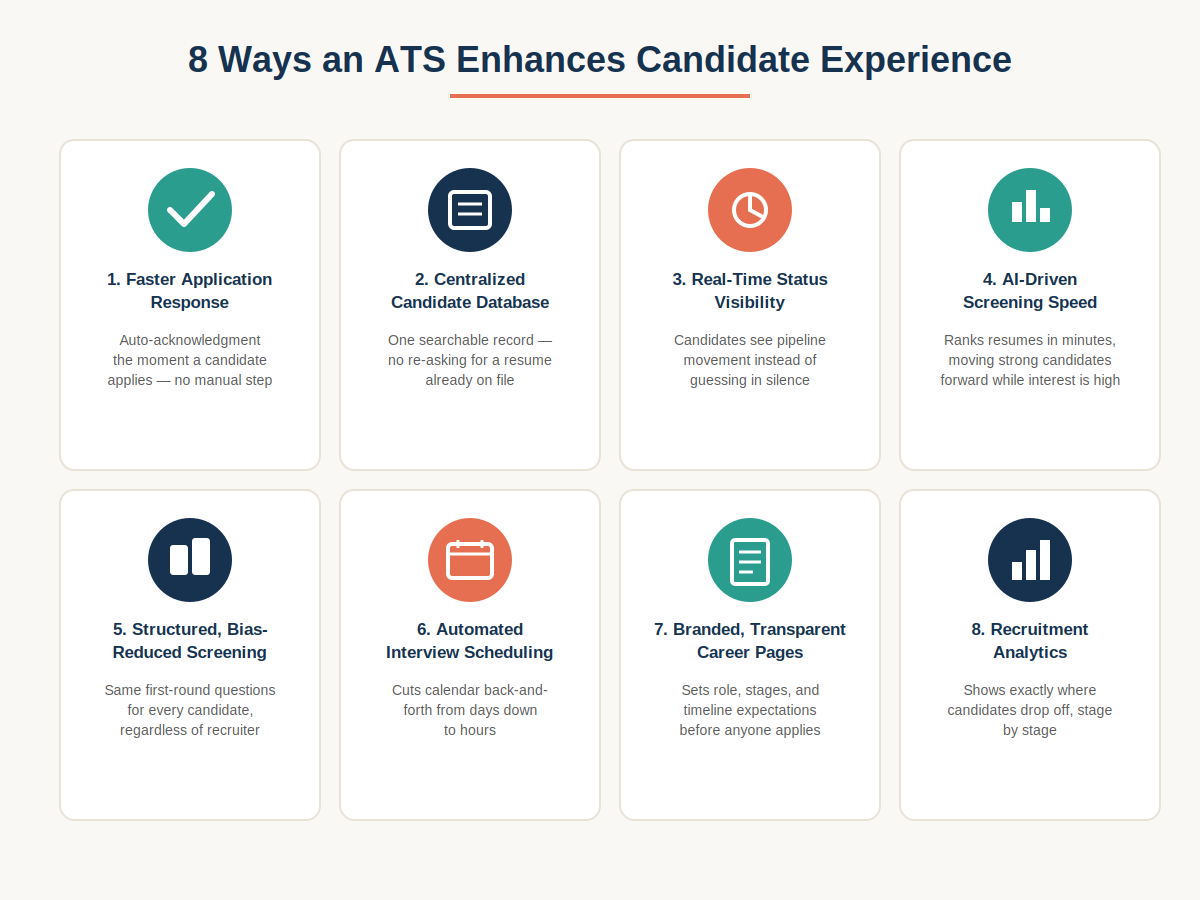
Eight Ways an ATS Enhances Candidate Experience
This is the operational core of the topic: the specific mechanisms through which the right software closes the gaps described above. Each of these maps to a common candidate complaint.
1. Faster, More Consistent Application Response
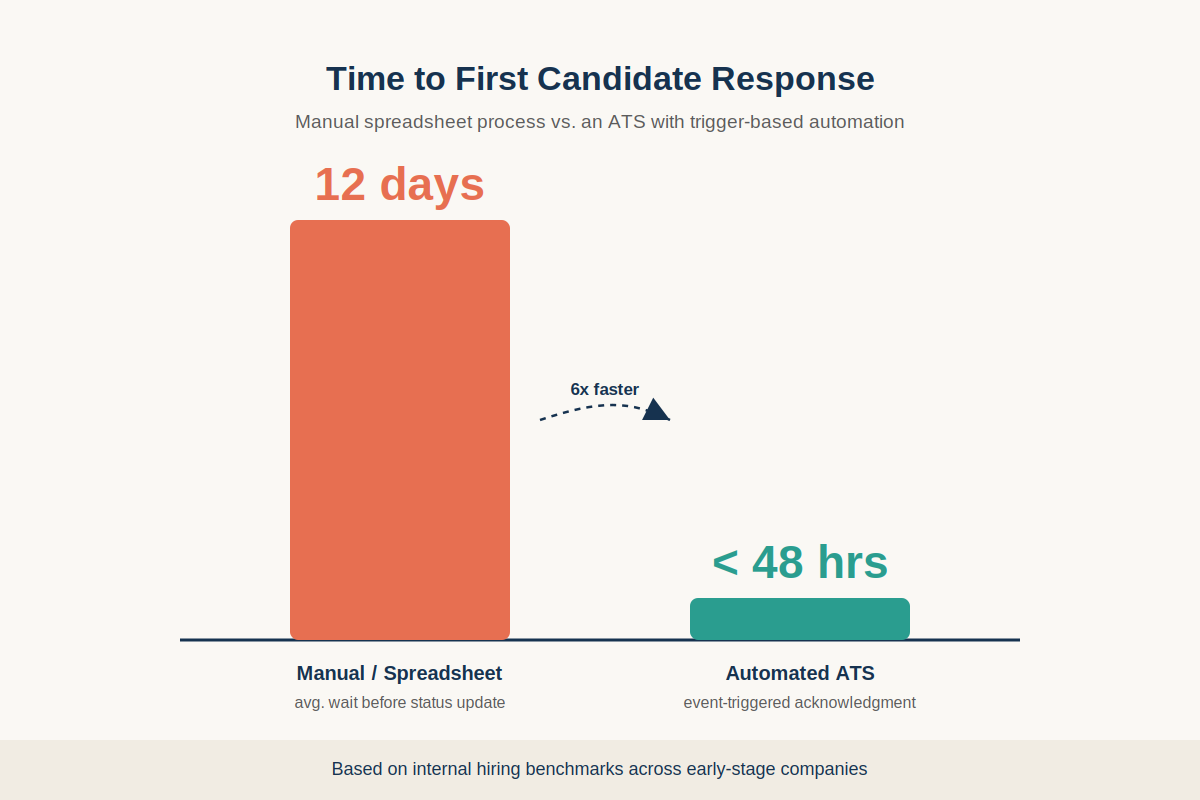
An ATS with workflow automation software built in can trigger an acknowledgment email the moment an application is submitted, without a recruiter touching it. That single automated step removes the most common candidate complaint- silence- before it can happen.
The architecture decision that matters here is trigger-based automation versus batch processing. A system that sends acknowledgments in a nightly batch still leaves candidates who applied in the morning waiting up to 20 hours for a response.
Event-triggered automation, fired the moment an application record is created, closes that gap to minutes rather than hours, and it costs nothing extra in recruiter time once configured.
2. Centralized Candidate Database Management
When every applicant’s resume, notes, and interview feedback live in one searchable record, recruiters stop losing track of where someone is in the pipeline. Candidate Database Management means a candidate is never asked to resend a resume they already submitted three weeks earlier, and a hiring manager never has to ask, ” Did we already talk to this person?”
This matters more than it sounds like on paper. A candidate asked to re-submit information they already provided reads it as a sign the company is disorganized, and it’s one of the more common reasons candidates cite for declining to continue with a process even when the actual role and compensation are competitive.
3. Real-Time Status Visibility
Modern ATS platforms let candidates see or be notified of pipeline movement: applied, under review, interview scheduled, decision pending instead of guessing.
This alone addresses a large share of the “ghosting” complaints candidates raise in exit surveys, because uncertainty, not rejection, is usually the actual source of frustration.
It’s worth separating two related but distinct capabilities here: internal pipeline visibility, which helps recruiters, and candidate-facing status visibility, which helps applicants.
A platform that only tracks status internally still leaves the candidate in the dark unless that status change is paired with an outbound notification. Both pieces need to be configured for candidate experience to actually improve.
4. AI-Driven Screening That Shortens Time-to-Response
AI Candidate Insights tools can parse and rank resumes against a role’s requirements within minutes of submission rather than days. This doesn’t just save recruiter time; it means a strong candidate can move to the interview stage in 48 hours instead of two weeks, while their interest is still high.
The compliance consideration here is worth flagging: AI screening should be used to rank and prioritize, not to make silent final rejections without any human review, particularly in jurisdictions with emerging AI-in-hiring disclosure requirements.
Teams evaluating an ATS should confirm how the screening logic is explained to both recruiters and, where required, candidates.
5. Structured, Bias-Reduced First-Round Screening
An AI interviewer or structured screening flow gives every candidate the same first-round experience: same questions, same evaluation criteria, no dependency on which recruiter happened to pick up their application.
Candidates consistently rate structured processes as fairer, even when the outcome is a rejection.
This also solves a scaling problem for lean teams. A founder or single recruiter who’s personally conducting every first-round call caps how many candidates can move through the pipeline in a given week.
Structured, automatable first-round screening removes that ceiling without sacrificing consistency across candidates.
6. Automated Interview Scheduling
Removing manual back-and-forth over calendar links can cut scheduling time from days to hours. For candidates juggling a current job and multiple interview processes, this single change is often the difference between staying engaged and quietly withdrawing.
Cost-wise, this is one of the higher-leverage automations available, because the alternative a recruiter or coordinator manually checking five calendars per interview loop is pure administrative overhead that scales linearly with headcount growth, while automated scheduling doesn’t.
7. Branded, Transparent Career Pages
A Job Posting Software layer that supports a branded, clearly structured careers page sets expectations upfront: role scope, process stages, expected timeline, so candidates aren’t applying into a black box. Transparency at the top of the funnel reduces drop-off further down it.
A career page that lists the actual number and format of interview stages, along with a realistic timeline, tends to see fewer candidates dropping out mid-process, simply because expectations were set correctly from the start rather than adjusted reactively after a candidate already feels frustrated.
8. Recruitment Analytics That Catch Drop-Off Points
Analytics on time-to-hire, stage-by-stage drop-off, and recruiter response time let a hiring team see exactly where candidates are disengaging instead of guessing. A team that notices a 40% drop-off between “applied” and “screened” can fix that specific stage rather than redesigning the whole process.
Without this layer, teams tend to make process changes based on the most recent bad experience someone happens to remember, rather than on where the data actually shows the leak.
Analytics turn candidate experience from an anecdote-driven conversation into a measurable, fixable operational metric.
Individually, each of these is a modest fix.
Together, they’re what actually determines whether an ATS enhances candidate experience in practice or just digitizes the same slow, inconsistent process that existed on spreadsheets; the software alone doesn’t guarantee the outcome; how it’s configured does.
How these fit into a hiring process, in order:
- Candidate applies through a branded career page with clear role and timeline information
- Automated acknowledgment is sent within minutes
- AI screening ranks and shortlists within 24–48 hours
- Structured first-round screening is scheduled automatically
- Status updates trigger at each pipeline stage without manual input
- Interview scheduling is handled through automated calendar sync
- Recruiter reviews analytics weekly to catch stage-specific drop-off
- Decision (offer or rejection) is communicated with a defined SLA, not left open-ended
1. ATS for Startup Teams vs. ATS for Tech Companies at Scale
An ATS for startup teams typically needs to solve for speed and low overhead: a lean recruiter or founder managing hiring alongside other responsibilities, with limited time for configuration.
An ATS for Tech Companies hiring at higher volume needs the same core mechanics, but with more emphasis on structured screening consistency across a larger interviewer pool and more granular analytics to manage recruiter load across multiple simultaneous searches.
2. Cost and Implementation Considerations
The implementation cost of an ATS isn’t only the subscription fee. It’s also the setup time required to configure workflows, templates, and career page branding correctly, and this is where candidate experience gains are frequently left on the table.
A team that adopts an ATS but never configures automated status triggers is paying for software while still delivering a manual-process experience to candidates.
For early-stage teams, this is a meaningful argument for platforms with flat, predictable pricing and no per-recruiter fees, since it removes the temptation to under-provision seats and route candidate communication back through informal channels like personal email.
Migration cost also matters more than teams expect going in; a platform that offers supported migration from an existing ATS (moving candidate records, historical notes, and open pipelines) avoids the common failure mode where a switch to new software temporarily makes candidate experience worse, not better, during the transition period.
Compliance is the other underweighted line item. Candidate data, resumes, screening notes, and interview feedback carry data-handling obligations that vary by region, and an ATS that centralizes this data needs clear retention and access controls, not just a searchable database.
This becomes more relevant, not less, as AI screening tools take on more of the initial evaluation work, since candidates and regulators increasingly expect visibility into how automated shortlisting decisions are made.
3. Why Manual Processes Fail at Scale, Not at Launch
It’s worth naming why this problem is often invisible early on. A five-person startup hiring for its first two roles can manage candidate communication manually without much friction; the volume is low enough that nothing falls through.
The failure mode shows up later, once hiring scales to 4–6 simultaneous roles and the same manual habits that worked at low volume start missing candidates at a rate the team doesn’t notice until offer acceptance rates or employer review sites start reflecting it.
By the time it’s visible in outcome data, the underlying process gap has usually existed for two or three hiring cycles already.
Case Studies: Candidate Experience Fixes in Practice
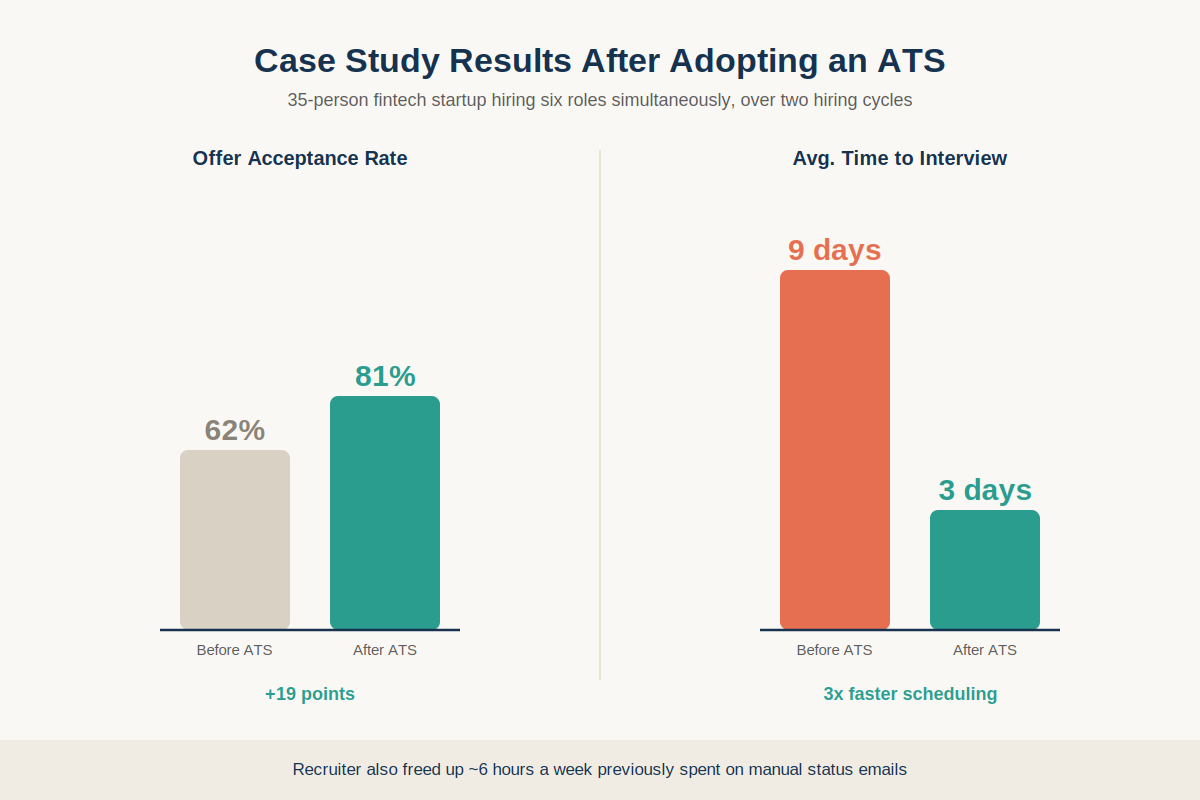
A 35-person fintech startup hiring for six roles simultaneously was averaging 12 business days before any candidate heard back after applying.
Every role was being tracked in a shared spreadsheet, and follow-ups depended entirely on whichever team member remembered to check it that week.
After introducing automated status updates and AI-driven shortlisting, that window dropped to under 48 hours, and the team’s offer acceptance rate improved from 62% to 81% over the following two hiring cycles.
The recruiter also reported spending roughly 6 fewer hours a week on manual status emails, time that was redirected into sourcing.
A seed-stage SaaS company relying on email and spreadsheets for interview scheduling was losing an estimated 3–4 candidates per quarter to scheduling delays alone, based on candidate feedback collected in exit surveys.
Interview loops that should have taken 3–5 days to schedule were routinely stretching to 9–10 days once calendar conflicts and multiple email threads were factored in.
Moving scheduling into automated workflows cut the average time-to-interview from 9 days to under 3, and the team no longer needed a dedicated coordinator to manage loop logistics for a single open requirement.
Choosing an ATS: What Actually Affects Candidate Experience
Not every ATS feature moves the needle on candidate experience. Some are genuinely load-bearing; they change what a candidate actually sees or waits for.
Others are convenience features for recruiters that a candidate never encounters directly, and while useful internally, they shouldn’t be mistaken for candidate experience improvements when evaluating a platform.
| Capability | Candidate-Facing Impact | Why It Matters |
| Automated status updates | High | Removes silence, the #1 candidate complaint |
| AI resume screening speed | High | Shortens time-to-response while interest is high |
| Branded career page | Medium | Sets expectations before application |
| Interview scheduling automation | High | Cuts multi-day delays to hours |
| Internal-only reporting dashboards | Low | Useful for recruiters, invisible to candidates |
What Most Teams Get Wrong About Candidate Experience
Most teams treat candidate experience as a messaging problem: better email templates, warmer rejection copy, a friendlier careers page. That’s polish, not infrastructure. It doesn’t fix the underlying issue if a candidate still waits two weeks for a status update.
The more common and costlier mistake is buying an ATS and configuring it purely around recruiter convenience: internal notes, internal tags, internal pipelines with no attention to what candidates actually see or receive.
A tool can technically be in place, and candidate experience can still be poor, because automation was pointed inward instead of outward.
The other pattern worth naming: teams often measure candidate experience anecdotally (“candidates seem happy”) instead of through actual drop-off data.
Without stage-by-stage analytics, a hiring team can be losing 30–40% of qualified candidates at a specific stage and have no idea it’s happening.
There’s also a tendency to treat candidate experience improvements as a one-time setup rather than an ongoing operational habit.
A team might configure automated status updates when they first adopt an ATS, then never revisit whether the templates, timing, or thresholds still match how the company hires a year later as headcount and role complexity change.
Candidate experience, like any process metric, degrades quietly without periodic review usually the same way it broke down in the first place: not through a single bad decision, but through gradual neglect once the initial setup work feels “done.”
FAQ
1. What is candidate experience in recruitment?
Candidate experience is the overall perception a job applicant forms based on every interaction with a company during the hiring process: application, communication, interviews, and final decision. It’s shaped primarily by speed and transparency, not tone or branding alone, and it’s measurable through concrete metrics like time-to-response and stage-by-stage drop-off rather than general sentiment.
2. How does an ATS enhances candidate experience?
An ATS Enhances Candidate Experience by automating the operational steps most likely to be missed: application acknowledgment, status updates, interview scheduling, and rejection communication, so candidates aren’t left waiting without information. The improvement comes from consistency: every candidate gets the same baseline communication regardless of how busy a recruiter is that week.
3. Why do candidates drop out of the hiring process?
The most common reason is silence or delay: candidates who don’t hear back within a reasonable window assume they’ve been rejected and disengage, often before a recruiter has even reviewed their application.
Slow interview scheduling and unclear process expectations set at the application stage are the next two most common causes.
4. Does a good candidate experience actually affect offer acceptance?
Yes. Candidates who experience long delays or unclear communication are more likely to accept a competing offer or decline even after receiving one, since the process itself signals how the company operates day-to-day.
This effect tends to be strongest for the most in-demand candidates, who typically have the most alternative options and the least patience for a slow process.
5. What ATS features matter most for small hiring teams?
For lean teams, automated status updates, AI-driven screening, and scheduling automation matter most, since these are the steps most likely to be skipped manually when a recruiter is managing multiple roles at once.
Teams evaluating options for their first real hiring stack should weigh these three capabilities more heavily than reporting depth or advanced customization, which matter more once hiring volume and headcount grow.
6. Is candidate experience only about communication?
No. Communication is the most visible piece, but structured, consistent screening and clear process transparency at the application stage matter just as much, since they set expectations before communication even begins.
A candidate who knows upfront that a process involves three stages over roughly two weeks is far less likely to feel misled than one given no timeline at all.
Conclusion
If your team is losing candidates to slow follow-ups or scheduling delays rather than to actual hiring decisions, that’s a process gap worth pressure-testing before it costs another quarter of strong applicants.
Hirium has plans that are built for exactly this: startups and SMBs that need automated candidate communication and AI screening without adding recruiter headcount. You can review how it fits your current process at hirium.com.