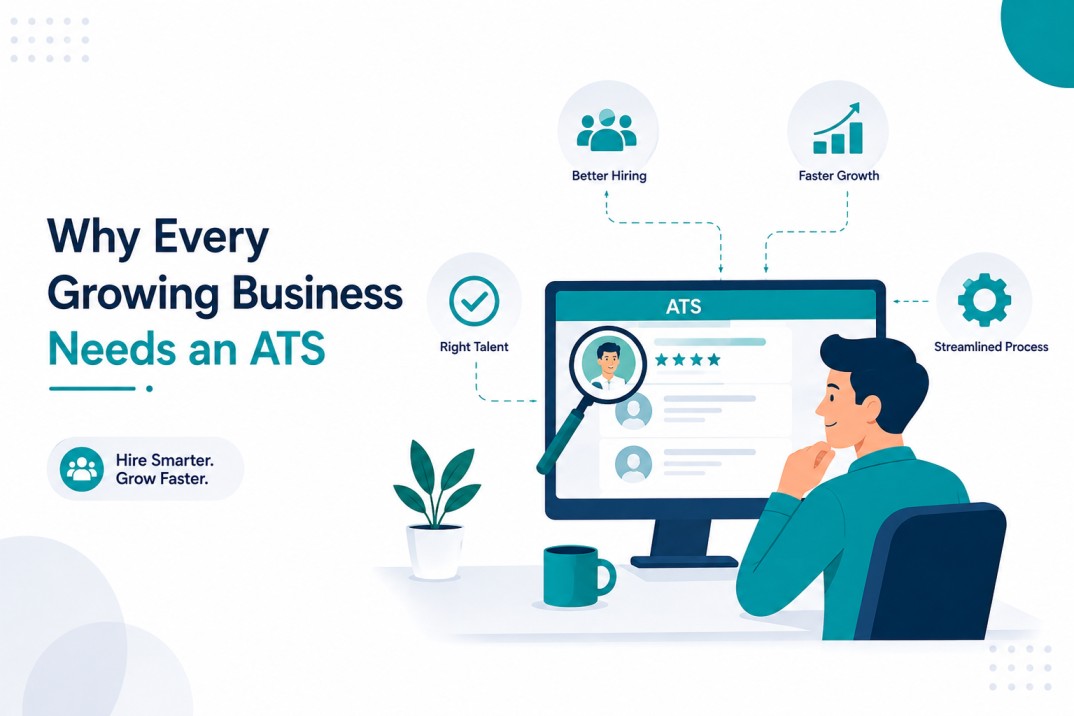
Why Every Growing Business Needs an ATS (Application Tracking System)
An Applicant Tracking System (ATS) is software that manages the recruitment process, from posting a job to hiring a candidate.
As businesses grow, hiring volume increases, and manual methods like spreadsheets and email threads become harder to manage accurately.
According to RecruitCRM’s 2026 ATS report, 60% of small businesses with 1 to 50 employees now use an ATS, a sharp rise from previous years when adoption was mostly limited to large enterprises.
This shift shows that growing businesses need structured hiring systems earlier than expected, not just to save time, but to avoid losing strong candidates to a slow process.
What Is an ATS?
An Applicant Tracking System (ATS) is software that automates and optimizes recruitment. It streamlines processes such as posting jobs, collecting and organizing applications, tracking candidates through different stages, and onboarding new hires.
With features like resume parsing, automated communication, data analytics, and integrations with job boards and social media platforms, an ATS offers both efficiency and strategic insights.
Why every Growing Business Needs an ATS?
1. Managing High-Volume Hiring Without Chaos
Hiring becomes harder when several positions open together. Resumes can get buried in emails, spreadsheets become difficult to update, and recruiters may miss candidate follow-ups.
An ATS keeps applications, candidate details, interview stages, and hiring updates in one place, giving the team a clear view of every open position.
Use Case: A retail company opening new stores may need dozens of employees within a short period. Instead of managing separate spreadsheets for each location, the hiring team can use one system to sort applications, track candidates, schedule interviews, and see which positions still need attention.
2. Improving Candidate Experience During Hiring
Candidates want to know what happens after they apply. Long gaps between interviews, unclear updates, and repeated email exchanges can make the hiring process frustrating. An
ATS can help recruiters send application updates, manage interview schedules, and keep candidate communication organised throughout the process.
Use Case: A small software company hiring developers may receive many applications for one position. The recruiter can use an ATS to acknowledge applications, move suitable candidates to the next stage, schedule interviews, and send updates without handling every message manually.
3. Hiring for Niche and Hard-to-Fill Roles
Finding the right person for a specialised position can take time. Recruiters may receive many resumes, but only a few candidates may have the required skills or experience. An
ATS can help sort applications using job-related criteria, making it easier for recruiters to focus their time on suitable candidates.
Use Case: A fintech company hiring a senior backend developer may receive resumes from candidates with different technical backgrounds. The hiring team can use relevant skills, experience, and qualifications to narrow the candidate pool before moving people to interviews with the help of an ATS for tech companies.
4. Managing Seasonal and Contract Hiring
Some businesses need to hire many people during specific periods. Retailers may recruit before major sales seasons, while logistics companies may need extra workers during busy delivery periods.
Managing these applications manually can become difficult when hundreds of candidates apply within a short time.
Use Case: A logistics company preparing for a busy delivery season may need warehouse workers and delivery staff quickly. An ATS can keep applications organised, help recruiters move candidates through different hiring stages, and give hiring managers a shared view of the recruitment pipeline.
5. Keeping Recruitment Records Organised
Growing companies often have more people involved in hiring. When candidate information is spread across emails, spreadsheets, and personal notes, it becomes difficult to understand why a hiring decision was made.
An ATS keeps candidate records, interview feedback, hiring stages, and other recruitment information together.
Use Case: A healthcare staffing company may need to review candidate records for different roles and locations. With an ATS for healthcare, recruiters and hiring managers can access candidate information and previous feedback from one system instead of searching through old emails or separate files.
Key Benefits: Why every Growing Business Needs an ATS
- Higher Productivity: An ATS can handle routine tasks such as resume parsing, interview scheduling, and candidate updates, giving recruiters more time to focus on interviews and hiring decisions.
- Better Candidate Screening: Resume parsing and candidate matching can help recruiters find applicants whose skills and experience match the requirements of a role, reducing manual screening work.
- Faster Hiring Process: A centralised recruitment workflow helps teams track applications, schedule interviews, and move candidates between hiring stages without relying on multiple spreadsheets or email threads.
- Easy to Scale: Whether a business is hiring for five positions or fifty, an ATS can help manage a larger number of applications without adding the same amount of manual work for the HR team.
- Lower Recruitment Costs: By reducing repetitive administrative work and helping teams manage hiring internally, an ATS can lower recruitment expenses and reduce the time spent filling open positions.
FAQs
1. When should a growing business start using an ATS?
Knowing why every growing business needs an ATS becomes important when hiring is difficult to manage through spreadsheets and emails, especially with multiple positions, recruiters, or large application volumes.
2. Can small businesses use an ATS?
Yes, small businesses can use an ATS to organise applications, reduce repetitive recruitment tasks, track candidates, and maintain a clear hiring process without needing a large HR team.
3. How does an ATS improve the hiring process?
An ATS keeps candidate information and hiring activities in one place. Recruiters can track applications, schedule interviews, communicate with candidates, and move applicants through different hiring stages more easily.
4. What features should businesses look for in an ATS?
Important ATS features include job posting, resume parsing, candidate tracking, interview scheduling, communication tools, reporting, candidate database management, and integrations that support the recruitment workflow.
5. Can an ATS help with high-volume hiring?
Yes, an ATS can help recruiters manage large numbers of applications by organising candidate information, sorting resumes, tracking hiring stages, and reducing repetitive administrative work during busy recruitment periods.
6. Does an ATS reduce recruitment costs?
An ATS can help reduce recruitment costs by cutting repetitive administrative work, shortening hiring timelines, improving internal recruitment processes, and reducing the need for manual candidate management across multiple tools.
Conclusion
Hiring can become difficult to manage when a business starts growing, with more candidates, job openings, and hiring managers involved in the process. Why every growing Business Needs an ATS becomes clear when recruitment starts getting harder to manage manually. An ATS brings these activities into one place, making it easier to manage applications, screen candidates, schedule interviews, and track hiring progress.
Hirium can help growing businesses manage their recruitment process with tools such as job posting, AI resume parsing, candidate database management, candidate profile management, and an AI interviewer. These features can reduce repetitive work and give hiring teams a clearer view of their candidates.
For businesses that want to move away from scattered spreadsheets and manual recruitment tasks, Hirium provides a practical way to organise hiring and manage candidates from application to selection.