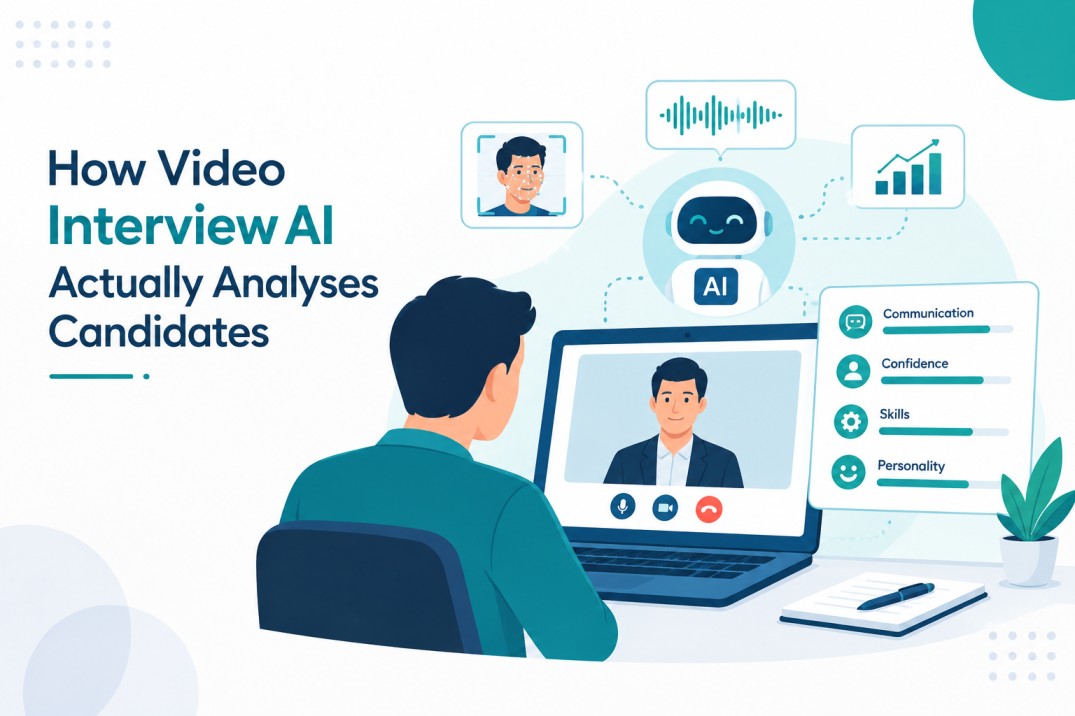
How Video Interview AI Actually Analyses Candidates
Nearly two-thirds of job seekers have now sat through an AI-run interview, up 13 % points in just six months, according to the Greenhouse 2026 Candidate AI Interview Report, which surveyed 2,950 active job seekers.
That number keeps climbing every quarter, yet most candidates, and even a lot of recruiters, cannot explain how the software behind the screen actually breaks down an answer.
This guide opens up that process step by step and shows exactly what video interview AI checks for, how it turns an answer into a score, and where its limits still show up.
What Is Video Interview AI?
Video interview AI is software that reviews a recorded or live interview and produces a structured score instead of a gut-feel reaction.
Most AI video interview software runs in one of two formats: asynchronous, where a candidate records answers to preset questions on their own time, or live, where the system listens in real time and can ask a follow-up question based on what a candidate just said.
Unlike a plain video call, an AI-based video interview platform benefits from pairing the recording with language models, speech analysis, and scoring rules the hiring team sets up in advance.
The output isn’t one verdict. It’s a set of scored components a recruiter can open, check line by line, and compare across every candidate applying for the same role.
How Video Interview AI Actually Analyses Candidates
Here are the four layers behind every score. A single interview answer gets pulled apart in several ways before it turns into a number on a dashboard.
1. What the Candidate Actually Said
The audio is transcribed first. From there, the content gets checked against the job requirements: did the candidate answer the actual question, did they give a specific example instead of a vague claim, and did their response touch the skills or experience the role calls for?
Many platforms look for structure here too, rewarding answers that follow a clear situation-task-action-result flow over answers that ramble without landing on a point.
2. How the Candidate Said It
This layer covers pace, filler-word frequency, pause length, and vocabulary clarity. A candidate who speaks in short, direct sentences with few “ums”s typically scores higher on communication clarity than someone who trails off mid-thought, regardless of how strong their actual answer content is.
This is also where AI interview feedback gets specific, telling a recruiter something like “candidate paused for over four seconds before three of five answers” instead of a general impression.
3. Tone and Vocal Delivery
Some platforms measure energy and steadiness in the voice, checking for consistency between how a candidate talks about strengths versus how they talk about weaknesses.
This part of the analysis draws more scrutiny than any other. Older systems tried to infer emotion and even facial expression from video, and several major vendors have since pulled back from that approach after research raised doubts about its accuracy and after regulators started asking hard questions.
What’s left in most modern tools leans on voice and word choice rather than reading a face.
4. Structured Comparison Against the Scorecard
Every answer gets weighed against a rubric the hiring team built before the interview even started. If “client communication” carries 30 per cent weight for a sales role, an answer touching that skill pulls more score weight than one that doesn’t.
This is the step that turns a pile of individual answers into one ranked shortlist a recruiter can actually act on.
What Video Interview AI Does Not Do
It’s worth being direct about the limits here, because a lot of candidates and even some hiring managers assume more than the software delivers.
A capable AI-based video interview tool hands back a scored, evidence-backed report; a person still reviews it and makes the call. And it does not guarantee a bias-free process on its own.
It cannot know what a candidate is thinking or determine whether someone is telling the truth simply from their voice, words, or appearance.
Speech patterns and language are signals that software can analyse, but they are not direct proof of personality, honesty, confidence, or ability.
Facial analysis also needs careful treatment. Some older video assessment approaches attempted to use facial expressions or other visual signals to infer emotions or personality. Research has raised concerns about whether these signals can reliably support hiring decisions, which is one reason employers need to understand exactly what their chosen system measures.
AI also does not remove bias automatically. Bias can enter through interview questions, scoring criteria, training data, speech recognition, or the way recruiters interpret the results.
For recruiters, the safer approach is to use AI to organise evidence and reduce repetitive screening work while keeping human review in the process.
A candidate score can point to areas worth reviewing, but it should not become the only reason a top talent is rejected or advanced.
From Score to Shortlist: How Feedback Reaches Recruiters
Once an interview wraps, the output usually lands on a dashboard with three things: a numeric score against each rubric item, a transcript with the flagged moments highlighted, and a short written summary.
A recruiter can skim the summary, click into the transcript for anything unclear, and compare five or fifty candidates side by side without sitting through a single full recording.
This is the real time saved: not the interview itself, but the hours a hiring manager used to spend rewatching recordings one at a time.
Why the Same Software Gives Different Results Job to Job
A video interview AI is only as good as the setup behind it. Two companies running the identical tool can get very different quality of results depending on how well they wrote their interview questions, how carefully they weighted the scorecard, and whether anyone calibrated the system against real hires before rolling it out.
A vague question like “tell me about yourself” gives the AI little to score against. A specific, role-relevant question gives it something concrete to measure.
This is also why a hiring team switching tools for hiring should spend more time on question and rubric design than on comparing vendor feature lists.
What This Means If You’re Being Interviewed by AI
For candidates, the practical takeaway is simple. Answer the actual question asked, give one concrete example rather than a general claim, and speak in complete thoughts rather than trailing off.
Don’t try to perform for a camera or worry about facial expression, since most current systems put far more score weight on what you say and how clearly you say it than on how you look while saying it.
Hirium is a free ATS platform that provides AI video interviews to screen candidates faster, eliminate biasness to get measurable outcomes
FAQs
1. How does video interview AI analyse candidates?
Video interview AI can analyse interview responses through speech transcription, language analysis, role-specific competencies, and predefined scoring criteria. Some systems may also analyse speech patterns such as pace and pauses.
2. What does AI video interview software look for in a candidate?
AI video interview software can assess factors such as answer relevance, specific examples, job-related skills, communication patterns, and responses against a predefined interview scorecard.
3. Can an AI-based video interview detect whether a candidate is lying?
No. An AI-based video interview cannot reliably determine whether a candidate is telling the truth. Speech patterns, facial expressions, or word choices should not be treated as proof of honesty or deception.
4. Does AI interview feedback replace a human recruiter?
No. AI interview feedback can organise responses, highlight relevant evidence, and reduce manual screening time, but recruiters should review the results and consider the wider candidate profile before making a hiring decision.
5. How can candidates prepare for an AI video interview?
Candidates should understand the role, prepare specific examples from their experience, answer the question directly, and practise explaining their thoughts clearly. The goal should be a relevant and genuine response rather than simply using keywords.