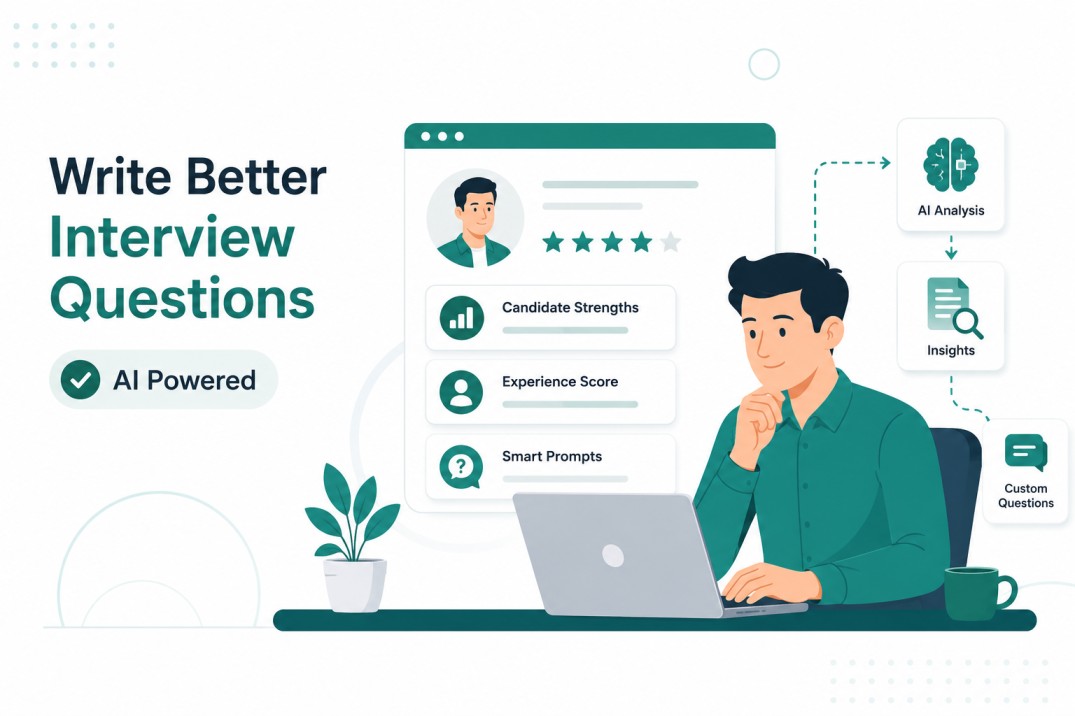
How AI Candidate Insights Change the Way You Write Interview Questions?
According to Greenhouse’s 2026 survey of nearly 3,000 job seekers across the US, UK, Ireland, Germany, and Australia, 63% of US candidates say they’ve already gone through an AI-driven interview in the past six months.
That number alone should make any hiring manager pause. Interviews are no longer a simple back-and-forth between two people in a room.
They’re becoming data-informed conversations, shaped by insights AI pulls from resumes, past assessments, and behavioural patterns long before a candidate says a word.
This shift changes more than just who or what is asking the questions. It changes what makes a good question in the first place.
Generic prompts pulled from a shared template can no longer separate strong candidates from ones who simply prepared well.
If you’re still asking the same five questions to every applicant, you’re leaving valuable signal on the table. AI candidate insights give you the chance to ask better, sharper, more relevant questions instead.
What Are AI Candidate Insights?
AI Candidate Insights for Interview Questions come from analyzing resumes, assessment scores, and past interview data together, not in isolation.
Instead of reading each piece separately, the system connects them, surfacing patterns recruiters can act on directly when shaping what to ask next.
How AI Generates Insights From Resumes, Assessments, and Past Interviews
The system pulls structured data from a resume, scores from any assessments completed, and notes or transcripts from earlier conversations with the candidate.
It then cross-references these sources, looking for consistency, gaps, or standout signals. A strong score on a technical assessment paired with vague resume descriptions might prompt a deeper question.
A pattern across two prior interview rounds could shape what the next interviewer chooses to ask. The goal isn’t replacing human judgment; it’s giving interviewers something concrete to build questions around instead of starting from scratch each round.
The Difference Between AI Insights and Traditional ATS Filtering
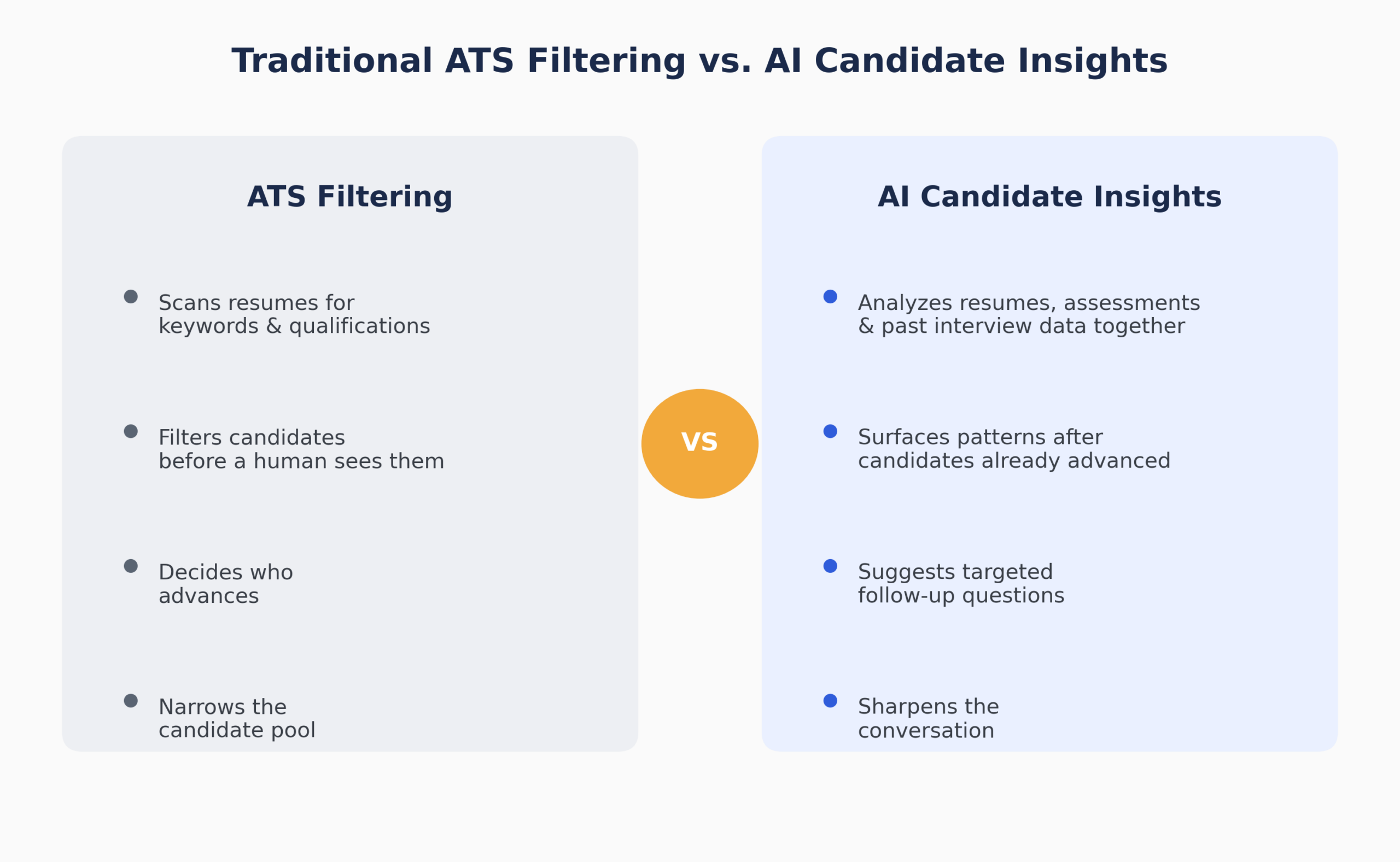
Traditional ATS filtering works like a gate. It scans resumes for keywords and qualifications, then lets candidates through or screens them out before a human ever sees the file.
AI Candidate Insights for Interview Questions work differently; they don’t decide who advances. They analyze the candidates who already made it through and hand interviewers specific, relevant angles to explore.
One narrows the pool. The other sharpens the conversation once someone is already sitting in the room.
Why Traditional Interview Questions Fall Short
Most interview processes still rely on the same recycled question banks, regardless of role, candidate background, or resume signals.
Without AI Candidate Insights for Interview Questions guiding the conversation, interviewers end up asking generic prompts that reveal little about whether someone actually fits the role.
-
The Problem With One-Size-Fits-All Question Banks
Standard question banks treat every candidate the same, regardless of their specific background or experience level.
A junior developer and a senior engineer might face nearly identical prompts, even though their skill gaps, career paths, and red flags differ entirely.
This approach saves prep time, but it costs accuracy. Interviewers end up gathering surface-level answers instead of the specific, relevant information needed to make a confident hiring decision.
-
How Generic Questions Let Weak Candidates Coast Through
Candidates who’ve interviewed frequently know exactly what generic questions look like, and they prepare polished, rehearsed answers well in advance. “Tell me about a time you faced a challenge” rarely catches anyone off guard anymore.
Without questions shaped around a candidate’s actual resume gaps or inconsistencies, weaker candidates can rely on general storytelling skills to move forward, while stronger, less-rehearsed candidates get overlooked.
-
The Cost of Misaligned Interviews on Time-to-Hire
When interviews fail to surface real red flags early, companies often discover mismatches only after an offer is made or, worse, after onboarding begins.
This forces teams back into another hiring cycle, extending time-to-hire and driving up cost per hire.
Misaligned questions don’t just waste an hour of conversation; they delay the entire pipeline behind that one role.
Practical Ways to Use AI Insights When Writing Questions
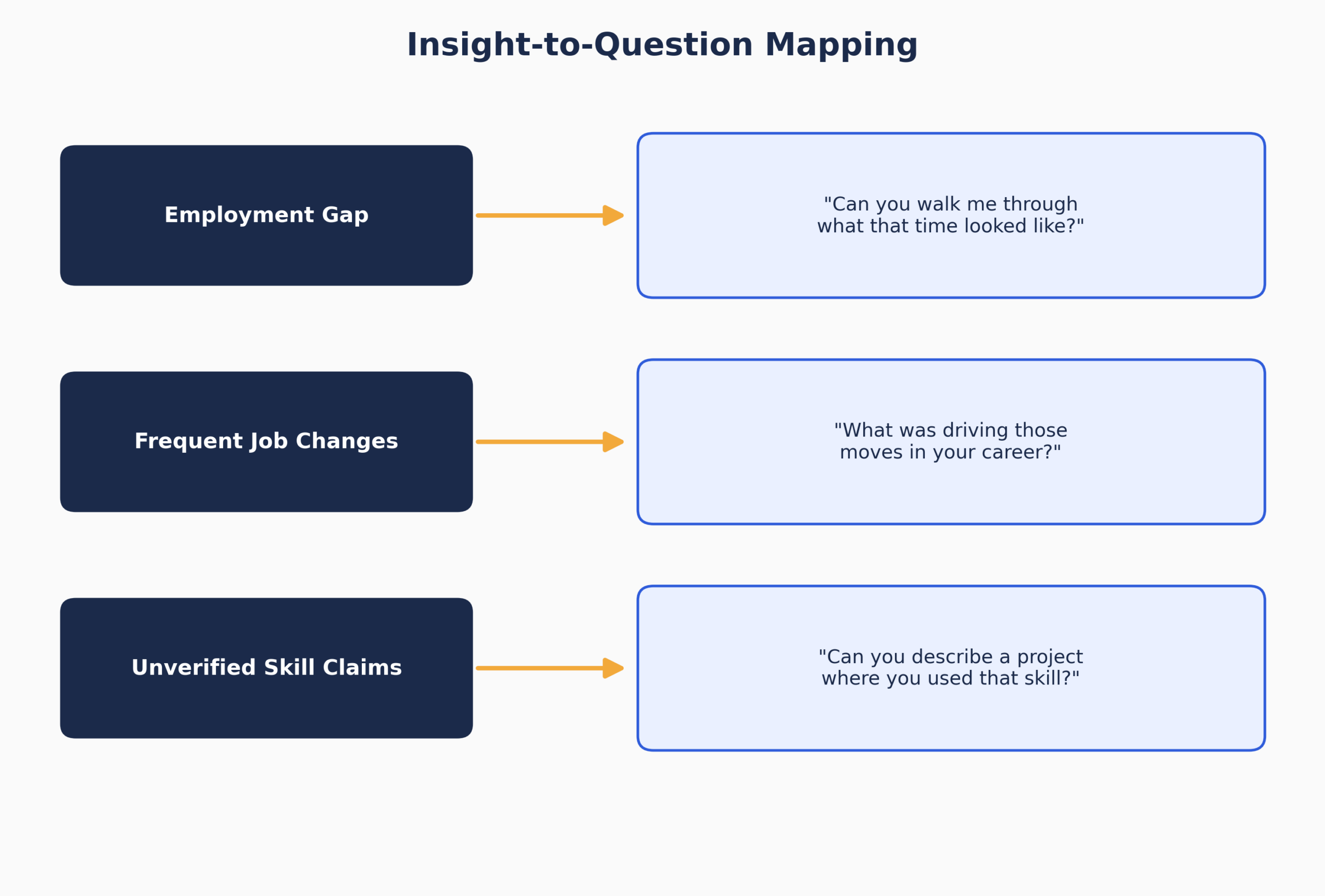
Turning raw data into good interview questions takes a deliberate process. AI Candidate Insights for Interview Questions become useful only when interviewers know how to translate flagged patterns, skill gaps, and inconsistencies into specific, purposeful questions instead of generic prompts.
-
Turning Skill Gaps Into Targeted Technical Questions
When a resume lists a skill without supporting projects or measurable outcomes, that gap becomes the starting point for a technical question. Instead of asking a candidate to rate their own proficiency, interviewers can request a walkthrough of a real scenario using that skill.
This approach separates candidates who genuinely understand a tool from those who simply added it to sound competitive on paper.
-
Using Career Trajectory Data to Probe Motivation and Fit
A candidate’s career path often reveals more than any cover letter. Lateral moves, industry switches, or a sudden jump in seniority all point to decisions worth understanding.
Questions built around trajectory data help interviewers learn what actually drove those choices, whether it was growth, necessity, or dissatisfaction, and whether the same motivations align with what this new role can realistically offer.
-
Flagging Inconsistencies in a Resume for Clarifying Questions
Dates that don’t quite line up, titles that shift unexpectedly, or responsibilities that seem inflated compared to the role’s seniority all warrant a closer look.
These inconsistencies aren’t automatically disqualifying, but they deserve a direct, non-confrontational question.
Giving candidates the chance to clarify builds a more accurate picture and often uncovers reasonable explanations that a resume alone couldn’t capture.
-
Calibrating Question Difficulty to the Candidate’s Actual Level
Not every candidate needs the same difficulty level, even for the same role.
Assessment scores and past performance data help interviewers pitch questions at the right level, challenging enough to test real ability, without wasting time on basics a candidate has already proven.
This keeps the conversation efficient and focused on genuinely uncovering strengths and gaps.
The Case Against Over-Relying on AI Insights
Data can guide a conversation, but it shouldn’t replace the person having it. Leaning too heavily on AI Candidate Insights for Interview Questions risks turning interviews into checklist exercises, where interviewers chase flagged patterns instead of listening to what the candidate is actually saying.
Why Human Judgment Still Matters in the Room
No system can read tone, hesitation, or the way someone lights up when discussing a project they genuinely cared about. These moments carry weight that data points alone can’t capture.
An interviewer who treats flagged insights as a starting point, rather than a script, stays alert to context the technology simply cannot pick up on. Judgment, built through experience, remains the deciding factor between a good hire and a great one.
The Risk of Losing Spontaneity and Genuine Conversation
When every question traces back to a flagged data point, interviews can start feeling mechanical.
Candidates notice when a conversation follows a rigid script built entirely around their resume history, and it often discourages the kind of open, natural dialogue that reveals character.
Some of the most useful moments in an interview happen off script, when a follow-up question emerges from genuine curiosity rather than a predetermined prompt pulled from a report.
When AI Signals Can Mislead Interviewers
Flagged patterns aren’t always accurate reflections of a candidate’s profile management true situation. A resume gap might reflect a caregiving responsibility rather than a lack of initiative, and frequent job changes could stem from repeated layoffs in a volatile industry rather than restlessness.
Treating every signal as a red flag without context leads to unfair assumptions, and interviewers who forget this risk rejecting strong candidates for reasons that were never actually a problem.
How to Start Using AI Candidate Insights in Your Interview Process
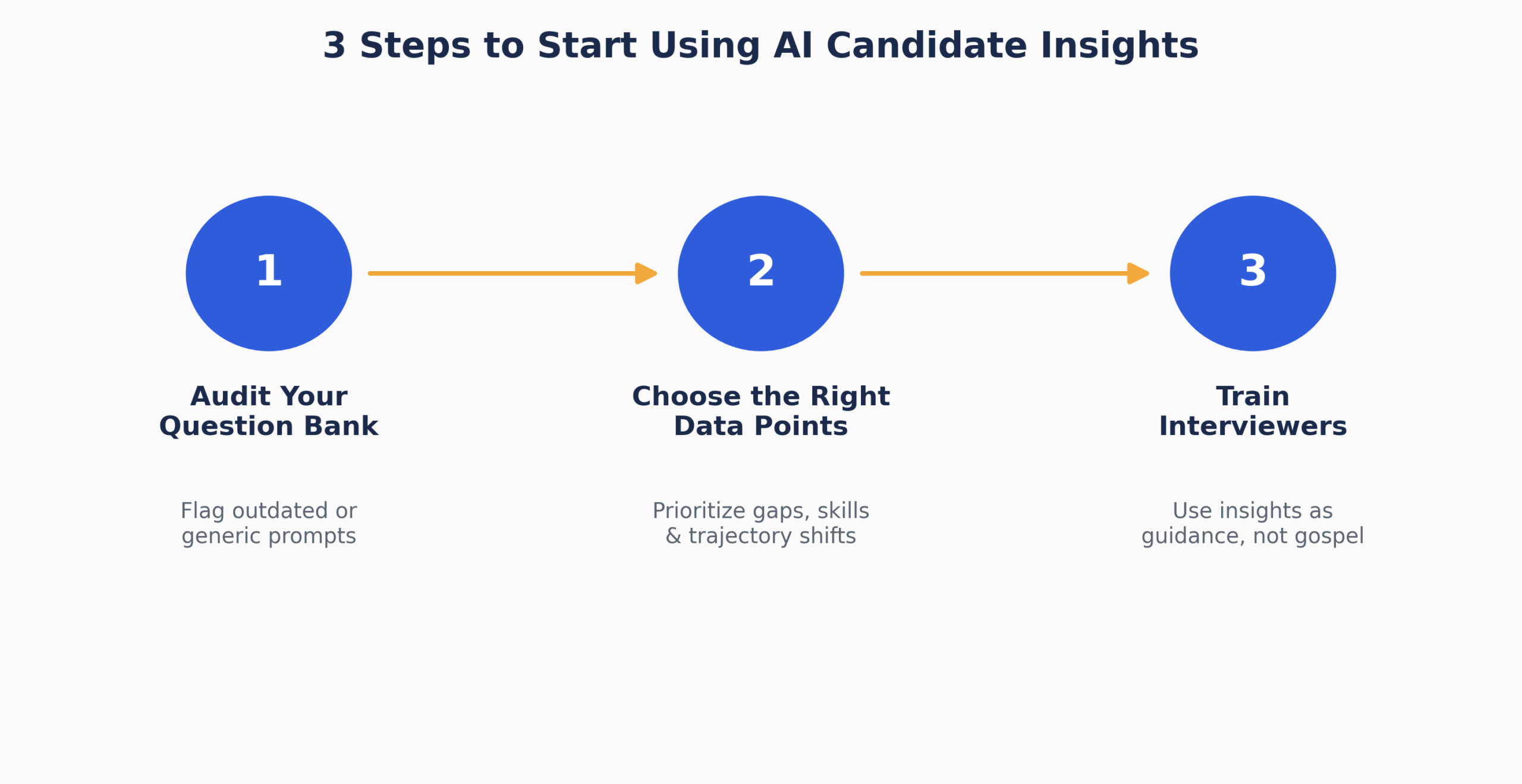
Adopting AI Candidate Insights for Interview Questions doesn’t require an overhaul overnight. It starts with reviewing what’s already in place, identifying which data points actually matter, and preparing interviewers to use insights as guidance rather than gospel.
-
Auditing Your Current Question Bank
Before adding anything new, it helps to look honestly at what’s already being asked. Many question banks carry outdated prompts that no longer connect to the role or the kind of candidates coming through the pipeline.
Flagging which questions consistently produce vague, rehearsed answers is a useful starting point. This audit reveals where generic prompts can be replaced with ones built around real resume and assessment signals instead.
-
Choosing the Right Data Points to Act On
Not every flagged pattern deserves a question. Interviewers need to prioritize signals that genuinely affect role fit, like unexplained gaps, unverified skill claims, or trajectory shifts, over minor formatting quirks or irrelevant details.
Choosing selectively keeps interviews focused rather than overwhelming candidates with questions about every small inconsistency a system happens to surface. The goal is depth on what matters, not volume for its own sake.
-
Training Interviewers to Use Insights Without Over-Indexing on Them
Insights are only as good as the person interpreting them. Interviewers need practice treating flagged data as a prompt for curiosity, not a verdict already decided.
Training should cover how to phrase questions without sounding accusatory, how to weigh context candidates provide, and when to set a flagged pattern aside entirely.
Without this calibration, even useful insights can lead to unfair or lopsided conversations.
Conclusion
Interview questions built around real candidate data consistently outperform generic templates, not because of AI interviewers, but because it gives them something specific to work with. AI Candidate Insights for Interview Questions turn a resume from a static document into a starting point for genuine, targeted conversation.
The teams that adapt their process this way spend less time on surface-level small talk and more time actually verifying fit, skill, and motivation before an offer goes out.
Platforms like Hirium make this shift practical rather than theoretical. Instead of asking recruiters to manually cross-reference resumes, assessments, and past interview notes,
Hirium surfaces these patterns directly within the hiring workflow, so interviewers walk into every conversation already knowing where to dig.
ATS For startups and SMBs without a dedicated data science team, that kind of built-in insight closes the gap between having candidate information and actually using it well.
Frequently Asked Questions
1. Does AI replace the need for human interviewers?
No. AI Candidate Insights for Interview Questions support the interviewer; they don’t replace them. The system surfaces patterns worth exploring, but interpreting tone, context, and genuine motivation still requires human judgment.
Interviewers remain responsible for deciding which flagged signals matter and how to ask about them without turning the conversation into a checklist exercise.
2. What data do AI candidate insights actually use?
These insights typically draw from resume details, assessment scores, and notes or transcripts from earlier interview rounds. The system cross-references this information to spot gaps, inconsistencies, or standout strengths. It doesn’t rely on a single source in isolation; combining multiple data points gives interviewers a fuller picture before they walk into the room.
3. Can small teams use this without a large ATS budget?
Yes. Many modern applicant tracking platforms now include candidate insight features at accessible pricing tiers, not just enterprise plans. Small teams don’t need a massive tech stack to benefit; even basic resume parsing combined with structured assessment data can highlight useful patterns. The key is choosing a tool that fits the hiring volume and complexity of the roles being filled.
4. How do you avoid bias in AI-generated insights?
Bias creeps in when flagged patterns are treated as automatic red flags rather than starting points for conversation. Avoiding this means training interviewers to ask open, non-judgmental questions about gaps or inconsistencies, and giving candidates real room to explain context. Regularly auditing which patterns the system flags also helps catch skewed or unfair assumptions early.