AI Recruitment Software for Software Development Companies: The Complete Guide
Every engineering leader has lived through the same nightmare hiring cycle: a job posting goes live, 400 resumes arrive in 72 hours, half the applicants can’t actually write the code they claim to know, and by the time a recruiter finally schedules a technical interview, the strongest candidate has already accepted an offer somewhere else.
This isn’t a talent problem. It’s a process problem and it’s exactly why AI recruitment software for software development companies has moved from “nice to have” to boardroom priority in 2026. It’s also why platforms like Hirium’s intelligent recruitment software have grown quickly among startups and engineering-led teams looking for a faster alternative to spreadsheet-driven hiring.
Software companies don’t hire the way other industries do. A generic ATS built for retail, hospitality, or sales can log applications and send rejection emails, but it has no idea whether a candidate can architect a distributed system, debug a race condition, or ship production-ready code in Go versus Python. Hiring engineers requires software that understands engineering and that’s a fundamentally different product category from traditional applicant tracking.
This guide breaks down what AI recruitment software actually does, why development companies need a purpose-built version of it, which features separate serious platforms from repackaged spreadsheets, and how to evaluate one for your engineering org whether you’re a 15-person startup hiring your first backend team or a 500-engineer company standardizing pipelines across QA, DevOps, and platform engineering.
A note on where this guide comes from: it draws on published 2026 hiring benchmarks, current recruiting research, and the product experience of teams building dedicated technical hiring infrastructure including Hirium’s own team, which works daily with engineering leaders on exactly this problem.
Why Software Development Companies Have a Different Hiring Problem
Before comparing tools, it helps to be precise about the problem, because the pain points in technical hiring are structurally different from general recruitment.
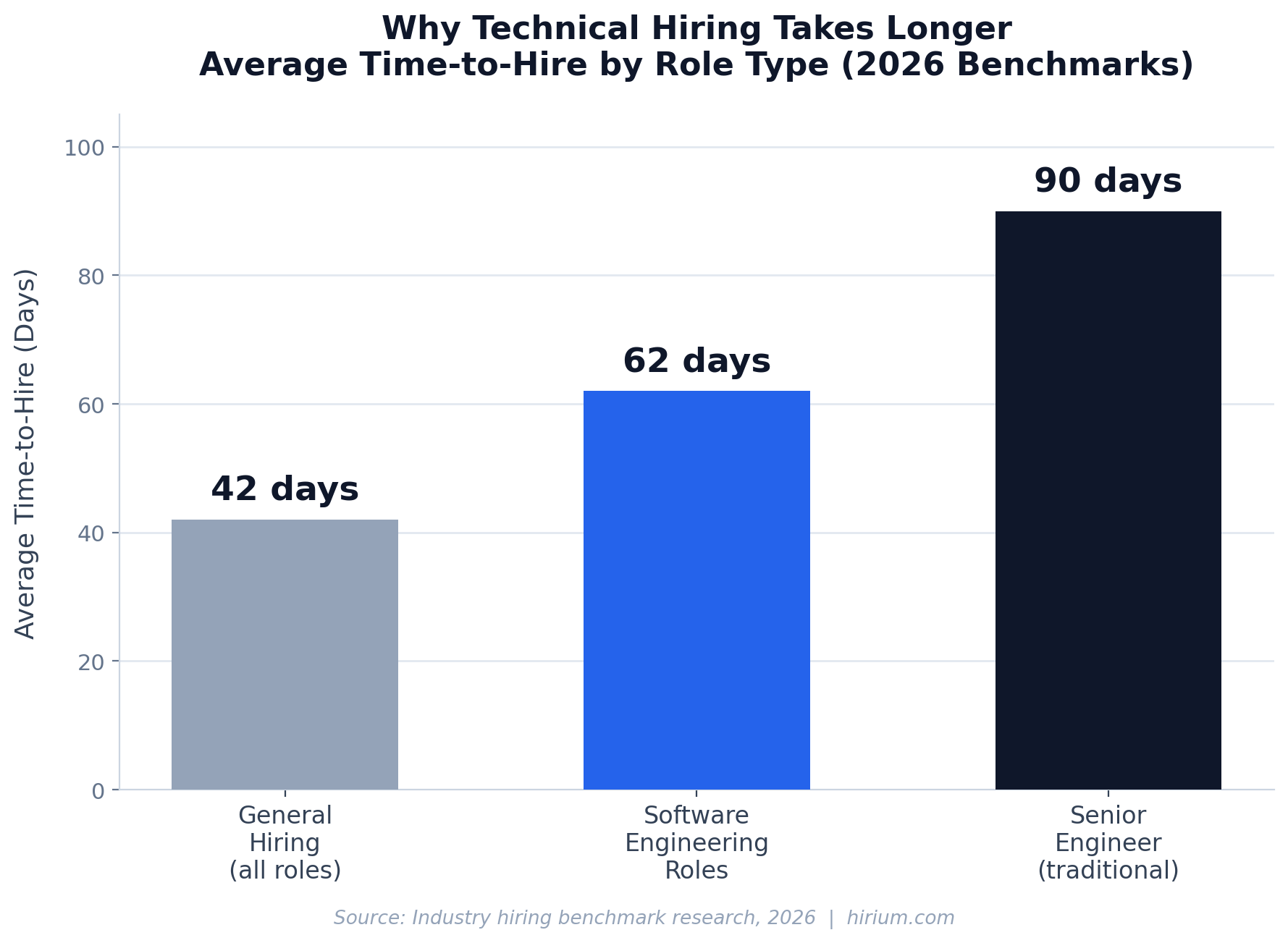
The applicant volume is disproportionately high, and quality signal is disproportionately low. Engineering job postings routinely draw hundreds of applications, and industry benchmarking shows engineering roles now take roughly 62 days to fill globally well above the general hiring benchmark of around 42 days. A large share of those applicants list frameworks and languages they’ve barely touched, which forces recruiters to spend hours separating genuine technical fit from resume-optimized noise.
The interview funnel has gotten longer and more expensive. Hiring teams are now conducting significantly more interviews per hire than they were a few years ago, and the average technical interview bar keeps rising as engineering leaders demand stronger evidence of real-world coding ability before extending an offer. More rounds mean more coordination between recruiters, hiring managers, and technical leads and more opportunities for a strong candidate to drop out mid-process.
The talent shortage is structural, not cyclical. Analysts tracking the global engineering labor market point to a shortage in the millions of unfilled software roles, driven by AI-related demand growth outpacing new graduate supply, senior engineers retiring, and tighter visa pipelines in some markets. That scarcity means every day a requisition stays open is a day a competitor might close the candidate first.
Collaboration is inherently cross-functional. Unlike most departments, engineering hiring decisions aren’t made by recruiters alone they require input from hiring managers, tech leads, and sometimes entire pods of engineers doing pair-programming assessments. A recruitment tool that doesn’t support structured, asynchronous technical collaboration creates bottlenecks no amount of sourcing can fix.
Put these four factors together and it’s clear why development companies searching for recruitment software need something purpose-built, not a general-purpose ATS with a few keyword filters bolted on.
What Is AI Recruitment Software?
AI recruitment software is a hiring platform that uses machine learning, natural language processing, and automation to handle the repetitive, high-volume, and analytically heavy parts of recruitment resume screening, candidate matching, interview scheduling, and pipeline tracking while giving recruiters and hiring managers structured data to make faster, more consistent hiring decisions.
For software development companies specifically, this means the AI layer is trained and tuned to understand technical signals: programming languages, frameworks, system design experience, GitHub activity, certifications, and role-specific competencies for engineering, QA, DevOps, SRE, and platform roles not just generic keyword matches.
Adoption of this category has moved well past early-adopter territory. Independent industry research now puts AI usage somewhere in the high-80s percentage range among companies actively recruiting, with recruiting consistently ranked as the single most common use case for AI within HR functions. The direction of travel is unambiguous: AI-assisted hiring is becoming the default, not the exception, and the companies still running fully manual technical screening are increasingly the ones losing candidates to faster-moving competitors.
Core Problems AI Recruitment Software Solves for Tech Companies
1. Unqualified Applications Overload
Engineering roles attract enormous applicant volume, and manually reading every resume for language proficiency, framework experience, and years of relevant (not just adjacent) work is not a sustainable use of a recruiter’s or hiring manager’s time. Intelligent resume screening reads for technical substance actual project experience, stack overlap, and seniority signals rather than surface-level keyword density, so recruiters spend their time on candidates worth a conversation.
2. Interview Coordination Delays
Coordinating technical interviews across multiple engineers’ calendars, tracking structured feedback, and keeping hiring managers aligned is where most technical pipelines quietly stall. Automated scheduling and centralized feedback tracking remove the back-and-forth emails and Slack threads that routinely add days sometimes weeks to a hiring timeline.
3. Inconsistent, Subjective Evaluation
When five interviewers use five different mental rubrics to judge the same candidate, “good engineer” becomes a matter of opinion instead of evidence. Structured evaluation tracking standardizes assessment criteria across every interviewer, which improves both hiring accuracy and legal defensibility.
4. Scaling Pain During Growth or Launch Phases
Hiring 3 backend engineers a quarter is a very different operational challenge than hiring 30 across four time zones during a product launch. Without infrastructure built for scale, recruiting teams either burn out or start cutting corners on screening exactly when hiring quality matters most.
5. Disconnected Hiring Managers and Recruiters
Recruiters source candidates; engineering leaders judge technical fit. When these two groups work from separate spreadsheets or disconnected tools, feedback gets lost, decisions slow down, and candidates sense the disorganization.
Key Features to Look for in AI Recruitment Software for Developers
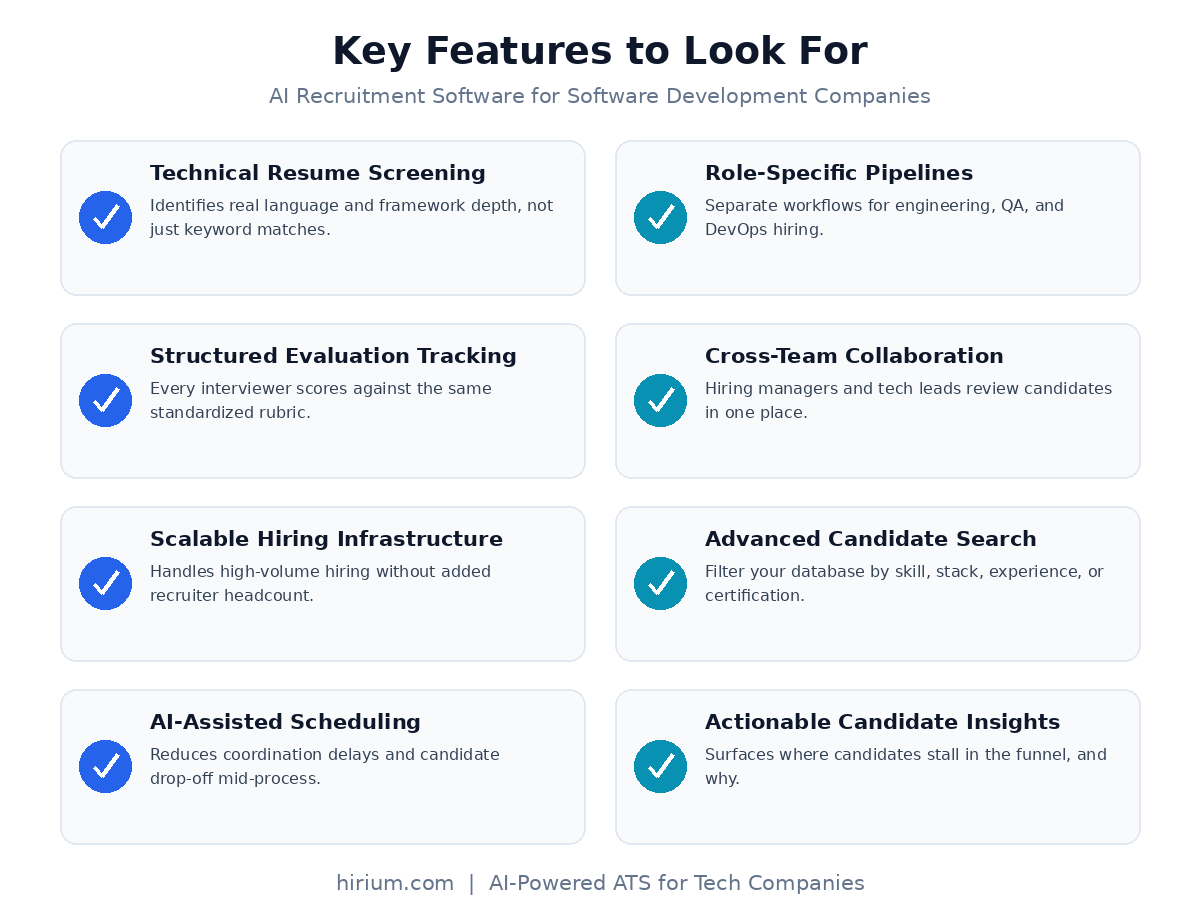
Not every ATS labeled “AI-powered” is built for the realities of technical hiring. Here’s what actually matters when you’re evaluating a platform for engineering, QA, or DevOps recruitment and how these map to Hirium’s core feature set for resume parsing, automated screening, interview management, and workflow automation.
Technical Resume Screening
The system should automatically identify candidates with relevant languages, frameworks, and technical depth distinguishing between someone who listed “Python” once on a bootcamp project and someone with three years of production Python experience. This is the single highest-leverage feature for cutting through high applicant volume, and it directly determines how reliable your resume screening in practice, not just in a sales demo.
Role-Specific Hiring Pipelines
Engineering, QA, and DevOps roles don’t move through the same evaluation stages. A platform should let you build customized workflows for each function different assessment types, different interviewers, different scorecards rather than forcing every requisition through one generic pipeline template.
Structured Evaluation and Scorecard Tracking
Standardized, structured assessment criteria across interviewers is what turns hiring from a gut-feel exercise into a repeatable, data-backed decision process. Look for tools that let every interviewer score against the same rubric and surface that data in one place.
Cross-Team Collaboration Tools
Hiring managers and technical leads need to review profiles, leave feedback, and track candidate progress without leaving the platform or waiting on a recruiter to relay updates manually. This is especially critical for distributed and remote engineering teams where hiring managers and recruiters may rarely be in the same room.
Scalable Infrastructure for Volume Hiring
Whether you’re doubling headcount after a funding round or staffing a new product line, the platform needs to handle high-volume hiring without falling over meaning bulk actions, templated outreach, and pipeline automation that doesn’t require linear increases in recruiter headcount.
Advanced Candidate Search and Database Reuse
A searchable internal database filterable by skill, tech stack, experience level, or certification turns every past applicant into a potential future hire, instead of starting from zero on every new requisition.
AI-Assisted Interview Scheduling
Since a meaningful share of hiring delays trace back to interview logistics rather than decision-making itself, automated scheduling that accounts for engineer availability materially reduces candidate no-shows and drop-off mid-process.
Actionable Candidate Insights and Analytics
The best platforms don’t just move candidates through a pipeline they surface insights that help shorten time-to-hire by flagging where in the funnel candidates stall and why.
How AI Recruitment Software Works, Step by Step
- Job requisition and JD creation – AI helps draft role-specific, bias-checked job descriptions calibrated to the seniority and stack you’re hiring for.
- Sourcing and application intake – Candidates apply through your careers page, job boards, or are sourced directly; the system ingests resumes and profile data automatically.
- Technical screening and parsing – Resumes are parsed for skills, experience, and stack alignment, and ranked against the role’s actual requirements.
- Pipeline routing – Qualified candidates move into role-specific pipelines (engineering, QA, DevOps) with the correct assessment stages already configured.
- Structured interviews and scorecards – Interviewers evaluate against standardized criteria, and feedback is centralized instead of scattered across email threads.
- Collaborative decision-making – Recruiters and hiring managers review consolidated feedback and candidate data in one dashboard to reach a decision faster.
- Offer and analytics loop – Once hired, the system feeds time-to-hire, source-of-hire, and pipeline conversion data back into future hiring strategy.
The Business Case: What AI Recruitment Software Actually Changes
The numbers behind this shift are hard to ignore for anyone accountable to a hiring budget or a delivery timeline.
Engineering roles typically take substantially longer to fill than the average open role across other functions, and average time-to-hire across many organizations has been trending upward, not downward, over the past several years even as headcount growth targets in tech have continued climbing. That combination longer fill times paired with more aggressive hiring goals is precisely the gap AI recruitment software is designed to close.
Independent research aggregating enterprise adoption data has found that organizations applying AI across the full sourcing-to-screening-to-scheduling funnel see meaningfully faster time-to-hire, while partial adoption still produces measurable improvement over fully manual processes. The pattern across multiple studies is consistent even when the exact percentages vary: the deeper the AI integration across the funnel, the larger the time and cost savings.
For a software company, faster time-to-hire isn’t just an HR metric. It’s the difference between shipping a roadmap on schedule and watching a senior engineer’s backlog pile up for two extra months while a requisition sits open. It’s the difference between winning a candidate at offer stage and losing them to a competitor who moved faster. For engineering leaders and founders, technical hiring speed is a product velocity issue disguised as an HR issue.
That said, the data also carries an honest caveat worth sitting with: research from major analyst firms has found that a large share of HR organizations have deployed AI tools without yet realizing significant business value from them. Buying AI recruitment software is not automatically the same as using it well. The gap between organizations that see real ROI and those that don’t usually comes down to implementation quality proper pipeline configuration, interviewer training on structured scorecards, and genuine adoption by hiring managers, not just by the recruiting team.
How to Choose the Right AI Recruitment Software for Your Engineering Team
Use this checklist when evaluating vendors:
- Does it understand technical roles specifically, or is it a general ATS with AI features added on top? Ask for examples of how it differentiates a junior React developer from a senior full-stack engineer.
- Can hiring managers and tech leads collaborate natively inside the platform, or will they still need side conversations over Slack and email?
- Does it support role-specific pipelines for engineering, QA, DevOps, and SRE or does everything funnel through one generic template?
- How transparent is the AI screening logic? With growing regulatory attention on automated hiring tools, you need to be able to explain to a candidate and, if necessary, an auditor how a screening decision was reached.
- Can it scale without a proportional increase in recruiter headcount during high-volume hiring pushes?
- What does onboarding and support actually look like? A powerful platform that takes three months to configure defeats its own purpose.
- Is there a free or low-commitment way to test it against your actual open requisitions before you sign a long-term contract?
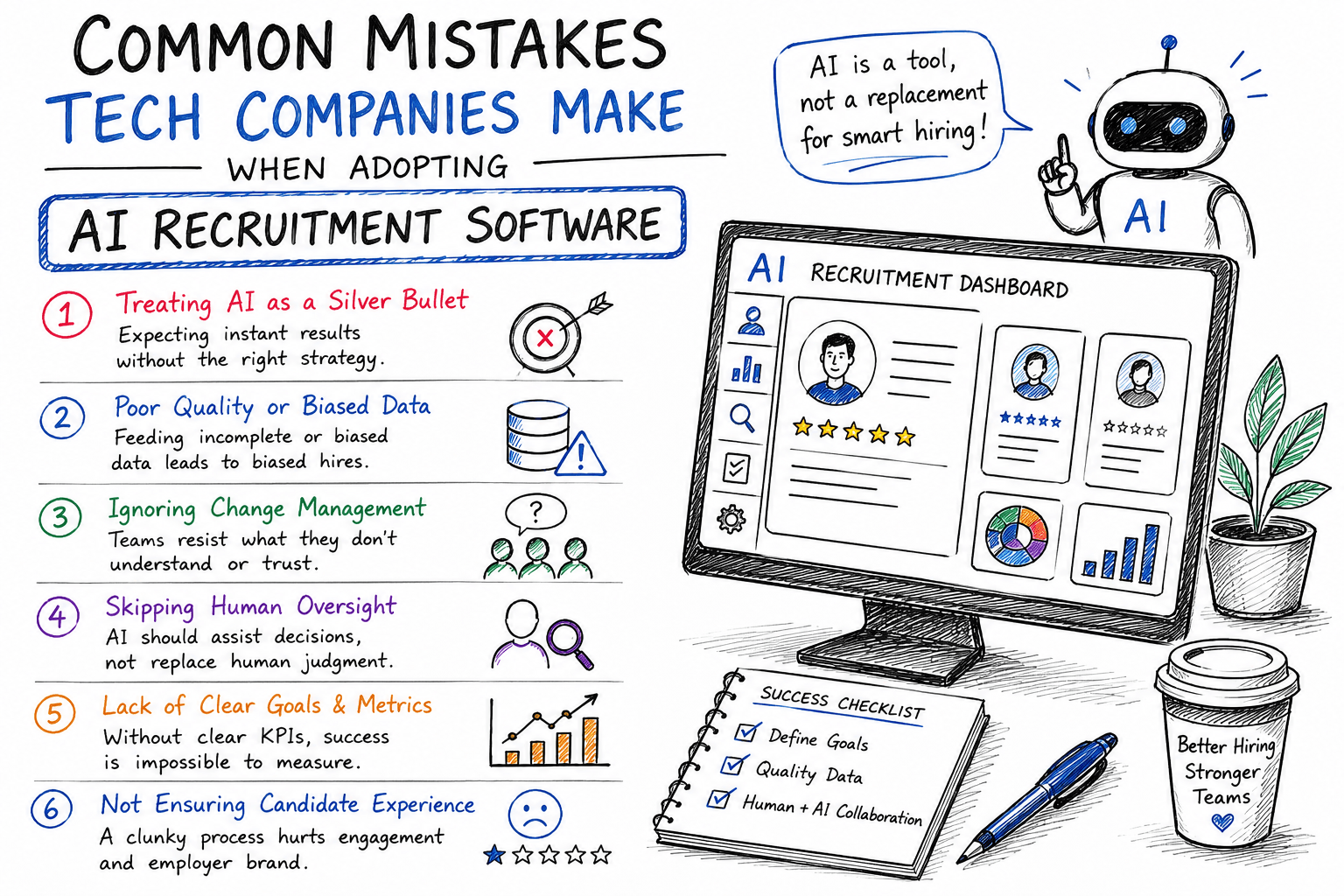
Common Mistakes Tech Companies Make When Adopting AI Recruitment Software
- Treating AI screening as a black box. Candidates and internal stakeholders both deserve to understand, at a high level, how screening decisions are made. Opacity erodes trust on both sides of the hiring table.
- Skipping interviewer training on structured scorecards. The best evaluation framework in the world doesn’t help if interviewers still submit a one-line “seemed strong” comment instead of scoring against defined criteria.
- Automating sourcing but leaving scheduling manual. Partial automation leaves the most common bottleneck interview coordination untouched.
- Never auditing the tool for bias. Automated hiring decisions carry real compliance exposure. Regular bias audits aren’t optional in a regulatory environment that’s tightening every quarter.
- Choosing a platform built for generalist hiring and trying to force-fit engineering pipelines into it after the fact, rather than starting with a tool designed for technical recruitment from day one.
For more real-world breakdowns of these mistakes and how engineering-focused teams are fixing them, Hirium’s recruiting insights blog covers time-to-hire benchmarks, resume parsing accuracy, and hiring-manager collaboration in more depth.
Why Hirium Is Built for Technical Hiring
Hirium’s ATS for tech companies was designed around the specific realities described above, rather than adapted from a generic recruitment tool.
It combines technical resume screening that reads for real language and framework depth, role-specific hiring pipelines for engineering, QA, and DevOps, structured evaluation tracking so every interviewer scores against the same criteria, and native collaboration tools that let hiring managers and tech leads weigh in without leaving the platform. For companies scaling quickly, Hirium’s infrastructure is built to handle high-volume hiring during product launches or expansion phases without forcing recruiting teams to grow headcount at the same rate as requisitions.
Software companies evaluating AI recruitment software can start with Hirium’s free plan three months of the AI-powered ATS with no credit card required to test technical screening, pipeline management, and collaboration tools against their own live requisitions before making a longer-term commitment.
Frequently Asked Questions
1. Should tech companies invest in an ATS?
Yes. Software development companies handle a disproportionately high volume of technical applicants, longer interview cycles, and more cross-functional decision-making than most other departments. A purpose-built ATS reduces manual screening time, standardizes technical evaluation, and shortens time-to-hire.
What features make Hirium suitable for tech companies?
Hirium combines technical resume screening for languages and frameworks, role-specific pipelines for engineering, QA, and DevOps, structured evaluation tracking, collaboration tools for hiring managers and tech leads, and infrastructure built to handle high-volume or bulk developer hiring.
Can Hirium handle bulk developer hiring?
Yes. Hirium’s infrastructure is built for scalable hiring, including rapid, high-volume recruitment during product launches or expansion, without requiring a proportional increase in recruiter headcount.
Does Hirium support collaboration with technical hiring managers?
Yes. Hiring managers and tech leads can review candidate profiles, leave structured feedback, and track pipeline progress directly inside Hirium.
How does Hirium improve technical candidate quality?
By screening resumes for actual technical substance rather than keyword matches, and by standardizing evaluation criteria across every interviewer for consistent, comparable hiring decisions.
Is AI recruitment software reliable for evaluating developers fairly?
It improves consistency by applying the same screening and evaluation criteria to every candidate. That said, no automated system should be treated as infallible regular bias audits, human oversight, and transparency about how screening works are all necessary for fair, defensible hiring.
How much does AI recruitment software typically cost?
Pricing varies widely, from free or low-cost plans for small teams to enterprise contracts. Many platforms, including Hirium, offer a free tier so teams can validate fit before committing.
What’s the difference between a general ATS and AI recruitment software built for developers?
A general ATS tracks applications with generic keyword matching. AI recruitment software built for developers recognizes technical signals specifically languages, frameworks, system design experience and supports the structured, cross-functional evaluation technical hiring requires.
Final Thoughts
The technical hiring problem in 2026 isn’t a shortage of applicants it’s a shortage of fast, accurate, collaborative ways to find the right ones inside a flood of resumes. Purpose-built AI recruitment software closes that gap: filtering for genuine technical fit, standardizing evaluation across interviewers, keeping recruiters and tech leads aligned, and scaling without breaking under volume.
If your engineering team is still running technical hiring through spreadsheets, generic job boards, and scattered Slack threads, it may be time to see what a platform built specifically for tech hiring looks like. Explore Hirium’s ATS for tech companies, or book a free demo to see it working against your own open roles.