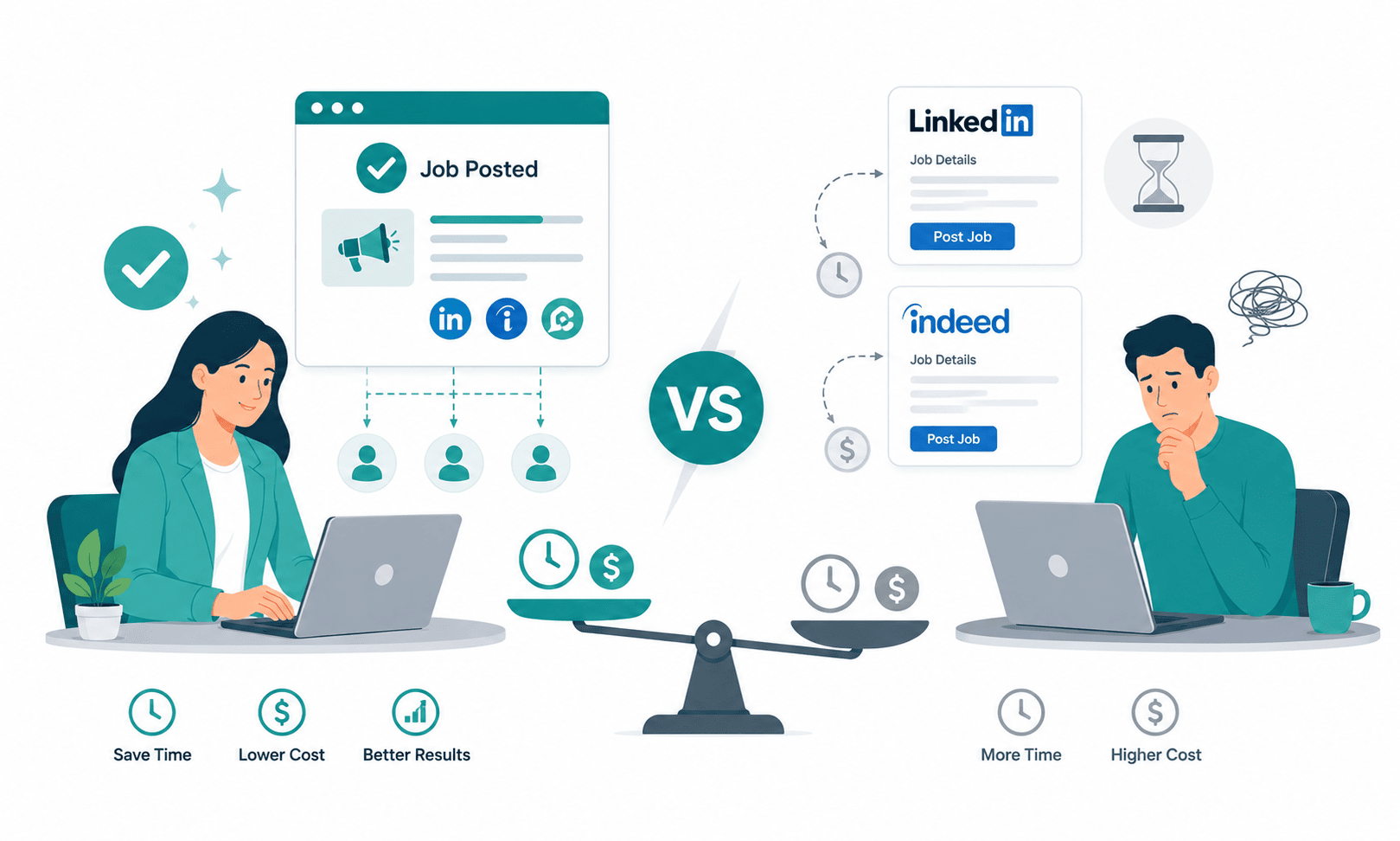
Job Posting Software vs Posting Manually on LinkedIn and Indeed: A Cost-Time Breakdown
A recruiter posting one role to LinkedIn, Indeed, and three niche boards spends between 3.5 and 5 hours on posting administration alone before a single resume arrives. Multiply that across 15 open roles per quarter and a two-person talent team loses 52–75 hours every quarter to copy-pasting job descriptions, reformatting bullet points, and re-uploading company logos. That is roughly two full working weeks per quarter spent on a task that produces zero hiring signal.
The debate around Job Posting Software vs Manual Posting is usually framed as a convenience question. It is not. It is a unit-economics question, and most hiring teams have never actually run the numbers. The direct subscription cost of a posting tool is visible on an invoice. The cost of manual posting is invisible because it hides inside salaries, missed candidates, and roles that stay open 8–12 days longer than they should.
That invisibility is exactly why the manual approach survives. A founder sees “post job: free” on Indeed and assumes the process costs nothing. What the free listing conceals is the ₹2,500–₹4,000 (or $30–$50) of loaded recruiter time each posting cycle consumes, the duplicate listings that fragment applicant flow, and the branding inconsistencies that quietly depress apply rates by 10–15% on secondary boards.
This breakdown puts hard numbers on both sides: the true hourly cost of manual multi-board job posting, the hidden costs nobody budgets for, a side-by-side comparison table, and a realistic timeline showing how one-click distribution changes the math for a team hiring at startup or SMB scale.
SHRM benchmarking data puts the average cost per hire at nearly $4,700, and industry experts estimate that 60% or more of total hiring costs are “soft costs” primarily the time managers and HR staff invest in the hiring process. Manual posting sits squarely inside that soft-cost bucket.
What Is Job Posting Software?
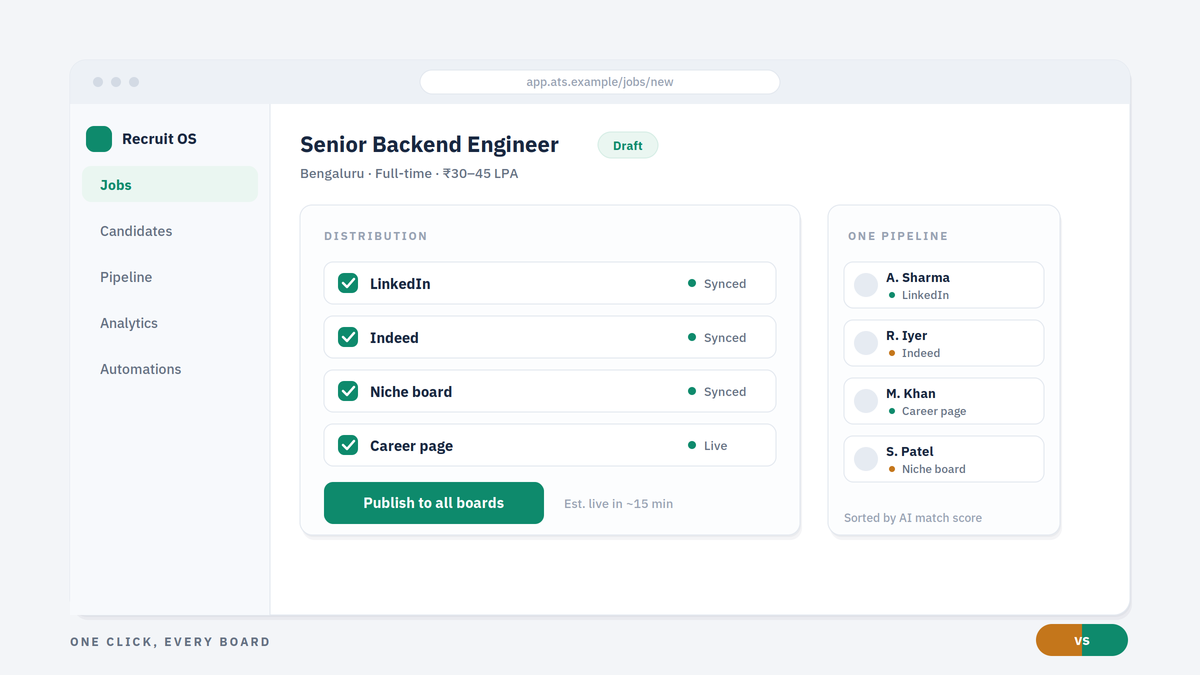
Job posting software is a recruitment tool that distributes a single job listing to multiple job boards such as LinkedIn, Indeed, and niche platforms from one dashboard, in one action. It standardizes formatting and branding across boards, routes all applicants into one pipeline, and tracks which source delivers the strongest candidates.
Most modern posting tools ship as part of an applicant tracking system (ATS) rather than as standalone products, which matters for the cost math later: the posting feature is only the front door to a larger workflow covering screening, tracking, and reporting.
The Core Problem: Manual Posting Costs 3–4x More Than Teams Budget
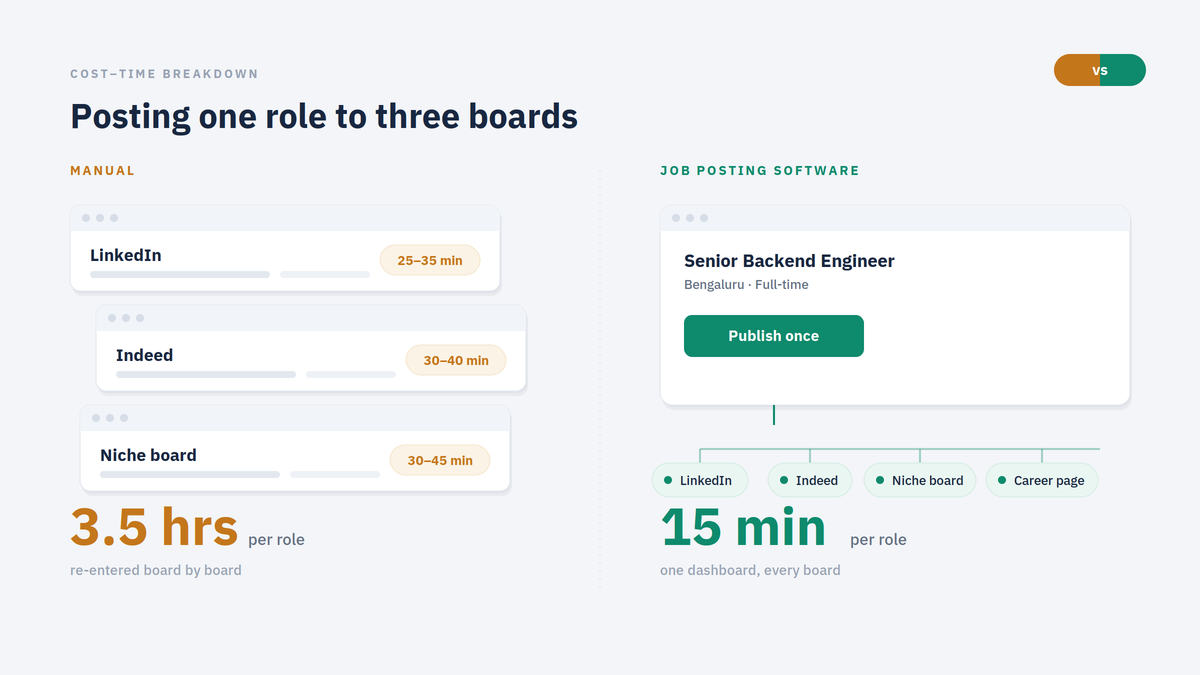
Ask a hiring manager how long it takes to post a job manually and the typical answer is “20 or 30 minutes.” The observed reality across startup and SMB hiring teams is closer to 45–70 minutes per board for a first-time posting, once you count the full cycle: adapting the description to each board’s format, re-entering screening questions, uploading assets, setting salary fields that differ by platform, and verifying the listing went live correctly.
For a standard three-board distribution (LinkedIn, Indeed, one niche board), that is 2.5–3.5 hours per role. Teams consistently underestimate this by 3–4x because they only count the writing, not the re-entry, QA, and login overhead across platforms.
The problem compounds in three ways:
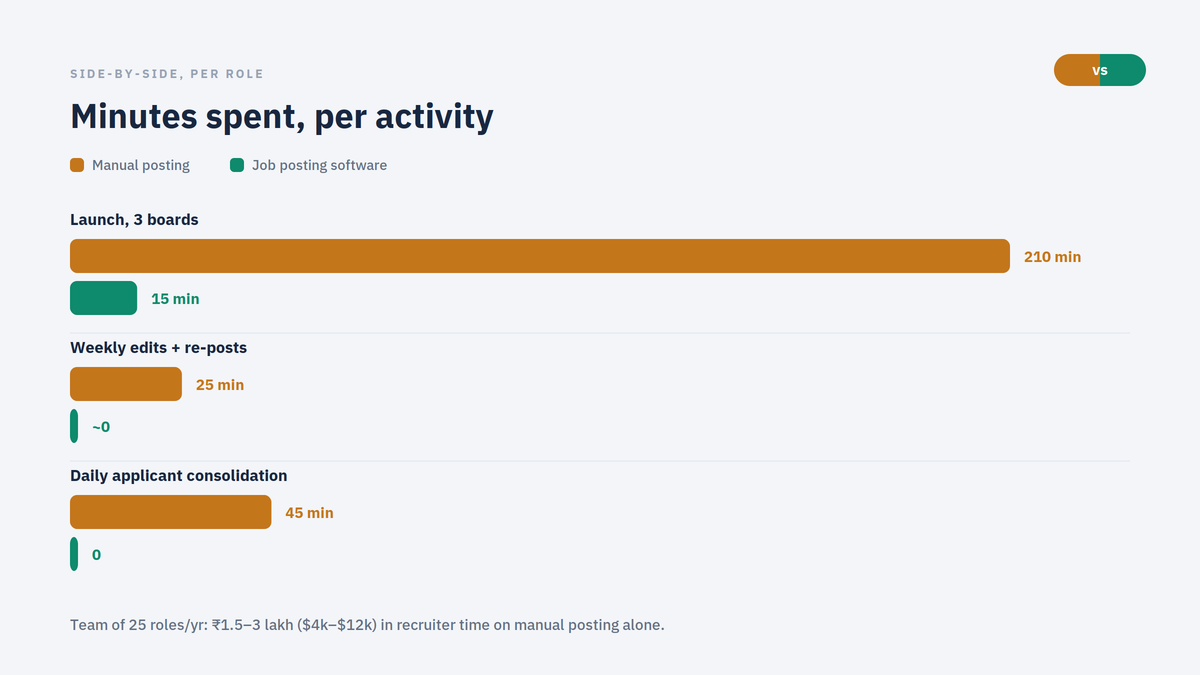
Volume multiplies linearly. A startup hiring 25 roles a year at 3 hours of posting admin per role burns 75 hours annually nearly two full working weeks on data entry. At a loaded talent-team cost of ₹800–₹1,200 per hour ($10–$15 in India; $35–$50 in the US), that is ₹60,000–₹90,000 (or $2,600–$3,750) per year spent on copy-paste.
Maintenance is never counted. Every edit, a salary band change, a location update, a revised requirement must be replicated manually across every board. Teams managing 10+ live listings typically spend another 2–3 hours per week on updates, expirations, and re-posts.
Applicant flow fragments. Candidates from Indeed land in one inbox, LinkedIn applicants in another, and career-page applicants in a third. Recruiters spend 30–60 minutes per day consolidating applicants into spreadsheets before screening even begins, and response times stretch to 4–6 days long enough for the strongest 10–15% of candidates to accept interviews elsewhere.
None of this appears on a budget line, which is why the manual approach looks free right up until you measure time-to-hire and find it running 8–12 days behind comparable teams.
The Full Cost-Time Breakdown: Job Posting Software vs Manual Posting
This is where the comparison of Job Posting Software vs Manual Posting stops being abstract. Below is the complete cost structure of each approach, broken into direct time, hidden costs, and downstream effects followed by a side-by-side table.
How Long Does It Take to Post a Job on Multiple Job Boards Manually?
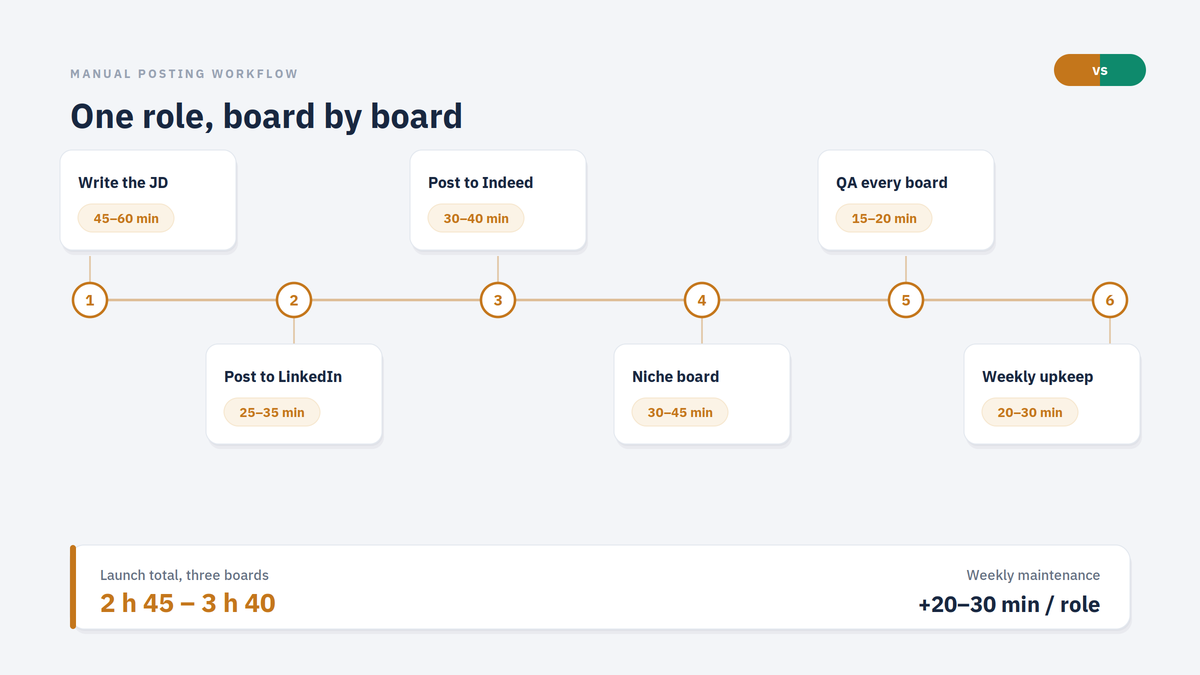
Here is the realistic manual workflow for a single role distributed to three boards, timed step by step:
- Write and format the master job description 45–60 minutes, including approvals.
- Post to LinkedIn 25–35 minutes: create the listing, adapt formatting (LinkedIn strips certain markup), configure screening questions, set targeting, verify the live listing.
- Post to Indeed 30–40 minutes: re-enter the role in Indeed’s structured fields, rebuild screening questions in Indeed’s format, decide on sponsorship budget, verify indexing.
- Post to a niche or regional board 30–45 minutes: many niche boards have older interfaces, manual logo uploads, and slower review queues.
- QA passes across all boards 15–20 minutes: check salary display, location tags, apply links, and branding on each platform.
- Weekly maintenance per role 20–30 minutes: refresh expiring posts, sync any edits across boards, delete filled listings.
Total for one role: 2 hours 45 minutes to 3 hours 40 minutes at launch, plus ongoing maintenance. For a team running 6–8 concurrent openings, posting administration alone consumes 4–6 hours per week half a working day, every week, indefinitely.
With one-click distribution inside an ATS, the same workflow collapses to steps 1 and a single 10–15 minute publish action. The master description is written once, mapped automatically to each board’s format, and pushed live simultaneously. Edits propagate from one place. The launch cycle drops from ~3 hours to ~1 hour (most of which is the job description itself, which no tool eliminates), and weekly maintenance drops to near zero.
The Hidden Costs of Posting Jobs Manually on LinkedIn and Indeed
Direct time is the visible half of the equation. Four hidden costs typically exceed it.
Duplicate job listings. When the same role is manually posted with slightly different titles or descriptions (“Sr. Backend Engineer” on LinkedIn, “Senior Backend Developer” on Indeed), aggregators often index them as separate roles. Candidates apply to both, recruiters screen the same person twice, and report double-counts openings. Teams without a centralized candidate database report 8–12% of screening time wasted on duplicate applicants and worse, candidates who receive two different rejection timelines for the same role form a lasting negative impression of the employer.
Inconsistent employer branding. Manual re-entry means each board ends up with a slightly different version of the company: a logo missing here, an outdated benefits paragraph there, a salary range on one board but not another. Listings with complete, consistent branding and disclosed salary ranges convert visitors to applicants at meaningfully higher rates; salary transparency alone is associated with apply-rate lifts of 20–30% on major boards. Inconsistency doesn’t just look sloppy; it directly reduces top-of-funnel volume and undermines employer branding investments made elsewhere.
No source effectiveness data. Manual posting gives you applicant counts per board at best. It cannot tell you which board produced the candidates who reached final rounds or got hired. Without source effectiveness tracking, teams keep paying to sponsor boards that generate volume but not quality, a budget leak of ₹15,000–₹40,000 ($200–$500) per quarter for a typical SMB sponsoring 2–3 boards.
Screening bottlenecks downstream. Fragmented intake makes every later stage slower. This is where AI resume screening changes the calculus: when all applicants flow into one pipeline, screening tools can parse and rank hundreds of resumes in minutes instead of the 7–8 recruiter-hours it takes to manually review 200 applications at 2–3 minutes each. Manual posting doesn’t just cost time at the top of the funnel; it forecloses automation everywhere below it.
Workflow Automation Software: Where the Compounding Savings Live
The posting click itself is worth perhaps 2 hours per role. The larger return comes from what workflow automation software does after candidates arrive.
In a manual setup, every status change is a human action: moving a candidate to “interview,” emailing a rejection, reminding a hiring manager to submit feedback. Across a 40-candidate pipeline, that is 60–90 discrete manual actions per role. Automated workflows auto-acknowledgment emails, status-triggered updates, interview reminders, structured rejection templates remove 70–80% of those actions.
The candidate-facing effect is measurable. Teams that automate acknowledgments and status updates cut average response time from 4–6 days to under 24 hours, and faster response times are consistently associated with higher offer-acceptance rates, because the strongest candidates are usually in 3–4 processes simultaneously and take the process that moves.
Candidate database management adds a second-order saving that manual teams never capture: every applicant from every board becomes a searchable, tagged record. When a similar role opens 6 months later, the first 20–30 candidates come from the existing database at zero acquisition cost, routinely cutting sourcing time for repeat roles by 30–50%.
AI Candidate Insights: The Data Layer Manual Posting Can’t Produce
Beyond automation sits an analytical layer manual processes structurally cannot build. AI candidate insights, shortlisting scores, skills-match analysis, pipeline-health indicators depend on structured data flowing through one system. A spreadsheet assembled from three job-board inboxes has no structure to analyze.
The practical outputs matter for cost control: recruitment analytics on time-to-hire per role type, offer-acceptance trends, recruiter load, and cost per applicant by source. These numbers are what let a talent lead walk into a budget conversation and defend or cut every rupee or dollar of job-board spend with evidence. Manual teams argue from anecdotes; instrumented teams argue from dashboards.
Integration and Compliance Considerations Most Comparisons Skip
Two cost categories rarely appear in vendor comparisons but matter disproportionately for growing teams.
The first is integration debt. A posting workflow doesn’t live in isolation: applicant data eventually needs to reach interview scheduling, offer letters, background checks, and HRIS onboarding. Manual processes handle these handoffs by re-typing candidate details into each downstream system 10–15 minutes of duplicated entry per hire, plus a meaningful error rate on names, email addresses, and offer terms. A connected hiring pipeline passes structured records forward automatically, so a candidate entered once at application stays intact through onboarding. Teams switching tools should also weigh migration cost explicitly: exporting 2–3 years of candidate history from a legacy system can take 20–40 hours if unsupported, which is why free, assisted migration is a genuine line item in the evaluation, not a nice-to-have.
The second is compliance exposure. Applicant records scattered across job-board inboxes, personal email threads, and spreadsheets make it nearly impossible to honor data-retention rules, respond to a candidate’s deletion request under laws like GDPR or India’s DPDP Act, or produce a defensible audit trail if a hiring decision is ever challenged. A single system of record with timestamps, structured stage history, and standardized rejection reasons reduces that exposure structurally. For salary-transparency regulations now active in several US states and the EU, centralized posting also guarantees the disclosed range is identical on every board; something manual re-entry gets wrong often enough to create real legal risk.
Side-by-Side Cost Table: One Role, Three Boards
| Cost component | Manual posting | Job posting software |
| Initial posting time (3 boards) | 2.5–3.5 hours | 10–15 minutes |
| Weekly maintenance per role | 20–30 minutes | ~0 (edits propagate automatically) |
| Applicant consolidation | 30–60 min/day across roles | 0 (single pipeline) |
| Duplicate/branding losses | 8–12% screening waste; 10–15% apply-rate drag | Largely eliminated |
| Source-quality visibility | Applicant counts only | Full source-to-hire analytics |
| Direct tool cost | ₹0 / $0 | ₹0–₹8,000/mo ($0–$100/mo); free tiers exist |
At a loaded cost of ₹1,000/hour ($12–$40/hour depending on market), manual posting for a team running 25 roles per year carries a true annual cost of ₹1.5–₹3 lakhs ($4,000–$12,000 in higher-wage markets) in time alone before counting the vacancy cost of roles staying open 8–12 days longer.
How One-Click Multi-Board Posting Changes the Math: An Example Timeline
Consider a 40-person SaaS startup hiring a product designer, a backend engineer, and two SDRs in the same quarter, a normal load for a one-recruiter team.
Manual timeline (per role):
- Day 1–2: Write a description, get approval.
- Day 3: Post to LinkedIn and Indeed (afternoon gone).
- Day 4: Post to niche board; fix formatting issues found in QA.
- Day 5–20: Applicants trickle into three inboxes; recruiter consolidates every morning; first responses go out on day 4–6 after application.
- Day 21+: Screening backlog of 150+ unreviewed applications; hiring manager asks “where are we?” and nobody has a single-view answer.
One-click timeline (same role, using an ATS such as Hirium):
- Day 1–2: Write a description, get approval (unchanged no tool writes your role for you).
- Day 3, 10:00 AM: Publish once; the role is live on LinkedIn, Indeed, niche boards, and a branded career page by 10:15 AM with identical formatting and salary display.
- Day 3 onward: Every applicant lands in one pipeline; auto-acknowledgements go out instantly; AI screening ranks incoming resumes continuously, so the recruiter reviews a scored shortlist of 20 instead of a raw pile of 150.
- Day 7–10: First interviews scheduled roughly a week earlier than the manual track.
Across four concurrent roles, the delta is 10–14 recruiter-hours per week reclaimed and first-interview dates pulled forward by 5–9 days. Since vacancy costs for revenue-adjacent roles run $500+ per day in lost output by common industry estimates, shaving even one week off two of those four roles is worth $7,000+ per quarter against a tool cost that, on free or flat-priced plans, can be effectively zero.
Real-World Application: Two SMB Scenarios
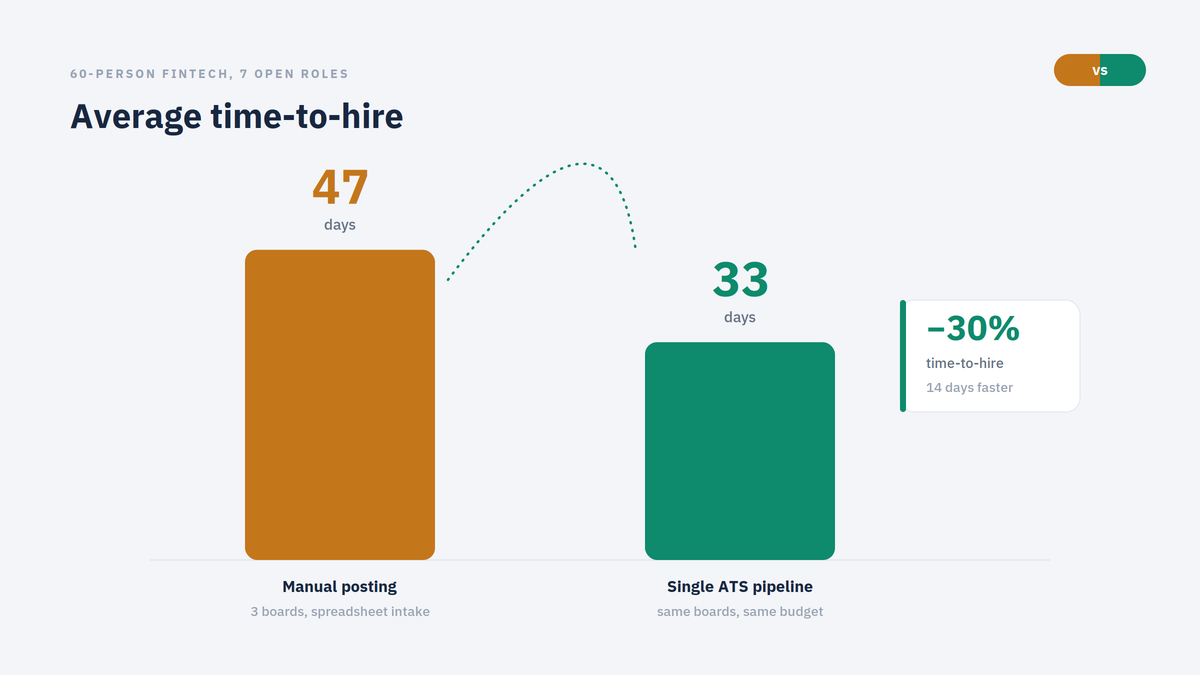
A 60-person fintech startup (India) was posting each role manually to LinkedIn, Indeed, and two regional boards, spending roughly 11 hours per week on posting and applicant consolidation across 7 open roles. After consolidating distribution and intake into a single ATS pipeline, posting administration dropped to under 2 hours per week and average time-to-hire fell from 47 to 33 days, a 30% reduction with no increase in job-board spend.
A 25-person D2C brand hiring seasonal volume needed 12 warehouses and support hires in 6 weeks. Manually, the team had previously managed 400+ applications in spreadsheets with a 5-day average first-response time. Running the same campaign through one-click distribution plus automated screening and acknowledgments, first-response time dropped below 12 hours, duplicate applications fell to near zero, and all 12 seats were filled in 4.5 weeks instead of the 7 weeks the prior season required.
Decision Framework: When Manual Posting Still Makes Sense (and When It Doesn’t)
Not every team should buy software. Use hiring volume and repetition as the deciding variables:
| Your situation | Recommended approach |
| 1–3 hires per year, one board is enough | Manual posting is fine; software adds little |
| 4–10 hires/year across 2+ boards | Free-tier posting software; the time savings alone justify onboarding effort |
| 10–30 hires/year, 1–2 recruiters | Full ATS with automation and screening; manual costs now exceed ₹1 lakh+ / $3,000+ annually |
| 30+ hires/year or seasonal spikes | ATS is non-negotiable; manual processes fail visibly at this volume |
Three evaluation questions cut through vendor noise: Does the tool post to the specific boards your candidates actually use (not just a long logo list)? Does it unify applicants into one pipeline with real-time candidate tracking, or just deep-link back to each board? And can cheap free plans, flat pricing, and supported migration matter more for SMBs than enterprise feature depth?
What Most Teams Get Wrong About the Software-vs-Manual Decision
The most common error is not choosing manual posting, it is choosing software and continuing to work manually inside it. Roughly half of small teams that adopt an ATS use it as a glorified filing cabinet: they post through it but still screen every resume by hand, still write every rejection email individually, and still chase hiring managers over Slack. They then conclude the tool “didn’t save much time.” The posting click was never where the majority of the savings lived; the automation and screening layers were.
The second error is the opposite bias: assuming free manual posting is genuinely free. Founders anchor on the ₹0 invoice and ignore that they are paying recruiter salaries to perform data entry. Any process whose cost is denominated in hours rather than invoices gets systematically undercounted and manual multi-board posting is the purest example of that fallacy in hiring.
The third: optimizing for board count over board fit. A tool that syndicates to 50 boards you’ve never heard of is worth less than one that posts cleanly to the 3 boards where your candidates actually are, and then tells you with source data which of those 3 deserves next quarter’s budget.
Finally, teams measure the wrong success metric after switching. The instinct is to track applications per posting, which almost always rises with wider distribution and then gets celebrated as proof of ROI. But raw volume is a cost, not a benefit every additional unqualified application consumes screening capacity. The metrics that actually validate the switch are time-to-first-response, time-to-hire, offer-acceptance rate, and cost per hire by source. If those four don’t move within two quarters, the tool is being used as a posting button rather than a system, and the fix is process adoption, not another vendor evaluation.
Run Your Own Numbers Before You Decide
The honest conclusion of any cost-time breakdown is that the answer is arithmetic, not ideology. Take your actual role volume, time one real posting cycle end to end, apply your loaded hourly cost, and compare it against a tool you can trial at zero cost.
If you’re evaluating a switch from manual multi-board posting and want to see the one-click workflow against your own open roles, Hirium rated 4.5/5 on G2 and used by 5,000+ businesses offers a forever-free plan with no credit card required, plus free supported migration from tools like Zoho Recruit. Post one live role through it this week, time the difference yourself, and let your own stopwatch settle the debate.
Frequently Asked Questions
Is it free to post a job on LinkedIn and Indeed?
Partially. Both platforms offer free organic listings, but free posts lose visibility within 3–7 days as newer listings push them down. Meaningful applicant volume on competitive roles usually requires sponsorship typically ₹400–₹1,500 ($5–$20) per day per board. The listing may be free; the reach rarely is, and the recruiter time to create and maintain it never is.
How long does it take to post a job on multiple job boards?
Manually, expect 2.5–3.5 hours to launch one role across three boards, plus 20–30 minutes per week of maintenance per role. With one-click distribution through posting software or an ATS, the same launch takes 10–15 minutes after the description is written, and edits sync automatically across all boards.
Is job posting software worth it for small businesses?
It depends on volume. Below 3–4 hires per year, manual posting is usually fine. At 5+ hires per year across multiple boards, the 2–3 hours saved per role plus unified applicant tracking typically outweighs the cost, especially since several platforms built for SMBs offer forever-free plans with no credit card required, making the downside of trying one effectively zero.
How do you track applicants from multiple job boards in one place?
Use a system with a centralized pipeline: every applicant, regardless of source board, lands in one database with source tags, status labels, and full history. This eliminates spreadsheet consolidation, surfaces duplicates automatically, and enables reporting on which board produces hires rather than just applications. Email-forwarding hacks and shared inboxes break down beyond roughly 50 applicants per month.
What is the difference between a job board and job posting software?
A job board (LinkedIn, Indeed) is a destination where candidates search for roles. Posting software is the distribution and management layer that publishes your role to many boards at once, standardizes branding, and pulls all responses back into one pipeline. Boards own the audience; the software owns your workflow, data, and analytics on top of those audiences.
Can posting software improve candidate quality, not just speed?
Yes, indirectly but measurably. Faster first responses keep strong candidates engaged before competing offers land; AI-based screening and shortlisting surface the best 10–15% of applicants who would otherwise sit unread in a backlog; and source analytics shift budget toward the boards producing hires rather than volume. Quality improves because good candidates stop leaking out of a slow, fragmented process.
How do I estimate what manual posting currently costs my team?
Track one full posting cycle: hours spent posting and maintaining listings across boards, plus daily applicant-consolidation time, multiplied by your loaded hourly recruiting cost, multiplied by annual role volume. Most teams that run this exercise land between ₹1.5–₹3 lakhs ($4,000–$12,000) per year. If you’d rather pressure-test the numbers against benchmarks before changing tools, that’s a 30-minute working session, not a sales call.