
How to Write Job Descriptions That Get Found by AI Resume Parsers and Candidates Alike
Nine out of ten employers believe their own screening systems are quietly rejecting qualified people and the problem often starts before a single resume arrives. It starts with the job description itself. A posting written for a human reader but ignored by machine-readable logic never reaches the candidates it was meant to attract, because the parsing layer that indexes, ranks, and surfaces it can’t make sense of the words on the page.
That gap between “written well” and “read well by software” is the entire premise behind Resume Parser Friendly Job Descriptions. Most hiring teams optimize resumes for parsers and never think to apply the same discipline to the job posting that the resume is supposed to match against. The result is a mismatch on both ends of the pipeline: a parser that can’t cleanly extract candidate data, sitting across from a job description it also can’t cleanly interpret.
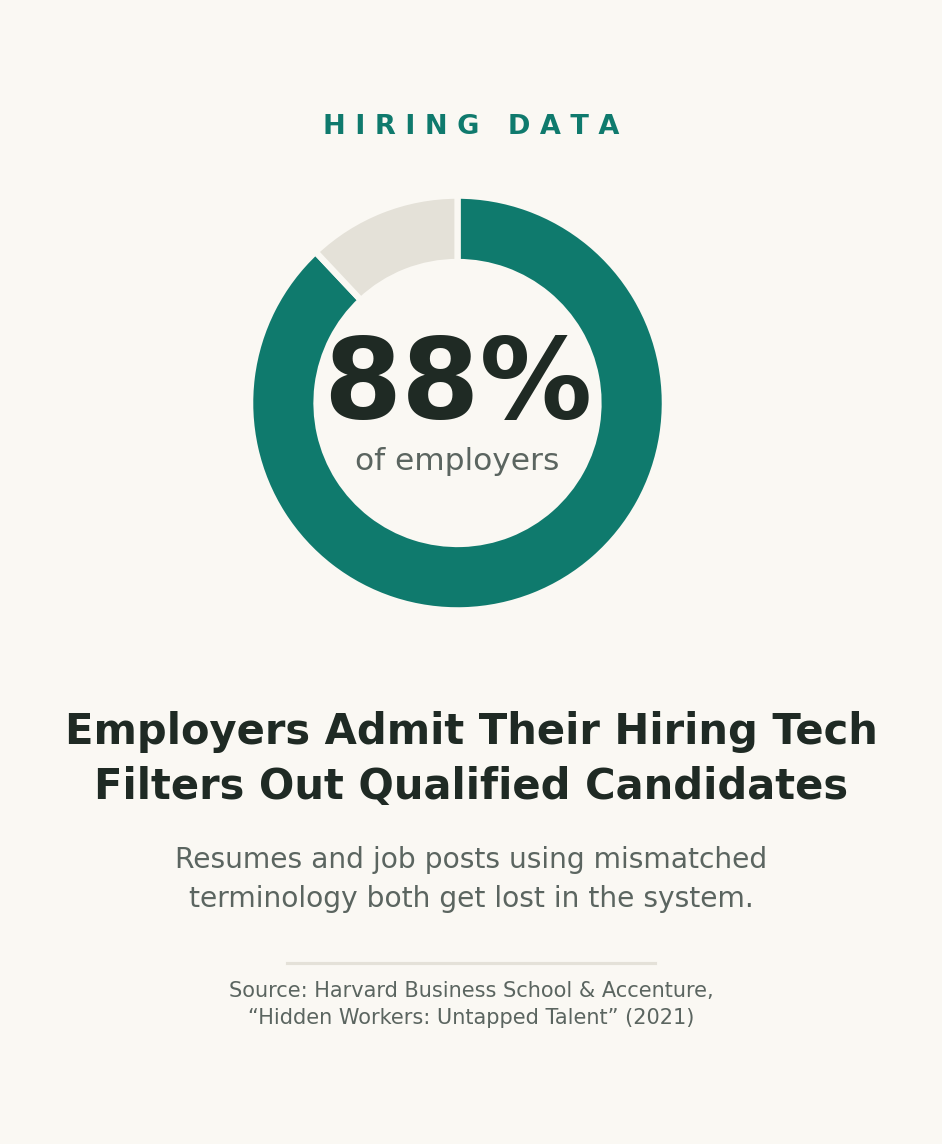
According to Harvard Business School and Accenture’s Hidden Workers: Untapped Talent study, 88% of executives surveyed said their hiring technology screens out qualified, high-skilled candidates because their resumes don’t match the exact terminology the system expects. The terminology mismatch runs in both directions; vague or inconsistent job descriptions create the same ambiguity that trips up resume parsing.
Fixing the resume side of that equation has become an entire industry. Fixing the job description side, where Resume Parser Friendly Job Descriptions actually originate, gets almost no attention by comparison despite sitting upstream of every match, rank, and shortlist the system produces.
This piece breaks down what makes a job description genuinely parser-friendly: where keyword placement actually matters, how to structure skills and requirements so an AI resume screening engine can extract them cleanly, the formatting mistakes that quietly confuse parsers, and a before/after example you can apply to your next posting.
What Are Resume Parser Friendly Job Descriptions
Resume Parser Friendly Job Descriptions are job postings structured, worded, and formatted so that an AI resume parser or applicant tracking system can accurately extract role details, required skills, and qualification criteria. This structure lets the system match candidate profiles against the posting correctly, instead of losing context to inconsistent formatting or ambiguous phrasing.
The Core Problem: Job Descriptions Are Written for Humans, Not Systems
Most hiring managers write job descriptions the way they’d describe the role in conversation: loosely structured, adjective-heavy, and inconsistent in terminology. That approach works fine for a human reading top to bottom. It breaks down the moment a parser tries to extract structured fields from unstructured prose.
A typical mid-sized startup receives 250 to 400 applications per open role during a standard 30-day posting window. Job posting software and ATS platforms rely on parsing both sides of that exchange the incoming resumes and the job description they’re scored against to rank candidates automatically. When the job description itself uses inconsistent skill names, buries requirements inside narrative paragraphs, or mixes required and preferred qualifications without clear separation, the matching logic has nothing reliable to anchor against.
The scale of the miss is bigger than most teams assume. Internal recruiting teams routinely underestimate this by 3–4x, assuming their postings are “clear enough” because a human skimmed them and understood the gist. Parsers don’t skim. They tokenize headings, bullet structures, and phrase patterns, and when those patterns are inconsistent, extraction accuracy drops sharply which means qualified candidates get ranked lower not because they lack the skills, but because the system couldn’t confirm the skills existed on either side of the match.
There’s a second-order cost too. Job boards and AI-powered candidate search tools the systems candidates now use to search for roles rely on the same structured extraction. A posting that confuses an ATS also confuses the discovery layer candidates use to find it, which shrinks the applicant pool before screening ever begins.
The financial impact compounds quickly. A single mis-parsed requirements section can suppress an open role’s visibility for the full 3–4 week posting window, which means a company effectively pays for advertising that a meaningful share of its target audience never sees. For a hiring team running 8–10 concurrent open roles, that’s not a one-off formatting slip it’s a structural leak across the entire hiring funnel, and it’s one most teams never diagnose because the symptom looks like “we’re not getting enough qualified applicants” rather than “our job descriptions don’t parse.”
Recruiting teams also underestimate how much this compounds with recruiter workload. When a job description fails to parse cleanly, the ATS often surfaces a wider, lower-quality applicant pool for manual review instead of a narrower, well-ranked one. A recruiter who should be reviewing 15–20 strong matches ends up screening 60–80 loosely ranked candidates by hand, which adds 2–3 extra hours per role, every cycle, purely because the upstream posting wasn’t structured for extraction.
How to Structure a Job Description Parsers Can Actually Read
This is the part most guides skip past with vague advice like “use clear language.” Parsing accuracy comes down to specific structural decisions, not tone. Below is the process, broken into the areas that matter most: keyword placement, skills/requirements structure, and format hygiene.
Keyword Placement That Actually Helps Parsing
Parsers weigh terms differently depending on where they appear in the title, first paragraph, dedicated skills section, or buried mid-sentence in a narrative block. Placement discipline matters more than keyword volume.
- Put the exact job title in the H1 and the first sentence. Avoid internal-only titles like “Growth Ninja” or “Rockstar Engineer” parsers and job search algorithms match against standardized title taxonomies, and creative titles fail to match entirely.
- Front-load the top 3–5 required skills in the first 100 words. Systems weight early-appearing terms more heavily during ranking, and candidates scanning search results decide relevance in the first two lines.
- List tools and technologies by their exact market name. Write “Salesforce,” “Python,” or “Google Analytics” rather than “CRM platform” or “coding languages” generic category terms that don’t match specific skill fields in a candidate’s parsed profile.
- Use the same term consistently throughout the post. If the first section says “Project Management,” don’t switch to “PM experience” in the requirements list further down; parsers treat these as separate tokens unless the system has strong synonym mapping.
- Avoid keyword stacking in a single line. A line reading “SQL, Python, Java, AWS, Docker, Kubernetes, React, Node” with no context reads as noise to most parsers and doesn’t map cleanly to structured skill fields.
Structuring Skills and Requirements for Clean Extraction
Structured candidate records built from parsed resumes are only useful if the job description they’re scored against uses the same field logic. Requirements sections should mirror the fields a candidate record actually contains: job title, years of experience, hard skills, certifications, and location or work-arrangement details.
Separate “Required” from “Preferred” explicitly, with their own subheadings. When both are blended into one bulleted list, ranking algorithms often can’t distinguish a hard cutoff from a nice-to-have, which either disqualifies borderline-strong candidates or lets underqualified ones rank too high.
Use quantified experience bands instead of vague seniority language. “4–6 years in backend development” parses far more reliably than “several years of relevant experience,” and it gives candidates an honest benchmark to self-select against before applying.
Common Formatting Mistakes That Confuse Parsers
- Skills embedded inside paragraphs instead of bullets. A sentence like “the ideal candidate will have strong experience with React, Node.js, and REST APIs” buries three critical terms inside prose the parser has to infer skill boundaries from, rather than reading them as discrete list items.
- Tables, columns, or graphic-based layouts on the career page. Some career-page builders render qualifications inside design elements that parsers can’t read as text at all, the same problem seen in resumes with two-column templates.
- Acronyms without the full term on first use. “5+ years in SEO” should read “5+ years in search engine optimization (SEO)” at least once, since parsers and search algorithms may index the full term, the acronym, or both, depending on configuration.
- Missing location and work-type data in structured fields. “Remote-friendly, occasional travel” buried in a closing paragraph doesn’t get indexed the way a dedicated “Location: Remote (US)” field does.
- Non-standard section headers. Headings like “The Journey Ahead” or “Who You’ll Be” instead of “Responsibilities” and “Requirements” prevent both parsers and candidates from quickly locating the information they’re scanning for.
Cost and Time Implications of Getting This Wrong
Fixing parsing issues after the fact costs more than building the structure in from the start. A hiring team that rewrites postings mid-cycle typically loses 5–7 days of visibility while the corrected version re-indexes across job boards and internal search, on top of the time already spent reviewing a poorly ranked applicant pool.
There’s also a compliance dimension worth factoring in. Inconsistent or vague requirement language phrases like “must be a culture fit” or “recent graduate preferred” creates both a parsing problem and a discrimination-risk problem, since these terms are difficult to defend as job-related criteria if a hiring decision is ever challenged. Structuring requirements around specific, measurable skills solves both issues at once: it parses cleanly and it holds up as objective criteria.
Integrating Job Descriptions with Candidate Matching Systems
Resume Parser Friendly Job Descriptions aren’t just an internal formatting exercise; they’re the input layer for whatever matching or ranking logic sits downstream. Modern Candidate Profile Management systems build a structured profile from every parsed resume: title history, skills, certifications, tenure. That profile only produces a useful match score if the job description it’s compared against uses the same field structure.
This is also where AI Candidate Insights tools add the most value. Platforms that surface funnel analytics where applicants drop off, which requirement line filters out the most candidates, and how a posting’s match rate compares to similar roles can only generate that analysis from postings with consistent, structured fields. A narrative-style job description gives an analytics layer nothing reliable to measure against, which means teams lose visibility into whether a low applicant count is a sourcing problem, a compensation problem, or a parsing problem.
Job Description Formatting for Career Page Visibility
Career pages built on modern job posting software typically generate structured data markup automatically, but only when the underlying job description content is already field-structured. A posting with a clean title, a defined location field, and a distinct skills list gives that markup something accurate to populate. A narrative-style posting forces the platform to guess at which sentence contains the job title or the required skills, which produces incomplete or incorrect markup even on a technically capable career page.
This matters beyond internal ATS ranking. Search engines and AI-powered job aggregators read that same structured markup to decide how and where to surface a posting in candidate-facing search results. Two identical roles posted with identical compensation can see meaningfully different application volume purely based on which one gives the discovery layer cleaner data to index.
Case Studies: Parsing Fixes in Real Hiring Pipelines
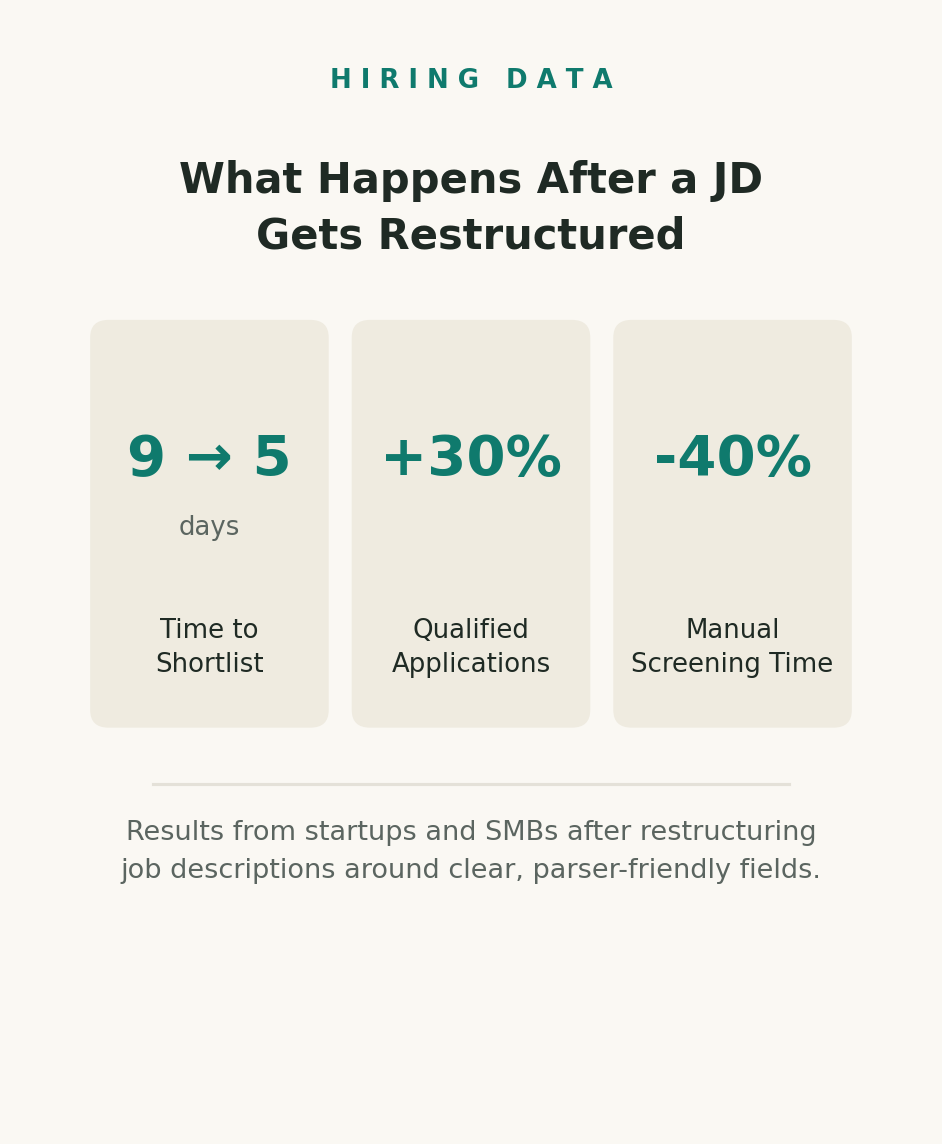
A Series A SaaS startup rewrote its job descriptions to separate required and preferred skills into distinct sections and replaced internal job titles with standardized market titles. The team also removed narrative-style intros in favor of a fixed template covering title, experience band, required tools, and location. Within one hiring cycle, qualified-applicant match rates on their AI resume screening shortlist improved noticeably, and average time-to-shortlist dropped from 9 days to 5 days across four open roles. Recruiter time spent manually re-screening mismatched applicants fell by roughly 40%, since the ranked shortlist required far less manual correction.
A 40-person logistics SMB had been losing candidates to competitor postings despite offering comparable pay. After auditing their listings, the team found that critical software requirements were buried in narrative paragraphs rather than bulleted skill lists, and two of five open roles used internal-only job titles that didn’t match any standard taxonomy. Restructuring three postings around clear requirement bullets and consistent terminology increased qualified application volume by roughly 30% over the following month, without any change to the advertised compensation or job boards used. The company also reported that the career-page bounce rate dropped after requirements moved from paragraph form into a scannable bullet structure, since candidates could self-qualify in seconds instead of reading a full paragraph to find the skills section.
Choosing an Approach: Comparing Job Description Structures
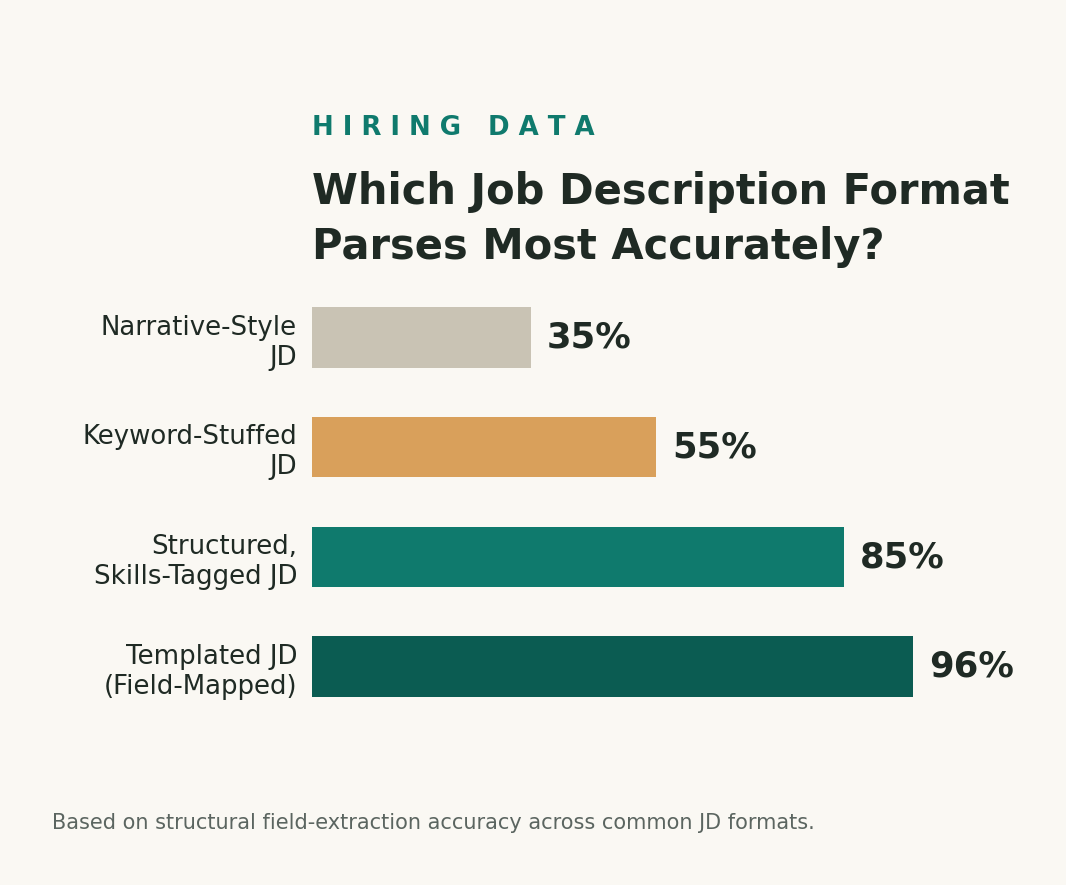
Not every hiring team needs to solve this problem the same way, and the right approach depends on posting volume and how much manual review capacity a team has. Four common approaches show up across startups and SMBs, each with different tradeoffs between parsing accuracy, candidate experience, and the effort required to maintain them across dozens of open roles.
| Approach | Parsing Accuracy | Candidate Readability | Maintenance Effort |
| Narrative-style JD (paragraph-heavy) | Low skills buried in prose | Moderate | Low |
| Keyword-stuffed JD (dense skill lists, no structure) | Moderate extracts terms, loses context | Poor | Low |
| Structured, skills-tagged JD (clear H2/H3s, required vs. preferred) | High | High | Moderate |
| Templated JD generated inside modern job posting software with built-in field mapping | Highest schema-matched to parser fields | High | Low, once template is set |
The middle two rows are where most teams unintentionally land either writing loosely because structure feels like extra effort, or overcorrecting into dense keyword lists that read poorly to actual candidates. Both approaches solve for one side of the problem while ignoring the other. The goal is a posting that a parser can extract cleanly and a candidate can scan in under ten seconds, which is what the structured, template-based approaches on the table’s lower half are built to deliver.
The fourth option matters increasingly because more recruiting platforms now generate AI Candidate Insights directly from structured job data flagging drop-off points in a role’s applicant funnel, or surfacing which requirement lines are filtering out the most candidates. That level of analysis is only possible when the underlying job description was structured cleanly enough to be parsed the same way a resume is.
What Most Teams Get Wrong
The most common mistake isn’t bad writing, it’s treating the job description as marketing copy first and structured data second. Teams spend hours perfecting employer-brand language and almost no time checking whether the requirements section would parse cleanly if run through the same engine that screens incoming resumes.
The second mistake is copying last year’s posting without auditing terminology drift. Job titles and tool names change fast. “Growth Marketer” becomes “Lifecycle Marketing Manager,” a tool gets renamed after an acquisition and a stale posting silently mismatches against how candidates and parsers currently tag those same skills.
The third, and most avoidable, mistake is assuming that because a human reviewer would understand a loosely worded requirement, a parser will too. Recruiters read intent. Parsers read patterns. A posting that says “must be comfortable wearing many hats” communicates nothing extractable, while “must independently manage recruiting, onboarding, and payroll administration” gives a system three distinct, matchable skill fields.
A fourth pattern shows up specifically at growing companies: hiring managers each write their own postings with no shared template, which means requirements, headers, and terminology vary role to role even within the same team. This isn’t just a parsing inconsistency, it also makes it impossible to compare funnel performance across roles, since a low applicant count on one posting can’t be reliably attributed to the market, the compensation, or the formatting without a consistent baseline to compare it against.
Before and After: A Parser-Friendly Rewrite
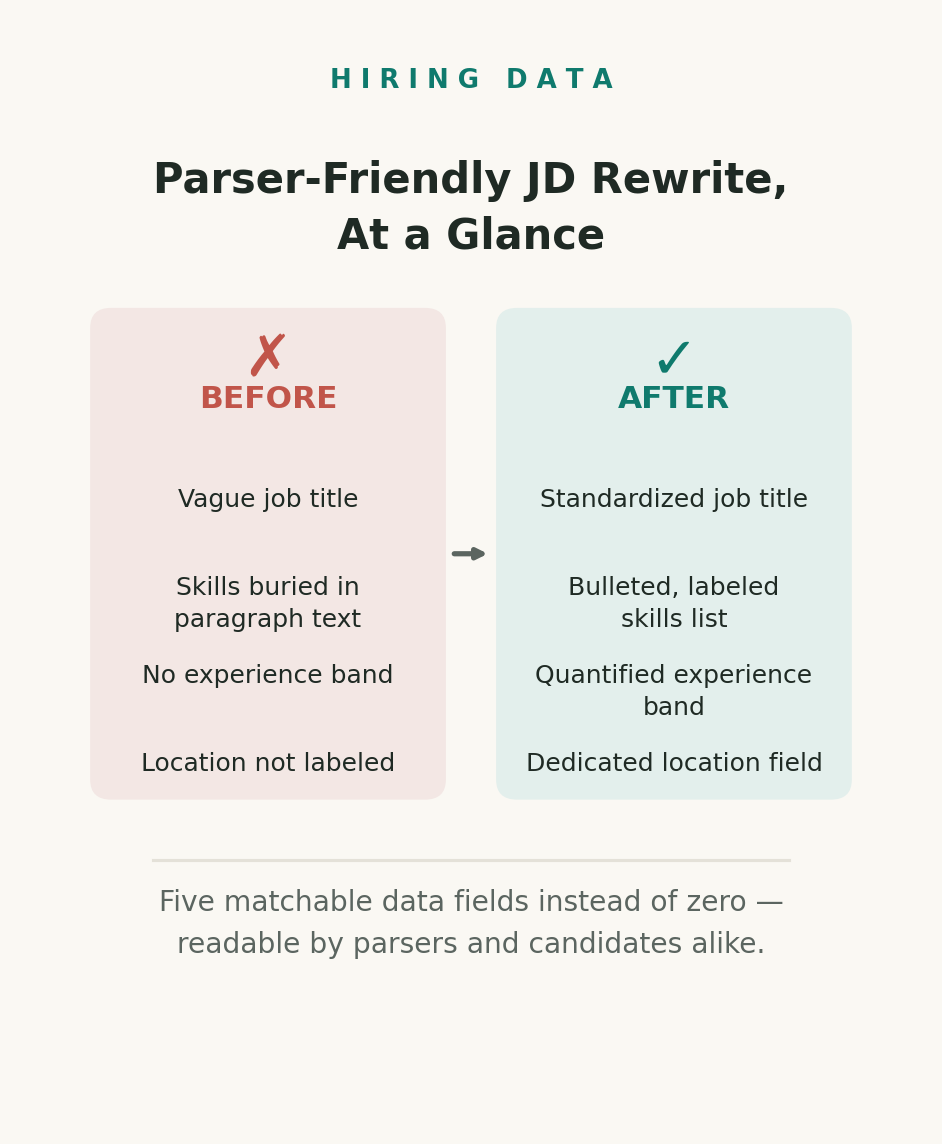
Before: “We’re looking for a rockstar marketer who can wear many hats and thrive in a fast-paced environment. Experience with digital tools and campaigns is a plus.”
After:
- Title: Digital Marketing Manager
- Experience: 3–5 years in performance marketing
- Required skills: Google Ads, Meta Ads Manager, HubSpot, email campaign management
- Preferred skills: SEO, marketing automation workflows
- Location: Hybrid Bengaluru, India
The rewritten version gives a parser five distinct, matchable fields instead of zero. It also gives a candidate scanning the post in six seconds a faster answer to “do I qualify,” which is exactly the outcome Resume Parser Friendly Job Descriptions are meant to produce on both ends of the funnel.
Parser-Readability Checklist
Use this list as a final pass on any draft. It’s the fastest way to confirm a posting qualifies as one of the Resume Parser Friendly Job Descriptions your ATS and career page can both actually read, rather than one that only looks organized to a human skimming it.
Before publishing a job description, confirm it against these points:
- Standardized job title in the H1 and opening sentence
- Top required skills appear within the first 100 words
- Required and preferred qualifications are in separate, labeled sections
- Tools and technologies use their exact market names, spelled consistently throughout
- Acronyms are spelled out at least once alongside the short form
- Location and work-arrangement details sit in their own labeled line, not buried in prose
- No skills or requirements are embedded inside narrative paragraphs
- Section headers use standard labels: Responsibilities, Requirements, Qualifications, Location
Getting This Right at Scale
Writing one parser-friendly job description is a straightforward editing exercise. Maintaining that standard across dozens of open roles, multiple hiring managers, and several job boards is a process problem, not a writing problem which is where most teams quietly slip back into narrative-style postings under deadline pressure.
The teams that solve this durably usually do it with a shared template and a review step, not a one-time rewrite. A template enforces the field structure title, experience band, required skills, preferred skills, location regardless of who’s writing the posting or how much time they have, which keeps every listing on a growing team readable by the same parsing logic across every role.
If your team is evaluating how much of your applicant drop-off traces back to job description structure rather than candidate quality, Hirium’s platform builds field-structured postings and AI-driven candidate matching into the same workflow, so the posting and the parsing logic are never working against each other. You can review the free plan details directly at hirium.com.
Frequently Asked Questions
What makes a job description ATS-friendly?
An ATS-friendly job description uses standardized titles, consistent terminology, and clearly separated skill and requirement sections instead of narrative paragraphs. This structure lets the parsing layer extract fields accurately, which improves how well the system matches incoming resumes against the posting. It also reduces the manual cleanup recruiters need to do when a ranked shortlist comes back inaccurate, saving review time on every open role.
How do AI resume parsers read job postings?
Parsers tokenize headings, bullet points, and phrase patterns to extract structured fields, job title, required skills, experience level, and location. Job descriptions formatted with clear structure and consistent phrasing extract more reliably than dense paragraphs where requirements are implied rather than stated outright. The same logic applies to resumes, which is why postings and resumes should ideally be evaluated against the same formatting standard.
What formatting breaks resume parsers?
Tables, multi-column layouts, embedded graphics, and skills buried inside sentences are the most common causes of parsing failure. These formats either hide text from the parser entirely or prevent it from cleanly separating one data field from another, which forces the system to guess at boundaries it should be reading directly from clear structure.
Can candidates find a job posting through AI-powered job search tools?
Yes, and the same structural rules apply. Job search tools and career-page search engines index structured fields the same way an internal parser does, so a poorly structured posting loses visibility in candidate-facing search results, not just in internal ranking systems. A role that’s hard for a parser to read is often just as hard for a candidate to find.
How long should a job description be for accurate parsing?
Length matters less than structure. A 400–600 word posting with clearly labeled sections parses more reliably than a 1,200-word posting written entirely in paragraph form, because extraction depends on formatting patterns rather than word count. Teams should prioritize a clean field structure over hitting a specific length target.
Do bullet points help or hurt ATS parsing?
Bullet points generally help, since they signal discrete, separable data points to a parser. The exception is when bullets are overloaded with multiple unrelated skills crammed into a single line, which can cause the same ambiguity as a narrative paragraph. One skill or requirement per bullet keeps extraction clean.
Should every job description use the same template?
A consistent template improves parsing accuracy and makes it easier to audit postings at scale, but the underlying fields title, required skills, preferred skills, experience, location matter more than rigid visual formatting. Teams evaluating job posting software should prioritize platforms that enforce this field structure automatically, since manual consistency across dozens of postings is difficult to maintain long-term without it.