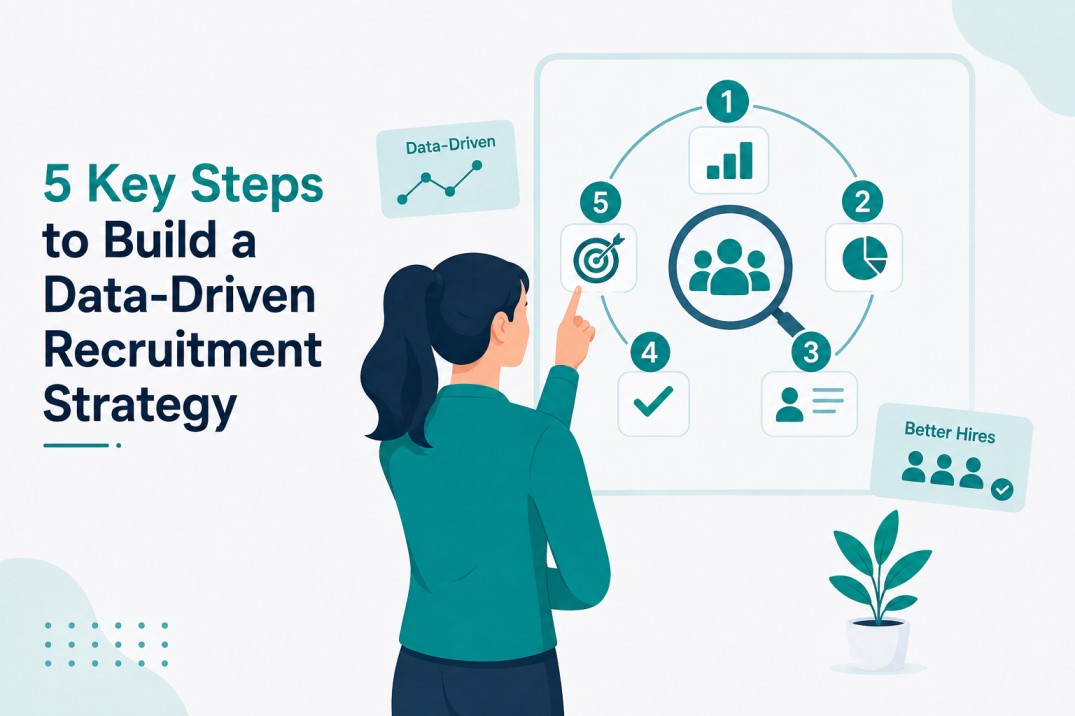
5 Key Steps to Build a Data-Driven Recruitment Strategy
Most hiring decisions still come down to gut feel. A recruiter likes a resume, an interviewer gets a good vibe, and a candidate moves forward without anyone checking whether that instinct actually predicts success on the job. The problem is this approach is expensive.
The U.S. Department of Labour reports that a bad hire costs at least 30% of that employee’s first-year salary. In a mid-level role, that can mean tens of thousands of dollars lost to one wrong decision.
A data-driven recruitment strategy fixes this by replacing guesswork with measurable signals at every stage of hiring, from where candidates come from to why they drop off.
This guide breaks the process into 5 practical steps any hiring team can start using right away.
5 Key Steps to Build a Data-Driven Recruitment Strategy
Here is the recruitment strategy, from tracking key metrics to centralizing candidate sourcing strategy data for better hires:
Step 1: Define the Metrics That Actually Matter
Before collecting any data, a hiring team needs to agree on which numbers are worth tracking. Without this step, teams pull reports that look impressive but don’t change any decisions.
Metrics worth tracking:
- Time-to-hire: how long it takes from application to offer acceptance, broken down by role
- Offer acceptance rate: the percentage of offers candidates actually accept, a signal of how competitive the process is
- Source effectiveness: which channels (referrals, job boards, LinkedIn, career page) produce candidates who get hired, not just candidates who apply
- Cost-per-hire: total recruiting spend divided by number of hires, so budget decisions have a baseline
- Recruiter load: how many open roles or candidates each recruiter manages, useful for spotting bottlenecks before they cause delays
Metrics to avoid chasing:
- Total application volume with no quality filter attached. A job post that gets 500 applications means nothing if none of them convert to hires.
- Resumes screened per day, since this rewards speed over accuracy and can hide poor shortlisting decisions.
Step 2: Centralize Candidate Data in One System
Data only becomes useful when it lives in one place. Spreadsheets, email threads, and sticky notes each hold a piece of the hiring picture, but none of them talk to each other, and none of them survive a recruiter leaving the company.
Why scattered data breaks a hiring strategy:
- No single source of truth means two people can report different numbers for the same role
- Historical comparison becomes impossible; there’s no way to know if this quarter’s time-to-hire is better or worse than last quarter’s without consistent records
- Candidate history gets lost, so a strong applicant who wasn’t right for one role never gets reconsidered for the next one
What a centralized system enables:
- Every candidate interaction, from application to final decision, lives in one searchable record
- Recruiters can compare performance across roles and time periods using the same dataset
- Past candidates who were good but not selected can be tagged and resurfaced when a similar role opens
Step 3: Use AI Screening to Standardize the Top of Funnel
The earliest stage of hiring is where the most inconsistency creeps in. One recruiter might reject a resume for a gap in employment history while another lets it through. Over hundreds of applications, this inconsistency skews who even reaches an interview.
Where human bias shows up in early screening:
- Different recruiters applying different unwritten standards to the same job requirements
- Fatigue setting in after reviewing dozens of resumes in a row, leading to rushed decisions late in the day
- Unconscious preferences for certain schools, companies, or resume formats that have nothing to do with job performance
How AI screening creates consistency:
- The same criteria get applied to every resume, every time, regardless of who’s reviewing or what time of day it is
- Shortlisting happens faster, so strong candidates aren’t lost to slow response times
- An AI interviewer can run first-round screening on standardized questions, giving every candidate the same starting point before a human ever gets involved
Step 4: Track Funnel Analytics and Fix Bottlenecks
A hiring funnel has five stages: applied, screened, interviewed, offered, accepted. Most teams only look at the start and end of that funnel, the total applicants and the final hire, and miss what’s happening in between.
Mapping the funnel stage by stage:
- Applied to screened: how many candidates make it past the first filter
- Screened to interviewed: how many qualified candidates actually get scheduled
- Interviewed to offered: how many interviews convert to offers
- Offered to accepted: how many offers get accepted versus declined
Finding and fixing bottlenecks:
- A large drop between screened and interviewed usually points to scheduling delays or slow recruiter follow-up, not a lack of qualified candidates
- A low offer acceptance rate often signals the process is too slow, or the offer isn’t competitive against what candidates are getting elsewhere
- Recruitment analytics that break down time spent at each stage make it possible to see exactly where candidates are dropping off, instead of guessing
Step 5: Review, Iterate, and Benchmark Over Time
A data-driven strategy isn’t a one-time setup. Metrics that mattered six months ago might not reflect where the hiring process struggles today, so the numbers need regular review, not a single audit that gets filed away.
Setting a review cadence:
- A monthly check-in on core metrics like time-to-hire and source effectiveness catches problems early
- A quarterly deeper review compares trends across a longer stretch of time, showing whether changes made are actually working
Benchmarking against past hiring cycles:
- Comparing this quarter’s time-to-hire against the last few quarters shows whether process changes are helping or just adding steps
- Tracking offer acceptance rate over time reveals whether the company is becoming more or less competitive for candidates
- Recruiter load trends over several cycles show whether the team needs more support before burnout affects hiring quality
The strategy only holds up if it gets revisited on a fixed schedule. Otherwise it becomes another one-time project instead of an ongoing practice.
A Simple Framework to Get Started?
The shift from manual hiring to a data-driven recruitment strategy doesn’t happen overnight, but the difference between the two approaches becomes clear once they’re placed side by side.
| Factor | Manual / Spreadsheet-Based Approach | Data-Driven Recruitment Strategy |
| Time-to-hire | Tracked inconsistently, if at all. Delays go unnoticed until a role has been open for weeks | Measured at every funnel stage, so slow points get caught and fixed early |
| Visibility | Limited to whatever one recruiter remembers or manually logs. No shared view across the team | Every candidate interaction lives in one system, giving the whole team the same view of where things stand |
| Consistency | Screening standards shift between recruiters and even between days for the same recruiter | The same criteria get applied to every candidate through structured screening tips and AI-assisted shortlisting |
| Scalability | Breaks down as hiring volume grows. More roles mean more spreadsheets, more email threads, more room for error | Handles growth without adding chaos, since the system tracks new roles and candidates the same way it tracked the first one |
Conclusion
Building a data-driven recruitment strategy doesn’t require a large team or an expensive analytics setup. It requires selecting the right metrics, keeping candidate data in one place, standardizing early-stage screening, closely tracking the funnel, and reviewing results on a fixed schedule.
Each step builds on the last, and skipping any one of them leaves gaps that manual hiring processes often hide until they become costly.
This is where a tool like Hirium fits in. Its centralized candidate database, AI resume screening, and recruitment analytics give startups and SMBs a way to put these 5 steps into practice without building a system from scratch. Teams that want to try it can start on Hirium’s free plan, with no credit card required, and see how a data-driven recruitment strategy plays out on their own hiring data.
FAQs
1. What is the first step in building a data-driven recruitment strategy?
The first step is choosing which metrics matter. Most teams jump straight to collecting data before deciding what they’re trying to measure, which leads to reports full of numbers that don’t inform any decision. Start with 4-5 core metrics like time-to-hire, offer acceptance rate, and source effectiveness.
2. Which hiring metrics should small teams track first?
Small teams get the most value from time-to-hire, offer acceptance rate, and source effectiveness. These three show how fast the process moves, whether candidates want to join, and which channels actually produce hires, without requiring a large HR team to maintain a complex dashboard.
3. Can startups build a data-driven strategy without a large HR team?
Yes. A data-driven recruitment strategy doesn’t require a dedicated analytics team. A centralized candidate database and a handful of tracked metrics can be managed by one or two people, especially when the ATS handles the tracking automatically instead of requiring manual spreadsheet updates.
4. How does AI screening fit into a data-driven approach without adding bias?
AI screening reduces bias by applying the same criteria to every candidate instead of leaving standards to shift between recruiters or across a long day of reviewing resumes. It works best as a first filter, with human judgment still deciding who moves forward after that.
5. How often should a hiring team review its recruitment data?
A monthly check-in on core metrics catches problems early, while a quarterly review compares trends over a longer stretch and shows whether changes are actually working. Skipping this step turns a data-driven recruitment strategy into a one-time project instead of an ongoing practice.