Recruitment Tech Stack 2026: How AI Resume Screening, Parsing, and Scheduling Fit Together
Recruiters are being asked to close roles faster while carrying nearly double the workload, and most are trying to do it with software that was never designed to talk to each other.
That gap faster expectations, heavier caseloads, disconnected tools is the real story behind why the recruitment tech stack conversation has moved from “which ATS should we buy” to “how many systems are we actually running, and why don’t they share data?”
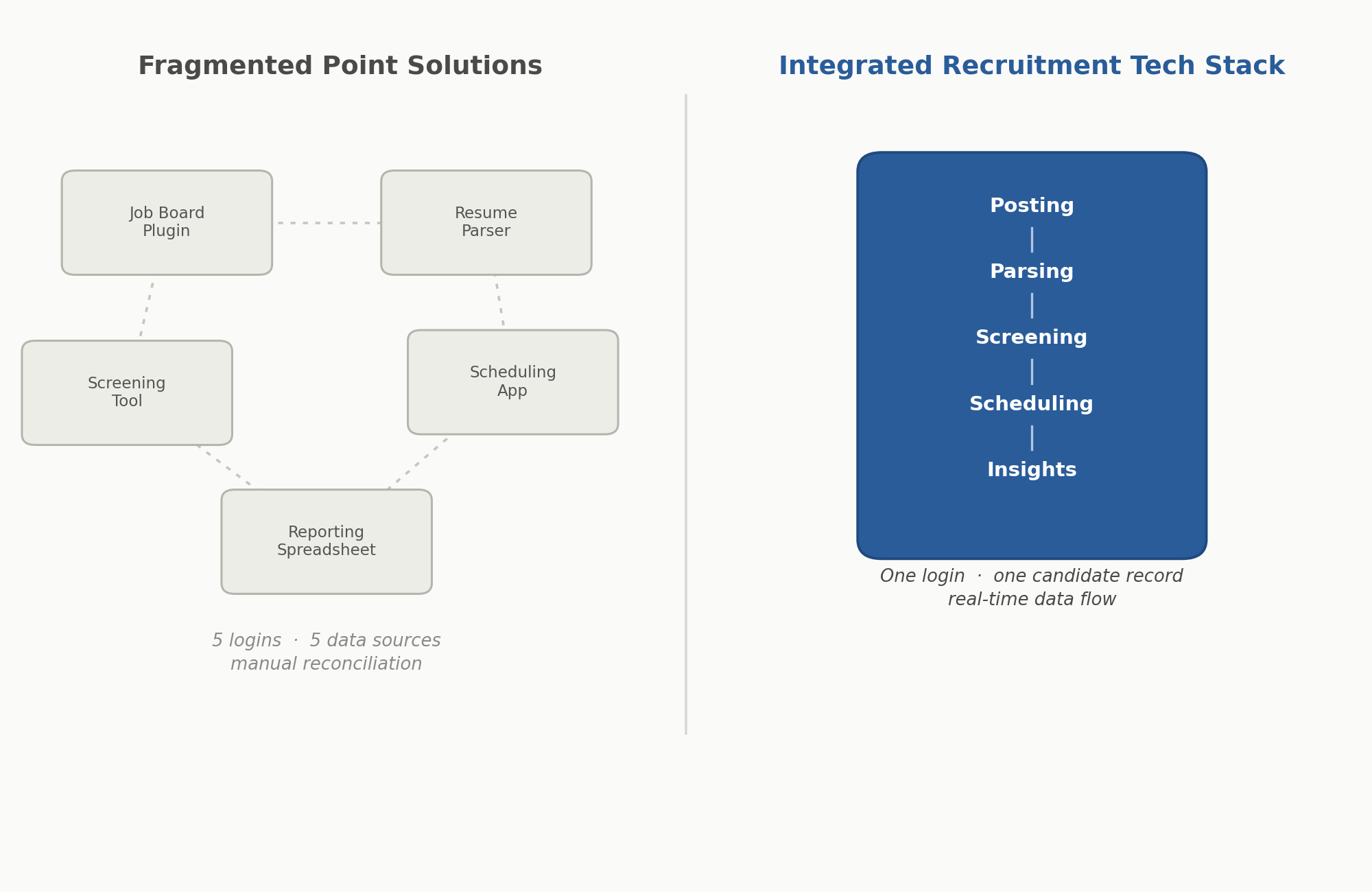
A typical SMB hiring pipeline today touches a job board plugin, a resume parser, a screening tool, a scheduling app, and a spreadsheet for reporting. Five logins. Five sources of truth.
One candidate.
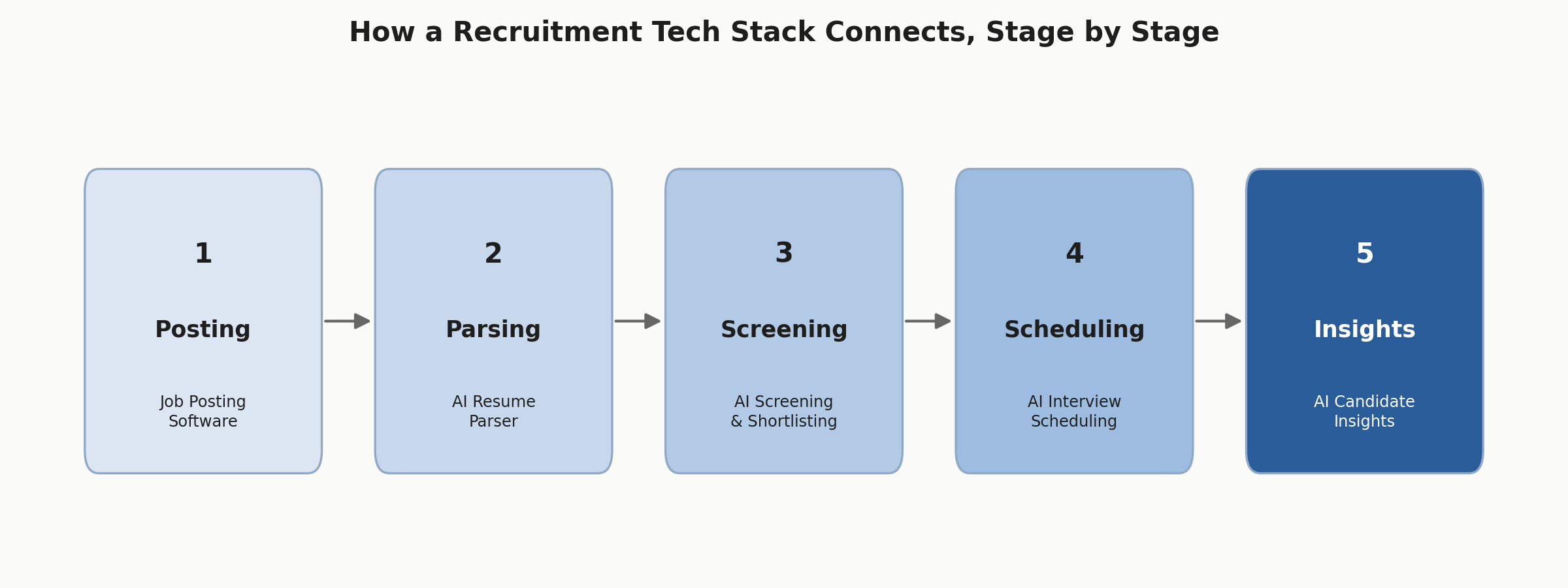
This piece maps how those five stages posting, parsing, screening, scheduling, and insights are supposed to connect, why most recruitment tech stack setups break at the handoffs between them, and what an integrated approach changes about time-to-hire, recruiter workload, and candidate experience.
It’s written for founders and talent leads who already have some version of this stack running and want a clearer picture of where their setup is likely leaking time, not for teams starting from a blank slate.
According to SHRM’s 2026 Recruiting Executives Benchmarking data, drawn from more than 4,600 organizations, extra-large organizations saw median requisitions per recruiter climb 67% in 2026, even as median time-to-fill for non-executive roles dropped to 39 calendar days.
What Is a Recruitment Tech Stack?
A recruitment tech stack is the combined set of software tools a hiring team uses to move a candidate from job posting to offer, typically covering job distribution, resume parsing, screening, interview scheduling, and reporting.
The stack can live in one integrated platform or be assembled from separate point solutions that pass data between them.
The Core Problem: Fragmentation Costs More Than the Subscriptions
The direct cost of running four or five separate hiring tools is rarely the line item that hurts. A job posting software subscription, a parser, an AI screening software add-on, and a scheduling tool each run somewhere between $50 and $400 a month for a small team.
That’s manageable on its own.
The real cost shows up in the handoffs. Every time a candidate moves from one tool to the next, someone has to re-enter data, re-tag a status, or manually export a spreadsheet.
Recruiters at SMBs report losing 3 to 5 hours per week just reconciling candidate records across disconnected systems time that doesn’t show up in any single tool’s usage report.
Fragmented stacks also break the feedback loop between stages. If your AI resume parser lives in one tool and your interview notes live in another, nobody can see whether the candidates your parser scored highest are the ones actually getting hired.
Most teams underestimate this gap by 3 to 4x; they assume their tools are “integrated” because data technically moves between them via CSV export, not because it moves in real time.
Candidate experience absorbs the rest of the damage. A candidate who applies through a job posting software widget, gets parsed into a separate ATS, then receives a scheduling link from a third tool experiences three disconnected touchpoints instead of one coherent process.
Delays between stages are one of the leading reasons candidates drop out of active pipelines before an offer is made.
Tool sprawl compounds quietly over time rather than all at once. A founder picks a job board plugin in year one, a recruiter adds a parsing tool in year two because the first one couldn’t handle volume, and a scheduling app gets bolted on after a bad no-show experience.
None of these was a wrong decision individually; each solved a real problem at the time, but three years in, the combined recruitment tech stack has no single owner and no shared data model, and nobody remembers why any particular tool was chosen.
Untangling that later costs far more time than choosing one connected platform would have cost upfront.
A working recruitment tech stack isn’t five separate purchases; it’s one data flow with five checkpoints. Each stage exists to answer a specific question, and each one depends on clean data from the stage before it.
Stage 1: Job Posting Software Where the Data Originates
Job posting software is the entry point for every downstream stage. It distributes a role to job boards, a careers page, and often social channels, and it captures the raw application: resume file, contact details, and any custom screening questions.
The quality of this stage determines the quality of everything after it.
A career page that doesn’t capture structured fields (location, notice period, salary expectations) forces the next stage parsing to guess at information it should have received directly.
Branded, customizable career pages that collect structured data upfront cut parsing errors significantly compared to generic “apply via email” flows.
There’s also a distribution question worth separating from the data-capture question.
Where a role gets posted (general job boards, niche industry boards, social channels, employee referral links) affects volume and candidate quality, but it’s a different problem from whether the application data that comes back is structured well enough for the next stage to use.
Teams sometimes optimize heavily for distribution reach while leaving the actual application form as an unstructured resume-upload box, which pushes all the real work and all the risk of error onto the parsing stage that follows.
Stage 2: AI Resume Parser: Turning Documents Into Structured Data
An AI resume parser converts unstructured resume files (PDF, DOCX, scanned images) into structured fields: work history, skills, education, tenure, and contact information.
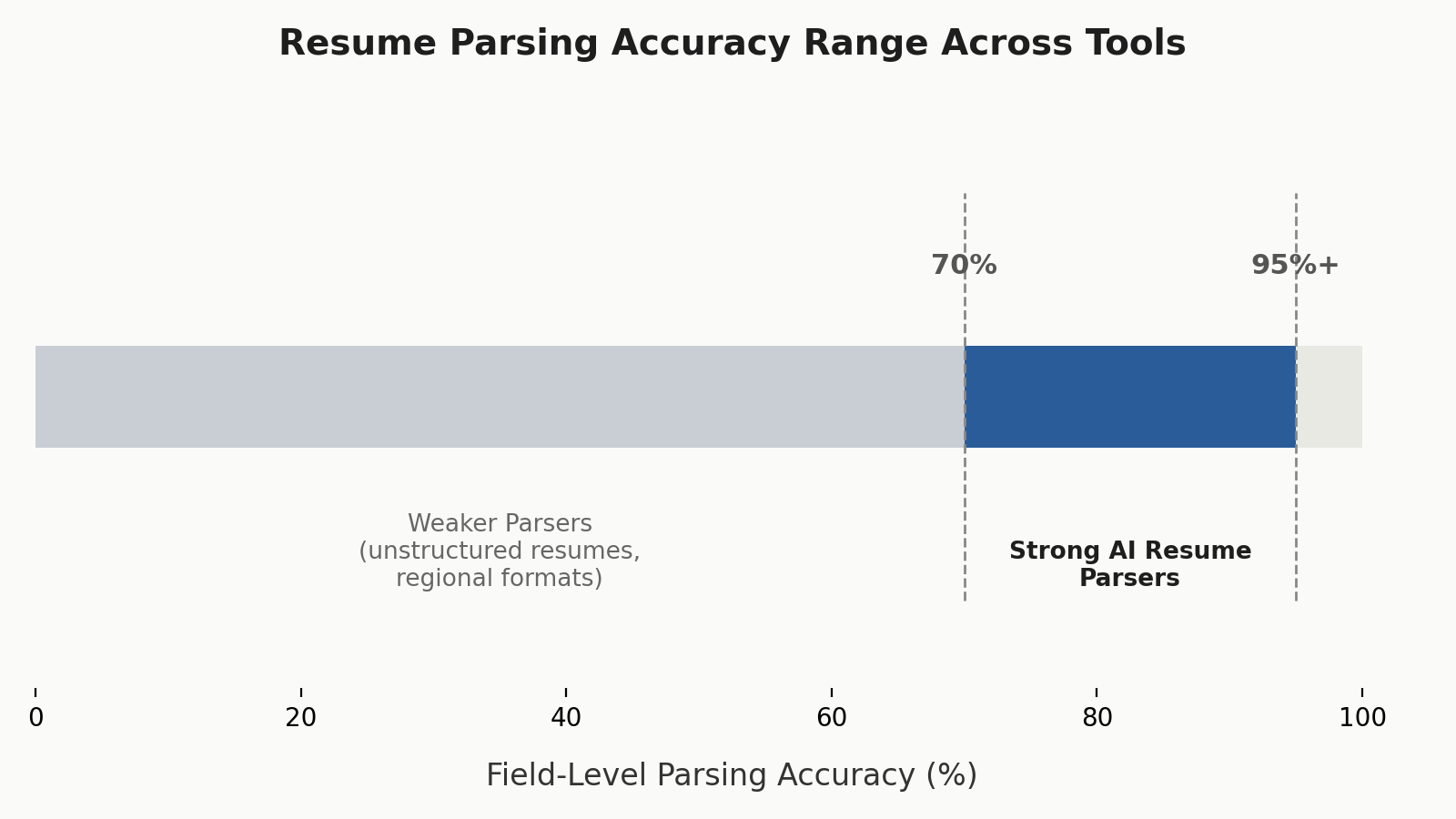
This is the step most fragmented stacks get wrong, because parsing accuracy varies enormously between tools, anywhere from 70% to 95%+ field-level accuracy depending on how the parser handles non-standard resume formats.
How AI resume parsing works, at a technical level, typically involves three passes: optical character recognition (OCR) for scanned or image-based resumes, natural language processing to identify field boundaries (where “experience” ends and “education” begins), and entity extraction to pull structured values like dates, job titles, and skill keywords.
Parsers trained on a narrow dataset, say, only Western-format resumes, degrade badly on regional formats, which matters for any startup hiring across geographies.
Parsing errors compound downstream. A resume parsed with the wrong tenure dates will misrepresent a candidate’s experience level to the screening tool that reads it next, which can silently disqualify a qualified candidate before a human ever sees the profile.
Stage 3: AI Screening and Shortlisting Where Judgment Gets Applied
Once resume data is structured, AI screening software applies role-specific criteria to rank and shortlist candidates.
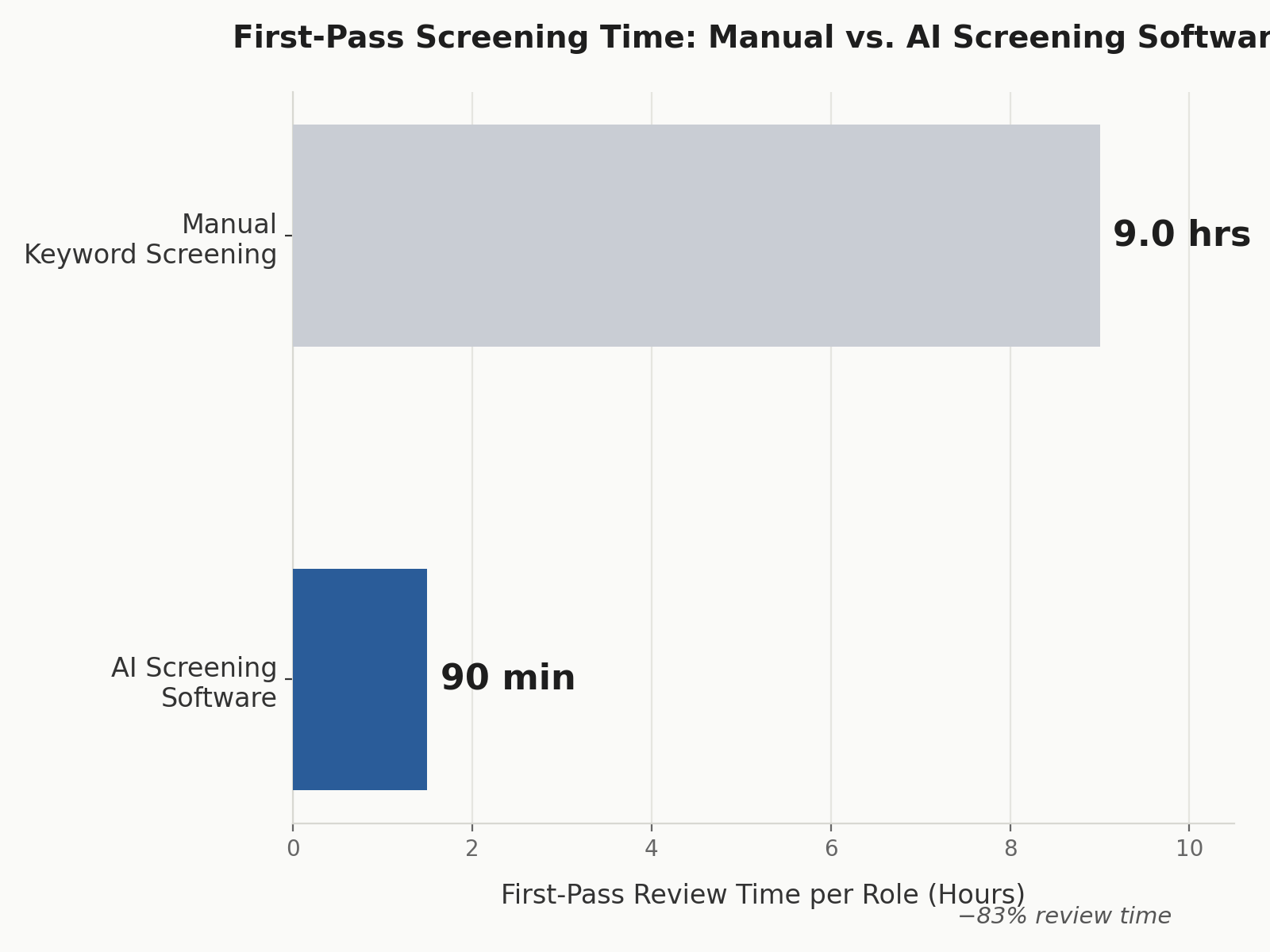
This is where most of the time savings in a modern stack come from: a recruiter reviewing 250 raw applications manually might spend 8 to 10 hours on first-pass screening; automated shortlisting against defined criteria can cut that to under an hour of recruiter review time on the pre-filtered shortlist.
The risk at this stage is resume screening bias criteria that inadvertently favour certain schools, employment gaps, or resume formatting over job-relevant skills.
Structured, criteria-based screening (scoring against explicit job requirements rather than pattern-matching against “successful past hires”) is the standard defence against this, and it’s worth asking any vendor exactly what their scoring model weighs.
Some platforms extend this stage with an AI interviewer that conducts a structured first-round conversation before a human recruiter gets involved, applying the same consistent criteria to every candidate rather than letting the quality of a first screen vary by which recruiter happens to be available that day.
This matters most for high-volume roles, where the difference between a rushed five-minute phone screen and a consistent structured conversation compounds across dozens of candidates.
Stage 4: AI Interview Scheduling: Removing the Back-and-Forth
AI interview scheduling tools sync recruiter and interviewer calendars with candidate availability, automatically propose slots, and send reminders without manual coordination.
Scheduling sounds like a minor stage, but it’s one of the highest-friction points in a fragmented stack, because it usually depends on data (candidate contact info, interviewer roles) that has to be manually copied over from the screening tool.
In an integrated stack, scheduling triggers automatically the moment a candidate is shortlisted no export, no separate outreach.
Automated workflows that handle status updates, reminders, and follow-up emails at this stage are what typically shave the most days off time-to-hire, since manual scheduling back-and-forth commonly adds 3 to 7 days per hiring round.
Stage 5: AI Candidate Insights Closing the Loop
AI candidate insights recruitment analytics on time-to-hire, offer acceptance rate, recruiter load, and source effectiveness is the stage most fragmented stacks skip entirely, because it requires data from all four previous stages in one place.
Without it, teams can’t tell whether their highest-scoring candidates from screening are actually the ones accepting offers, or whether a particular job board is producing applicants who drop out before interview.
This stage is also where a recruitment tech stack either proves its value or exposes its gaps.
Source effectiveness data, for example, only means anything if it can be traced all the way from the original job posting through to an accepted offer a connection that’s trivial inside one platform and genuinely difficult to reconstruct across four disconnected tools and their separate exports.
Recruiter load reporting has the same dependency: it requires knowing not just how many candidates a recruiter is assigned, but how many hours each stage of the process is actually consuming, which only surfaces when stage-by-stage timestamps live in a single system.
Here’s the process, end to end, as data should flow through a connected stack:
- Posting role goes live on job boards and a branded career page, capturing structured application data
- Parsing resumes are converted into structured, searchable candidate profiles
- Screening profiles are scored and shortlisted against role-specific criteria
- Scheduling: shortlisted candidates are automatically routed to interview slots
- Insights outcomes across all four stages are tracked back to source, recruiter, and time-to-hire metrics
When any one of these five steps lives in a disconnected tool, the loop breaks and the team loses the ability to see which upstream decisions are actually producing good hires.
Integration and Compliance Considerations
Connecting five stages isn’t purely a UX preference; it has real architecture implications. Point-solution stacks typically rely on API integrations, Zapier-style middleware, or scheduled CSV exports to move data between tools, and each of those connection types introduces a different failure mode.
API integrations break silently when a vendor changes an endpoint; middleware adds a paid layer and a delay; CSV exports require someone to remember to run them.
Data privacy adds another layer teams often underweight. Candidate resumes, contact details, and interview notes are personal data under frameworks like India’s DPDP Act or the EU’s GDPR, and every additional tool in the stack is another system that has to be covered by consent language, retention policy, and data-processing agreements.
A five-tool stack means five separate data-processing relationships to audit; a single platform means one.
Cost implications extend beyond subscription fees. A point-solution stack usually has a hidden integration cost, either a developer’s time to build and maintain connectors, or a recruiter’s time to do it manually every week. For a startup without dedicated engineering bandwidth for HR tooling, that hidden cost is often larger than the visible subscription total across all four or five tools combined.
Migrating an Existing Recruitment Tech Stack
Teams already running a fragmented setup rarely want to rebuild their hiring process from zero, and migration risk is a legitimate reason stacks stay fragmented longer than they should.
The safest migration path preserves historical candidate records first, exporting existing profiles, interview notes, and status history before switching any single stage over so reporting continuity isn’t lost mid-quarter.
A phased cutover, moving one stage at a time (parsing first, then screening, then scheduling) rather than switching everything simultaneously, also limits the blast radius if a new tool doesn’t behave as expected during an active hiring cycle.
Vendors offering free, supported migration from an existing ATS remove most of the manual export work from this process, which is often the single biggest reason teams delay a switch they already know they want to make.
Real-World Application: What the Data Flow Looks Like in Practice
A 40-person fintech startup running four separate hiring tools a job board plugin, a standalone parser, a generic screening add-on, and a shared calendar for scheduling was averaging 52 days to fill mid-level engineering roles, with recruiters spending an estimated 6 hours weekly reconciling candidate status across systems.
Two recruiters were splitting responsibility for eight open roles, and neither had full visibility into where candidates were stalling because status updates lived in whichever tool touched them last.
After consolidating posting, parsing, screening, and scheduling into one connected platform, the same team cut time-to-hire to roughly 30 days and eliminated manual status reconciliation almost entirely, since shortlisted candidates routed straight to scheduling without a data export step.
Recruiter load per open role effectively dropped, not because headcount changed, but because the hours previously spent on data reconciliation shifted to candidate-facing work.
A separate case from an SMB recruiting agency screening 300+ applications per role monthly found that structured, criteria-based AI screening replacing a manual keyword-search process cut first-pass review time from roughly 9 hours to under 90 minutes per role, while surfacing candidates who would have been filtered out by keyword mismatches alone.
The agency’s internal tracking showed offer-acceptance rates held steady even as first-pass review time dropped by more than 80%, suggesting the faster process wasn’t trading speed for candidate quality.
Both cases point to the same underlying mechanic: the time savings didn’t come from any single AI feature being dramatically smarter than a human recruiter. They came from removing the manual handoffs between stages that were quietly consuming hours every week.
Comparison Framework: Point Solutions vs. an Integrated Recruitment Tech Stack
Not every team needs to consolidate immediately, but the trade-offs are worth evaluating against actual hiring volume and team size.
| Factor | Fragmented Point Solutions | Integrated Recruitment Tech Stack |
| Data continuity | Manual export/import between tools | Single candidate record across all stages |
| Setup and admin time | Separate onboarding per tool | One onboarding, one login |
| Reporting | Recruiter builds reports manually from multiple exports | Centralised recruitment analytics by default |
| Cost at SMB scale | Often $200–$600/month across 4–5 tools | Frequently flat-rate, sometimes free-tier available |
| Best fit | Large teams with dedicated tool owners per stage | Startups and SMBs without dedicated developers or an HRIS administrator |
The deciding factor is usually team size relative to hiring volume. A team screening fewer than 50 applications a month may not feel fragmentation costs yet. A team screening 250+ applications monthly across multiple open roles usually feels it within the first quarter.
Company stage matters as much as raw volume. A 15-person startup hiring its first 5 employees can often get by with a lightweight, even manual, process for a while.
The inflexion point tends to arrive earlier than founders expect, usually somewhere around 3 to 5 simultaneous open roles, -which is when a single recruiter or founder can no longer hold the full candidate picture in their head across scattered tools, and a connected system stops being a convenience and starts being a necessity.
What Most Teams Get Wrong About Their Recruitment Tech Stack
The most common mistake isn’t picking the wrong individual tool; it’s evaluating each stage in isolation.
Teams will run a rigorous vendor comparison for their AI resume parser, then bolt on whatever scheduling tool a previous employee happened to set up, without checking whether the two systems share data natively.
A second pattern: teams overweight AI screening accuracy and underweight what happens after screening. A highly accurate shortlist that still requires manual scheduling coordination and manual status updates back to candidates doesn’t save nearly as much time as the vendor’s screening-accuracy claim implies, because the bottleneck simply moves to the next disconnected stage.
A third, quieter problem is that most teams never look at AI candidate insights until something is already broken: a role that’s been open for 90 days, or a recruiter who’s clearly overloaded. Recruitment analytics are treated as a nice-to-have report rather than the mechanism that tells you which stage in your recruitment tech stack is actually causing the delay. Without source-level and stage-level data, teams end up guessing whether the problem is sourcing, screening, or scheduling and often fix the wrong one.
A fourth pattern shows up specifically at growth-stage companies: they built their original recruitment tech stack when they were hiring five people a year, and never revisited it once volume hit fifty.
A stack that felt lightweight at low volume becomes the bottleneck itself once a team is running ten open roles in parallel, because the manual coordination that was tolerable at small scale multiplies linearly with every additional requisition.
The fix usually isn’t a single new tool; it’s re-evaluating whether the stage-to-stage handoffs still make sense at the current hiring volume.
Frequently Asked Questions
-
What is a recruitment tech stack?
A recruitment tech stack is the full set of software tools job posting, resume parsing, AI screening, interview scheduling, and analytic that a hiring team uses to move candidates from application to offer.
It can be one integrated platform or several point solutions connected manually or via integrations, and the strength of that connection determines how much manual work the team absorbs at every handoff between stages.
-
How many tools does a hiring process actually need?
Functionally, five capabilities are required: posting, parsing, screening, scheduling, and insights. These can be delivered by five separate tools or consolidated into one platform; the capability count doesn’t change, but the number of logins, data handoffs, and admin overhead does.
Teams often conflate “more tools” with “more capability,” when the actual variable that matters is whether those capabilities share one candidate record.
-
Does AI resume screening reduce bias?
It can, if the scoring model evaluates candidates against explicit, job-relevant criteria rather than pattern-matching against past “successful” hires, which risks encoding historical bias into every future shortlist. Ask any vendor exactly what their model weighs, whether criteria are configurable per role, and whether the scoring logic is auditable rather than a black box.
-
What’s the difference between an ATS and a full recruitment tech stack?
An ATS (applicant tracking system) is often just the parsing and candidate-database layer of a hiring process. A full recruitment tech stack includes posting, screening, and scheduling around that core, either built into the ATS natively or connected via separate integrated tools; the label “ATS” alone doesn’t guarantee those other stages are covered.
-
How much does a recruitment tech stack cost a startup?
Running separate point solutions for posting, parsing, screening, and scheduling typically costs an SMB $200–$600 per month combined, before accounting for the hidden time cost of maintaining integrations between them. Integrated platforms vary in pricing; some offer flat pricing with no per-recruiter fees, and a few, including forever-free tiers with no credit card required, exist specifically for early-stage teams testing their hiring process before scaling spend.
-
Can one platform really replace five separate hiring tools?
Yes, when the platform is built to handle all five stages natively rather than bolting on integrations after the fact. The test is whether a candidate’s status, score, and history carry forward automatically between stages without manual re-entry; that’s the practical difference between a genuinely integrated recruitment tech stack and one that’s merely “connected” by scheduled exports.
Where This Leaves You
If you’re evaluating your own recruitment tech stack and trying to figure out whether fragmentation is actually costing you time, not just money, the fastest diagnostic is to trace one candidate manually through your current process and count how many times someone has to re-enter or re-export their data. If it’s more than once, that’s the stage worth fixing first.
Hirium was built around exactly this data-flow problem: posting, parsing, AI screening, scheduling, and candidate insights running in one connected platform rather than four or five stitched-together tools, with a forever-free tier for teams that want to test the model before committing.
If you want to see how your current stack compares, the Hirium team can walk through your specific hiring volume and workflow.