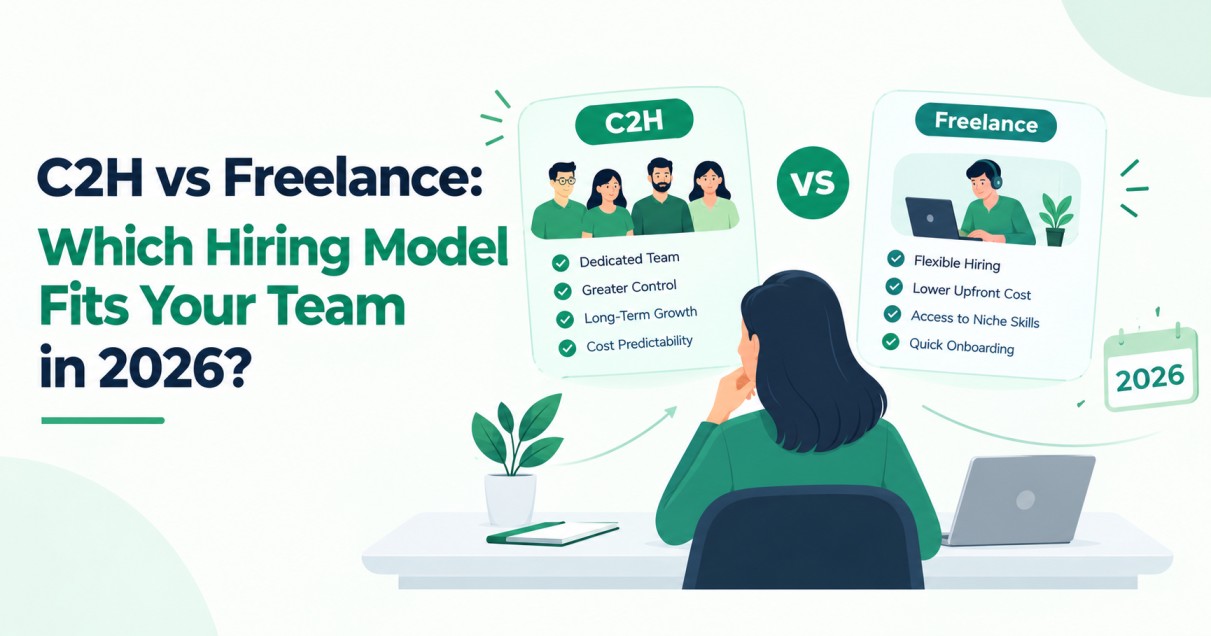
C2H vs Freelance: Choosing the Right Model for You
Choosing between C2H vs freelance depends on the role, project duration, level of control, budget, and long-term hiring plans. Both models give companies access to skilled professionals without immediately committing to a traditional permanent hire.
Upwork’s Future Workforce Index 2026 reports that 38% of skilled US knowledge workers freelance, up from 28% a year earlier. This growth gives businesses access to a wider talent pool while also increasing competition for experienced professionals.
C2H works well for ongoing roles where the professional may eventually become a permanent employee. Freelancing suits defined projects with clear deliverables, timelines, and limited long-term involvement.
This guide compares C2H vs freelance hiring across cost, control, flexibility, conversion to permanent employment, and compliance.
What is C2H (contract-to-hire)?
Contract-to-hire (C2H) is an arrangement where a worker starts on a fixed-term contract, often through a staffing vendor, with an option to convert to a permanent role after an evaluation period, typically three to six months.
The employer sees real work before committing, and the worker sees the team before accepting. Conversion terms, fees, and notice periods are set in the contract.
What is freelance hiring?
Freelance hiring means engaging an independent professional for a defined task or project, paid by the hour or per deliverable. The freelancer runs their own schedule and tools, serves other clients, and has no expectation of permanent employment.
Control sits with the freelancer, and the contract should describe outputs, not working hours.
C2H vs freelance: how the two models compare
| Factor | C2H | Freelance |
| Best for | Ongoing roles you may make permanent | Defined projects with clear deliverables |
| Start speed | Slower: interviews and vendor paperwork | Faster: often days |
| Typical term | Fixed term, commonly 3 to 6 months | Per task or project |
| Cost shape | Contract rate or vendor margin, plus a conversion fee on some contracts | Hourly or per-deliverable rate, no benefits cost |
| Control | Works like a team member | Works to a scope, sets own hours |
| Context built | High over time | Low unless the engagement runs long |
| Conversion | The purpose, but not guaranteed | Uncommon, not the goal |
| Main risk | Candidate leaves or declines to convert | Availability and misclassification |
Three gaps decide most cases.
Speed. Freelancers usually start within days. C2H adds interviews and vendor paperwork, which stretches your time to hire.
Control. A C2H worker follows your processes, joins team meetings, and reports to a manager. A freelancer works to a scope and sets their own hours. Expecting C2H-level control from a freelance contract is a quick way to create classification problems.
Conversion. C2H exists to end in a permanent offer. Freelance usually does not.
Which costs more: C2H or freelance?
Neither model is cheaper by default. Compare total cost over the same period, not the rate card.
For C2H, add the contract rate or vendor margin, any conversion fee, and ramp-up time. For freelance, add the higher hourly rate, manager time spent on briefs and review, and the cost of rework or lost knowledge when the freelancer leaves.
Conversion fees deserve their own line in the contract, and they vary by vendor, so negotiate the fee and the conversion window upfront.
When a vendor supplies your C2H talent, strong vendor management keeps those terms consistent across contracts.
-
What most teams get wrong
Most teams pick the model by rate and ignore how the work will actually run. A freelancer managed like an employee creates classification risk. A C2H hire with no conversion plan wastes the trial.
Define the decision date, success criteria, and conversion terms before the contract starts, and write them down.
How to make C2H work
- Write the decision date and success criteria in week one.
- Hold structured check-ins at 30, 60, and 90 days.
- Agree the conversion fee, notice period, and pay band in the contract.
- Give the contractor the same access and onboarding as a new hire.
- Decide early on strong performers, since other employers may reach them first.
Offers are not automatic. Some candidates decline to convert, and some employers choose not to offer. Plan the conversion day with a new hire onboarding checklist so the switch includes updated paperwork, access, and benefits.
How to make freelance work
- Scope by deliverables and acceptance criteria, not hours.
- Limit revisions and state them in the contract.
- Include IP assignment and confidentiality terms.
- Pay by milestone.
- Require a handover document before final payment.
- Give access only to the tools the project needs.
Conclusion:
Mixed hiring gets messy when contractors, C2H candidates, and permanent hires sit in separate sheets.
That’s where Hirium ATS comes in.
It’s built for enterprises that need to move quickly without sacrificing quality. From short-term freelance gigs to full C2H pipelines, this ATS solves the hiring challenges and helps hire the right people
An ATS can hold all three in one pipeline, with separate stages for contract end and conversion.
Try Hirium ATS free and run one live role through it.
FAQs
1. What does C2H mean?
C2H stands for contract-to-hire. A worker starts on a fixed-term contract, often through a staffing vendor, and the employer has the option to make a permanent offer after an evaluation period, commonly three to six months.
2. Is C2H cheaper than freelance?
Not by default. Freelance carries a higher hourly rate and no benefits cost. C2H carries a vendor margin and sometimes a conversion fee. Compare total cost over the same period, including manager time and rework, before you decide.
3. Can a freelancer become a full-time employee?
Yes, but it is uncommon, since most freelancers choose independence. If you want to hire the person permanently, use C2H or a direct fixed-term contract, and discuss intent openly at the start.
4. How long should a C2H contract run?
Commonly three to six months: long enough to complete a real project cycle, short enough to keep strong candidates engaged. In India, confirm the term against fixed-term rules with your employment lawyer.
5. Which model carries more compliance risk?
Both can. Freelance risk comes from managing contractors like employees. C2H risk comes from the structure, such as vendor payroll and contract labour rules in India. Settle the legal structure before the first day of work.