How AI Candidate Insights Improve Diversity Hiring at Scale
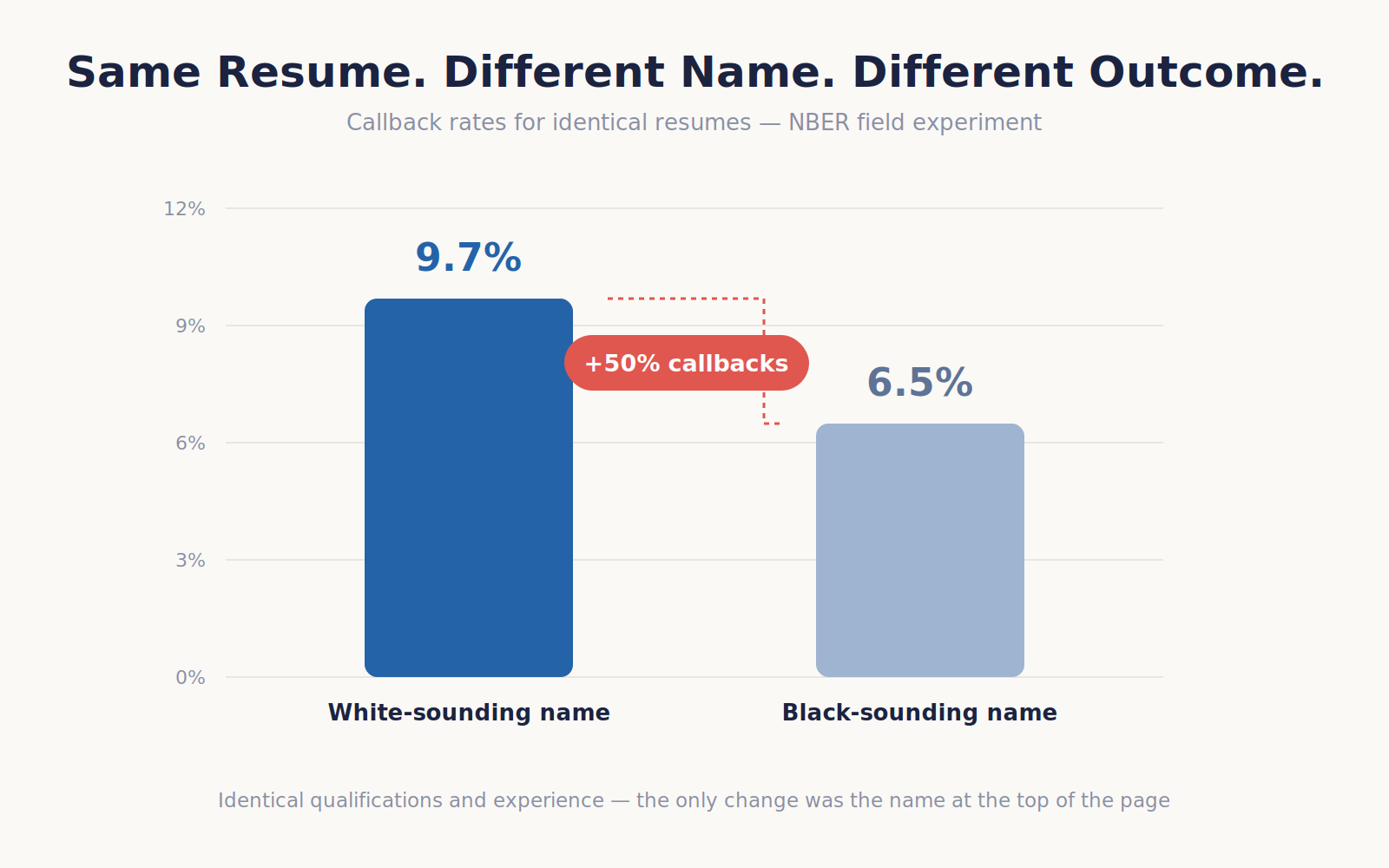
A resume with a white-sounding name receives 50% more callbacks than an identical resume with a Black-sounding name, according to a widely replicated field experiment from the National Bureau of Economic Research.
Same qualifications. Same experience. Different outcome, purely based on a name a recruiter glanced at for four seconds.
That gap hasn’t closed because most teams stopped measuring it, not because it stopped happening.
Manual resume review is still the default first filter at most startups and SMBs, and it’s a filter built on names, schools, gaps, and formatting all signals loosely correlated with identity and heavily correlated with bias.
AI candidate insights improve diversity hiring by changing what the first filter actually looks at. Instead of a recruiter skimming 200 resumes in an afternoon and forming snap judgments, structured AI screening evaluates every candidate against the same criteria, in the same order, without fatigue or first-impression drift setting in by resume number 40.
This isn’t a claim that AI eliminates bias by default; biased training data produces biased output just as easily as a biased recruiter does.
The difference is that a structured, insight-driven process can be audited, adjusted, and measured over time. A recruiter’s gut instinct cannot.
The distinction matters because “using AI” and “reducing bias” are not automatically the same thing. A screening tool bolted onto an otherwise unstructured process can just add a layer of false confidence to the same skewed outcomes.
The teams that actually see AI candidate insights improve diversity hiring outcomes are the ones that change the underlying process, not just the software doing the reading.
This piece covers how blind screening and structured candidate insights reduce bias at scale, what insight-driven diverse shortlists actually look like in practice, how to balance fairness with genuine role-fit, and a simple framework for tracking whether your diversity hiring efforts are working or just feel like they are.
What Is AI Candidate Insights-Driven Diversity Hiring?
AI candidate insights improve diversity hiring by using structured, criteria-based data skills, experience, assessment scores, and role-fit signals instead of subjective, identity-adjacent cues like name, school, or photo.
It replaces ad hoc resume judgment with consistent, auditable evaluation criteria applied identically to every candidate in the pipeline.
The Core Problem: Bias Hiding Inside Manual Screening at Scale
Most hiring teams underestimate how much bias enters the process in the first pass, not the final interview. Research on resume screening consistently finds that reviewers form an impression within the first 6-10 seconds of looking at a resume long before they’ve actually read the experience section.
At low volume, this is a manageable risk. At scale, it compounds fast. A startup screening 40 resumes a week for one role can absorb some inconsistency.
A growing company screening 40 resumes a day across six open roles cannot; the same unconscious pattern gets applied hundreds of times before anyone notices the shortlist has drifted toward one demographic profile.
Three factors make this worse for startups and SMBs specifically:
- Time-to-hire pressure. When a role needs to be filled in 3-4 weeks instead of 8-10, recruiters lean harder on fast, pattern-based judgment, which is exactly where bias lives.
- No dedicated DEI function. Larger enterprises often have a recruiter whose job is to audit shortlists for representation. Most 20-200 person companies don’t have that role, so nobody is checking.
- Recycled sourcing channels. Referral-heavy sourcing (still the top channel for SMB hiring) tends to reproduce the existing team’s network, and therefore its existing demographic makeup, before screening even begins.
The result: even well-intentioned hiring managers end up with shortlists that look like the last five hires, not the best available candidates. That’s not a values failure. It’s a process failure, and it’s fixable with structure.
The scale of the miss is usually bigger than teams expect. Internal audits at mid-size companies that have moved to structured screening commonly find that manual review was rejecting 20-30% of qualified candidates from underrepresented groups before a hiring manager ever saw their name, not because those candidates were unqualified, but because resume format, employment gaps, or non-traditional career paths triggered an unconscious “not a fit” read in under ten seconds.
A gap for caregiving, a non-linear path between industries, or a degree from a less-recognized university all read as red flags to a fast human skim, even when none of them predict job performance.
This is precisely the gap where AI candidate insights improve diversity hiring: not by adding a new filter, but by removing filters that were never based on job-relevant criteria in the first place.
How AI Resume Screening Reduces Bias in Practice
AI resume screening works by decoupling evaluation from identity. It scores what a candidate has actually done against what the role actually requires, and it does this the same way for candidate 1 and candidate 400.
This is the mechanism behind the broader claim that AI candidate insights improve diversity hiring outcomes, consistently applied at volume, not a single clever feature.
The Role of an AI Resume Parser in Structured Insights
An AI resume parser breaks an unstructured document a PDF or Word resume with wildly inconsistent formatting into structured fields: skills, years of experience, tools used, education, career progression.
This matters for diversity hiring for a specific reason: once information is structured, it can be evaluated on its own, separate from the visual and contextual cues (name, photo, address, graduation year) that trigger unconscious bias in a human reader.
Structured parsing also fixes a quieter bias problem: formatting bias. Candidates who can afford professional resume writing or design tools often get an unearned edge over equally qualified candidates who can’t.
Parsing normalizes the format so the content, not the design, does the work.
Candidate Profile Management as the Foundation for Fair Comparisons
Candidate profile management is what happens after parsing: every applicant is represented as a standardized profile with the same fields, populated the same way, viewable side-by-side. This is the step that makes an apples-to-apples comparison possible in the first place.
Without structured profile management, a recruiter comparing a traditional-format resume against a portfolio-style resume against a LinkedIn export is implicitly weighing presentation, not substance.
With it, every candidate shows up in the same shape, and the comparison happens on skills and outcomes.
A Numbered Process for Insight-Driven Screening at Scale
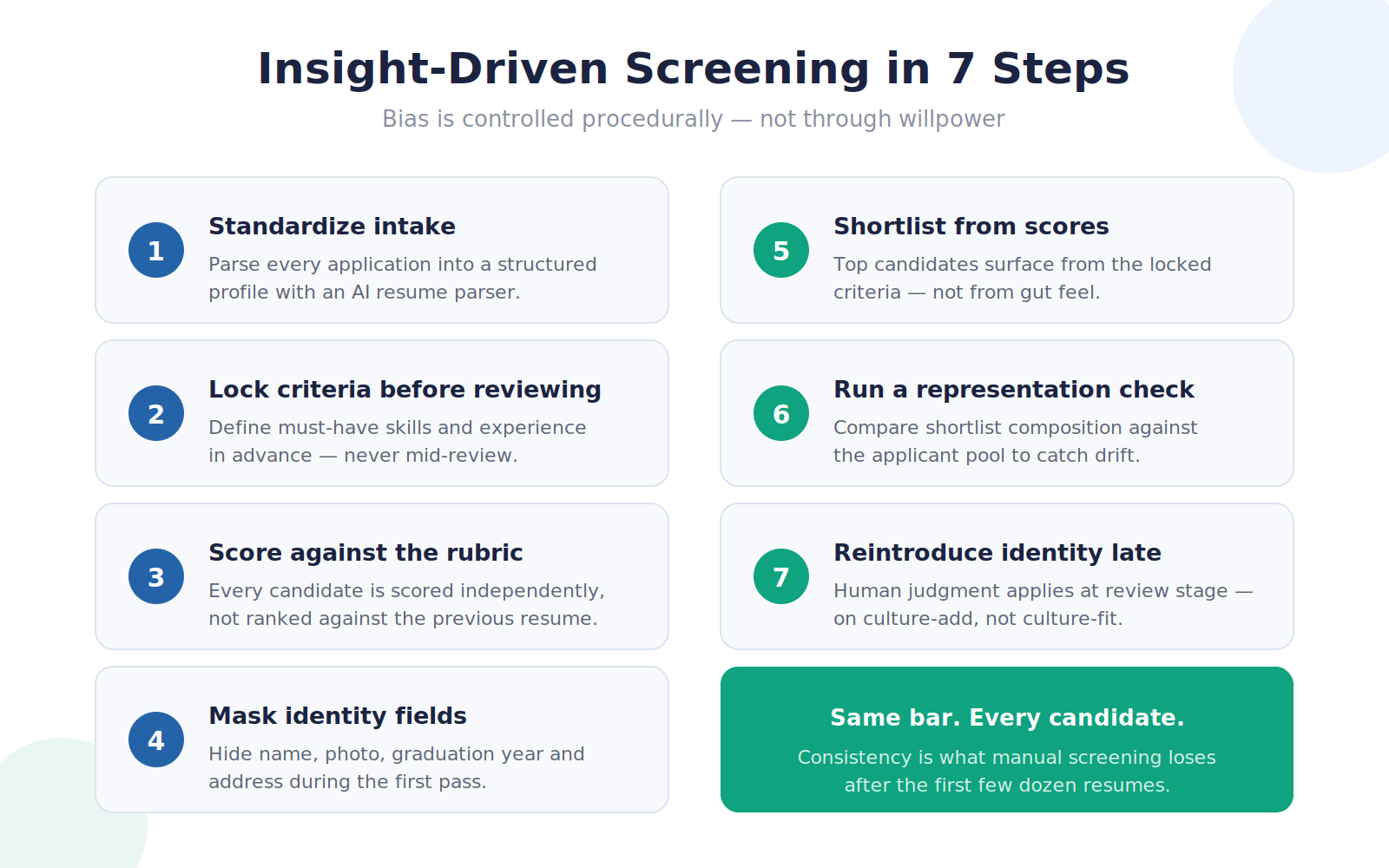
Here’s the general sequence teams use to move from raw applications to a bias-reduced shortlist:
- Standardize intake. Every application resume, portfolio link, and application form gets parsed into a structured candidate profile using an AI resume parser.
- Define role-fit criteria before reviewing candidates. Skills, minimum experience, and must-have qualifications are locked in advance, not adjusted mid-review based on who’s applied.
- Score against criteria, not against each other. Each candidate is scored on the same rubric independently, rather than ranked relative to whoever was reviewed just before them.
- Mask identity-adjacent fields during first-pass review. Name, photo, graduation year, and address are hidden or de-emphasized until the shortlisting decision is made.
- Generate a ranked shortlist from scores, not gut feel. The system surfaces the top-scoring candidates based on the locked criteria from step 2.
- Run a representation check on the shortlist. Before moving to interviews, compare the shortlist’s composition against the applicant pool’s composition to catch any drift.
- Reintroduce identity only at the human-review stage, where a recruiter applies judgment on culture-add and communication, not culture-fit, which tends to reward similarity.
This sequence works because bias is controlled procedurally, not through willpower. It doesn’t depend on a recruiter remembering to be objective on a Friday afternoon after eleven interviews.
Balancing Fairness With Role-Fit Signals
The most common objection to structured, bias-reduced screening is that it will dilute quality,y that removing “gut feel” means losing the ability to spot a genuinely strong candidate whose resume doesn’t tick every box. This concern is valid, but it usually points to a rubric problem, not a bias-reduction problem.
Role-fit and fairness aren’t actually in tension when the criteria are built correctly. The fix is separating must-have signals (the 3-4 things a candidate genuinely cannot succeed without) from nice-to-have signals (things that correlate with success but aren’t required).
Most manual screening collapses these into one undifferentiated impression, which is exactly where bias sneaks in disguised as “fit.”
A practical split looks like this:
- Must-have signals get weighted heavily and applied consistently: years of directly relevant experience, specific technical skills, required certifications.
- Nice-to-have signals get weighted lightly and never used to reject a candidate outright:t brand-name previous employers, elite-school credentials, polished resume design.
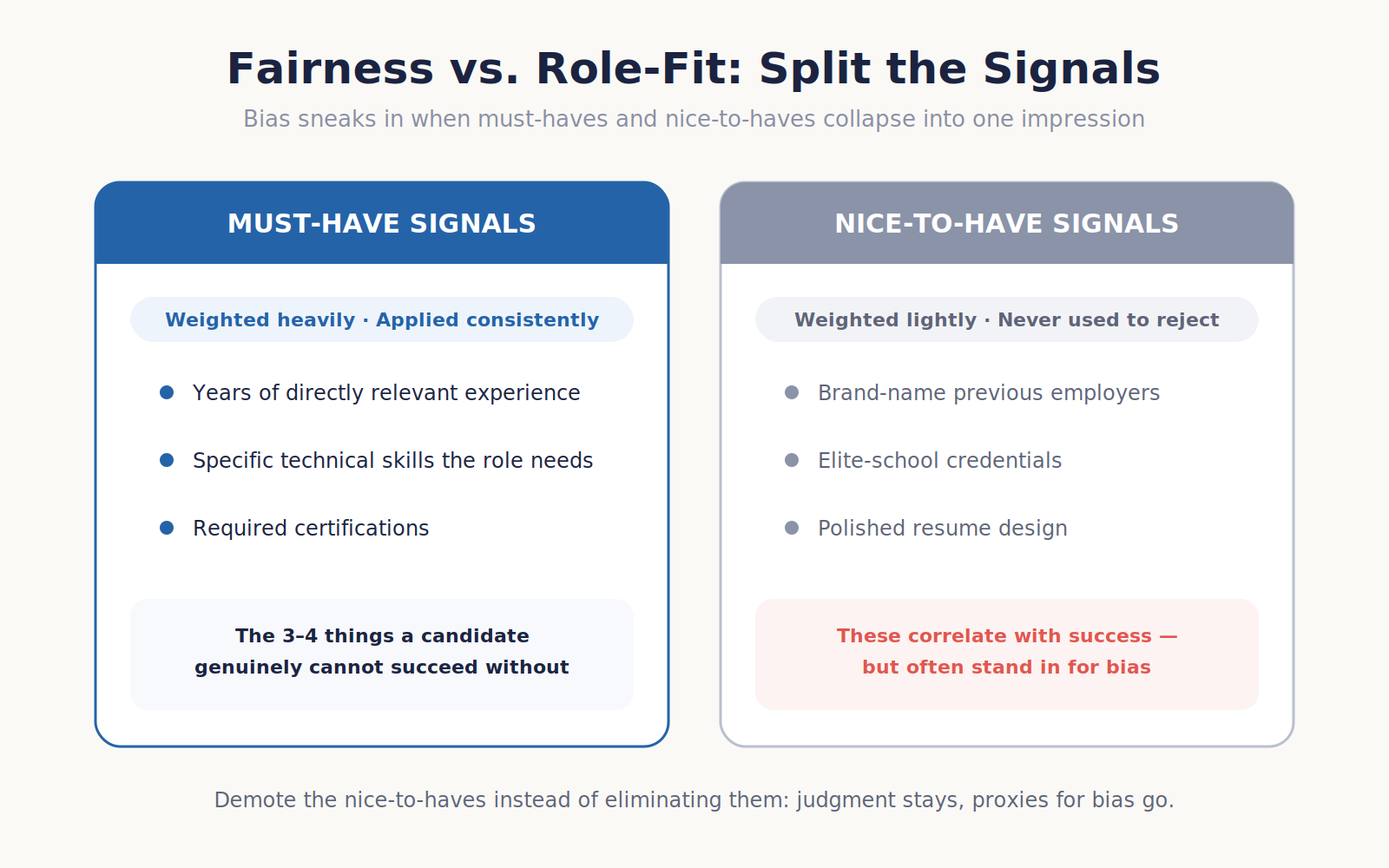
When nice-to-have signals are demoted rather than eliminated, hiring managers keep the judgment they actually need while losing the judgment that was standing in for bias. Candidates from non-traditional backgrounds stop being screened out on proxies and start being evaluated on the criteria the role actually requires.
Cost and Compliance Considerations
Structured AI screening isn’t free of tradeoffs. Teams evaluating tools should weigh a few things:
- Audit trail requirements. In jurisdictions with algorithmic hiring disclosure rules (such as New York City’s Local Law 144), any AI screening tool needs documented bias-audit results available on request.
- Training data provenance. A screening model trained on a company’s own historical “successful hire” data can quietly re-encode the same bias it’s meant to remove, since past hiring decisions are the training signal.
- Integration cost versus manual review cost. For a company screening under 500 applications a month, the calculus is different than for one screening 5,000+ smaller volumes may not justify a full platform migration on cost grounds alone, even though the bias case still holds.
- Candidate consent and transparency. Under most emerging AI-hiring regulations, candidates need to be told when an automated tool is involved in evaluating them, and given a path to request human review. This is a process design question, not just a legal checkbox; it also tends to increase candidate trust in the outcome.
- Vendor bias-audit cadence. A one-time audit at implementation isn’t enough. Screening criteria, role requirements, and applicant pools all shift over 6-12 months, and a model that was fair at launch can drift without a recurring audit schedule built in.
Case Studies: Insight-Driven Diverse Shortlists in Action
A 45-person fintech startup hiring for three engineering roles simultaneously was seeing shortlists that were over 85% male despite an applicant pool that was closer to 60/40. After switching to structured, criteria-first screening with identity fields masked at first pass, the shortlist composition moved to roughly match the applicant pool’s makeup within two hiring cycles, without changing the role requirements or lowering the bar.
A 120-person SaaS company running high-volume customer success hiring (30-40 applications per opening) cut its average screening time from roughly 12 minutes per resume to under 3, while its interview-to-offer ratio for candidates from non-traditional backgrounds (no four-year degree, career-switchers) roughly doubled because those candidates were no longer filtered out at the resume-skim stage before their actual skills were evaluated.
A 60-person logistics-software company hiring for a founding sales role had historically sourced almost entirely through warm referrals, which had produced five consecutive hires from the same two previous employers.
Once the team required structured, criteria-first screening for all applicants, including referrals before any hiring manager saw a name, the resulting shortlist for the role included three candidates from outside the founders’ existing network, one of whom was ultimately hired and became the top performer on the team within two quarters.
The referral pipeline hadn’t been producing bad candidates; it had just been the only pipeline anyone was actually screening carefully.
Across all three cases, the pattern is consistent: the diversity gain wasn’t the result of a diversity-specific rule. It was the result of applying the same, consistent evaluation bar to every candidate, including the ones who would previously have gotten a faster, less scrutinized path to an interview simply because they resembled the existing team.
Candidate Database Management and a Framework for Measuring Diversity Impact
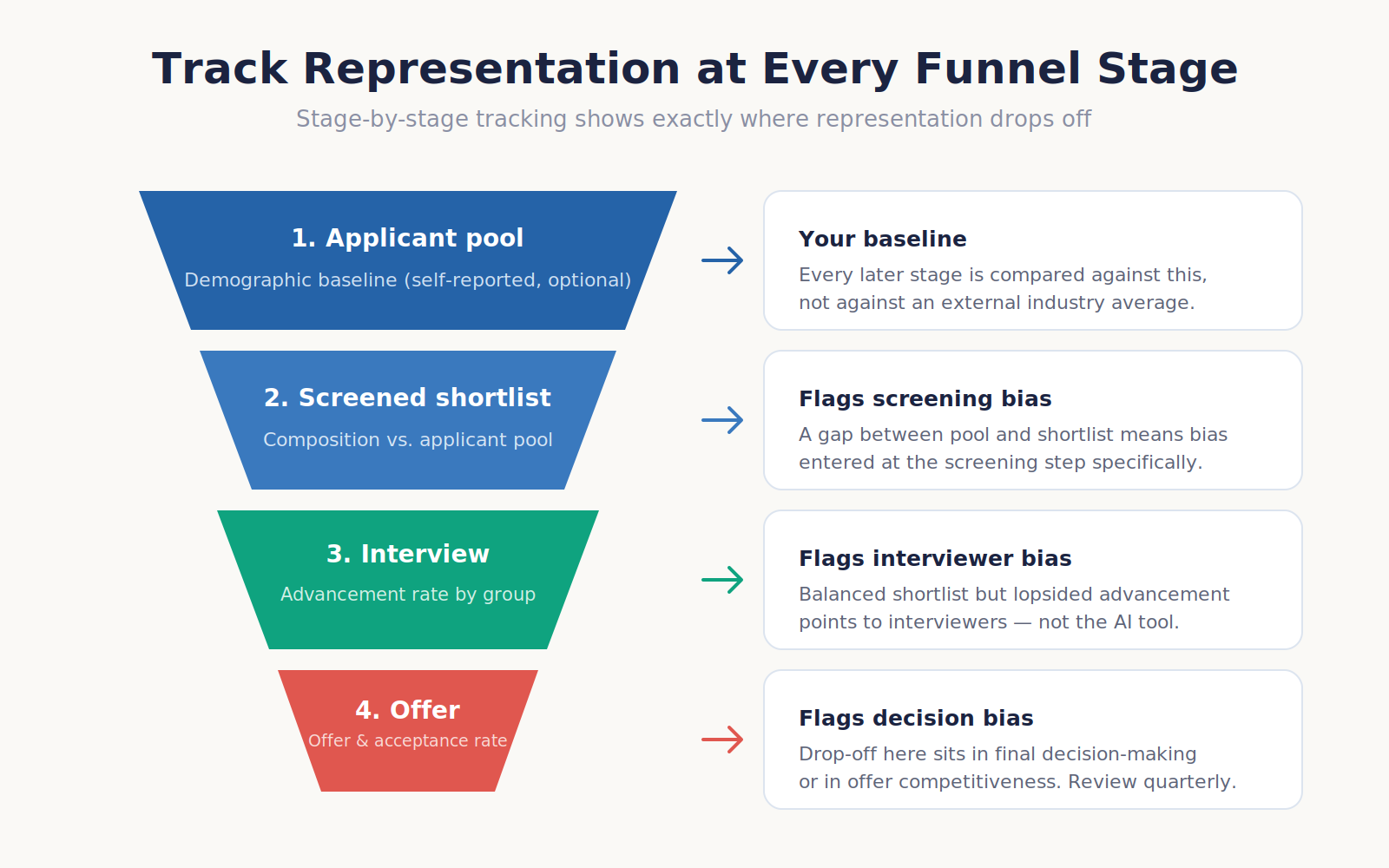
Reducing bias at the screening stage only matters if a company can prove it’s working, and that requires candidate database management that tracks representation over time, not just at the moment of hire.
A minimal framework for measuring diversity impact:
| Stage | What to Track | Why It Matters |
| Applicant pool | Demographic composition (self-reported, optional) | Baseline to compare every later stage against |
| Screened shortlist | Composition vs. applicant pool | Flags bias introduced at the screening step specifically |
| Interview stage | Advancement rate by group | Flags bias introduced by human interviewers, not the AI tool |
| Offer stage | Offer rate and offer-acceptance rate by group | Flags bias in final decision-making or in offer competitiveness |
The value of this table is that it isolates where in the funnel representation drops off. A company that sees a balanced applicant pool and a balanced shortlist, but a lopsided interview-to-offer rate, has an interviewer training problem, not a screening problem.
Without stage-by-stage candidate database management, that distinction is invisible, and teams end up “fixing” the wrong part of the pipeline.
This is where a centralized system pays off structurally: when candidate data lives in one place with consistent fields across every role and hiring manager, running this comparison monthly takes minutes instead of a manual spreadsheet reconciliation across six different hiring managers’ inboxes.
How to actually use the framework: Run it quarterly, not annually. A full year of drift is much harder to diagnose and correct than three months of it.
Compare each stage against the one before it, not against an external benchmark, since the goal is catching internal drop-off, not chasing an industry average that may not reflect your applicant pool.
And treat any single-quarter swing with some skepticism; a small applicant pool for a niche role can produce a lopsided-looking ratio purely from sample size, so look for a pattern across two or more hiring cycles before concluding there’s a real bias signal versus noise.
This is also where candidate database management earns its keep beyond compliance reporting.
A properly structured database lets a hiring team pull this exact funnel breakdown by role, by month, or by recruiter, which turns diversity hiring from an annual retrospective exercise into something closer to a live dashboard a talent lead can check the same way they’d check pipeline coverage or time-to-hire.
What Most Teams Get Wrong About AI and Diversity Hiring
The most common mistake isn’t skipping AI screening; it’s assuming that adopting it is the finish line rather than the starting point.
A screening tool that removes names from resumes but still ranks candidates using a model trained on a company’s last three years of “successful” hires will often just launder the existing bias through a more confident-looking system.
The second mistake is treating diversity hiring and quota hiring as the same thing, then overcorrecting or undercorrecting out of fear of the confusion.
Structured, insight-driven screening isn’t about hitting a demographic number. It’s about removing the noise that was preventing qualified candidates from being fairly evaluated in the first place;e the diversity outcome is a byproduct of a fairer process, not the input to it.
The third, quieter mistake: teams measure diversity at the hire stage only. By the time a skewed outcome shows up in who got hired, the actual bias event happened weeks earlier, at the screening stage, and there’s no data left to diagnose it. Stage-by-stage tracking, not a single end-of-quarter number, is what makes a diversity hiring effort correctable instead of just observable.
A fourth mistake shows up specifically at growing companies: rolling out structured screening for new hires while leaving the referral pipeline exempt from it “because those candidates are already vetted.
” In practice, referral hires are often the least scrutinized and the most demographically homogeneous part of the pipeline, precisely because they arrive with an implicit endorsement that bypasses structured evaluation.
Any diversity hiring effort that doesn’t apply the same criteria to referrals as to cold applicants is leaving the largest source of bias untouched.
The fifth mistake is treating a single structured screening pass as sufficient and skipping structured interviews entirely. Bias that gets successfully filtered out at the resume stage can walk right back in during an unstructured interview, where “culture fit” questions and inconsistent scoring reintroduce exactly the subjectivity the screening stage removed.
Diversity hiring efforts that stop at the shortlist and don’t extend the same discipline into interviews tend to see their gains erode by the time an offer goes out.
FAQ
-
Does AI actually reduce bias in hiring, or does it just hide it better?
It depends entirely on how the model is built and audited. AI trained on unaudited historical hiring data can replicate existing bias with more confidence, not less, because it treats past hiring patterns as the definition of “success.” AI built around structured, role-fit criteria with identity fields masked during first-pass review has been shown to reduce name- and format-based bias specifically, because it removes the signals that trigger it rather than trying to correct for them after the fact.
-
How does AI improve diversity in recruitment beyond just screening resumes?
Beyond initial screening, AI supports diversity hiring through consistent interview scoring rubrics, structured candidate database management that flags representation drop-off by funnel stage, and standardized candidate profiles that make like-for-like comparison possible across very differently formatted applications.
-
What is blind screening in hiring, exactly?
Blind screening means evaluating a candidate’s qualifications while withholding or de-emphasizing identity-adjacent details name, photo, graduation dates, address during the initial review stage. It’s typically reintroduced later, once a shortlisting decision based on skills and experience has already been made.
-
Can AI resume screening itself introduce new bias?
Yes. If an AI resume parser or scoring model is trained on a company’s historical “successful hire” outcomes without auditing those outcomes first, it can encode the same patterns a human reviewer would, just with an added layer of perceived objectivity that makes the bias harder to spot and challenge.
-
How do you measure whether diversity hiring efforts are actually working?
Track representation at every funnel stage separately:y applicant pool, shortlist, interview, and offer rather than only at final hire. Comparing composition stage-by-stage shows exactly where representation drops off, which points to whether the issue sits in screening, interviewing, or offer decisions. Reviewing this quarterly, and across at least two hiring cycles before concluding, avoids reacting to statistical noise from a single small applicant pool.
-
Is diversity hiring the same as quota hiring?
No. Quota hiring sets a fixed demographic target and hires toward it regardless of process. Diversity hiring, done through structured insights, focuses on removing bias from the evaluation process itself; a more representative outcome follows because qualified candidates who were previously filtered out on irrelevant signals now get fairly assessed.
-
Does removing identity information from resumes actually change who gets shortlisted?
Yes, in controlled studies and in practice. Field experiments on blind and name-redacted screening consistently show shifts toward more representative shortlists once identity-adjacent signals are removed from the initial evaluation because those signals were driving decisions that had nothing to do with qualification.
Where to Go From Here
If your team is evaluating whether structured, insight-driven screening is worth the switch from manual review, the honest starting point is a funnel audit, not a new tool. Pull your last two quarters of hiring data and check representation at each stage: applicant pool, shortlist, interview, offer.
That single exercise usually reveals whether the bias is entering at screening, at interviews, or somewhere else entirely, and it tells you what to fix first.
It’s worth doing this audit before shopping for a platform, not after.
A tool selected to solve a problem that turns out to live at the interview stage,e not the resume-screening stage, won’t move the numbers, no matter how well it parses resumes. The funnel data should drive the tool decision, not the other way around.
Once the audit points to where the drop-off actually happens, the fix is usually some combination of the process changes covered here: masking identity fields at first pass, locking role-fit criteria before review begins, and tracking representation stage-by-stage instead of only at the hire.
None of that requires new software on its own;n it requires consistency, which is exactly what unstructured, high-volume manual screening struggles to hold onto past the first few dozen resumes.
Hirium’s AI-powered screening and candidate database management tools are built around exactly this kind of stage-by-stage visibility, for teams that want the audit trail without building it manually in a spreadsheet. If it’s useful, the free plan is a low-friction way to see how AI candidate insights improve diversity hiring outcomes for your own shortlists before committing to anything further.