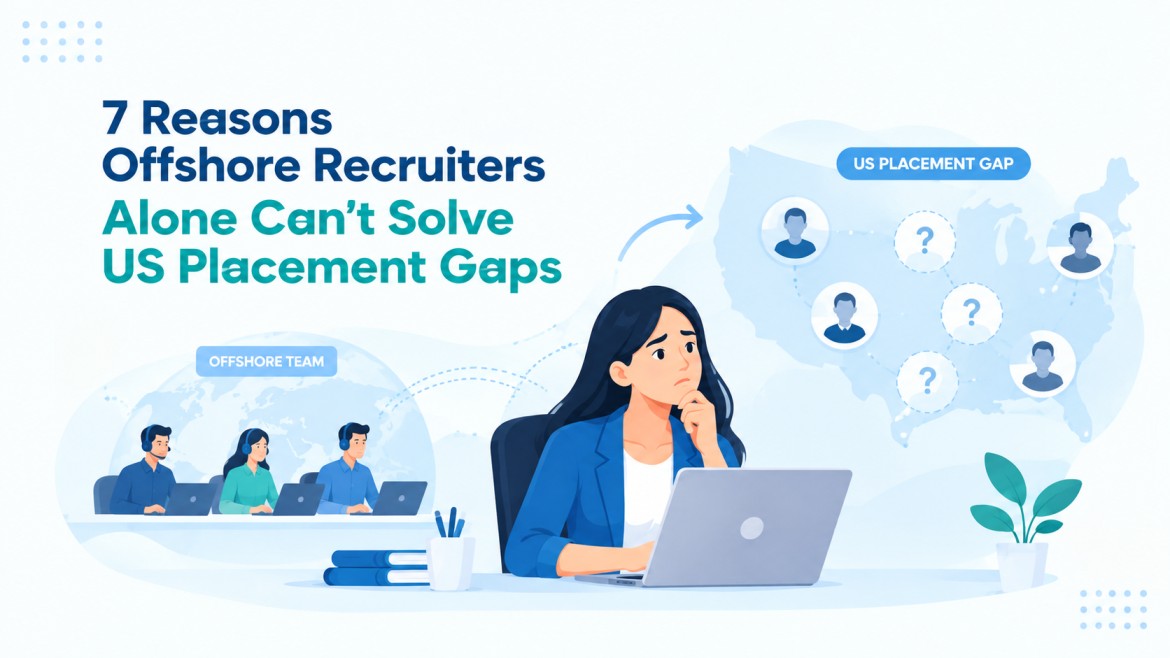
7 Reasons Why Offshore Recruiters Alone Can’t Solve US Placement Gaps
Offshore recruitment has long been a favoured tactic for US staffing firms looking to reduce costs and scale sourcing efforts. From the outside, it seems like a perfect solution: offshore teams handle resume sourcing, initial outreach, and scheduling, all while being significantly more cost-effective than their onshore counterparts.
But here’s the reality: while offshore recruiters are excellent support assets, they’re not built to fully close the placement loop, especially in the US market. Placement success is about more than sourcing. It’s about context, compliance, culture, and consistency, and that’s where relying solely on offshore efforts starts to break down.
According to the US Bureau of Labour Statistics, wholesale and manufacturing sales roles are projected to see little to no employment growth between 2025 and 2035, yet roughly 123,400 openings are expected every single year, almost entirely driven by workers leaving the occupation or exiting the workforce.
Let’s unpack the 7 key reasons why offshore recruiters alone can’t solve US placement challenges:
7 Reasons Why Offshore Recruiters Alone Can’t Solve US Placement Gaps
Offshore recruiters bring speed and cost savings, but scaling sourcing alone won’t close placement gaps. Here are seven reasons why onshore support remains essential for lasting success.
1. Limited Understanding of US Market Nuances
Offshore recruiters often miss regional salary benchmarks, industry jargon, and soft skills valued across sectors. This gap in market immersion affects candidate quality, especially for specialized roles where cultural and contextual fit matters most.
Key points:
- Missing regional salary and role expectations
- Limited grasp of industry-specific terminology
- Struggles identifying intangible candidate fit
2. Time Zone Challenges Impact Real-Time Execution
A 10- to 12-hour time difference delays shortlists, feedback, and interview scheduling. What should take minutes often stretches into 24 to 48 hours, slowing the entire hiring funnel across multiple recruitment stages.
Key points:
- Interview Feedback loops delayed by a full day
- Urgent client requests missed after hours
- Funnel slowdowns compound across each hiring stage
3. Compliance and Legal Complexities Are Risky
US staffing involves worker classification, overtime laws, and state-specific mandates like California PTO or New York sick leave. Offshore recruiters are rarely trained to navigate this legal maze, risking audits, lawsuits, or client churn.
Key points:
- Unfamiliarity with W2 vs 1099 classification
- Risk of EEO and pay transparency violations
- Legal missteps can trigger client churn
4. Cultural and Communication Gaps Lead to Misalignment
Recruitment depends on relationship building, and cultural fluency shapes how candidates and hiring managers respond. Offshore recruiters may misread tone, overuse formal language, or miss sarcasm, making outreach feel robotic instead of personal.
Key points:
- Tone and phrasing often feel impersonal
- Misreading humor or informal cues
- Immersion, not training alone, builds fluency
5. Lack of Access to Client Conversations and Feedback
Offshore teams are frequently excluded from intake calls and debrief sessions, missing critical context. Unwritten client preferences, like flexibility on seniority or specific tech skills, often never reach them, leading to rejected submissions.
Key points:
- Missed nuances from live client discussions
- Slower feedback trickling down to sourcing teams
- Higher rejection rates from misaligned candidates
6. Struggles with Senior or Niche Roles
Placing a VP of Product or a Cybersecurity Architect requires executive-level communication and tailored positioning. Offshore recruiters excel at high-volume sourcing but often struggle with the strategic framing senior candidates expect.
Key points:
- High-value roles need persuasive, tailored outreach
- Senior candidates rarely respond to generic messages
- Onshore engagement reduces fall-through risk
7. Manual Processes and Tech Limitations Hold Teams Back
Many offshore teams rely on spreadsheets and disconnected inboxes instead of a unified ATS. This limits visibility, increases errors, and makes it difficult to track candidate progress or measure recruiter performance accurately.
Key points:
- No centralized system for real-time tracking
- Inconsistent resume formatting and feedback logging
- Difficult to measure recruiter productivity
Final Thoughts
Offshore recruitment is valuable. It allows for cost-effective scaling, extended coverage hours, and a stronger sourcing bench. But it’s only one piece of the staffing puzzle not the whole solution.
To truly fix placement gaps in the US market, you need:
- Onshore context and client management
- Legal and compliance oversight
- Cultural fluency in candidate engagement
- A unified, collaborative tech stack
Empower Offshore and Onshore Teams With Smarter Tools
One of the smartest ways to maximize offshore efficiency while minimizing gaps is investing in intelligent ATS platforms like Hirium.
Hirium helps your onshore and offshore teams collaborate in real time, track candidate journeys with precision, and automate repetitive tasks so your recruiters can focus on what they do best: closing roles. From compliance tracking to performance insights, it equips staffing firms to scale smarter no matter where your team sits.
FAQs
Why do US staffing firms rely on offshore recruiters?
US staffing firms often turn to offshore recruiters to reduce sourcing costs, expand operational hours, and scale quickly. Offshore teams are especially helpful for high-volume sourcing, resume screening, and outreach tasks. However, while they offer efficiency, they may lack the context, compliance knowledge, and cultural nuance required for high-quality US placements.
Can offshore recruiters manage the full recruitment lifecycle for US clients?
Not effectively on their own. Offshore recruiters typically excel in early-stage tasks like sourcing and screening, but they often lack access to client conversations, deep market insights, and legal knowledge required for offer negotiations, compliance, and client alignment. Without support from onshore or hybrid teams, placements tend to suffer.
What roles are offshore recruiters best suited for?
Offshore recruiters are ideal for high-volume, entry-to-mid-level roles where speed and resume sourcing are critical. Roles like customer support reps, junior developers, or administrative positions are often a good fit. For senior, niche, or client-facing roles, a local recruiter with market fluency usually delivers better results.
How do time zone differences impact recruitment operations?
Time zone differences between offshore recruiters and US clients can delay real-time communication, resume submission, and interview scheduling. These delays can cause longer hiring cycles, reduced candidate engagement, and missed opportunities — especially in fast-moving markets or urgent contract roles.
How can staffing agencies improve offshore recruiter performance?
The best way to boost offshore recruiter output is by combining them with:
- Strong onshore client engagement.
- Continuous training in US hiring standards.
- Access to real-time ATS platforms (like Hirium) for collaboration.
- Clear SOPs and regular performance tracking.
This hybrid model ensures alignment, compliance, and efficiency across borders.