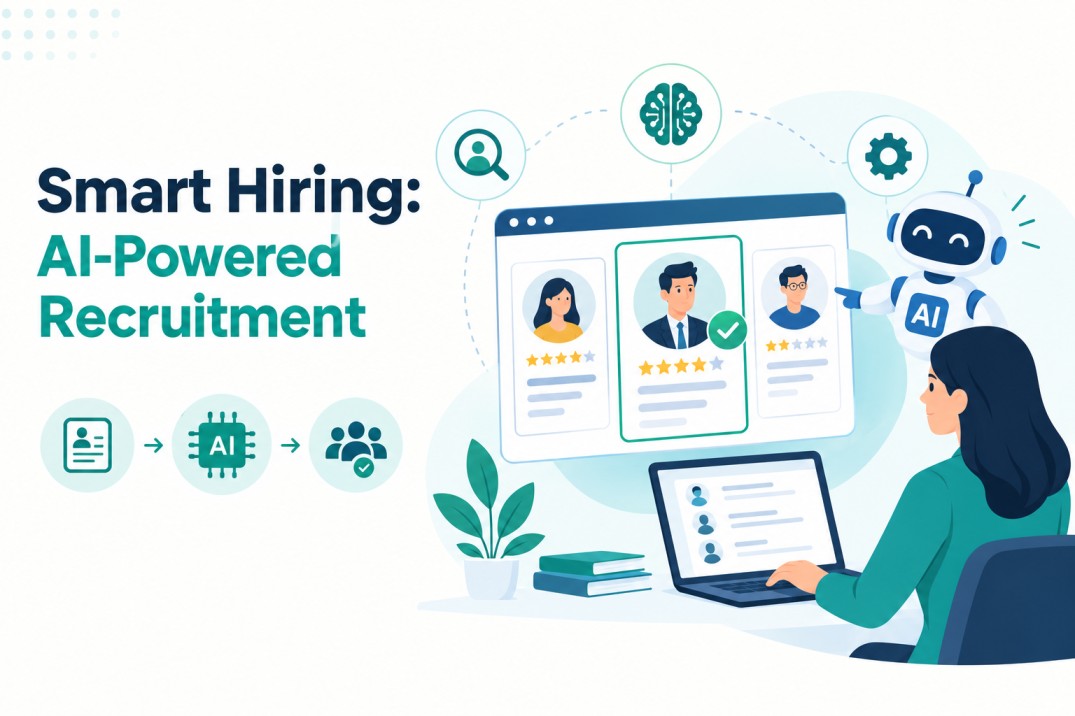
What Is Smart Hiring: A Guide to AI-Powered Recruitment
What is smart hiring? It’s a recruitment revolution driven by AI and automation. Smart hiring leverages artificial intelligence to transform traditional recruitment processes, making them more efficient and effective.
The AI recruitment market size is expected to grow from USD 596.16 million in 2025 to USD 640.99 million in 2026 and is forecast to reach USD 920.91 million by 2031 at 7.52% CAGR over 2026-2031.
This growth underscores the increasing reliance on AI to streamline hiring and address challenges inherent in conventional methods.
What Is Smart Hiring and Why It Matters?
Smart hiring uses AI and automation tools to eliminate bottlenecks in the recruitment process, from sourcing and screening to scheduling and selection. But it’s more than just speed. Smart hiring improves efficiency, enhances objectivity, and empowers recruiters to focus on strategic tasks instead of repetitive admin work.
Here’s how AI is transforming recruitment:
- AI-Powered Resume Screening: An ATS can parse thousands of resumes within seconds, identifying top candidates based on custom filters such as skills, experience, and role fit without human error or bias.
- Automated Interview Scheduling: Intelligent scheduling tools align calendars between candidates and interviewers automatically, freeing up recruiters from endless back-and-forth emails.
- Precision Candidate Matching: AI algorithms assess job descriptions against candidate profiles to suggest the most suitable matches, boosting the quality of hire and reducing time-to-fill.
A global survey recently revealed that 88% of companies are already using AI in some part of their hiring process. That level of adoption speaks volumes: AI is no longer optional. It’s essential.
The Core Components of AI-Powered Recruitment
Smart hiring is effective because it leverages a set of focused, intelligent tools that directly address the biggest challenges in recruitment. Let’s explore the foundational elements that make this approach so powerful.
1. AI in Candidate Sourcing
Through automated outreach, AI-powered tools scan platforms like LinkedIn, GitHub, job boards, and internal talent databases to identify qualified candidates, including those not actively seeking jobs.
This proactive sourcing approach widens the talent pool and increases the chances of connecting with high-potential professionals. Additionally, AI applies predictive fit scoring by analyzing historical hiring data and role-specific requirements to forecast which candidates are most likely to succeed.
This helps recruiters focus their efforts on individuals with the highest probability of being a long-term match.
2. AI in Resume Screening
Resume screening, once one of the most time-consuming and biased stages of recruitment, has been revolutionized by AI. Modern systems use Natural Language Processing (NLP) to read and evaluate resumes the way a human would, but faster and without fatigue.
NLP interprets context, understands variations in phrasing, and aligns resumes with job descriptions in a more nuanced way than keyword matching ever could. To support fairer hiring, AI systems can also be trained with bias-reduction algorithms that ignore demographic indicators like gender, age, and ethnicity.
As a result, companies can identify the best-fit candidates while promoting diversity and minimizing unconscious bias.
3. AI in Interviewing
AI chatbots are commonly used to conduct pre-screening interviews, collect basic candidate data, and answer frequently asked questions in real time. These chatbots are available 24/7, delivering a consistent and timely experience to every applicant.
In more advanced use cases, video interviewing tools analyze both verbal and non-verbal cues during recorded interviews.
These platforms assess speech patterns, facial expressions, tone, and body language to provide deeper insights into a candidate’s suitability for the role. This not only saves time but also ensures a more objective evaluation process.
4. AI in Decision-Making
One of the most impactful applications of AI in recruitment is its ability to turn data into actionable insights. AI-driven dashboards provide recruiters and hiring managers with ranked lists of candidates based on factors like job fit, engagement level, and performance potential.
These insights are generated by evaluating candidate behavior, past experiences, and application data. Furthermore, machine learning models can predict employee retention by assessing alignment with company culture, career trajectory, and historical retention patterns.
This empowers hiring teams to make smarter, evidence-based decisions and reduce costly turnover.
The Business Benefits of Smart Hiring
Companies embracing smart hiring are seeing measurable returns:
- Efficiency Gains: Chipotle used its AI assistant, Ava Cado, to increase application completion rates from 50% to 85%and slashed time-to-hire from 12 days to just 4.
- Enhanced Candidate Experience: With AI-powered chatbots and instant updates, candidates feel more engaged, valued, and informed throughout the hiring journey.
- Bias Reduction & Diversity Gains: By removing identifiers and standardizing assessments, companies like Unilever improved diversity in hiring by 16% using AI.
- Cost Savings: Automating resume screening, scheduling, and assessments helps recruiters focus on strategy and culture fit, leading to smarter, faster hires at lower costs.
Challenges & Ethical Considerations in AI Hiring
Of course, AI isn’t a silver bullet. Its power comes with responsibilities:
- Algorithmic Bias: If AI is trained on biased data, it may reinforce existing prejudices. One study found Black professionals receive 30–50% fewer callbacks when racial identity is revealed in resumes.
- Transparency & Accountability: Many AI systems operate as “black boxes,” making it difficult to understand why a candidate was rejected or ranked low.
- Data Privacy: With AI tools processing sensitive personal data, organizations must ensure GDPR, CCPA, and EEOC compliance and adopt strict data security protocols.
How to Implement AI in Your Hiring Process
Implementing AI into your recruitment strategy isn’t just a matter of plugging in new software. It requires thoughtful planning, the right tools, and a strong understanding of your company’s specific needs and goals. Here’s how to do it effectively:
- Find your actual bottleneck. Are recruiters drowning in applications, or is the problem interview scheduling, or slow decision-making? AI works best when it’s aimed at a specific, named problem, not adopted because it’s trending.
- Pick tools that fit your stack. Look for resume parsing, scheduling automation, and candidate scoring that integrates with the applicant tracking system you already use, or replaces it with one built for your team size.
- Pilot before you scale. Run the tool on one role or one department first. Confirm it’s saving time and not quietly filtering out good candidates before rolling it out company-wide.
- Audit for bias regularly. Don’t treat this as a one-time compliance checkbox. Re-check outcomes across gender, ethnicity, and other variables on a set schedule.
- Keep humans in the loop for final decisions. AI can narrow the field and surface data. The actual hiring decision, especially for senior or culture-critical roles, should still involve a person.
Conclusion: Smart Hiring Is Smart Business
Smart hiring is changing how great companies find great talent. Instead of spending hours manually screening resumes or coordinating interviews, recruiters now have tools that handle those tasks in minutes.
That means faster hiring, fewer drop-offs, and more time to focus on building real connections with candidates.
It’s not just about speed; it’s about hiring the right people, reducing bias, and making sure no great candidate slips through the cracks.
The data backs it up: companies using AI in recruitment are cutting costs, improving candidate experiences, and making better long-term hires.
If your team is struggling with delays, Hirium help to build this gap for burnout, or inconsistent results, smart hiring is the smarter way forward.
FAQs: Your Smart Hiring Questions Answered
What is smart hiring, and how does it work?
Smart hiring uses AI and automation to streamline recruiting, from resume screening to candidate selection, making hiring faster, fairer, and more data-driven.
Can AI eliminate bias in recruitment?
Not entirely, but well-designed AI tools can reduce unconscious bias by focusing on objective, skills-based criteria. Regular audits are essential.
Is AI hiring expensive to implement?
While initial setup has costs, AI tools save money long-term by reducing time-to-hire, improving candidate quality, and freeing recruiters for strategic tasks.
Is AI suitable for every type of role?
AI is especially powerful for high-volume and well-defined roles. For creative or senior positions, AI can assist, but human judgment remains key.
How can companies get started with AI hiring?
Start by identifying pain points, pilot a tool with a clear use case (e.g., resume screening), train your teams, and evaluate results before scaling.