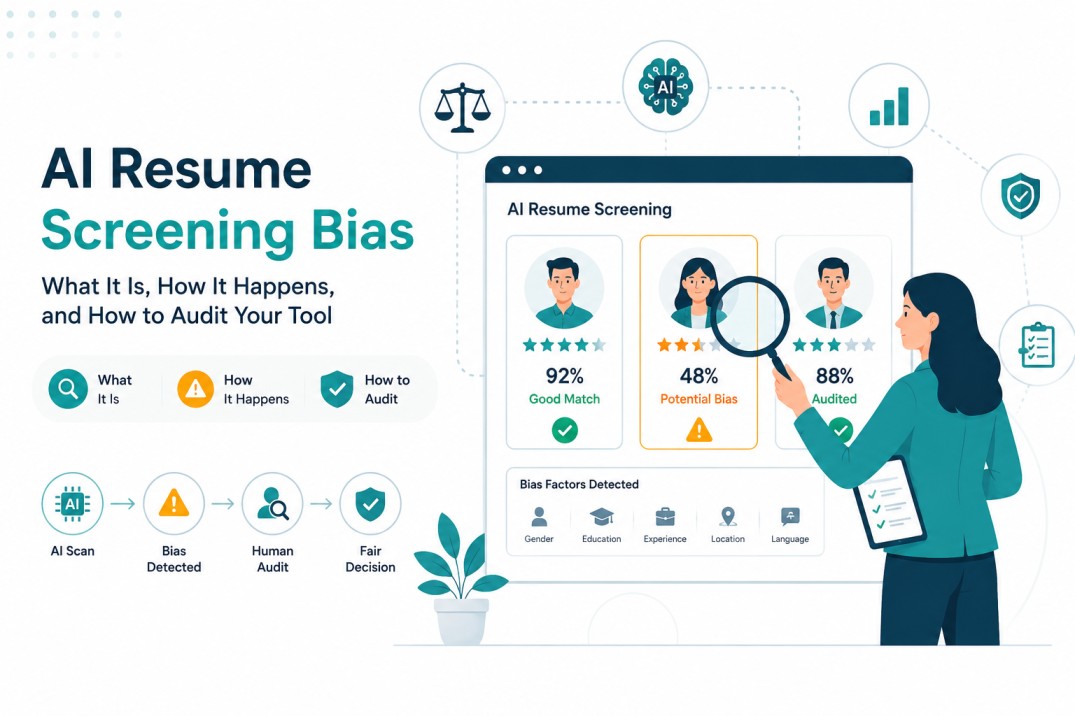
AI Resume Screening Bias: What It Is, How It Happens, and How to Audit Your Tool
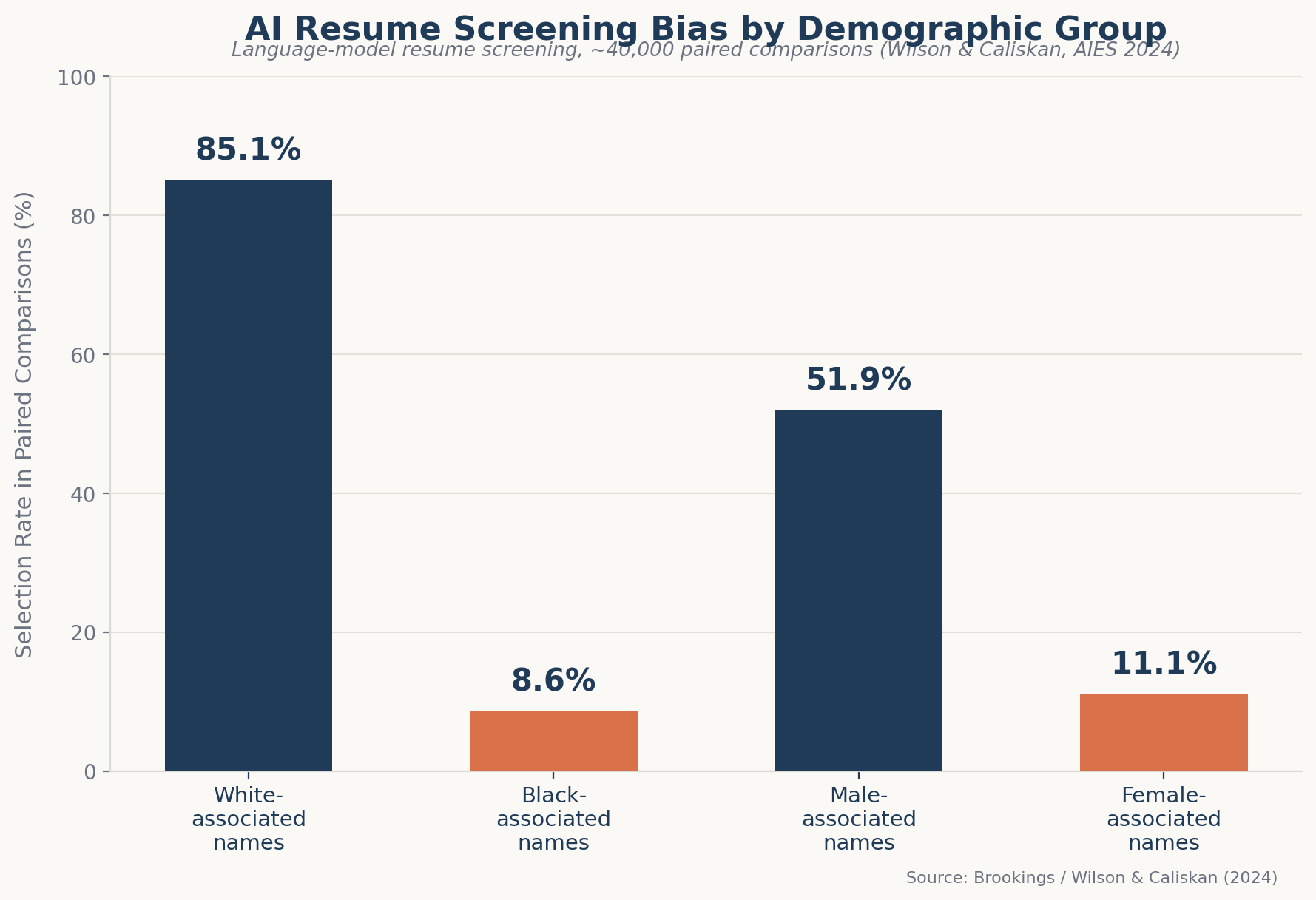
A language model asked to rank identical resumes will favor the white-associated name over the Black-associated name in roughly 85% of paired comparisons, even when every line of experience is word-for-word the same.
That isn’t a hypothetical. It’s the documented result of a 2024 University of Washington study that ran three widely deployed AI screening models through more than 3 million resume-to-job comparisons.
Most hiring teams assume automation removes human prejudice from the funnel. The evidence points the other way. AI resume screening bias doesn’t erase the bias baked into decades of hiring data; it launders it, runs it at machine speed, and applies it uniformly to every applicant who touches the system, not just the handful a recruiter happened to glance at on a busy Friday.
For startups and SMBs screening at volume, often 200 – 400 applicants per open role with a single recruiter or hiring manager reviewing them, the appeal of AI screening is obvious.
What’s less obvious is that a biased model doesn’t fail loudly. It fails quietly, shortlist after shortlist, until an audit, a lawsuit, or a regulator finds the pattern first.
This piece breaks down what AI resume screening bias actually is, where it enters the pipeline, and the concrete steps to audit a screening tool before it quietly reshapes who gets hired.
What Is AI Resume Screening Bias?
AI resume screening bias is the measurable, systematic pattern in which automated screening tools parsers, ranking models, AI shortlisting engines score candidates differently based on protected or proxy attributes like race, gender, age, or name origin, rather than job-relevant qualifications. It produces skewed shortlists even when the input data appears neutral on its face.
The bias isn’t usually intentional. It’s inherited from training data, from historical hiring patterns, from proxy signals the model was never told to ignore.
The Real Scale of the Problem
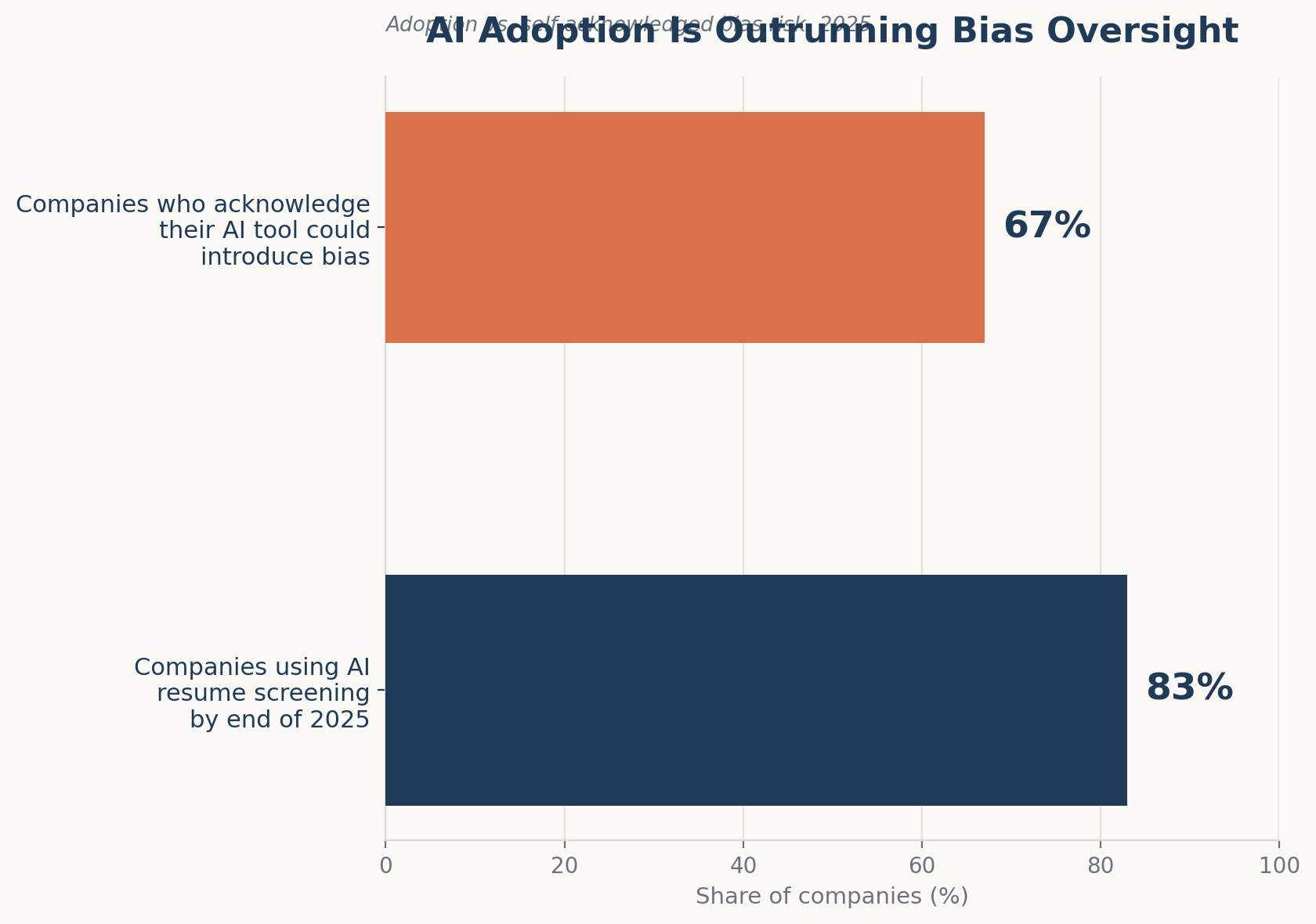
By the end of 2025, an estimated 83% of companies used some form of AI in resume screening, up from roughly 48% just two years earlier one of the fastest adoption curves in HR technology history.
At the same time, 67% of those companies openly acknowledge their tools could be introducing bias into hiring decisions. Adoption is outrunning oversight by a wide margin.
For a startup running three open roles at once, the math gets worse fast.
An AI screener processes the same volume in seconds, which means a biased scoring pattern doesn’t affect one role. It compounds across every requisition running through the system simultaneously.
Most teams underestimate the exposure by 3 – 4x, because they audit the tool once at implementation and never again.
A model that scored fairly on a validation set in month one can drift as it retrains on the company’s own (increasingly skewed) hiring outcomes in month twelve. AI resume screening bias isn’t a one-time defect. It’s a moving target.
The legal exposure is catching up, unevenly. New York City’s Local Law 144 now requires annual bias audits for automated employment decision tools used on NYC-based roles, with results published publicly.
The EEOC has issued guidance treating AI screening tools as subject to the same disparate-impact standards as any other hiring practice, and Illinois has its own AI video-interview disclosure law.
None of this requires a company to prove intent to discriminate; only that the outcome shows a measurable gap.
There’s also a quieter cost that never shows up on a compliance filing: talent loss.
A screening tool that systematically underweights certain candidate profiles isn’t just a legal exposure; it’s actively filtering out people who would have been strong hires.
For a startup competing for senior technical or leadership talent against companies with far larger recruiting budgets, losing qualified candidates to a scoring artifact is a self-inflicted disadvantage, not a neutral cost of doing business at scale.
Recruiting teams that track source effectiveness and recruiter load already have the data to see this pattern; the missing piece is usually the discipline to segment it by demographic or proxy variable rather than by source channel alone.
Where Bias Actually Enters the Pipeline
Bias rarely comes from one obvious source. It enters the screening pipeline at several distinct points, and an audit that only checks one of them will miss the rest.
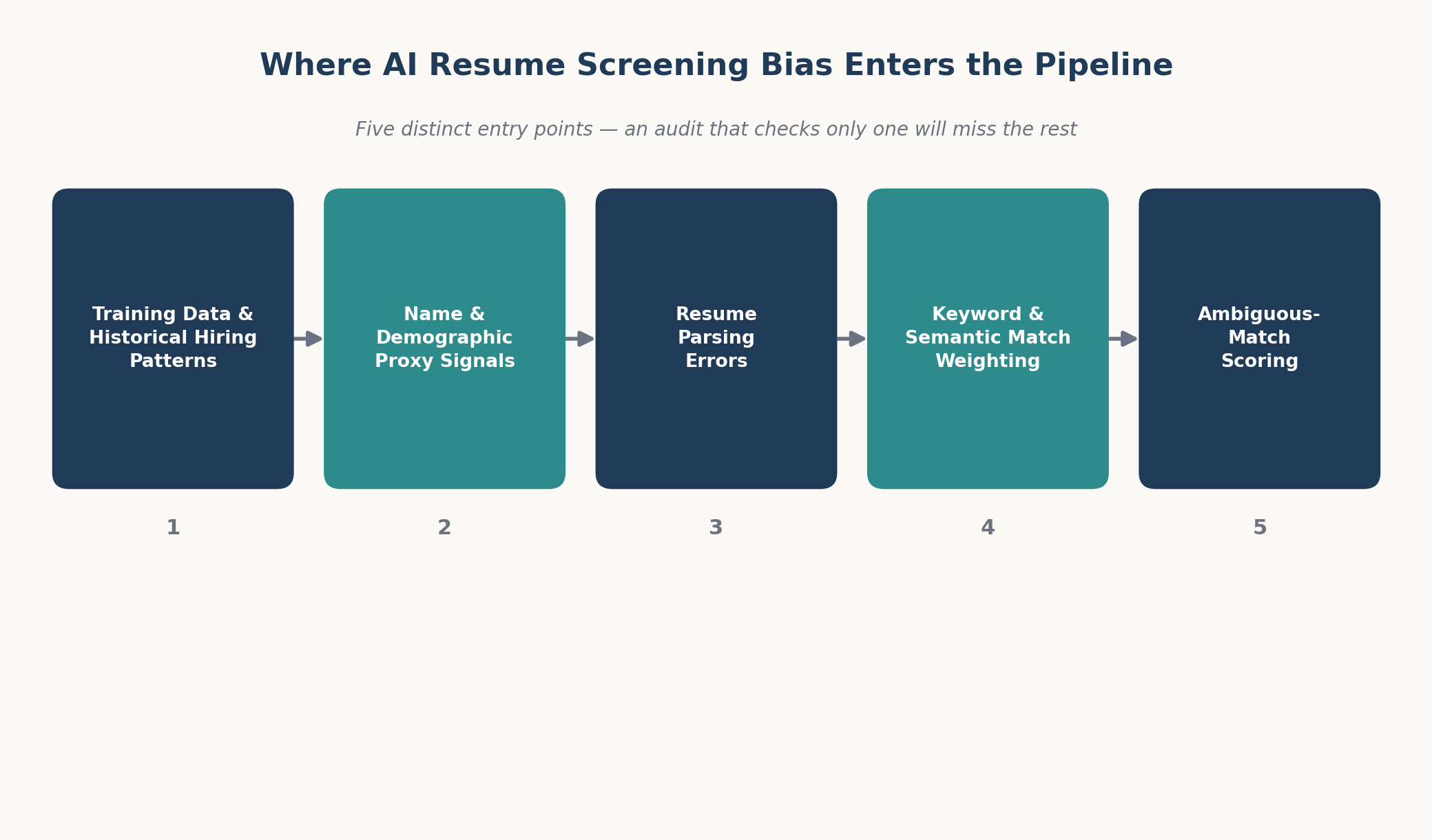
Training Data and Historical Hiring Patterns
Most resume-ranking models are trained directly or indirectly through embedding models on historical hiring outcomes.
If a company’s past hires skewed toward certain schools, employers, or demographic patterns, the model learns to reproduce that skew as “success,” regardless of whether the original pattern reflected merit or simply who applied and who was already inside the network.
Name and Demographic Proxy Signals
Names carry strong demographic signal even when race and gender fields are never collected.
Removing a “race” field from the application form does nothing if the model still reads the name.
Resume Parsing Errors
An AI resume parser built and tested primarily on Western-format resumes often misreads non-standard date formats, non-U.S. university names, or resumes formatted right-to-left or with different section orders.
A parsing failure doesn’t look like bias in a system log; it looks like a “low match score.” But if parsing errors cluster around candidates from specific regions or educational systems, the downstream effect is identical to intentional discrimination, just harder to trace.
Keyword and Semantic Matching Weighting
Ranking models that over-weight exact keyword matches penalize candidates who describe the same skill differently a pattern that correlates with career-changers, older candidates using outdated terminology, and non-native English speakers.
This is a subtler failure mode than name bias, but it shows up consistently in candidate profile management systems that weren’t tuned for phrasing diversity.
Ambiguous-Match Scenarios
Research from a 2025 mechanistic-interpretability study found that when a resume’s skill match to a job description was genuinely uncertain ot a clear yes or no, models defaulted to favoring male-associated names significantly more often than in clear-match cases.
Bias tends to hide in the gray zone, not the obvious cases.
This matters more than it might first appear, because most real candidate pools are mostly gray zone. A clear over-qualified or clear under-qualified resume rarely needs a sophisticated model; a basic keyword filter correctly handles those cases fine.
The value proposition of an AI screener is precisely in judging the ambiguous middle, which is exactly where the research shows the model’s judgment becomes least reliable and most demographically skewed.
An audit that only tests obvious best-fit and worst-fit resumes will pass a tool that’s failing on the cases that actually require its judgment.
Cost and Vendor Evaluation Considerations
Auditing internally versus paying a third-party firm is a real budget decision, and the right call usually depends on headcount and regulatory exposure rather than company size alone.
A third-party audit engagement for a mid-size employer typically runs from a few thousand dollars for a narrow, single-role audit up to the low tens of thousands for a full annual compliance audit covering multiple roles and jurisdictions a meaningful line item for a 50-person startup, but usually far cheaper than a single disparate-impact claim.
Companies hiring only within jurisdictions without mandatory audit requirements sometimes deprioritize this spend entirely, which is a mistake for two reasons.
First, remote hiring means a “local” company is rarely hiring in only one jurisdiction for long.
Second, the EEOC’s disparate-impact standard applies regardless of whether a formal audit law exists in the hiring company’s state; the absence of a mandate doesn’t mean absence of liability if a gap surfaces later through a candidate complaint or litigation discovery.
How to Run a Resume Bias Audit: Step-by-Step
A usable audit doesn’t require a data science team, but it does require a repeatable process. Here’s the sequence that holds up under regulatory and internal scrutiny:
-
Pull outcome data by stage, not just final hires.
Track pass-through rates at every funnel stage: applied, screened-in, interviewed, offered, not just who ultimately got hired.
Bias frequently shows up at the screening stage and disappears by the time a human reviews the shortlist, which hides it from end-to-end audits.
-
Segment by protected class and proxy variables.
Where legally permitted, compare pass-through rates by race, gender, and age band. Where direct demographic data isn’t collected, use validated proxy methods (name-based demographic inference used in academic audits, geographic proxies) cautiously and only for the audit itself, never for scoring candidates.
-
Calculate the adverse impact ratio.
Apply the four-fifths rule: if any group’s selection rate falls below 80% of the highest-performing group’s rate, that’s a legally recognized red flag warranting deeper review.
-
Run matched-pair testing.
Submit functionally identical resumes except for a name swap or a demographic-associated detail (school, gaps, formatting style) and compare scores.
This is the single most direct way to isolate the model’s behavior from data noise.
-
Test the ambiguous-match zone deliberately.
Don’t only test clear-fit and clear-non-fit resumes. Build test cases where the match is genuinely borderline; that’s where the 2025 research found bias concentrates most heavily.
-
Audit parsing accuracy separately from ranking accuracy.
Check whether resumes are being read correctly before checking whether they’re being scored fairly. A parsing failure will masquerade as a low relevance score.
-
Check intersectional outcomes, not just single-axis ones.
A tool can pass a race-only audit and a gender-only audit while still showing a severe gap for, say, Black women specifically. Intersectional gaps are the ones most often missed by single-variable checks.
-
Document everything with timestamps.
Local Law 144 and similar frameworks require published audit results. Even where not legally required, dated documentation is the difference between “we caught it” and “we’re being sued and have no record we ever looked.”
-
Set a recurring audit cadence.
Quarterly at minimum, and after any model update, retraining event, or vendor version change. A model that passed in Q1 is not guaranteed to pass in Q3.
-
Escalate findings to the vendor with specifics.
If the screening tool is third-party, a request to “make it fairer” gets ignored. A request that includes the exact adverse impact ratio, the test resumes used, and the stage where the gap appeared gets a response.
Platforms built for the SMB and startup hiring stage Hirium among them increasingly bake pieces of this into the product itself, pairing an AI shortlisting layer with recruitment analytics that surface time-to-hire, recruiter load, and source effectiveness by stage, which gives teams the pass-through data step one of this process requires without a separate reporting build.
Compliance Considerations by Region
Regulatory coverage is inconsistent, which is itself a risk for any company hiring across state or national lines.
- United States (federal): The EEOC applies existing Title VII disparate-impact standards to AI tools; there’s no AI-specific federal statute yet, but existing law already covers biased outcomes regardless of the technology producing them.
- New York City: Local Law 144 mandates an independent bias audit within the prior year for any automated employment decision tool, with a summary published on the employer’s website.
- Illinois: The state’s AI Video Interview Act requires disclosure when AI is used to analyze video interviews and consent from the candidate.
- European Union: The EU AI Act classifies AI systems used in recruitment and candidate evaluation as high-risk, triggering mandatory risk assessments, human oversight requirements, and documentation obligations before deployment.
A company hiring remote talent across two or three of these jurisdictions is effectively subject to the strictest applicable standard, whether or not it operates there directly.
Case Study: Keyword Weighting Skewed a Technical Shortlist
A 40-person SaaS startup running AI-assisted screening for a senior engineering role noticed its shortlist consistently under-represented candidates who had switched into tech from adjacent fields.
An audit found the ranking model was weighting exact tool-name matches (“Kubernetes,” “Terraform”) far more heavily than described-equivalent experience phrased differently; a candidate who wrote “led container orchestration migration” scored lower than one who simply listed the tool name, regardless of actual depth of experience.
After adjusting the matching logic to weight semantic equivalence over exact keyword hits, the shortlist diversity of prior-experience backgrounds increased, and time-to-fill for the role dropped by roughly 9 days.
Qualified candidates who’d previously been filtered out at the parsing stage were now reaching the interview stage on the first pass rather than being manually recovered after a recruiter noticed the shortlist looked thin.
Case Study: Matched-Pair Testing Surfaced a Name-Based Gap
An HR team at a 60-employee fintech company ran matched-pair testing with identical resumes, swapped names across its screening tool ahead of a Local Law 144 filing deadline.
The test surfaced a 17-point gap in shortlist rate between resume pairs, consistent with the pattern documented in the University of Washington study, and the gap widened further in the ambiguous-match test cases specifically, mirroring the pattern found in the 2025 mechanistic-interpretability research.
The company moved to a blind first-pass screening step (names and demographic-adjacent fields withheld until the shortlist stage) and re-ran the audit 90 days later; the gap narrowed to within the four-fifths threshold, and the company had a documented before/after record to file.
Just as important internally, the finding shifted how the recruiting team evaluated future vendor tools; matched-pair testing became a standard step in every new tool trial rather than something reserved for compliance deadlines.
Comparison: How Companies Approach AI Resume Screening Bias Audits
| Approach | Cost | Audit Frequency | Compliance-Ready Documentation |
| Manual internal audit (spreadsheet-based) | Low, but high staff time | Ad hoc, often annual at best | Inconsistent, easy to lose |
| Third-party bias audit vendor | Moderate to high per engagement | Typically annual (matches Local Law 144 cadence) | Strong, built for regulatory filing |
| Platform-native fairness monitoring (built into the ATS ) | Included in existing tooling cost | Continuous, tied to every screening cycle | Automatic pass-through and stage-level data, but still requires a formal audit step for legal filings |
None of the three replaces the audit steps above; they change how much manual effort those steps take and how current the underlying data is when an audit runs.
A company with a single active jurisdiction and low hiring volume can often manage with a manual annual audit.
A company hiring across multiple states or countries, or running high-volume screening across several roles simultaneously, generally needs either a third-party partner or platform-native monitoring to keep pace.
A manual quarterly audit across a dozen open roles is a significant time cost for a recruiting team that’s already stretched thin.
What Most Teams Get Wrong About AI Resume Screening Bias
-
They treat “blind resumes” as a complete fix.
Stripping the name field feels like the obvious solution, and it helps. But zip codes, school names, employment gaps, and even certain phrasing patterns still carry strong demographic signal. A model that can’t see a name can still infer a great deal from everything around it.
-
They accept vendor claims of “unbiased AI” without audit evidence.
“Unbiased” is a marketing term, not a compliance status. Ask any vendor for their most recent bias audit results, the methodology used, and the date, not a statement of intent.
-
They audit once and consider it done.
Models retrain. Data shifts. A tool that passed in Q1 can fail by Q3, especially if it’s learning from the company’s own recent hiring outcomes, which can quietly reinforce whatever pattern already existed.
-
They check single-axis bias and miss intersectional gaps.
A tool can look clean on race alone and clean on gender alone while still showing a sharp gap for a specific intersection, like Black women or older candidates from non-traditional backgrounds. Single-variable audits miss this by design.
-
They confuse parsing errors with genuine low-fit scores.
A resume that scores poorly because the parser misread a non-U.S. date format looks, in the data, identical to a resume that scored poorly because the candidate genuinely wasn’t a fit. Separating those two failure modes is the difference between fixing the model and blaming the candidate.
-
They audit the model but never audit the job description.
Bias doesn’t only live in the ranking algorithm. A job description written with unnecessarily narrow keyword requirements “10 years experience” for a role that genuinely needs five, or a specific tool name where an equivalent tool would work fine, hard-codes a filter that no amount of downstream bias testing will catch, because the model is doing exactly what it was told to do.
-
They treat the audit as a compliance exercise rather than a hiring-quality exercise.
Framing it as “who are we losing that we shouldn’t be” produces a more thorough one, and tends to surface issues like the keyword-weighting problem in the first case study above that a pure compliance checklist would never have flagged, because nothing about it was illegal, just costly.
FAQ
1. Is AI resume screening actually biased, or is this overstated?
The evidence is not overstated. Multiple independent academic studies, including a 3-million-comparison audit from the University of Washington and a separate 2025 study covering over 330,000 real job postings, found consistent, statistically significant bias favoring white- and male-associated names across several widely used embedding models.
This isn’t a single flawed tool; it’s a pattern that shows up across the underlying model architectures most screening products are built on.
2. How do you check if an AI hiring tool is biased?
Run matched-pair testing (identical resumes, swapped names or demographic-adjacent details), calculate the adverse impact ratio using the four-fifths rule across funnel stages, and check intersectional outcomes, not just single-axis ones. A one-time check isn’t sufficient; models drift as they retrain.
3. What laws currently regulate AI bias in hiring?
In the U.S., existing EEOC disparate-impact standards apply to AI tools even without AI-specific legislation, meaning liability doesn’t depend on a state having passed AI-specific rules. New York City’s Local Law 144 requires annual independent audits for automated employment decision tools, with published results. Illinois requires disclosure and consent for AI-analyzed video interviews. The EU AI Act classifies recruitment AI as high-risk, requiring documented risk assessments and human oversight before deployment.
4. Can AI resume screening ever be genuinely fair?
It can be measurably fairer than unaudited human screening in some cases; models can be tested and corrected in ways human judgment can’t be, but “fair” isn’t a permanent state a tool achieves once. It’s a status that has to be re-verified on a recurring cadence as the model, the applicant pool, and the job requirements all change, since a passing audit today says nothing about the model’s behavior after its next retraining cycle.
5. How often should a company audit its screening tool?
Quarterly at minimum, and immediately after any vendor model update, retraining event, or significant shift in applicant volume or job mix. Annual audits satisfy the minimum bar set by laws like Local Law 144 but leave a wide window for drift to go undetected.
Where to Go From Here
If you’re evaluating a screening tool or auditing one already in production, or AI resume screening bias, the highest-leverage first step is matched-pair testing on your current live pipeline, not a vendor’s marketing claims.
It’s the fastest way to know whether the gap the research describes is showing up in your own hiring data.
Hirium‘s shortlisting and recruitment analytics layer surfaces pass-through data by stage as part of normal use, which removes the reporting-build step most of the audit process above otherwise requires.
If you’re mid-audit or setting one up for the first time, that stage-level visibility is worth checking against whatever tool you’re currently running.