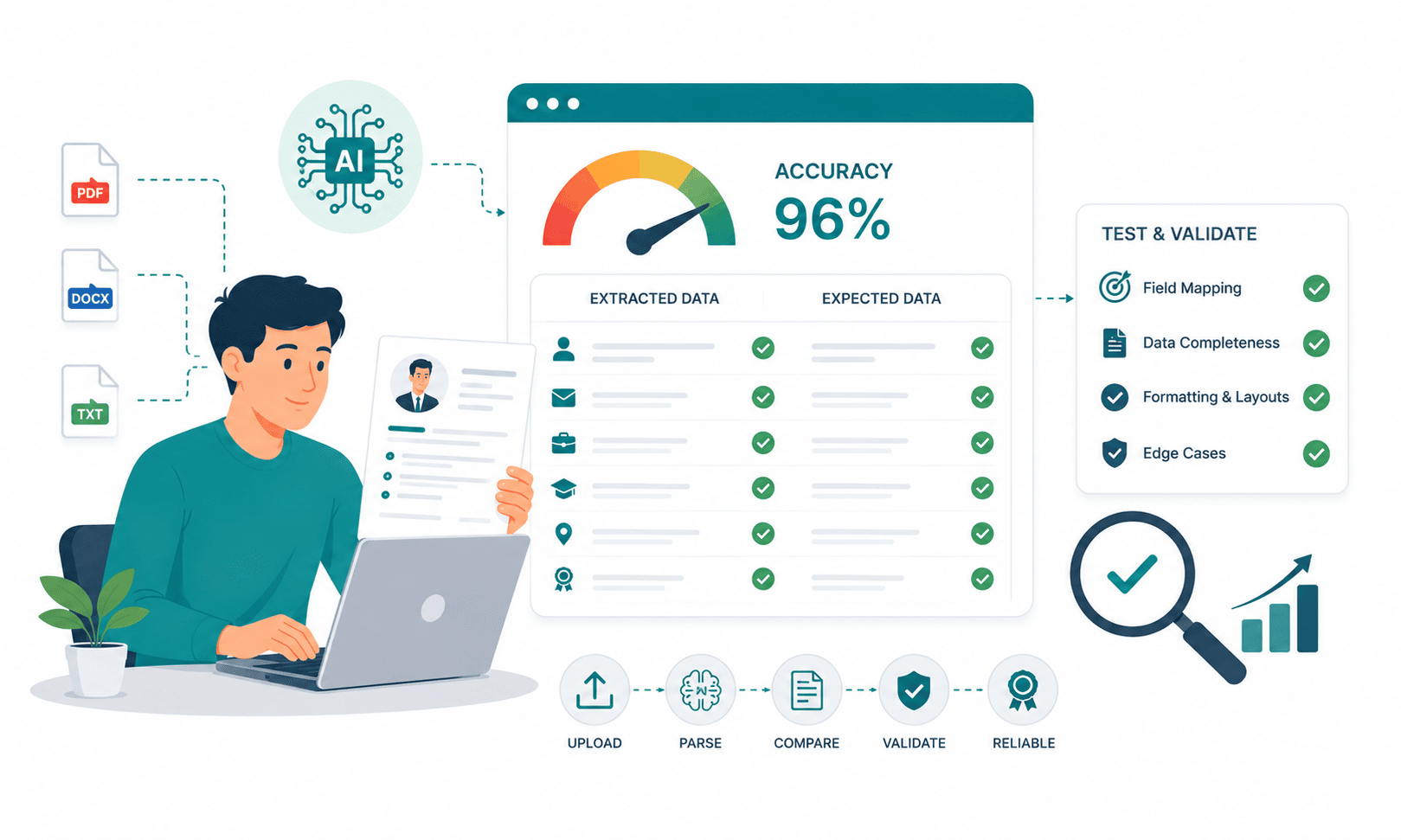
Resume Parser Accuracy: How to Test If Your AI Resume Parser Is Actually Reliable
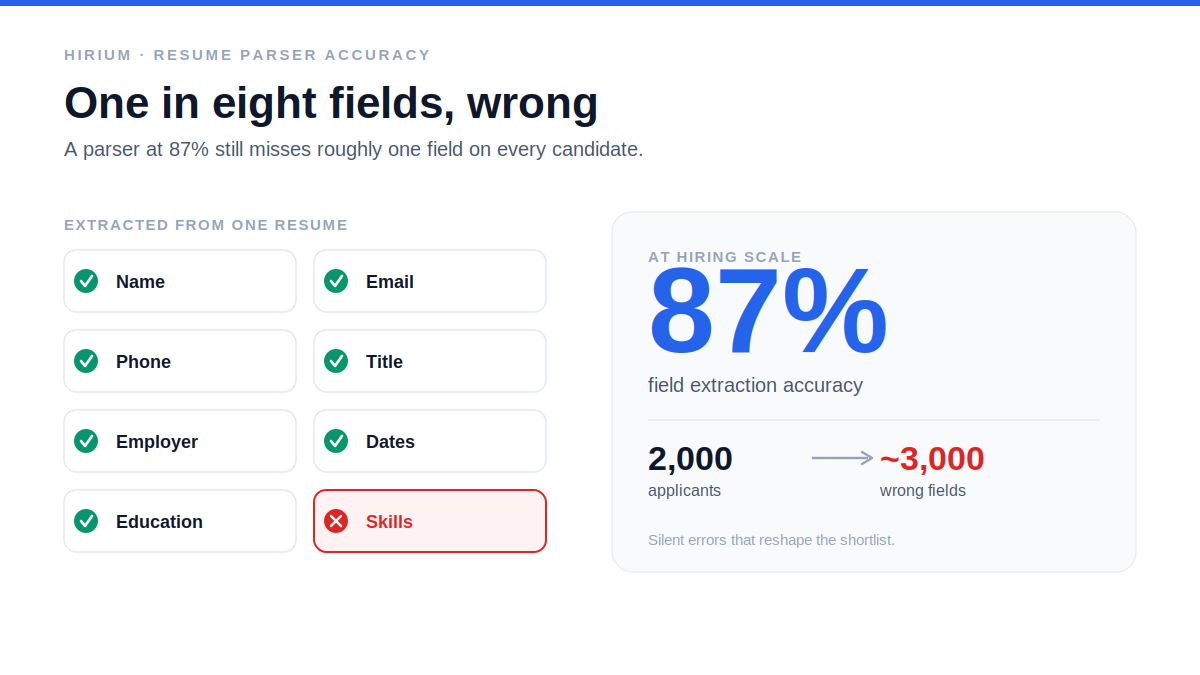
An AI parser that reads “87% of fields correctly” sounds dependable until you translate the number into hiring terms: roughly one in every eight data points on every candidate is wrong before a recruiter ever opens the profile. Multiply that across 2,000 applicants for a single high-volume role and the parser has quietly introduced thousands of small errors, a mistyped job title here, a skill that never got tagged there, each one capable of pushing a qualified person down the ranking or out of the shortlist entirely.
That gap between the accuracy a vendor prints on a slide and the accuracy you actually get in production is the single most under-tested assumption in modern recruiting technology. Most teams buy a parsing engine on the strength of a demo, migrate their Candidate Database into it, and never run a controlled check against resumes that look like their real applicant flow. The result is a system that everyone trusts and no one has measured. Treated seriously, Resume Parser Accuracy is the difference between a shortlist you can defend and one that quietly filters out the wrong people.
This guide fixes that. It lays out a repeatable 10-resume test set method any recruiting team can run in an afternoon, the specific metrics worth tracking, the failure points that break parsers in the field, and a practical way to report and remediate errors once you find them. Resume Parser Accuracy is not a marketing figure to accept, it is a measurable property of your stack that changes with every new file format your candidates upload.
By the end, you will be able to stop asking vendors what their accuracy is and start proving what it is on your own data. That shift from trusting a claim to verifying a result is what separates a reliable hiring pipeline from one that leaks good candidates silently.
The trap is measuring a parser by how much time it saves rather than whether it improves the hiring you actually do. Radancy’s recent analysis of the AI ROI gap in talent acquisition captures the disconnect: while a large majority of HR teams report that AI has made recruiting faster, only about a quarter say it has actually improved their ability to identify top candidates.
A parser that processes resumes in seconds but drops skills and mangles titles is a perfect example; it delivers the efficiency everyone can see while quietly eroding the data quality no one is measuring. As one of the session’s speakers put it, you don’t fix a signal-quality problem by running it through a faster filter.
What Resume Parser Accuracy Actually Means
Resume Parser Accuracy is the measurable degree to which a parsing engine extracts the correct information from a resume and maps it to the right structured field name, contact, work history, education, and skills compared against a verified ground-truth version of the same resume. It is expressed as a percentage of fields captured correctly, not one overall score.
That distinction matters because a parser can post a flattering headline number while failing badly on the fields that drive your screening. A tool that nails name and email but garbles employer names and skips half the skills is not “90% accurate” in any way that helps you hire.
Meaningful Resume Parser Accuracy is therefore always field-weighted: it counts the fields you rank and match on more heavily than the ones you never query. Read as a single blended percentage, the metric flatters weak tools; read field by field, it tells you where your pipeline is actually leaking.
The Core Problem: The Number on the Slide Is Not the Number You Get
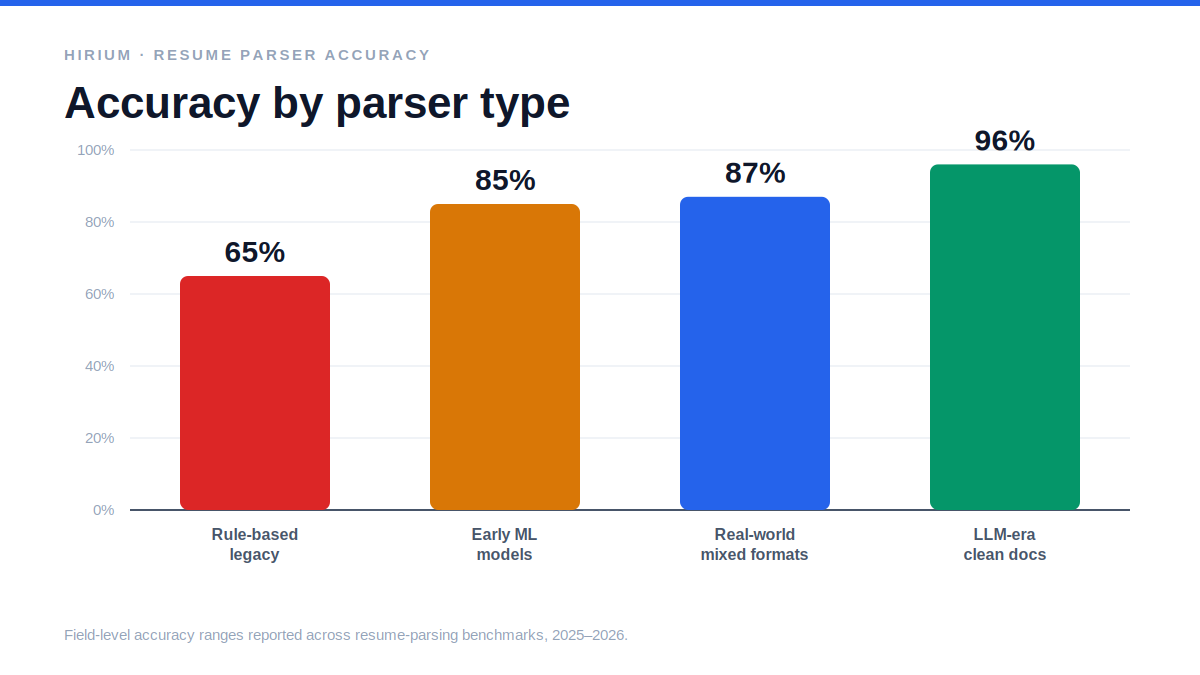
Nearly every vendor quotes the same figure. Independent and vendor benchmarks put transformer-based, LLM-era parsers around 95–97% on clean, single-column documents, legacy rule-based tools closer to 65%, and early machine-learning models near 85%. Those numbers are real for the conditions they were measured under.
Your applicant pool does not match those conditions. Field-level accuracy on messy, real-world resumes has been measured closer to 87%, against roughly 96% for careful human data entry. On multi-column layouts, scanned PDFs, mixed-language CVs, and resumes built inside tables, real performance drops further still. The headline figure describes a best case; your pipeline runs on the average case, and your true Resume Parser Accuracy is that average, not the peak.
The reason this stays hidden is that a parsing miss is invisible at the point of failure. When a parser drops a skill, nothing errors out the field is simply empty, and the downstream system treats “empty” as “the candidate doesn’t have it.”
That is the mechanism that turns a small extraction error into a hiring problem. A skill that never gets tagged does not appear in AI Resume Screening scores. A title normalized to the wrong seniority band surfaces the candidate for the wrong roles. An employer name misread quietly weakens a match. Each error compounds down the funnel, and none of them announce themselves.
Consider the scale. A startup running a single engineering req at volume might field 1,500–2,500 applications in three weeks. At 87% field accuracy across, say, 12 extracted fields per resume, you are looking at roughly 1.5 wrong fields per candidate, thousands of small distortions feeding the exact ranking your recruiters trust to save time.
Teams routinely underestimate this by 3–4x because they only ever see the resumes that made it through, never the qualified ones that a parsing gap pushed out of view.
There is a second cost that rarely gets counted: the recruiter hours spent correcting parsed data by hand. When Resume Parser Accuracy runs low, someone ends up re-typing employers, fixing dates, and re-tagging skills often 3–5 minutes per candidate. Across 2,000 applicants that is more than 100 hours of cleanup a month, which erases most of the efficiency the parser was bought to deliver.
Measuring Resume Parser Accuracy up front is cheaper than paying for it in manual rework later, and it is the only way to know whether your automation is actually saving time or merely relocating the work.
How to Test an AI Resume Parser: The 10-Resume Method
You do not need a data-science team or a 500-CV benchmark to get a trustworthy read on Resume Parser Accuracy. You need a small, deliberately varied test set, a ground-truth answer key, and a consistent scoring rubric.
The goal is not academic precision, it is catching the failures that will actually cost you candidates. Run the method below once and you will know more about your Resume Parser Accuracy than most teams learn in a year of using the tool.
Step 1: Build a 10-Resume Test Set That Mirrors Reality
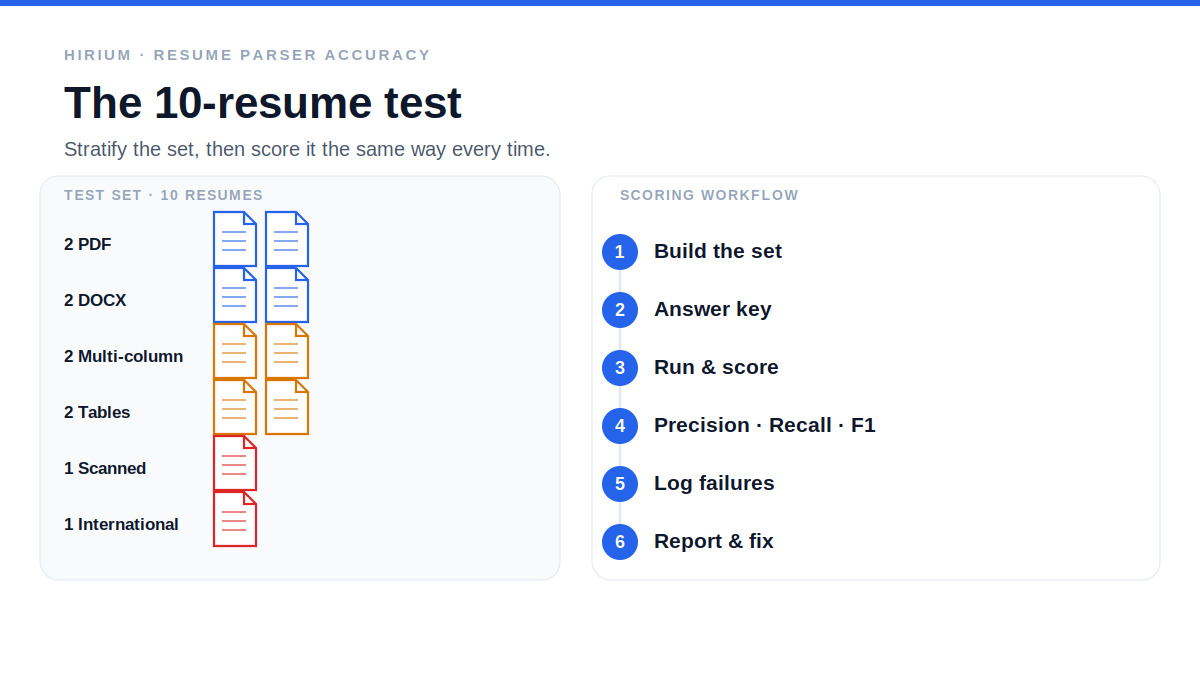
The value of this test comes entirely from the resumes you choose. A test set of ten clean, single-column PDFs will tell you your parser works on the resumes that never cause problems. Instead, stratify your ten to match the messiness of your real inbound flow, because Resume Parser Accuracy is only meaningful when measured on the formats you actually receive:
- Two standard single-column PDFs your baseline; these should score near-perfect.
- Two DOCX files Word documents parse differently than PDFs and expose field-mapping quirks.
- Two multi-column or template-heavy layouts the Canva/Novoresume-style designs where reading order breaks.
- Two resumes built inside tables are a classic parser trap, since cell boundaries scramble extraction.
- One scanned or image-based PDF this forces the optical character recognition (OCR) path and is where most tools quietly collapse.
- One international or mixed-language CV, non-Latin scripts, DD/MM dates, and unfamiliar degree names surface localization gaps.
Pull these from your own historical applicant flow wherever privacy policy allows, or anonymize real resumes by swapping names and contact details. Resumes that look like your actual candidates test the system you actually run.
Step 2: Create the Ground-Truth Answer Key
For each of the ten resumes, a human records what the correct extraction should be, field by field: full name, email, phone, most recent job title, most recent employer, total years of experience, education, and the full skills list. This ground-truth dataset is the answer key every parser output gets graded against. Without it, you are guessing, not measuring.
Keep the field list identical across all ten so scores are comparable. Standardizing the fields is what makes the numbers add up into an honest picture of Resume Parser Accuracy rather than ten disconnected impressions.
Step 3: Run Every Resume and Score Two Metrics That Matter
Feed all ten through the parser and score two things separately, because they fail for different reasons.
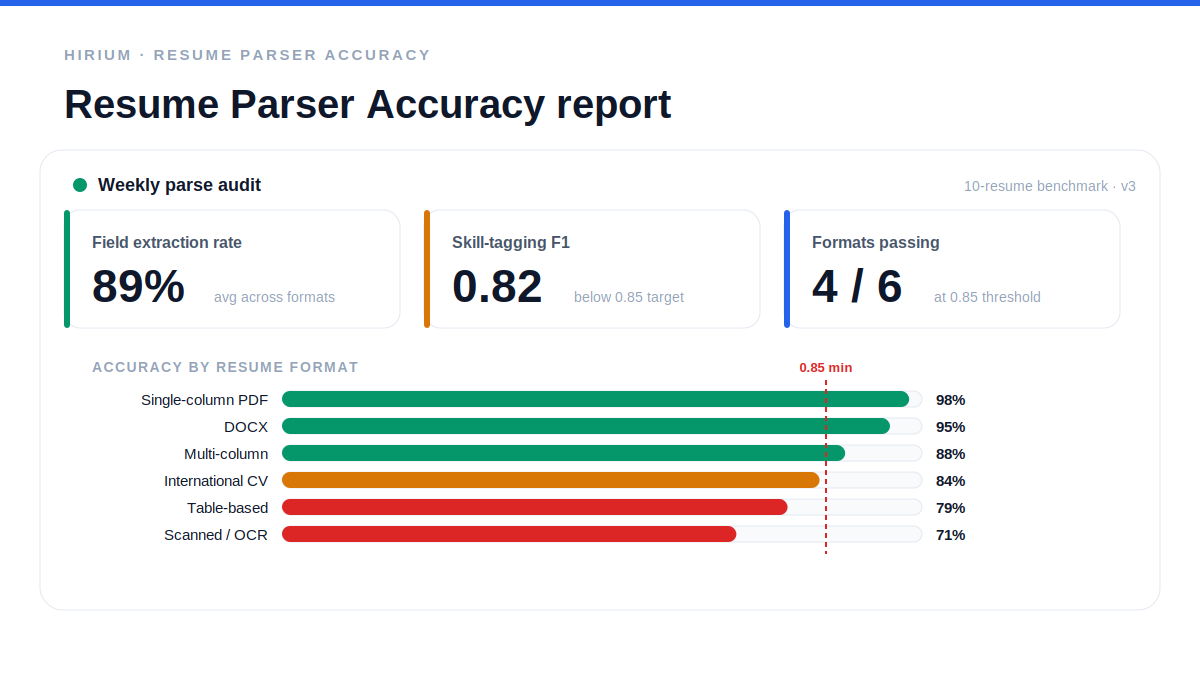
Field extraction rate measures how many core fields were captured and mapped to the correct place. If a resume has 8 gradeable fields and the parser gets 7 right, that resume scores 87.5% on field extraction rate. Average across all ten for a headline number, but always read the per-resume breakdown a single scanned PDF scoring 40% is far more informative than the average that hides it. This split view is the whole point of measuring Resume Parser Accuracy on stratified formats rather than a random sample.
Skill-tagging accuracy deserves its own score because skills drive matching and shortlisting more than any other field. Check three things: did the parser capture the skills that were present (recall), did it avoid inventing skills that were not there (precision), and did it normalize variants correctly “JS,” “JavaScript,” and “Javascript” collapsing to one tag rather than three. Weak skill-tagging accuracy is the quiet killer of good AI Candidate Insights, because every downstream recommendation inherits the gaps.
Step 4: Convert Raw Counts Into Precision, Recall, and F1
For a rigorous read, especially on skills, score with precision and recall rather than a single percentage. Precision asks: of the fields the parser filled, how many were right? Recall asks: of the fields it should have filled, how many did it get? The F1 score balances the two into a single figure.
A practical procurement bar drawn from field practice: if a parser drops below roughly 0.85 F1 on any resume category that represents 15% or more of your candidate flow, that is a blocker, not a rounding error. If it drops below that bar on a category that overlaps with a protected class, say, international candidates it is both an operational problem and a compliance exposure worth escalating.
Reporting Resume Parser Accuracy as precision, recall, and F1 rather than one blended percentage is what makes these thresholds enforceable instead of aspirational.
Step 5: Log Failure Points, Not Just Scores
A score tells you whether the parser failed; a failure log tells you why, which is what lets you fix it. For every miss, record the resume format, the field that broke, and the failure type. Patterns emerge fast, and they almost always cluster around the same culprits.
The most common resume parsing failure points, in rough order of frequency:
- Reading-order errors on multi-column layouts the parser interleaves two columns and produces scrambled work history.
- Table-based resumes cell structure defeats extraction; fields land in the wrong place or vanish.
- Scanned or image PDFs the OCR step introduces character errors that cascade into every field.
- Non-standard section headers “Where I’ve Worked” instead of “Experience” means the parser never finds the section.
- Date format ambiguity 03/04/2025 read as March 4 in one locale and April 3 in another, distorting tenure calculations.
- Skill synonymy and abbreviation missed or duplicated skills from unnormalized variants.
Each of these has a fix, which is the point of logging them.
Step 6: Report and Remediate
Turn the failure log into two outputs. First, a short report the whole hiring team can read: overall field extraction rate, skill-tagging accuracy, per-format scores, and the three worst failure patterns. A one-page Resume Parser Accuracy summary in this shape is usually enough to align recruiters, hiring managers, and the vendor on what needs fixing. Second, a remediation path for each pattern.
Remediation usually falls into a few buckets. Reading-order and table failures often improve when candidates apply through a structured Job Posting Software intake or career-page form that captures key fields directly, sidestepping the parser for the highest-stakes data.
OCR failures argue for a tool with a stronger image-processing path, or for flagging scanned uploads for a quick human check. Header and synonym failures are usually configuration: expand the parser’s section-header dictionary and skill-normalization map. And any parser whose Resume Parser Accuracy you cannot re-test after an update is a parser you cannot trust over time retesting on the same ten resumes after every vendor release is how you keep Resume Parser Accuracy honest.
Set a cadence rather than treating this as a one-off. Most teams that take Resume Parser Accuracy seriously re-run the ten-resume set quarterly and after any parser or model update, and they add two or three new resumes each time a new format starts trending in their applicant pool. That way the answer key grows with the real world instead of freezing at whatever the inbound mix looked like on the day you first tested.
The whole protocol takes one recruiter and one analyst about a day. It is the cheapest vendor due diligence you can run and the one that catches the most production issues.
Where Parsing Sits in Your Candidate Database management
Parsing is not a standalone feature; it is the front door to your entire Candidate Database management layer, and its accuracy sets the ceiling for everything built on top. A search that filters candidates by skill is only as good as the skills that got tagged. A shortlist ranked by experience is only as good as the tenure the parser calculated.
This is why measuring Resume Parser Accuracy pays back far beyond the parser itself. Clean structured data at intake means reliable filtering, defensible ranking, and AI Candidate Insights you can actually act on. Dirty data at intake means every downstream feature inherits the errors, and no amount of clever scoring recovers a skill that was never captured. Modern platforms Hirium among them treat Resume Parser Accuracy as a first-class quality metric precisely because it governs the trustworthiness of the whole system, not one screen.
There is a compounding effect worth naming. A candidate parsed poorly today does not just rank wrong today; that broken record sits in your database and resurfaces the wrong way every time you search it for future roles. Low Resume Parser Accuracy at intake therefore degrades your talent pool for months, not minutes, which is why the cost of ignoring it is always larger than it looks in a single hiring cycle.
Case Studies: When Parsing Accuracy Changes the Outcome
A 40-person SaaS startup, hiring at volume. The talent lead was fielding roughly 1,800 applications a month across five open roles and trusting the parser’s shortlist to save time. A 10-resume audit revealed that table-formatted resumes about 20% of inbound were losing an average of three skills each, and those candidates were ranking two full tiers below where their experience warranted. Switching those applicants to a structured career-page intake and re-tuning the skill map lifted qualified-candidate surface rate on that segment by an estimated 18%, without adding a single recruiter hour.
An SMB agency migrating off a legacy ATS. During a supported migration, the team ran the same test on both the old and new parsing engines before committing. The legacy tool scored 71% field extraction rate on scanned PDFs; the replacement scored 93% on the identical set. Because they measured Resume Parser Accuracy before migrating rather than after, they avoided importing years of half-parsed candidate profiles and cut expected data-cleanup time from an estimated three weeks to under two days.
A Framework for Comparing Parser Reliability
When you evaluate parsers or the ATS platforms they live inside, score them against your test results, not their marketing. The table below is worth using only because it compares the dimensions that actually predict production reliability, and each row maps to something your own Resume Parser Accuracy test can confirm or contradict.
| Evaluation criterion | Weak signal | Strong signal |
| Accuracy claim | “95% accurate” with no conditions | Per-format accuracy you can reproduce on your own 10-resume set |
| Scanned / OCR handling | No mention, or “PDF supported” | Dedicated OCR path, tested above ~90% on image PDFs |
| Skill tagging | Flat keyword match | Normalized synonyms + precision/recall you can verify |
| Retesting after updates | No versioning, silent changes | Re-runnable benchmark, change notes on parser updates |
| Downstream integration | Parses to a black box | Clean structured data feeding search, ranking, and insights |
If a vendor cannot let you run your own resumes through a trial and see the field-level output, treat that as its own answer. The strongest signal of trustworthy Resume Parser Accuracy is a vendor willing to be measured on your data instead of theirs.
What Most Teams Get Wrong About AI Resume Screening
The most common and most expensive mistake is optimizing for the wrong error. Teams obsess over false positives the unqualified candidate who slips into the shortlist because that error is visible and mildly embarrassing. A recruiter sees the bad match and rolls their eyes.
The error that actually costs you is the false negative: the qualified candidate whose skill never got tagged, who therefore never ranked, who you never saw and never knew you lost. False negatives are invisible by definition, so they never enter the feedback loop, and teams systematically under-invest in the parsing quality that would catch them.
Your AI Resume Screening can look like it is working beautifully while quietly discarding exactly the people you most wanted to interview which is why Resume Parser Accuracy deserves scrutiny long before you tune the scoring model that sits on top of it.
The second mistake is treating Resume Parser Accuracy as a one-time purchase decision instead of an ongoing quality metric. Parsers change when vendors ship model updates. Your applicant mix changes when you open roles in new markets or new formats trend among candidates.
A parser that scored 94% last quarter can degrade without a single alert firing. The teams that stay reliable are the ones that keep the same ten resumes on hand and re-run them on a schedule treating Resume Parser Accuracy the way an engineering team treats a regression test, not a launch-day checkbox.
The third is trusting the average and ignoring the distribution. A 91% average that hides a 45% score on the scanned-PDF segment is not a 91% parser for the candidates who submit scanned PDFs and those candidates are often the ones with the least polished tooling, which correlates with exactly the diverse, non-traditional backgrounds many teams claim to want.
Averaged Resume Parser Accuracy can look healthy while the tool systematically underserves a specific slice of your pipeline, which is both a hiring miss and, depending on who falls in that slice, a fairness risk.
A fourth, quieter mistake is confusing a parser’s confidence score with its correctness. Many tools return a confidence figure alongside each extracted field, and teams read a high number as proof the field is right. It is not.
Confidence reflects how sure the model is, not whether it is correct, and the two diverge most on exactly the messy resumes where Resume Parser Accuracy matters. Only a ground-truth comparison tells you the truth; the model’s own self-assessment cannot.
Test It Before You Trust It
Every ranking, filter, and shortlist in your hiring stack inherits the quality of the parse that fed it so Resume Parser Accuracy is not a spec to skim past, it is the foundation the rest of your pipeline stands on. The good news is that it takes an afternoon to measure and a rubric that is straightforward to remediate.
If you are evaluating a new parser, migrating off an old ATS, or simply want to know whether the shortlist you trust is built on clean data, run the 10-resume test on your own applicant flow before you commit to any vendor. Teams that migrate to Hirium run this exact check as part of a free, supported migration, so the Resume Parser Accuracy is proven on real resumes not promised on a slide before a single candidate profile moves over. Measure first, then trust.
Frequently Asked Questions
What is a good resume parser accuracy rate?
For clean, single-column resumes, expect 94–99% field-level accuracy from a modern LLM-era parser. But the number that matters is your weighted average across the formats your candidates actually submit, which is usually lower. A practical bar: no resume category representing 15% or more of your flow should fall below roughly 85% on the fields that drive screening. Judge Resume Parser Accuracy on your worst high-volume segment, not your best.
How do you test an AI resume parser?
Build a 10-resume set that mirrors your real applicant mix across PDF, DOCX, multi-column, table-based, scanned, and international formats. Create a human-verified answer key for each, run all ten through the parser, and score field extraction rate and skill-tagging accuracy against the key. Log every failure by format and field so patterns become fixable. This is the fastest reliable way to measure Resume Parser Accuracy on data that resembles your own.
Why do resume parsers fail on scanned PDFs?
Scanned resumes are images, not text, so the parser must first run optical character recognition to convert pixels into characters before it can extract anything. Every OCR error, a misread letter, a merged line, a dropped accent cascades into the downstream fields. Parsers without a strong image-processing path routinely score far lower on scanned documents than their headline accuracy suggests, which is why scanned files are the fastest way to expose weak Resume Parser Accuracy.
What does field extraction rate actually measure?
Field extraction rate is the share of core resume fields name, contact, employer, title, dates, education, skills that a parser captures and maps to the correct place, scored against a verified answer key. It is the most direct measure of whether your structured candidate data is trustworthy, and it should always be read per format, not just as a single average. Alongside skill-tagging accuracy, it is the metric that most closely reflects real Resume Parser Accuracy.
Can parsing errors reject qualified candidates?
Yes, and this is the central risk. When a parser fails to tag a skill or misreads a title, that gap flows straight into screening and ranking. The candidate is scored as if they lack experience they clearly have, drops down the shortlist, and is often never reviewed by a human. The error is silent, which is exactly why it goes uncaught for so long.
How accurate are AI resume parsers in 2026?
The best transformer- and LLM-based parsers reach roughly 95–97% on clean documents, a large jump over legacy rule-based tools near 65%. Real-world field-level accuracy across mixed formats sits closer to 87%. The honest answer for any specific stack is: whatever it scores on your own test set. If you want to pressure-test a parser before you commit to it, running the 10-resume method is the fastest way to get a number you can trust.
Should resume parser accuracy affect which ATS I choose?
It should be near the top of the list, because the parser is the intake layer every other feature depends on. Two platforms with identical screening, ranking, and analytics will produce very different results if one parses your resumes at 93% and the other at 78%. Before committing to any ATS, ask to run your own 10-resume set through its parser and compare Resume Parser Accuracy on your actual formats. A good vendor will welcome the test, and it is the clearest way to separate a reliable choice from a well-marketed one.