In-house recruitment vs outsourcing: Which Fits Your Hiring Volume?
Most hiring teams don’t choose between in-house recruitment and outsourcing based on data. They choose based on what the company has always done, or what a founder saw work at their last job. That habit gets expensive fast once volume changes.
According to SHRM’s 2025 Benchmarking Report, the average cost per hire in the United States now sits at $5,475 for non-executive roles, and over $35,000 for executive positions. Time-to-fill averages around 40 days across most industries.
Neither number tells you which hiring model fits your company. A team hiring three people a year and a team hiring thirty face completely different math, even if their cost per hire looks identical on paper.
The real decision isn’t in-house versus outsourcing. It’s whether your current model can handle the volume you’re actually hiring at, not the volume you had last year.
This post breaks down where each model holds up, where it breaks, and how AI in recruitment is shifting that threshold.
What In-House Recruitment Actually Costs
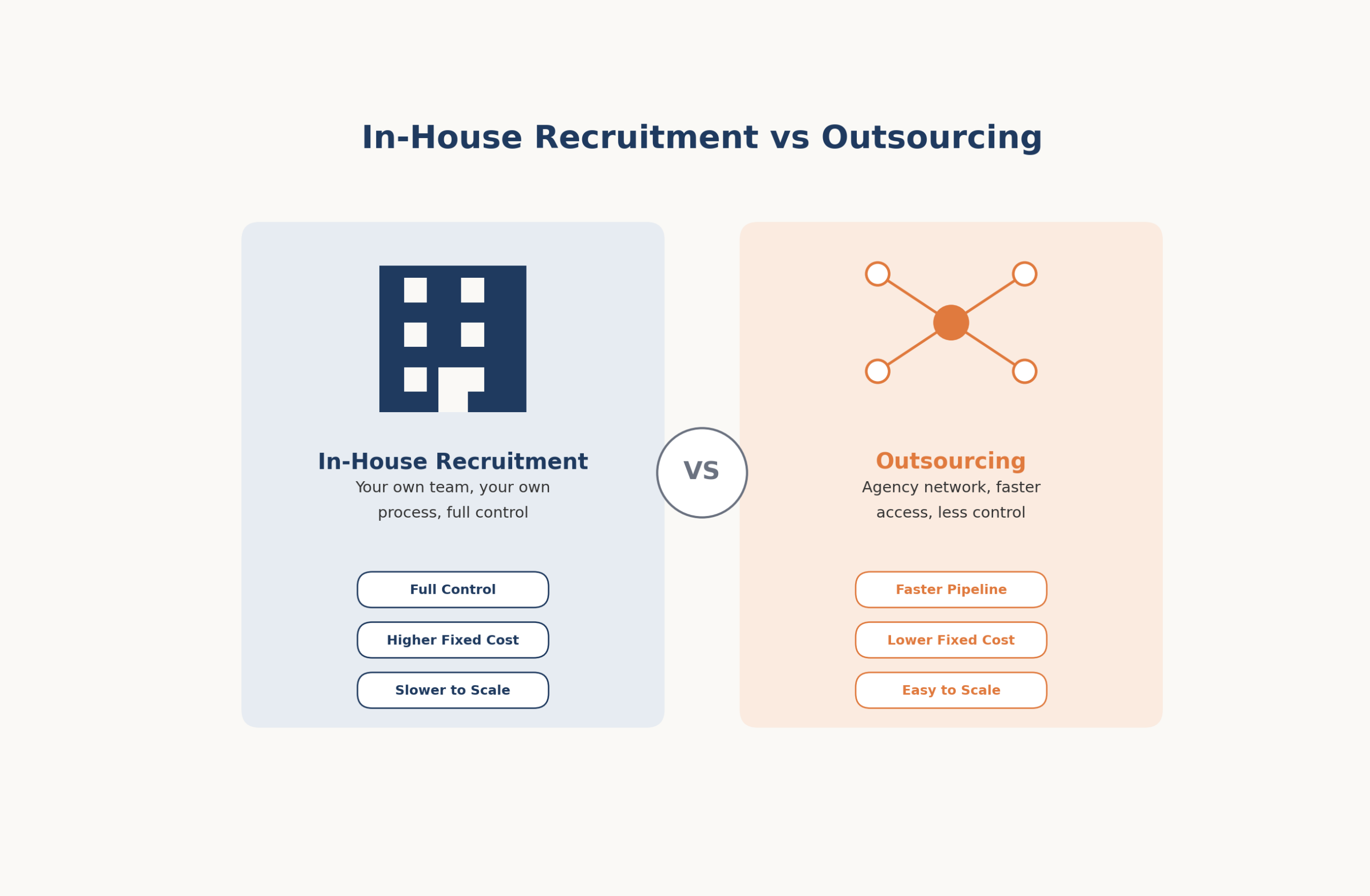
In-house recruitment means a company hires and manages its own recruiters as employees, handling sourcing, screening, and hiring entirely with an internal team instead of paying an outside agency or platform to do it.
1. Salary, tools, and hidden overhead
An in-house recruiter’s salary is only part of the bill. Add ATS software, job board postings, background check fees, and recruitment marketing spend.
Then factor in the hiring manager’s time spent screening resumes and sitting through interviews. Most companies underestimate this overhead until they actually total it up.
2. Where in-house teams break down at scale
One recruiter can manage a handful of open roles well. Push that to fifteen or twenty simultaneous roles and quality drops fast. Response times slow, candidates go cold, and hiring managers start filling gaps themselves.
Without more headcount or better tooling, in-house teams hit a wall long before hiring volume actually peaks.
Outsourcing hands hiring off to specialists who already have candidates lined up. It trades a chunk of control and margin for speed, which matters most when a role sits open too long.
3. Speed and candidate pipeline access
A staffing agency already has relationships with candidates before you post a role. They pull from an existing database instead of starting from zero, which cuts weeks off time-to-fill. For urgent or high-volume roles, that head start often matters more than the fee.
4. The trade-offs: cost per placement, less control over process
Agencies typically charge 15-25% approx of the candidate’s first-year salary, which adds up fast at volume. You also lose visibility into how candidates are screened and represented before they reach you. For roles where culture fit or brand voice matters, that hands-off approach can backfire.
In-House vs Outsourcing: Side-by-Side Comparison
| Factor | In-House Recruitment | Outsourcing (Staffing Agency) |
| Cost | Higher fixed cost from salaries, tools, and overhead, but stays predictable regardless of hiring volume | Lower fixed cost, but per-hire fees add up quickly at higher volume |
| Speed | Slower to start since sourcing begins from scratch, but improves once a pipeline is built | Faster from day one, since the agency already has candidates ready to go |
| Control | Full control over screening, employer branding, and candidate experience | Less control, since the agency represents your company to candidates on your behalf |
| Scalability | Hard to scale up quickly for sudden hiring spikes; scaling down means layoffs | Easy to scale up or down since you’re not carrying the headcount |
| Quality of hire | Generally stronger long-term fit, since the internal team understands company culture deeply | Can vary depending on the agency’s understanding of your specific needs and culture |
The Volume Threshold: When Each Model Makes Sense
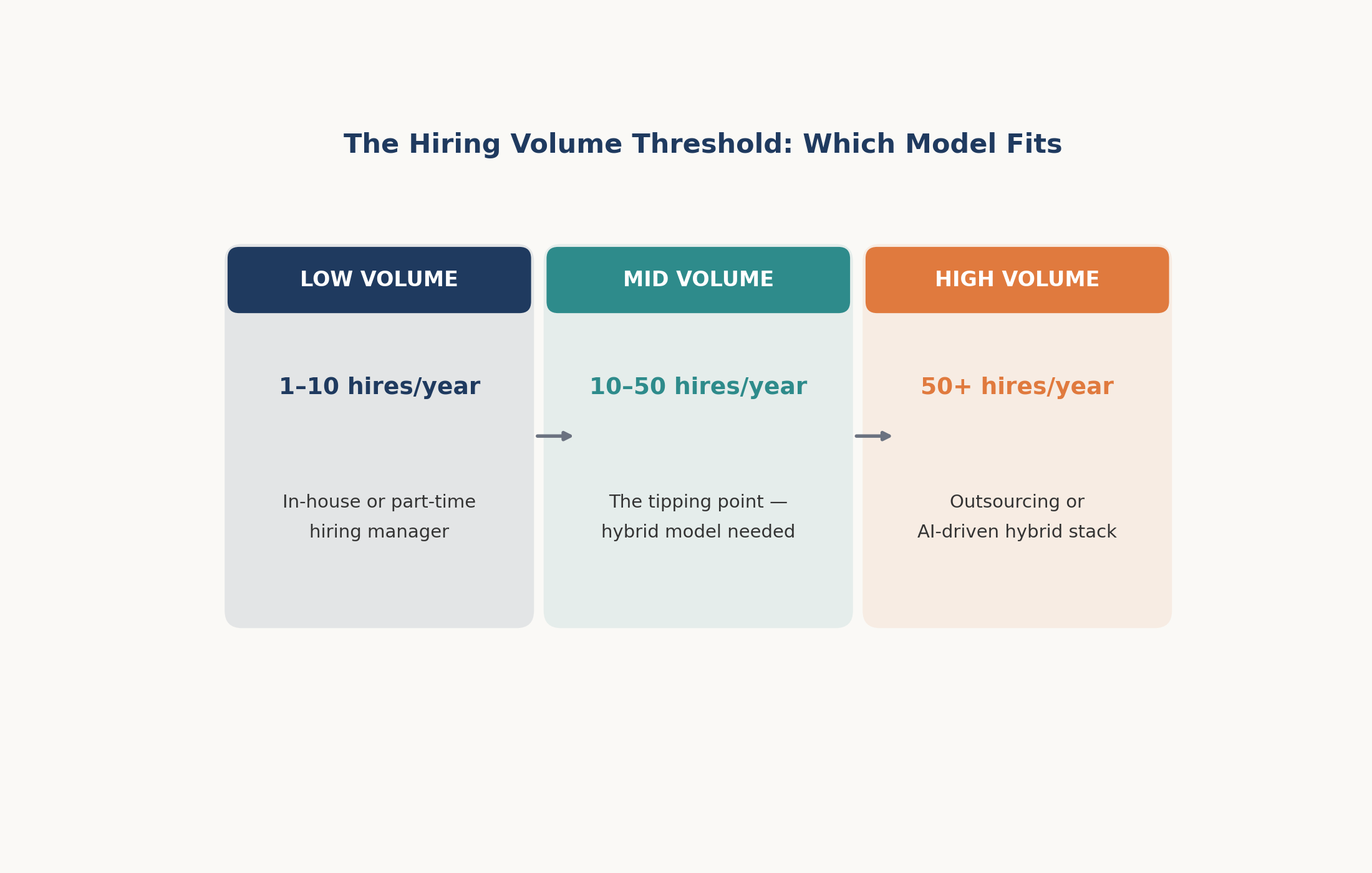
1. Low volume (1-10 hires/year): in-house or hybrid
At this volume, a dedicated in-house recruiter is often overkill. Most companies handle this with a hiring manager doing double duty, or a single generalist HR hire managing recruitment alongside other tasks. The volume is low enough that speed and cost per hire rarely become urgent problems.
What tends to work best here:
- One person owning recruitment part-time, supported by an ATS
- Occasional outside help for hard-to-fill or specialized roles
- No need for dedicated recruitment headcount
2. Mid volume (10-50 hires/year): the tipping point
This is where most companies get the model wrong. Volume is high enough that a part-time approach falls apart, but not always high enough to justify a full internal recruitment team. Companies here either overinvest in headcount they don’t fully need, or underinvest and let hiring managers absorb the slack.
Signs you’ve hit this tipping point:
- Hiring managers are spending more time screening than doing their actual job
- Time-to-fill is creeping past 40 days
- Candidate experience is slipping because follow-up is inconsistent
3. High volume (50+ hires/year): where outsourcing or a hybrid stack usually wins
Past 50 hires a year, the math shifts. Building an in-house team large enough to handle that volume gets expensive fast, and slow to scale up or down with demand. This is where outsourcing to a staffing agency, or running a hybrid model with AI handling the repetitive screening work, tends to outperform a fully internal team.
What usually works at this stage:
- A lean in-house team focused on strategy and final-stage interviews
- Agencies or recruitment talent partners handling sourcing and initial screening
- AI resume screening tools cutting down manual review time across high applicant volume
How AI in Recruitment Changes the Math
AI doesn’t replace the choice between in-house and outsourcing. It changes what each option can handle, closing gaps that used to force companies toward one model or the other.
-
AI resume screening and what it replaces on an in-house team
AI resume screening handles the first pass through hundreds of applications, something that used to eat up a recruiter’s entire day. This frees an in-house team to focus on interviews and candidate relationships instead of manual sorting, letting a small team handle volume that once required more headcount.
-
Where AI closes the gap between in-house speed and agency speed
Agencies have always won on speed because of existing pipelines. AI narrows that gap by helping in-house teams screen and shortlist just as fast, without needing an outside database. The advantage shifts back toward companies that want control without sacrificing turnaround time.
HR Hiring Teams: Building a Hybrid Model
Neither model works perfectly on its own at scale. Most HR hiring teams end up blending both, keeping what each does best and outsourcing the rest.
-
Keep sourcing in-house, outsource screening, or vice versa
Some teams keep sourcing internal since it protects employer branding, then outsource high-volume screening to an agency during hiring surges. Others do the opposite, using an agency’s pipeline for sourcing while keeping final screening and interviews in-house to protect culture fit and decision quality.
-
A sample hybrid workflow for a growing team
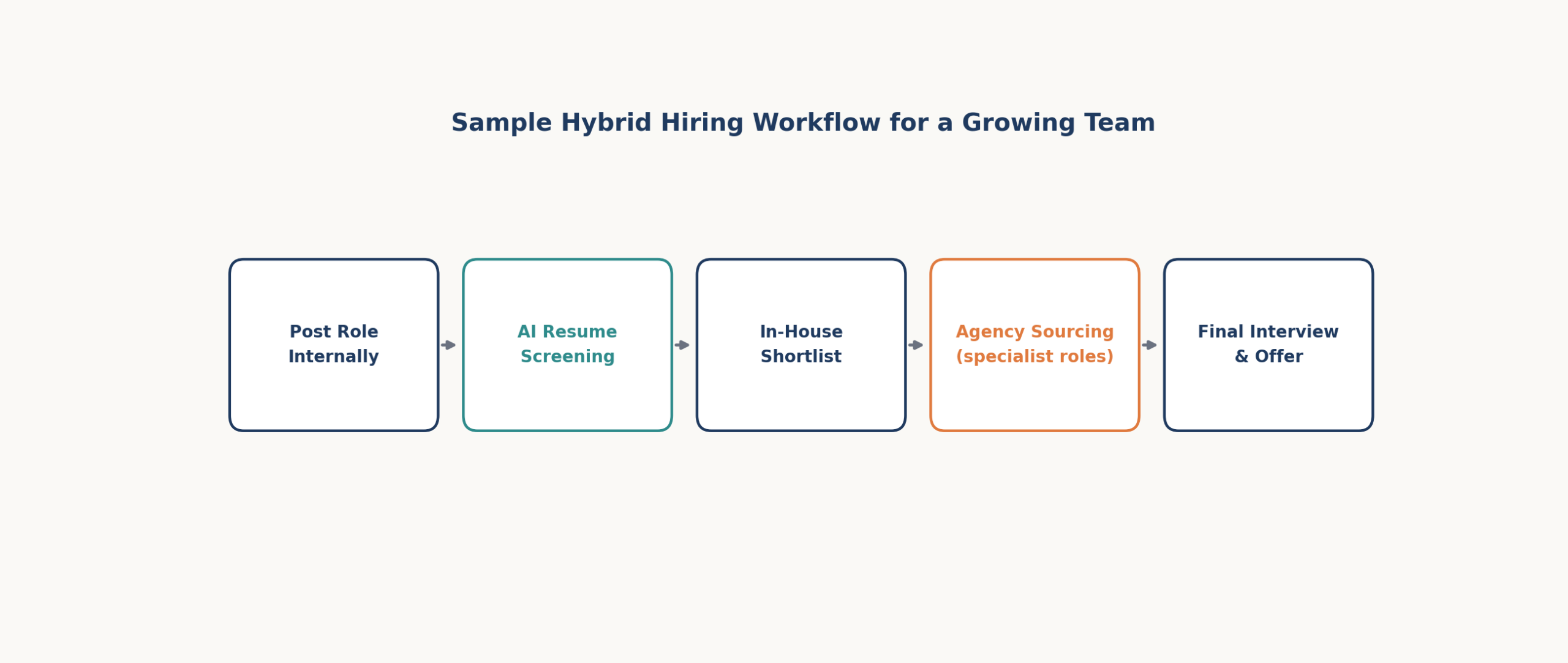
A growing team might post roles internally, run AI resume screening to shortlist candidates, then bring in an agency only for hard-to-fill specialist roles. In-house recruiters handle final interviews and offers. This keeps core smart hiring under company control while outsourcing the parts that spike unpredictably.
Conclusion
There’s no single right choice between in-house recruitment and outsourcing. The best model depends on how many roles you’re hiring for this year, not what worked before. Low hiring volume works fine with a lean in-house setup. Mid volume is where most teams either spend too much or fall behind. High-volume hiring usually needs outsourcing or a mix of both to keep up.
AI resume screening makes this easier too, since it lets smaller teams do more without extra stress. The best move is to check your hiring volume against these levels before deciding, then build a process that can grow with you.
Whatever model you pick, the same problem shows up again and again: too much time spent screening resumes by hand.
Hirium AI-powered ATS handles hiring workflows in one place. This lets a small in-house team handle a much bigger workload without hiring more staff, and keeps a hybrid setup simple instead of messy.
FAQs
1. Is in-house recruitment cheaper than outsourcing?
It depends on volume. In-house costs more upfront in salary and tools, but stays steady no matter how many people you hire. Outsourcing charges per placement, so it can get expensive fast once hiring volume goes up.
2. Can a company switch between in-house and outsourcing without disruption?
Yes, but it takes planning. Most companies move gradually, testing a hybrid model first before fully switching. Sudden changes can leave gaps in your hiring pipeline if not managed carefully.
3. Does AI in recruitment reduce the need for outsourcing?
It reduces it in some cases. AI resume screening handles the repetitive work that used to push companies toward agencies for speed. It doesn’t remove outsourcing entirely, but it narrows the gap for mid-sized hiring volumes.
4. What hiring volume actually justifies an in-house recruiter?
Most companies hit that point somewhere around ten to fifteen hires a year, when a hiring manager can no longer handle recruitment alongside their regular job without it slowing everything down.
5. Is a hybrid model harder to manage than picking one option?
Not if it’s set up well. A hybrid model works best when each part has a clear job, like keeping sourcing in-house and outsourcing screening during busy periods. Without that clarity, it can get confusing fast.